
International Shipping Cost Estimator: The 2026 Guide to Accurate Quotes
- Alex
- 6 hours ago
- 12 min read
Hidden fees can constitute up to 40% of the total landed cost of your international shipment, turning a perceived bargain into a budget-breaking liability. You've likely felt the sting of unexpected "bill-backs" for duties or realized too late that your carrier charged based on dimensional weight rather than actual pounds. With major carriers implementing a 5.9% general rate increase in 2026, guessing your logistics budget is no longer an option. You need a reliable international shipping cost estimator that provides radical transparency before you print a label.
It's frustrating to waste hours toggling between DHL, UPS, and FedEx tabs just to find a rate that doesn't eat your entire margin. We understand that global trade should be orderly, not chaotic. This guide teaches you how to master the complexities of global logistics to secure the best possible rates across 220+ countries. We will preview the hidden mechanics of 2026 fuel surcharges, explain how to navigate automated customs documentation, and show you how to compare the world's leading carriers in one unified platform for maximum profitability.
Table of Contents
Beyond the Quote: Why You Need an International Shipping Cost Estimator
An international shipping cost estimator is a digital tool that calculates precise transport expenses by analyzing three critical variables: package mass, Dimensional weight, and the destination country. It's more than a calculator; it's a financial safeguard. In the 2026 logistics market, static rate sheets are essentially obsolete. Carriers now implement frequent adjustments, including the 5.9% general rate increase seen this year, making printed price lists unreliable within days of publication. Relying on outdated data leads to friction and lost revenue.
Understanding the distinction between a "quote" and a "total landed cost" is vital for business survival. A standard quote usually only reflects the base freight charge between two points. In contrast, an accurate estimate factors in the total landed cost, which includes duties, taxes, and local surcharges. For small and medium businesses (SMBs), this transparency is essential. Without it, unexpected fees can quickly erode profit margins, leaving you to foot the bill for costs you didn't pass on to your customers. Using a robust estimator ensures you maintain healthy margins on every global order.
The Role of Logistics Brokers in Price Estimation
Logistics brokers act as an optimizer for your workflow by aggregating wholesale rates from a network of global carriers. Instead of spending hours logging into separate portals, you get a single view of DHL, UPS, and FedEx options side-by-side. These brokers leverage massive shipping volumes to secure discounted rates that are typically unavailable at a direct carrier's retail counter. This model removes traditional barriers to entry, allowing even low-volume shippers to access professional-grade pricing without subscription requirements or volume minimums.
Real-Time vs. Estimated Data: Understanding the Difference
Accuracy depends entirely on the source of the data. While some tools provide "ballpark" figures based on historical averages, a high-quality international shipping cost estimator uses live API integrations to pull up-to-the-minute pricing directly from carrier servers. A Real-Time API is the gold standard for accuracy because it reflects current market conditions instantly. Factors like fuel surcharges, which represent between 15% and 28% of total costs in 2026, or peak season adjustments are factored in immediately. This ensures the price you see is the price you actually pay, stripping away the anxiety of procedural friction and hidden billing surprises.
Decoding the Math: How Shipping Estimators Calculate Your Total Bill
Understanding the arithmetic behind your invoice is the first step toward controlling your logistics budget. A professional international shipping cost estimator follows a precise formula to arrive at a quote: Base Rate + Surcharges + Duties + Taxes = Total Cost. While mileage plays a part, carriers primarily use "Zoning" to determine costs. A shipment to a rural area in a nearby country might cost more than a shipment to a major hub thousands of miles away because of the complex infrastructure required for that final mile.
Speed is the primary multiplier in this equation. Choosing Express over Economy can double or triple your estimate because it requires dedicated cargo space and priority handling. Additionally, 2026 fuel surcharges currently represent between 15% and 28% of the total shipping cost for parcels. These fluctuations are why a static quote is often inaccurate by the time the package actually leaves your facility. To get a handle on these variables, you can compare real-time rates across different service levels instantly.
Dimensional Weight: The Hidden Cost Multiplier
Carriers charge based on the space a package occupies, not just its physical mass. The formula for this calculation is (Length x Width x Height) / Divisor. If your box is large but contains lightweight items like textiles or plastic components, the carrier will bill you for the "volume" weight instead of the actual weight. This explains why a massive, 2kg box of bubble wrap can be more expensive to ship than a dense, 5kg box of metal parts. To lower your estimates, use the smallest possible packaging and avoid "shipping air" by selecting boxes that closely match your product dimensions.
Customs, Duties, and Taxes (Landed Cost)
The most complex part of any estimate involves tariffs and taxes. These are determined by Harmonized System (HS) codes, which categorize every traded product to assign specific duty percentages. You must also decide between DDU (Delivered Duty Unpaid) and DDP (Delivered Duty Paid). With DDP, you pay all costs upfront, ensuring your customer has a seamless experience without surprise fees at their door. Utilizing automated customs documentation is the only way to ensure these landed cost estimates are accurate and compliant with current 2026 regulations.
Comparing Multi-Carrier Rates: Express, Air, and Sea Freight
Stop wasting time logging into three different carrier portals every morning. A unified international shipping cost estimator replaces fragmented workflows by showing you DHL, UPS, and FedEx side-by-side in a single interface. For urgent US exports, you must choose between Express Parcel and Air Freight. Express is typically the best choice for smaller consignments under 45kg, while standard Air Freight becomes more economical as weight increases beyond that threshold. Standard air freight rates in 2026 provide a reliable middle ground for American businesses looking to balance speed with a strict logistics budget.
When time is less critical, Sea Freight is the logical choice for bulk goods. Over 80% of global trade by volume moves via ocean, and for good reason. In 2026, a 40ft container from China to the US West Coast typically ranges between $3,000 and $5,500, offering significant savings over air transport. If you don't have enough cargo to fill a full container, you can use LCL (Less than Container Load) estimates to pay only for the cubic meters your goods occupy. Within North America, cross-border trucking between the US, Mexico, and Canada supports over $1.3 trillion in annual trade, providing a stable ground alternative for nearshoring projects.
Express Shipping: Speed vs. Cost Trade-offs
Paying the premium for 1-3 day global delivery provides peace of mind through "Last Mile" reliability. When you compare international shipping rates, look beyond the initial price tag to the carrier's local infrastructure in the destination country. A cheap rate is worthless if the carrier lacks the local fleet to navigate the final delivery stretch punctually. High-priority express services ensure your goods stay at the top of the manifest, which is critical during the peak season when rates can jump by 20% to 40%.
Freight Forwarding: Moving Bulk Goods Globally
Moving palletized cargo requires a different approach than shipping loose parcels. A professional freight forwarder acts as your expert intermediary, handling the administrative burden of multimodal transport across 220+ countries. Remember that as the US-based shipper, you are responsible for assuring that the goods comply with all local customs regulations. An integrated international shipping cost estimator helps you request custom quotes for these specialized needs, ensuring every sea-air or bulk road shipment remains profitable and compliant with current 2026 trade laws.
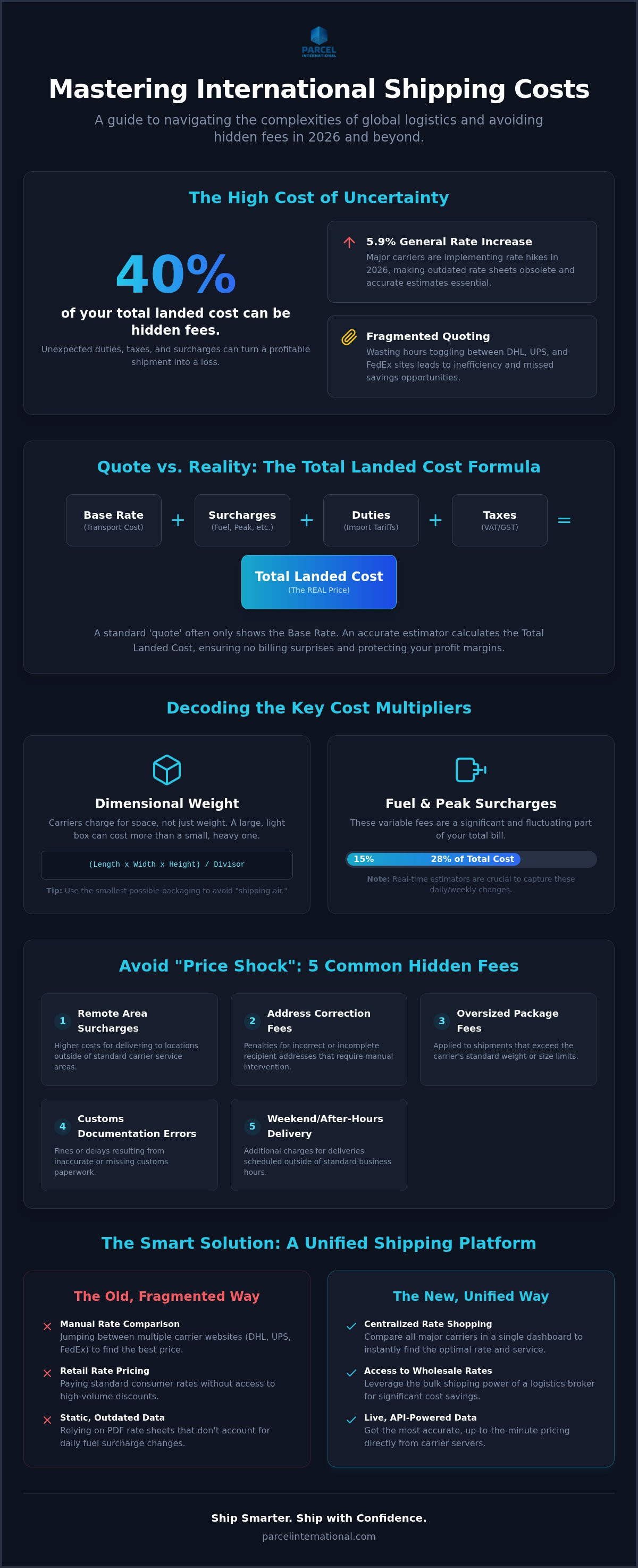
Avoiding "Price Shock": 5 Common Hidden Fees in International Shipping
Hidden fees can quietly consume 20% to 40% of your total landed cost if you aren't vigilant. Transparency is the only way to protect your business margins from "price shock" after a parcel has already left your dock. Carriers often apply surcharges that don't appear in a basic freight quote, making a comprehensive international shipping cost estimator an essential tool for modern logistics. By identifying these costs upfront, you can price your products accurately and avoid absorbing unexpected expenses.
Remote Area Surcharges: Shipping to the "outback" or sparsely populated regions requires extra infrastructure. Carriers charge a premium for these routes because they lack the delivery density of major urban hubs.
Address Correction Fees: A simple typo in a postal code or street name is a costly mistake. In 2026, carriers have increased address correction fees to as much as $25.50 per correction.
Residential Delivery Surcharges: Delivering to a home address is more expensive for carriers than stopping at a commercial loading dock. Always specify the destination type to ensure your estimate reflects the residential premium.
Customs Brokerage Fees: Clearing goods through international borders involves administrative labor. Standard brokerage fees typically range from $125 to $350 per entry for standard clearance, depending on the complexity of the shipment.
To keep your operations lean, you must move beyond fragmented workflows and manual calculations. Compare all carrier surcharges in one place to ensure your final invoice matches your initial quote.
Peak Season and Emergency Surcharges
Timing your shipments is a strategic decision. Rates frequently spike by 20% to 40% during the Q4 holiday season due to strained carrier capacity. Beyond seasonal peaks, global events like labor strikes or port congestion can trigger "Emergency Situation" fees. Using a real-time international shipping cost estimator allows you to monitor these fluctuating surcharges daily. This agility helps you decide whether to expedite a shipment now or wait for a more stable pricing window.
The Importance of Accurate Weight and Dims
The "Audit Gap" occurs when a carrier re-weighs your parcel at their hub and finds a discrepancy. If your measurements are off, the carrier will back-bill you at their highest retail rate, often adding an administrative penalty. Use a calibrated digital scale and a metal tape measure for every box. Always add a 50-gram buffer to your weight estimate to account for tape, labels, and slight scale variances that trigger carrier audits. This small adjustment prevents the procedural friction of disputed invoices and keeps your logistics orderly.
Simplifying Global Logistics with Parcel International
Moving from fragmented, multi-platform workflows to a singular, unified solution is the fastest way to regain control of your supply chain. Our platform automates the complex calculations discussed in previous sections, acting as a high-precision international shipping cost estimator that pulls live data from the world's leading carriers. Whether you are managing small consignments or bulk freight, our technology strips away the typical anxieties associated with global trade. You get a transparent view of the market across 220+ countries without the need for manual spreadsheets or constant carrier site-hopping.
Efficiency is paramount for modern businesses, especially when managing international parcel shipping. Our interface integrates directly with your existing systems, providing a seamless experience for international shipping for ecommerce. Beyond simple rate comparisons, you access professional customs support and automated documentation tools. These features ensure your goods comply with 2026 trade regulations, preventing the delivery delays and "audit gaps" that often plague unassisted shippers.
Transparency as a Core Pillar
We believe in a business model built on radical transparency. Unlike many competitors, we don't require subscription fees or volume commitments to access our platform. Every user gets direct access to discounted wholesale rates usually reserved for high-volume enterprises. This egalitarian approach removes traditional barriers, allowing you to focus on growth rather than restrictive contracts. Our margin-based model is straightforward: you see the total cost upfront, including all surcharges, so your peace of mind remains intact from the first quote to the final delivery.
Getting Started with Your First Estimate
Using our shipping calculator is a logical, sequential process designed for speed. Follow these steps to secure your best rate:
Input Details: Enter the precise weight and dimensions of your parcel. Remember to include the 50-gram buffer for packaging materials.
Select Destination: Choose from over 220 countries. The system will automatically account for current zoning and remote area surcharges.
Compare Options: Review the side-by-side results for DHL, UPS, and FedEx. Filter by speed or price depending on your specific project needs.
Confirm and Ship: Select your preferred service and generate your compliant customs documentation instantly.
Trade doesn't have to be chaotic. By using a professional international shipping cost estimator, you transform a complex hurdle into a competitive advantage. Start comparing international shipping rates today and experience the relief of an optimized, orderly logistics workflow.
Secure Your Global Margins with Accurate Logistics Data
Mastering your logistics costs is no longer a matter of guesswork; it's a strategic necessity for business growth. By understanding the core formula of total landed costs and accounting for the 2026 carrier rate increases, you protect your bottom line from unexpected "price shocks." Utilizing a professional international shipping cost estimator ensures you remain agile in a fluctuating market. This tool allows you to choose between express, air, and sea freight based on real-time data rather than historical averages, keeping your margins healthy and your customers happy.
Transparency is the antidote to the friction of global trade. You can access wholesale rates and automated customs documentation immediately without the barrier of subscription fees or complex volume minimums. Get a Real-Time International Shipping Quote today to compare live pricing from DHL, FedEx, and UPS. There's no registration required to see how much you can save on your next shipment across 220+ countries. Take control of your international logistics and enjoy the relief of a unified, orderly shipping workflow.
Frequently Asked Questions
How accurate are international shipping cost estimators?
Accuracy depends on the data source. An international shipping cost estimator that uses real-time API connections provides the highest level of precision by pulling live carrier rates directly from their servers. These tools factor in 2026 fuel surcharges and current zoning instantly. However, the final invoice relies on the accuracy of your input. Always use a calibrated scale and measure to the nearest millimeter to ensure the quoted price matches the final bill from the carrier.
What information do I need to get an accurate shipping quote?
You need four primary details for a reliable quote. First, the exact weight and dimensions of your packed box. Second, the specific origin and destination zip codes. Third, the type of goods to determine the HS code for customs calculations. Finally, the required delivery speed and address type, whether residential or commercial. Providing these details upfront prevents the "audit gaps" and back-billing penalties discussed earlier in this guide, ensuring your logistics budget remains predictable.
Why is the final shipping price different from the estimate?
Price differences usually stem from carrier re-weighs or specific surcharges not selected during the estimate. If a carrier's automated hub detects a size discrepancy, they'll adjust the billing to their highest retail rate. Other triggers include address correction fees, which have reached $25.50 in 2026, or residential premiums. Using a robust international shipping cost estimator helps you identify these variables before you ship, ensuring your quoted price remains stable and your profit margins stay intact.
Does the shipping estimator include customs duties and taxes?
Professional estimators calculate the total landed cost, which includes duties, taxes, and government fees. This transparency is vital for protecting your profit margins. You must choose between DDP (Delivered Duty Paid), where you handle costs upfront, or DDU (Delivered Duty Unpaid), where the customer pays at the door. Automated documentation tools use your product's HS code to provide these estimates, ensuring there are no financial surprises at the border for you or your international customers.
What is the cheapest way to ship a package internationally in 2026?
Sea freight is the most economical choice for overseas bulk shipments, with costs as low as $0.03 per kilogram for large volumes. For North American exports, ground transport to Canada or Mexico is often the most cost-effective solution for heavier goods. You can also lower expenses by shipping during the off-peak season. Rates typically jump by 20% to 40% during the Q4 peak, so timing your shipments for Q1 or Q2 can significantly improve your business profitability.
How do I calculate dimensional weight for my parcel?
Dimensional weight is calculated by multiplying length, width, and height, then dividing by a carrier divisor, usually 5000 for metric measurements. Carriers compare this result to the actual physical weight and bill you for whichever is higher. To keep your estimates low, minimize "shipped air" by using boxes that fit your products tightly. This prevents you from paying for empty volume, which is a common cause of unexpectedly high international logistics invoices that can erode your margins.
Can I get a freight estimate for sea and air cargo on the platform?
Yes, you can access estimates for express parcel, air, sea, and road freight on a single interface. This unified view allows you to compare the cost-benefit ratio of different transport modes side-by-side. Whether you need a 3-day express service for a small parcel or a 30-day ocean transit for palletized cargo, the platform provides the transparent data required to make an informed decision without the frustration of navigating multiple carrier websites or dealing with fragmented workflows.
Is there a fee to use the shipping cost calculator?
There is no fee or subscription requirement to use the shipping cost calculator. We operate on an egalitarian model that provides every user with direct access to wholesale rates usually reserved for high-volume enterprises. You don't have to worry about volume minimums or hidden registration charges. You only pay the shipping rate displayed when you book. This transparent approach removes traditional barriers, allowing you to optimize your global supply chain and manage your international logistics with total peace of mind.


Comments