
How to Compare International Shipping Rates in 2026: A Strategic Guide
- Alex
- Jul 4
- 11 min read
Updated: Jul 16
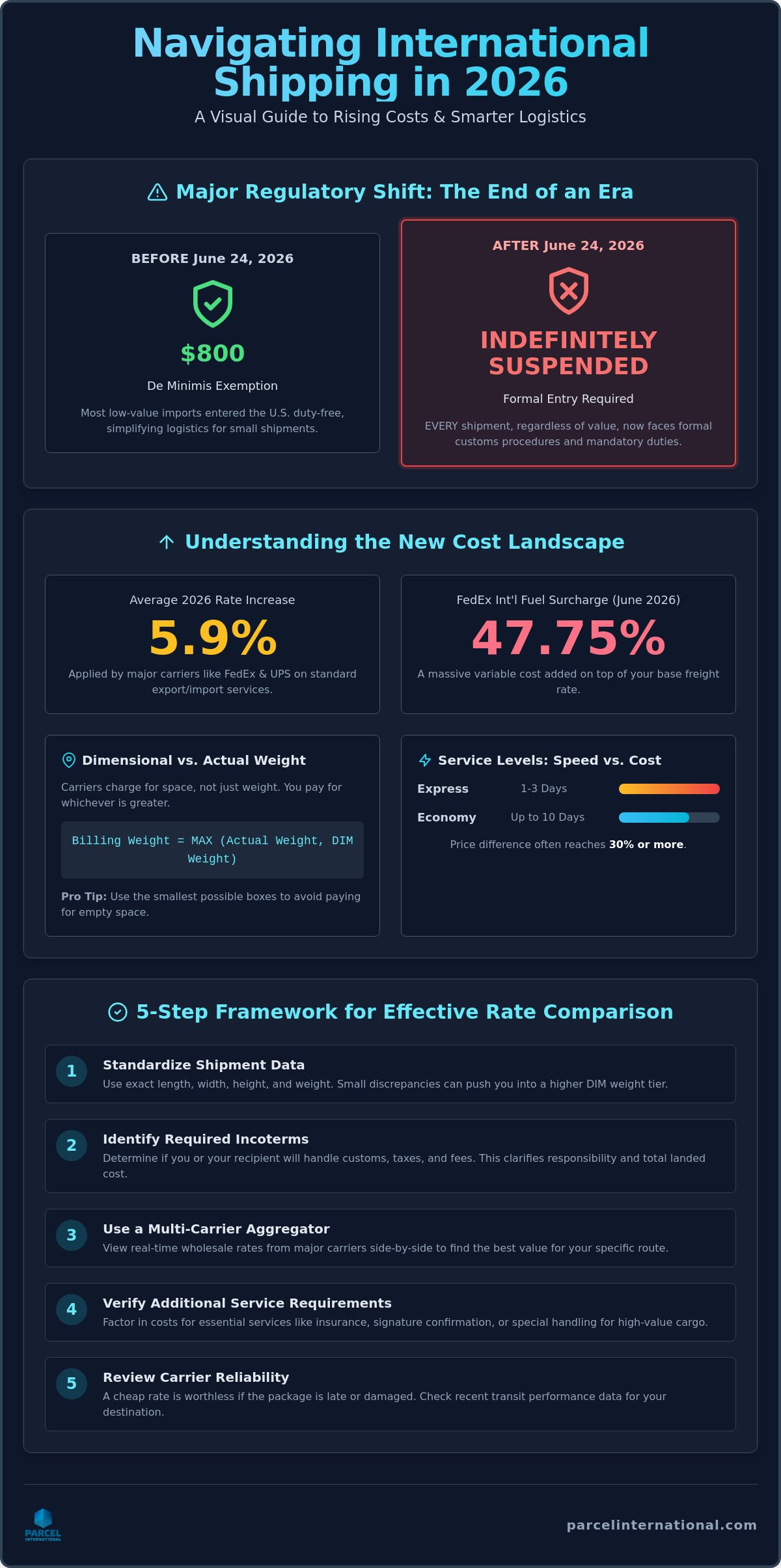
Did you know that as of June 24, 2026, the $800 de minimis duty exemption in the United States has been indefinitely suspended? This massive regulatory shift means every low-value import now faces formal entry procedures and mandatory duties, regardless of its price tag. If you still use manual spreadsheets to compare international shipping rates, you're likely missing hidden costs that are currently eroding your profit margins.
It's exhausting to manage fragmented workflows while major carrier rates from industry leaders like FedEx and UPS have all climbed by as much as 5.9% this year alone. You deserve transparent pricing and automated documentation, not another afternoon wasted on manual data entry or the stress of unexpected customs delays. We'll show you how to master the art of comparing global carrier rates to reduce costs and streamline your international logistics. This guide explores how to navigate volatile fuel surcharges, leverage automation for faster clearance, and build a reliable shipping strategy that survives the complexities of the 2026 market.
Table of Contents
Key Factors Influencing International Shipping Rates in 2026
As of early 2026, standard list rates for major export and import services increased by an average of 5.9%. When you compare international shipping rates, you're looking at a complex total figure comprised of base freight, variable surcharges, and mandatory government duties. The landscape changed permanently on June 24, 2026, when the $800 de minimis duty exemption was suspended indefinitely. Now, every single shipment requires formal entry procedures and is subject to applicable fees. Understanding the factors in determining the freight rate is the only way to protect your margins from these compounding costs and ensure your pricing remains competitive in a global market.
Dimensional Weight vs. Actual Weight
Carriers don't just bill you for how heavy a box is. They charge for the volume it takes up in a cargo hold. This is known as dimensional (DIM) weight. Most carriers calculate this by multiplying dimensions and dividing by a specific divisor. If the resulting volume weight exceeds the actual weight, that's what you pay. To avoid these costs, use the smallest possible boxes and eliminate wasted space. Dimensional weight is the industry standard for 2026 across all air and road freight modes.
Service Levels: Balancing Speed and Budget
Choosing between Express and Economy is about more than just speed. Express transit times usually range from 1 to 3 days, while Economy can take up to 10. The price difference often reaches 30% or more. Time-definite delivery is a logical choice for high-value inventory or urgent restocks that require guaranteed security. For most growing businesses, door-to-door services are the default because they remove the need to manage multiple logistics intermediaries.
Fuel surcharges remain a massive variable in your final logistics spend. In June 2026, FedEx's international fuel surcharge hit 47.75%, which can significantly alter your budget if you aren't prepared for monthly adjustments. Destination infrastructure also impacts the final quote. Shipping to a global hub like Singapore is significantly more cost-effective than delivering to a remote zone with limited road access or high last-mile friction. When you compare international shipping rates, ensure you're looking at a quote that accounts for these regional price spikes, current currency fluctuations, and potential administrative fees that vary by territory. This holistic view prevents the common "sticker shock" that occurs when only looking at the base freight price.
A 5-Step Framework to Compare International Shipping Rates Effectively
Finding the right balance between cost and speed requires a repeatable, logical process. To compare international shipping rates effectively, you must look beyond the base price and account for every variable that could trigger a post-shipment invoice adjustment. Follow this five-step framework to ensure your logistics remain both cost-effective and predictable.
Step 1: Standardize your shipment data. Use exact length, width, height, and weight measurements for every box. In 2026, even a small discrepancy can move your package into a higher dimensional weight tier.
Step 2: Identify the required Incoterms. Determine if you or your recipient will handle taxes and fees. Consult official Customs Duty Information to understand how these terms impact your total landed cost.
Step 3: Use a multi-carrier aggregator. View real-time wholesale rates from major carriers side-by-side to find the best value for your specific route.
Step 4: Verify additional service requirements. Factor in costs for insurance, signature delivery, or special handling. With fuel surcharges reaching 47.75% in June 2026, protecting your high-value cargo is more critical than ever.
Step 5: Review carrier reliability. Price is important, but a cheap rate is worthless if the package arrives late or damaged. Check recent transit performance for your destination zone.
Gathering Precise Shipment Data
Estimates are the enemy of efficiency. Using "roughly 5kg" as a weight often leads to painful correction fees that appear on your bill weeks later. Accurate HS codes are also vital for calculating duties, especially after the June 24, 2026, suspension of the U.S. de minimis threshold. For a deeper look at the paperwork required to keep your cargo moving without friction, review our guide on international shipping customs documentation.
Using an Aggregator for Real-Time Quotes
Searching individual carrier websites is a fragmented, time-consuming workflow that often hides the best deals. A multi-carrier aggregator allows you to compare international shipping rates on a single screen, showing you wholesale broker rates that are often significantly lower than standard retail prices. Parcel International provides this level of transparency without requiring subscription fees or volume minimums. This egalitarian approach allows you to access professional shipping tools regardless of your business size, moving you from chaotic multi-platform workflows to a singular, unified solution.
Navigating Customs and Hidden Surcharges
"Why is my final bill higher than the quote?" is the most frequent question in global logistics. The frustration is understandable. Most shippers assume the initial price covers the entire journey, but a quote is often just the base freight. When you compare international shipping rates, you must identify which surcharges are included and which will be billed later. Transparency is the only way to move from fragmented, high-anxiety workflows to a predictable logistics strategy.
Common surcharges are often the culprits behind "bill shock." Residential delivery fees apply when a carrier must use a smaller vehicle to access a neighborhood. Remote area surcharges occur when a destination sits far from a primary logistics hub, requiring extra fuel and time. Fuel surcharges remain the most volatile variable in 2026. With FedEx surcharges reaching 47.75% in June, these fees can nearly double your base cost. It's also vital to distinguish between shipping rates and duties. Shipping rates cover transportation; duties are government-mandated taxes. You should use official tools to estimate duties and taxes before you book to avoid being blindsided by the total landed cost.
Automated Customs Documentation
Customs delays don't just waste time; they trigger expensive storage fees that can exceed the cost of the shipment itself. Digital commercial invoices allow customs agents to review your cargo while it's still in the air, speeding up clearance in over 220 countries. Trade compliance is now an automated standard rather than a manual chore. If you don't accurately compare international shipping rates alongside the quality of a platform's documentation support, you might save a small amount on freight only to lose hundreds in customs penalties due to incorrect HS codes or missing paperwork.
Peak Season and Emergency Surcharges
The 2026 shipping landscape is marked by an early and compressed peak season. Shippers are frontloading merchandise to hedge against fuel price volatility and regulatory shifts, leading to unexpected capacity crunches as early as July. During these disruptions, carriers often apply emergency surcharges to manage the surge in volume. To protect your margins, consider locking in rates early or utilizing a broker that offers access to multiple carrier networks. This flexibility allows you to pivot when one carrier's surcharges become prohibitive. Transparency in surcharges is the hallmark of a good broker; it turns a hidden anxiety into a manageable line item.
Choosing the Right Mode: Parcel, Air, or Sea Freight?
Selecting the wrong mode of transport is a common way to overspend. If you only look at small parcels, you're missing the bigger picture. When you compare international shipping rates, you must evaluate the size and weight of your total shipment. Standard express parcel services are ideal for individual boxes under 30kg. However, if you're shipping multiple boxes to the same destination, you'll likely hit a "pivot point." This is the moment where consolidating your goods into a single air freight shipment becomes more economical than paying for several individual parcel labels.
Large-scale commercial projects require a different approach. This is where a freight forwarder becomes your most valuable ally. They act as a stable intermediary, negotiating space on ships and planes to ensure your bulk cargo moves efficiently. For businesses operating within Europe, road freight offers a flexible alternative for cross-border logistics. It bypasses the complexities of air cargo while maintaining reliable delivery times for heavy pallets and oversized goods.
Air Freight vs. Express Parcel
Air freight is the standard for high-value or urgent inventory that exceeds the 70kg weight limit of most express couriers. While express parcel services provide door-to-door convenience, air freight often requires palletization to ensure safety during transit. Use the Parcel International platform to view and compare both modes on a single screen. This unified solution removes the friction of jumping between different carrier portals. Compare your freight options today to see which mode fits your current timeline and budget.
Sea Freight for Bulk and Heavy Goods
Sea freight is the undisputed king of cost savings for non-urgent shipments. If your delivery window allows for several weeks of transit, sea freight can reduce your expenses significantly compared to air. You don't need to fill an entire container to benefit; Less than Container Load (LCL) options allow you to share space with other shippers. For goods entering or leaving Europe, booking sea freight via the Rotterdam hub provides access to world-class infrastructure and rapid inland distribution networks. Global container volumes reached a record 192.9 million TEUs in 2025, proving that sea freight remains the backbone of the global market. It's the orderly choice for an optimizer looking to move large volumes without the high-stakes cost of aviation.
Simplify Your Global Logistics with Parcel International
Moving your goods across borders shouldn't feel like a high-stakes gamble. Most platforms trap you behind monthly subscription fees or demand high volume commitments before you can even see their best pricing. At Parcel International, we operate differently. We provide a singular, unified solution that strips away the procedural friction of global trade. There are no subscriptions and no volume minimums. Whether you're shipping a single express parcel or managing a large-scale commercial project, you receive the same level of professional support and transparency. This egalitarian approach ensures that small businesses can thrive alongside industry giants without being penalized for their size.
Our platform acts as an optimizer, taking a chaotic process and making it orderly. Many shippers feel overwhelmed by the need to manage different logins, varying terms, and hidden requirements across multiple carrier sites. Our dashboard serves as your mission control, providing immediate relief from the fragmented systems that lead to human error. We've built our identity on a philosophy of radical transparency. You won't find fine-print fees or restrictive terms here. Instead, you get a reliable bridge to the global market that treats your peace of mind as a priority. With over 15 years of industry experience, we position ourselves as a stable intermediary that you can trust to deliver on every promise.
Direct Access to Wholesale Carrier Rates
Our roots in Rotterdam, the primary gateway to Europe, give us a unique perspective on the complexities of international logistics. We've leveraged this heritage to build stable partnerships with global carriers like DHL, UPS, and FedEx. We take the deep discounts we've negotiated and pass them directly to you. This allows you to compare international shipping rates and book wholesale prices that are usually reserved for high-volume corporations. You also benefit from a single point of contact for support. You don't have to chase different carriers for updates or resolutions; our dedicated team handles all coordination, providing a protective and dedicated layer of service for your cargo.
Booking Your First Shipment
The "Compare, Book, Track" workflow is designed for speed and logic. You enter your shipment data, view your options side-by-side, and print your labels in one seamless motion. Our automated customs tools are particularly vital given the 2026 regulatory shifts, such as the suspension of the U.S. de minimis threshold. These tools ensure your paperwork is compliant from the start, preventing the costly delays and storage fees that occur when documentation is handled manually. It's time to replace fragmented, high-stress workflows with an efficient system that values your time. Compare international shipping rates today on Parcel International and experience the relief of simplified global logistics.
Master Your Global Logistics Strategy
The shipping landscape in 2026 is complex, but it doesn't have to be chaotic. By mastering the 5-step framework and utilizing automated customs tools, you can protect your margins from rising fuel surcharges and new duty requirements. Accuracy is your best defense against post-shipment bill adjustments. When you take the time to compare international shipping rates through a single, transparent platform, you eliminate the friction of multi-platform workflows and gain total visibility over your landed costs.
We've been a trusted partner in global trade since 2007, providing reliable access to 220+ countries. Our commitment to radical transparency means you never have to deal with subscription requirements or hidden fees. We act as your stable intermediary, turning fragmented logistics into an orderly, efficient process that supports your business growth. It's time to move your cargo with the security and punctuality your customers deserve.
Start comparing real-time international shipping rates now. Take control of your supply chain today and ship with total confidence.
Frequently Asked Questions
How do I compare international shipping rates for different carriers in one place?
Use a multi-carrier aggregator platform to view real-time quotes from DHL, UPS, and FedEx on a single screen. This approach eliminates the need to visit multiple carrier websites and manually track different pricing structures. By entering your shipment details once, you can access wholesale rates that are often significantly lower than standard retail prices.
What is the cheapest way to ship a package internationally in 2026?
Sea freight remains the most economical choice for large, non-urgent shipments that can handle longer transit times. For smaller parcels, economy road freight or consolidated shipping services provide the lowest costs. To find the best value, always compare international shipping rates across different service levels to see where you can trade speed for significant budget savings.
Are there hidden fees when using a shipping rate comparison tool?
Transparent platforms like Parcel International don't charge subscription fees or hidden service costs. You only pay for the shipping you use. However, you must still account for carrier-specific surcharges such as fuel, residential delivery, or remote area fees. When you compare international shipping rates on our platform, we prioritize radical transparency so you see the most accurate total cost upfront.
How does dimensional weight affect my international shipping costs?
Dimensional weight charges you for the space your package occupies rather than its actual physical weight. Carriers use a standard formula to calculate this "space-based" price. If your box is large but relatively light, you'll be billed at the higher dimensional rate. Use the smallest possible packaging for your items to avoid paying for empty space and unnecessary shipping costs.
Can I compare freight rates for air and sea transport on your platform?
Yes, our unified dashboard allows you to evaluate air, sea, and road freight options alongside standard parcel services. This is essential for businesses that have moved beyond small box shipping and need to manage bulk cargo. You can easily identify the "pivot point" where air freight becomes more cost-effective than multiple individual parcels or book LCL sea freight for your heaviest goods.
What documents do I need to get an accurate international shipping estimate?
You need a commercial invoice, precise package dimensions, and the correct HS codes for your items. This information is vital for calculating duties and taxes, especially after the 2026 suspension of the U.S. de minimis threshold. Without these details, your estimate will only cover the base freight, which often leads to unexpected costs and delays during the customs clearance process.
Why are international shipping rates so high right now?
Current rates are driven by volatile fuel surcharges and major regulatory shifts that occurred in mid-2026. For instance, FedEx's international fuel surcharge reached 47.75% in June, and all shipments to the U.S. now face mandatory duties regardless of value. Geopolitical instability and an early peak season have also compressed carrier capacity, keeping prices elevated across the global market.
How do I avoid customs delays when shipping abroad?
Use automated digital documentation to ensure your paperwork is compliant before your package even arrives at the border. Digital commercial invoices allow customs agents in 220+ countries to review your cargo electronically, which drastically speeds up the clearance process. Providing accurate recipient contact information and precise HS codes will also help you avoid expensive storage fees and procedural friction.


Comments