
LTL vs FTL International Shipping Explained: The 2026 Business Guide
- Alex
- 12 hours ago
- 11 min read
Filling a trailer only halfway might be your most expensive mistake this year, yet booking a full truck you don't need is equally damaging to your margins. You've likely felt the sting of rising freight rates and the headache of shipments stalled by the 2026 suspension of de minimis exemptions. Getting your LTL vs FTL international shipping explained is no longer just about pallet counts; it's about navigating an environment where density-based pricing and strict formal customs entries are the new standard.
We understand that managing global logistics often feels like a constant battle against hidden fees and border friction. This guide provides the clarity you need to optimize your international logistics costs and ensure your cargo moves without procedural delays. You'll learn how to leverage automated customs support, navigate the latest IMO safety regulations, and choose the most efficient freight mode to simplify your documentation and protect your delivery speeds.
Table of Contents
Understanding the Basics: What are LTL and FTL Shipping?
Choosing the right transport mode is the foundation of any resilient supply chain. Having effective international road freight rates Europe strategies in place is vital for maintaining your margins. This section provides your LTL vs FTL international shipping explained breakdown to help you decide which model fits your current cargo volume and budget.
The decision between these two modes isn't just about the size of your boxes. It impacts your insurance premiums, your environmental footprint, and the speed at which you can clear customs. While one offers maximum cost-efficiency through shared resources, the other prioritizes speed and security through dedicated capacity. Understanding these fundamental mechanics is the first step toward optimizing your global logistics spend.
Defining Less Than Truckload (LTL)
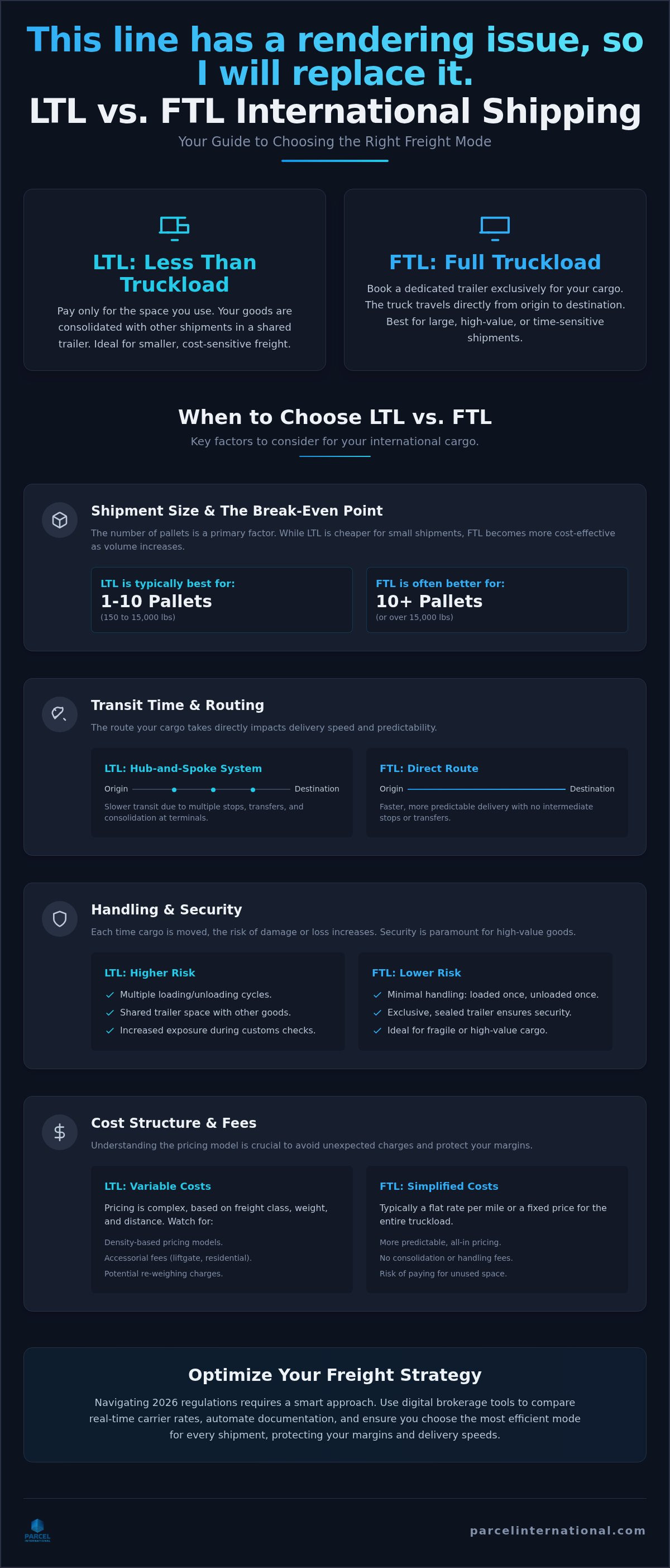
Less-than-truckload (LTL) shipping is the standard choice for smaller consignments. Typically, these shipments weigh between 150 and 15,000 pounds. You don't pay for a whole trailer. Instead, you only pay for the specific portion of the trailer your goods occupy. The carrier consolidates your freight with cargo from other shippers to fill the vehicle.
This model utilizes a "hub-and-spoke" system. Your goods may move between several terminals and undergo multiple transfers before reaching the final destination. It's highly economical for small to mid-sized businesses, though it requires precise planning to manage the slightly longer transit times associated with multiple stops.
Defining Full Truckload (FTL)
Full Truckload (FTL) shipping provides you with a dedicated vehicle for a single shipment. You've reserved the entire trailer for your cargo alone. This doesn't necessarily mean your goods fill every square inch of the truck. It simply means the vehicle moves your goods exclusively from point A to point B without any intermediate stops or terminal transfers.
FTL offers the highest level of control over the transit environment. Because the trailer is sealed at the origin and only opened at the destination, you significantly reduce the risk of damage caused by frequent handling. This makes FTL the gold standard for high-value cargo or time-sensitive shipments that cannot afford the delays of a consolidation network.
Both modes serve distinct purposes in a modern logistics strategy. Your choice depends on finding the balance between the cost-savings of consolidation and the speed of a direct route. By matching your cargo profile to the right mode, you ensure that your international shipments remain both predictable and profitable.
The Mechanics of International LTL: Efficiency for Smaller Loads
Consolidation is the core engine of LTL shipping. Carriers group diverse cargo from various shippers to maximize trailer density, ensuring you don't pay for empty space. Understanding the mechanics of consolidation is essential for anyone looking to have LTL vs FTL international shipping explained in a practical, business-first context. This shared model ensures cost-efficiency, though it means transit times are naturally longer because the truck makes multiple stops to pick up and drop off other goods.
In 2026, most carriers have shifted to a density-based pricing model, making Freight Class a direct reflection of how much space your shipment occupies rather than just its commodity type. Precise freight class identification is now mandatory to avoid unexpected re-weighing fees that can disrupt your logistics budget.
How Consolidation Works Across Borders
Your goods start their journey at a local terminal before moving to a specialized international gateway. Cross-docking plays a vital role here. This process allows carriers to unload incoming cargo and load it directly onto outbound vehicles with minimal storage time, keeping the supply chain fluid. For international safety, palletization is non-negotiable. It protects your goods during the frequent loading and unloading cycles at regional hubs and ensures stable handling during mandatory customs inspections.
Cost Dynamics and Accessorial Fees
Base rates are only one part of the total landed cost. You must also account for fuel surcharges and accessorial fees that can quickly inflate your bill if not managed correctly. Common extra charges include liftgate services for locations without loading docks, residential delivery fees, and detention charges for unexpected wait times at the border. To avoid surprises, you should use a digital platform to compare international shipping rates that factor in these specific requirements from the start.
By providing accurate dimensions and weight up front, you avoid the sting of re-weighing fees and procedural friction. You can compare real-time carrier rates to see which LTL provider offers the best balance of speed and transparent pricing for your specific route. This proactive approach ensures your LTL vs FTL international shipping explained knowledge translates into actual savings.
The Power of FTL: Speed and Security for Large Shipments
While sharing a trailer offers significant cost benefits, Full Truckload (FTL) shipping stands as the gold standard for high-value or time-sensitive international cargo. When you book FTL, you aren't just buying space; you're buying exclusive use of the entire vehicle. This means your goods aren't mixed with cargo from other shippers, which effectively eliminates the risk of cross-contamination or accidental damage from neighboring pallets. A freight forwarder managing urgent bulk orders will almost always prefer FTL because it bypasses the complex consolidation cycles that define the LTL model.
Direct routing is the primary driver of FTL's reliability. Because the truck moves directly from your pickup point to the final destination, there are no intermediate terminal stops. This operational simplicity is a core part of having LTL vs FTL international shipping explained correctly. You gain total control over the transit environment, ensuring that your cargo stays secure and on schedule from the moment it leaves your dock.
When Speed Trumps Cost: The FTL Advantage
Eliminating hub delays can reduce your transit time by 30-50% on average compared to shared loads. This speed makes FTL the only viable option for "Just-in-Time" manufacturing, where even a small delay at a regional terminal can stop a production line. You don't have to wait for a carrier to find other shipments to fill the truck. You set the schedule, and the vehicle moves on your timeline. This predictability simplifies your logistics planning and provides the relief of knowing exactly when your cargo will arrive at the border.
Security and Risk Mitigation
Security is a major factor for businesses moving fragile, hazardous, or high-security international shipments. Every time a pallet is moved at a terminal, the risk of theft or breakage increases. FTL reduces these "touchpoints" to just two: loading and unloading. This lack of handling is a significant advantage for delicate electronics or chemical products that require stable conditions. Dedicated seals and real-time GPS tracking for high-security lanes provide an extra layer of protection, ensuring your LTL vs FTL international shipping explained strategy prioritizes asset safety as much as speed. By choosing FTL, you remove the variables that often lead to insurance claims and procedural friction in a shared-load environment.
Choosing Your Mode: A Decision Framework for Global Logistics
Selecting the right transport mode requires more than just counting pallets. You must weigh the financial savings of shared loads against the operational risks of border delays. This LTL vs FTL international shipping explained framework helps you identify the "break-even" point where consolidation stops being a bargain and starts being a liability. Usually, once your shipment reaches 10 to 12 pallets, the cost per pallet for FTL often drops below the LTL rate, making the dedicated truck the smarter financial choice.
Your choice also depends on the destination country's infrastructure. While large FTL trucks are efficient for major industrial hubs, some regional destinations with narrow access roads might require the smaller vehicles typically used in LTL networks. You must balance these physical constraints against your budget and the urgency of the delivery to find the optimal path for your cargo.
Weight and Volume Thresholds
The 12-pallet rule is a standard industry benchmark. If your load occupies more than half a trailer, you should always run an FTL search. You also need to consider linear foot rules. Carriers often apply surcharges if a shipment takes up too much floor space regardless of weight. Since January 2026, most LTL carriers have fully transitioned to density-based pricing. This means your dimensional weight is the primary driver of your rate. If your cargo is light but bulky, FTL might offer more predictable pricing by removing these complex density calculations and unexpected re-weighing fees.
Impact on Customs and Documentation
Border friction is where the two modes diverge most sharply. In an LTL scenario, your goods share a trailer with dozens of other shippers. If just one of those shippers has incorrect paperwork or a "bad" shipment, the entire truck can be delayed at the border for days. This risk is a significant pain point for international logistics managers who need predictable timelines. FTL eliminates this variable entirely. Because the load has a single origin and a single destination, the customs process is significantly more streamlined.
Managing international shipping customs documentation is much simpler when you don't have to worry about the compliance levels of other companies. You have total visibility over the data filed for your cargo, which is especially critical following the 2026 suspension of de minimis exemptions. To find the most efficient route for your specific volume and avoid these common border headaches, compare real-time carrier rates on our platform today.
Streamlining Your Freight Strategy with Parcel International
Parcel International acts as your stable intermediary in a complex global market. We've taken the friction out of the booking process by serving as a digital broker that connects you to an extensive network of global LTL and FTL carriers. Having your LTL vs FTL international shipping explained is only useful if you have the tools to act on that information instantly. Our platform transforms a chaotic process into an orderly, efficient workflow, allowing you to move from inquiry to action as quickly as possible.
Real-Time Freight Comparison Tools
Stop wasting hours calling multiple carriers or waiting for email quotes that expire before you can approve them. Our dashboard allows you to see all available LTL and FTL options in seconds. We prioritize radical transparency. This means the rate you see is the rate you pay. There are no hidden requirements or surprise surcharges buried in fine print. You can filter results by speed, cost, or carrier reliability ratings to find the exact match for your cargo's needs. Whether you're managing a small-scale personal project or a large-scale commercial operation, our system adapts to your volume without requiring subscription fees or minimum commitments. We strip away the typical anxieties associated with global logistics, giving you the clarity to choose the most cost-effective mode for every shipment.
Expert Support for Cross-Border Logistics
International shipping involves more than just moving boxes. It requires managing a maze of administrative logistics and ever-changing trade rules. Our automated customs documentation engine is designed to handle the complexities of the 2026 regulatory environment. It helps you avoid the procedural friction that often stalls shared loads at the border, ensuring your paperwork is as ready as your freight. We provide the same level of precision for express parcel delivery as we do for massive road freight projects. If you're managing a complex freight project or a bulk shipment that requires a more personal touch, our team provides the high-stakes industry authority you need to move forward with confidence. We act as the bridge between fragmented workflows and a singular, unified solution.
We've been building our reputation for reliability in Rotterdam since 2007. Today, we provide access to 220+ countries, serving as the optimizer that makes the global market feel accessible to everyone. You don't have to deal with the stress of fragmented platforms or restrictive terms. Book your next international shipment with Parcel International and experience the relief of a truly optimized logistics strategy. This is the final step in mastering your LTL vs FTL international shipping explained journey.
Building a More Resilient Supply Chain for 2026
Mastering your logistics strategy requires a clear understanding of when to share a trailer and when to book a dedicated vehicle. The decision hinges on the 10 to 12 pallet break-even point and your specific tolerance for border delays. Having LTL vs FTL international shipping explained allows you to navigate density-based pricing models and strict customs requirements with total confidence. You don't have to manage these complexities alone or settle for fragmented workflows that eat into your margins.
Parcel International has served as a trusted industry authority since 2007, providing access to carriers in 220+ countries. We strip away procedural friction by including automated customs documentation with every booking. This ensures your cargo moves efficiently whether you choose the cost-savings of LTL or the speed of FTL. Simplify your global logistics and compare freight rates on Parcel International today. Take control of your delivery timelines and protect your bottom line with a partner that values transparency and ease of use. Your path to optimized international shipping starts with a single search.
Frequently Asked Questions
What is the main difference between LTL and FTL international shipping?
The primary difference lies in trailer usage. LTL involves sharing vehicle space with other shippers to reduce costs, while FTL provides a dedicated truck for your cargo alone. Having this LTL vs FTL international shipping explained simply means choosing between the cost-efficiency of consolidation and the speed of a direct route. LTL is ideal for smaller loads, but FTL offers superior security and faster transit times by eliminating intermediate terminal stops.
Is LTL always cheaper than FTL for international road freight?
LTL is not always the most economical choice. While it saves money for small shipments, the cost per pallet often drops for FTL once you reach a volume of 10 to 12 pallets. You must also account for accessorial fees like liftgate services or residential delivery. These extra charges can make a shared load more expensive than a dedicated truck, especially when you factor in the financial impact of potential transit delays.
How does LTL shipping affect my international delivery timeline?
LTL shipping usually takes longer than FTL due to the hub-and-spoke model. Your goods move through several regional terminals for loading and unloading alongside other cargo. These transfers add time to the journey. In contrast, FTL moves directly from your pickup point to the destination. On average, eliminating these hub delays can reduce your international delivery timeline by 30% to 50%, making FTL the better choice for urgent shipments.
Can I track my LTL shipment across international borders?
You can track your shipments, but the level of detail depends on the carrier's technology. Most modern LTL providers offer GPS tracking at the trailer level. However, because LTL cargo moves between different trucks and terminals, tracking can sometimes show gaps during transfers. Using a unified digital platform provides more consistent visibility, allowing you to monitor your goods as they cross borders and reach key milestones in the international delivery process.
What happens if my LTL shipment gets stuck at customs?
When an LTL truck is held at customs, it's often because one shipment in the consolidated load has documentation errors. This can delay every pallet on the vehicle. To protect your cargo, use automated tools to ensure your paperwork is flawless. If a delay occurs, your logistics provider will work with the carrier to resolve the issue. FTL avoids this risk entirely because the truck only carries your specific, single-origin goods.
When should I switch from LTL to FTL for my business shipments?
Make the switch to FTL when your shipment occupies more than 10 pallets or involves high-value, fragile items. You should also prioritize FTL for time-sensitive orders that require a predictable delivery window. This LTL vs FTL international shipping explained framework suggests that if the cost of a potential delay outweighs the savings of consolidation, a dedicated truck is the safer and more efficient investment for your business logistics.
Are there weight limits for international LTL shipping?
International LTL shipments typically weigh between 150 and 15,000 pounds. If your cargo exceeds this limit, carriers will likely classify it as a volume load or require an FTL booking. Since January 2026, pricing is heavily influenced by density. This means the amount of space your shipment takes up is just as important as its weight. Always provide accurate dimensions to avoid re-weighing fees and ensure you're using the most cost-effective transport mode.
Does Parcel International handle both LTL and FTL documentation?
Yes, Parcel International provides automated customs support for both LTL and FTL shipments. Our platform generates the necessary documentation to comply with the latest 2026 regulations, including formal entries now required for many international shipments. We take the headache out of complex paperwork, ensuring your cargo clears borders without procedural friction. Whether you're booking express road freight or a full trailer, our tools help you maintain a transparent and efficient logistics workflow.