
How to File a Claim for a Lost International Package: A 2026 Step-by-Step Guide
- Alex
- Jun 21
- 12 min read
With an estimated 104 million packages stolen in the United States last year and global parcel volume hitting 266 billion in 2026, the risk of a shipment vanishing is a reality for every business. It's exhausting to deal with the lack of clarity regarding who is responsible when a high-value shipment stops moving. If you're currently facing a missing shipment, knowing how to file a claim for a lost international package is the only way to recover your costs and maintain your peace of mind.
We understand the stress of navigating complex customs requirements and the financial impact of missing inventory. That's why we've streamlined the recovery process into a direct, actionable guide. You'll learn the exact documentation required by carriers like DHL and USPS, the specific 2026 timelines you must meet to avoid claim denial, and how to organize your evidence for fast reimbursement. We'll walk you through the steps for air freight and express shipping so you can move from a lost shipment to a successful recovery with total confidence.
Key Takeaways
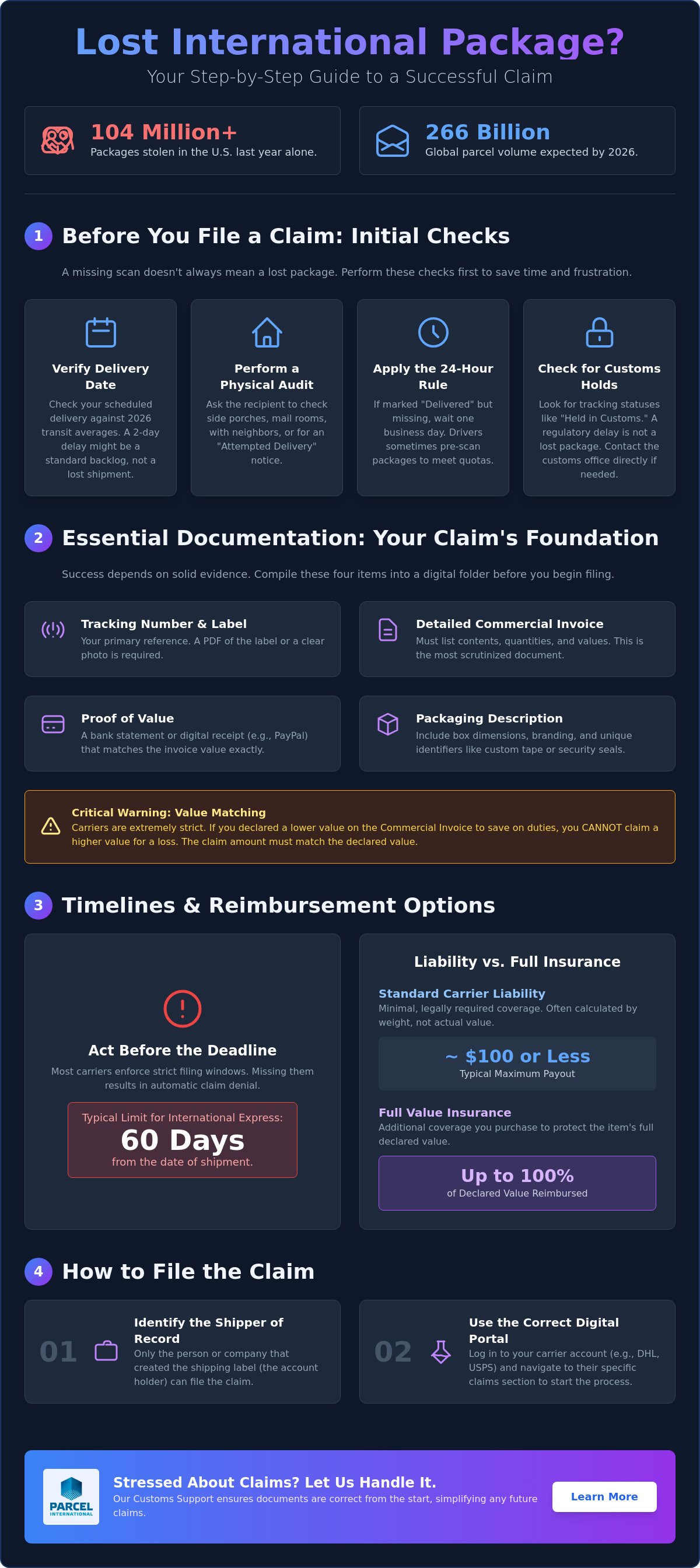
Verify your scheduled delivery date against current 2026 transit times to confirm the package is actually lost rather than experiencing a standard customs delay.
Gather critical evidence including your original shipping label and a detailed Commercial Invoice to satisfy the carrier's strict documentation requirements.
Learn exactly how to file a claim for a lost international package by identifying the Shipper of Record and accessing the correct digital portal for your specific carrier.
Act within carrier-specific windows, such as the 60-day limit for most international express shipments, to avoid automatic claim denial.
Distinguish between standard carrier liability and full value insurance to ensure you receive the maximum possible reimbursement for your lost inventory.
Table of Contents
Immediate Steps to Take Before Filing a Lost Package Claim
A missing status update doesn't always mean a permanent loss. Carriers prioritize efficiency, and their automated systems often trigger false alarms during peak transit periods. Verifying the facts is the first step in learning how to file a claim for a lost international package effectively. Start by comparing your original "Scheduled Delivery" date against the specific 2026 transit averages for your route. Global logistics networks are currently handling record volumes; a two-day delay might just be a standard backlog rather than a lost shipment.
Perform a physical audit before moving to the digital paperwork. Ask your recipient to check "safe places" like side porches, mail rooms, or behind planters. In 2026, many carriers utilize photo-capture delivery; if the tracking photo shows a porch but the box isn't there, porch piracy is a likely culprit. Check for neighbor signatures. Sometimes a well-meaning neighbor accepts a package to keep it out of the rain. If these steps fail, ensure the recipient didn't miss an "Attempted Delivery" notice from the local post office. These notices are frequently left when duties are unpaid or a signature is required for high-value items.
The 24-Hour Buffer Rule
Carriers generally ignore claims submitted within 24 hours of a missed delivery window. It's frustrating, but it's based on the reality of "ghost scans." These occur when a package is scanned into a container at an international hub but doesn't immediately move. If your package is marked "Delivered" but isn't present, wait one full business day. Drivers occasionally scan items as delivered while they're still on the truck to meet daily quotas. This buffer period is essential before you officially look into shipping insurance options or formal carrier disputes.
Differentiating Between Customs Holds and Lost Parcels
Don't mistake a regulatory delay for a total loss. Many "missing" packages are simply stuck because of missing international shipping customs documentation. Look for status codes like "Held in Customs" or "Awaiting Payment." If you don't see an "Inward Office of Exchange" scan, the package likely hasn't reached the destination country yet. If it has reached the exchange office but hasn't moved in 72 hours, contact the destination customs office directly. They can often release the shipment once a specific fee is paid or a document is uploaded. Understanding these nuances is a critical part of knowing how to file a claim for a lost international package without wasting time on shipments that are merely delayed.
Essential Documentation Needed for an International Claim
Evidence is your leverage. When you're determining how to file a claim for a lost international package, the success of your request depends entirely on the quality of your paperwork. Carriers operate on strict logic; any discrepancy between your initial declaration and your final claim will likely result in an immediate rejection. Before you log into a carrier portal, compile a digital folder containing these specific items:
Original Tracking Number and Label Copy: This is your primary reference. If you don't have a PDF of the label, a clear photo of the physical copy is necessary.
A Detailed Commercial Invoice: This document must list the specific contents, quantities, and values.
Proof of Value: Carriers require a bank statement, PayPal receipt, or credit card transaction that matches the commercial invoice exactly.
Packaging Description: Include details about the box dimensions, branding, and any unique identifiers like custom tape or serialized security seals.
If you aren't sure What to Do when a carrier asks for "supplementary evidence," remember that transparency is your best defense. For businesses managing frequent global trade, partnering with a provider for Customs Support ensures these documents are generated correctly from the start.
The Role of the Commercial Invoice
The Commercial Invoice is the most scrutinized document in any claim. In 2026, carriers are particularly strict about value matching. If you declared a lower value for customs to save on duties, you cannot later claim a higher amount for a loss. This is a common mistake in international parcel shipping that invalidates thousands of claims annually. For non-commercial shipments or gifts, you must still provide a "Pro Forma" invoice and a receipt of the original purchase to prove the item's replacement cost.
Photographic and Digital Evidence
Visual proof bridges the gap between a scan and a physical reality. Always photograph high-value items before sealing the box. These photos prove the item was in good condition and properly packaged before it entered the carrier's network. If a package is marked "Delivered" but is missing, use digital Proof of Delivery (POD) images provided by the carrier to dispute the scan. Compare the delivery photo to the recipient's actual doorway. Additionally, keep your initial drop-off receipt. The weight recorded at the point of origin is a vital data point; if the carrier claims the box was empty upon arrival, the weight verification proves the contents were present when you shipped them.
How to File the Claim: Step-by-Step Procedures
The process of learning how to file a claim for a lost international package starts with identifying the "Shipper of Record." This is the individual or business that originally contracted the carrier and paid the shipping fees. Most global carriers, including DHL and UPS, only recognize the sender as the legal claimant. If you are the recipient, you must contact the sender and ask them to initiate the process on your behalf. For those dealing with ocean freight, you might also need to consult the Federal Maritime Commission guidelines to understand specific jurisdictional rules for international sea transportation.
Once you've confirmed your right to file, submit an "Intent to Claim" form immediately. This formal notification freezes the investigation window and prevents your claim from being timed out while you gather documentation. Consolidate your evidence—including the invoice, tracking history, and proof of value—into a single, high-resolution PDF. Fragmented uploads are a common reason for technical delays or missed information during the carrier's review phase. Providing a unified file makes the auditor's job easier and speeds up your path to reimbursement.
Filing Through a Logistics Broker vs. Direct with Carrier
Platforms designed for international shipping for ecommerce offer a significant advantage by centralizing claims across multiple carriers. Instead of managing separate logins for every provider, you handle everything through a single dashboard. Brokers often have dedicated account managers who negotiate directly with carrier claim departments, which can bypass the standard automated rejections. If you ship directly with a carrier, be prepared for a more rigid interface. Carriers frequently reject claims filed by the recipient, so ensuring the sender handles the submission is vital for a successful outcome.
The Step-by-Step Submission Workflow
Follow this logical sequence to ensure your submission is processed without friction:
Step 1: Log into your shipping dashboard and locate the specific tracking ID. Confirm that the "In Transit" status has exceeded the carrier's minimum waiting period for 2026.
Step 2: Select the "File a Claim" option. Be precise in selecting "Lost" rather than "Damaged." These categories have different evidence requirements, and a mistake here can reset your timeline.
Step 3: Enter the itemized value exactly as it appears on your Commercial Invoice. Discrepancies between your claim and your customs declaration are a major red flag for auditors.
Step 4: Monitor the "Claim Review" status daily. Carriers may request a signed statement from the recipient confirming they didn't receive the package. Respond to these requests within 48 hours to maintain momentum.
Claim Timelines, Limits, and Common Reasons for Denial
Timing is the most common point of failure for most shippers. While you're waiting for a package to reappear, the carrier's clock is ticking toward a permanent expiration. For example, UPS requires claims to be filed within 60 days after the scheduled delivery date, while DHL Express expects written notification within 30 days of shipment acceptance. If you miss these specific windows, the system will automatically reject your request, regardless of the evidence you provide. Understanding these rigid deadlines is a fundamental part of how to file a claim for a lost international package successfully.
Liability limits are another area where shippers often face unexpected financial gaps. Standard international shipping rates typically include a default liability of only $100 for carriers like FedEx and UPS. If your shipment contains high-value inventory, this base coverage won't even cover your cost of goods. Effective January 2026, FedEx has also implemented Entry Preparation Charges on dutiable shipments valued at or below $800, adding another layer of cost that is generally not recoverable through a standard loss claim. You must verify your coverage level before the shipment leaves the warehouse to ensure your assets are fully protected.
Carrier Liability vs. Premium Insurance
The Warsaw and Montreal Conventions establish the legal framework that limits carrier liability based on the weight of the cargo rather than its actual market value. Because these international treaties prioritize carrier stability, standard rates only cover a fraction of high-value goods. For instance, DHL's liability for road transport in Europe is limited to approximately €10 per kilogram. To recover the full value of your items, you must check if you opted for supplementary shipping insurance at the time of booking. Without this specific add-on, your reimbursement will be capped at the carrier's weight-based minimums.
Why Claims Get Rejected
The "Delivered" scan hurdle is the most difficult obstacle to overcome. If a carrier's GPS data confirms the package arrived at the correct coordinates, they will likely deny a loss claim, attributing the disappearance to porch piracy. In 2026, with package theft impacting millions of households, carriers are becoming even more restrictive. Inadequate packaging remains the number one reason for claim denial; if an inspector determines your box didn't meet their burst-strength standards, they'll void your protection. Finally, shipping prohibited items to restricted territories immediately invalidates your right to a claim. Always verify destination-specific restrictions to keep your shipments eligible for reimbursement.
Don't leave your revenue to chance. If you want to ensure your claims are handled with professional precision, get expert Customs Support to manage your international logistics documentation.
Simplifying Logistics: How Parcel International Manages Your Claims
Managing international logistics shouldn't feel like a legal battle. While previous sections detailed how to file a claim for a lost international package, the most efficient strategy is to have an expert intermediary handle the friction for you. Parcel International serves as your professional bridge to global carriers. We transform a fragmented, multi-platform process into a singular, orderly workflow that prioritizes your peace of mind.
Our automated documentation tools are designed to prevent claims before they happen. By ensuring every Commercial Invoice and customs declaration is perfect at the point of origin, we remove the common excuses carriers use to deny reimbursement. As a professional freight forwarder, we provide the technical expertise needed to navigate high-stakes logistics without the typical anxieties of hidden fees or procedural delays. We focus on what you don't have to deal with, such as subscription requirements or volume minimums.
Expert Support When Things Go Wrong
When a shipment goes missing, our team leverages long-standing carrier relationships to expedite investigations. Instead of sitting on hold with a carrier call center, you access a dedicated support team that understands carrier-specific timelines and liability limits. You save hours of administrative work by utilizing a single claims dashboard for all your Air Freight, Sea Freight, and Road Freight needs. This radical transparency ensures you always know the status of your dispute without the need for constant follow-ups. We value your business continuity, providing direct answers and efficient solutions when you need them most.
Start Shipping Smarter Today
Relief comes from knowing your shipments are protected by a system built for reliability. You can use our platform to compare real-time rates and select carriers based on their historical performance records and reliability. Setting up your account allows you to automate customs paperwork, which significantly reduces the risk of loss due to regulatory holds or documentation errors. This proactive approach is the best way to avoid the stress of learning how to file a claim for a lost international package after the fact. You get access to wholesale rates and a partner dedicated to your success.
Secure Your Global Shipments for the Future
Recovering the value of a missing parcel requires a disciplined, evidence-based approach. Distinguishing between customs delays and actual losses early on saves you valuable time. Precision in your commercial invoice and strict adherence to 2026 carrier deadlines are the only ways to ensure your claim isn't rejected. While knowing how to file a claim for a lost international package is a necessary skill, the ultimate goal is to avoid these friction points entirely.
Parcel International has built global carrier partnerships since 2007 to provide a stable, reliable bridge to international markets. Our platform utilizes automated customs documentation tools to minimize risks and offers transparent, margin-based pricing with no hidden fees. Stop managing fragmented workflows. Start shipping with a partner that values your peace of mind. Compare rates and ship securely with Parcel International. You can turn complex logistics into a competitive advantage with the right support.
Frequently Asked Questions
How long do I have to file a claim for a lost international package?
Filing deadlines vary by carrier and service level. For instance, UPS requires claims within 60 days of the scheduled delivery date, while DHL allows up to 90 calendar days from the shipment date. USPS Priority Mail International provides a wider window of seven days to six months. Missing these specific 2026 deadlines results in an automatic denial, so you must act immediately once a loss is suspected.
Can I file a claim if I am the recipient of the package?
Typically, only the sender or "Shipper of Record" has the legal right to initiate a claim. Carriers have a contractual relationship with the person who paid for the shipping label. If you are the recipient, you must contact the sender and provide them with any evidence you have, such as a statement of non-receipt, so they can begin learning how to file a claim for a lost international package on your behalf.
What happens if my package is marked as delivered but I have not received it?
You should wait 24 hours before taking action, as "ghost scans" often occur during hub processing. If the package still hasn't appeared, check safe places and neighbors. You can dispute a false "Delivered" status by requesting the carrier's GPS delivery coordinates or Proof of Delivery (POD) image. If the data shows delivery to the wrong location, you have strong grounds for a successful claim.
How much money can I get back for a lost international shipment?
Your reimbursement depends on whether you relied on standard carrier liability or purchased supplementary insurance. Most carriers like FedEx and UPS provide a default liability of $100. USPS Priority Mail International includes up to $200. If your items are worth more, you'll only recover the full value if you declared that value and paid the additional fees at the time of booking.
Does international shipping insurance cover customs seizures?
No, standard shipping insurance does not cover items seized or destroyed by customs. If your shipment was held because it contained prohibited items or lacked proper documentation, the carrier is not liable for the loss. It's vital to verify destination-specific restrictions and ensure all paperwork is accurate to maintain your right to a claim if the package truly goes missing during transit.
How long does it typically take to resolve an international shipping claim?
Resolution times vary, but most major carriers aim to validate international claims within 10 to 15 business days once all documentation is submitted. Complex cases involving multiple international hubs may take longer. Providing a complete, high-resolution PDF of your Commercial Invoice and proof of value in your initial submission is the most effective way to prevent administrative delays and expedite your reimbursement.
What is a Commercial Invoice and why is it needed for a claim?
A Commercial Invoice is a mandatory document that details the contents, quantities, and transaction value of your shipment. Carriers require this to verify the actual financial loss. When you're figuring out how to file a claim for a lost international package, this invoice serves as your primary evidence. The value listed must match your initial customs declaration and your proof of payment exactly to be considered valid.
Can I file a claim for a package that was delayed but eventually arrived?
You cannot file a "loss" claim for a package that was eventually delivered. However, if you used a premium service with a money-back guarantee, such as Global Express Guaranteed, you may be eligible for a refund of the shipping costs if the delivery missed its window. These requests must usually be filed within 30 days of the mailing date to be eligible for a postage refund.


Comments