
How to Find HS Codes for International Shipping (2026)
- Alex
- 10 minutes ago
- 12 min read
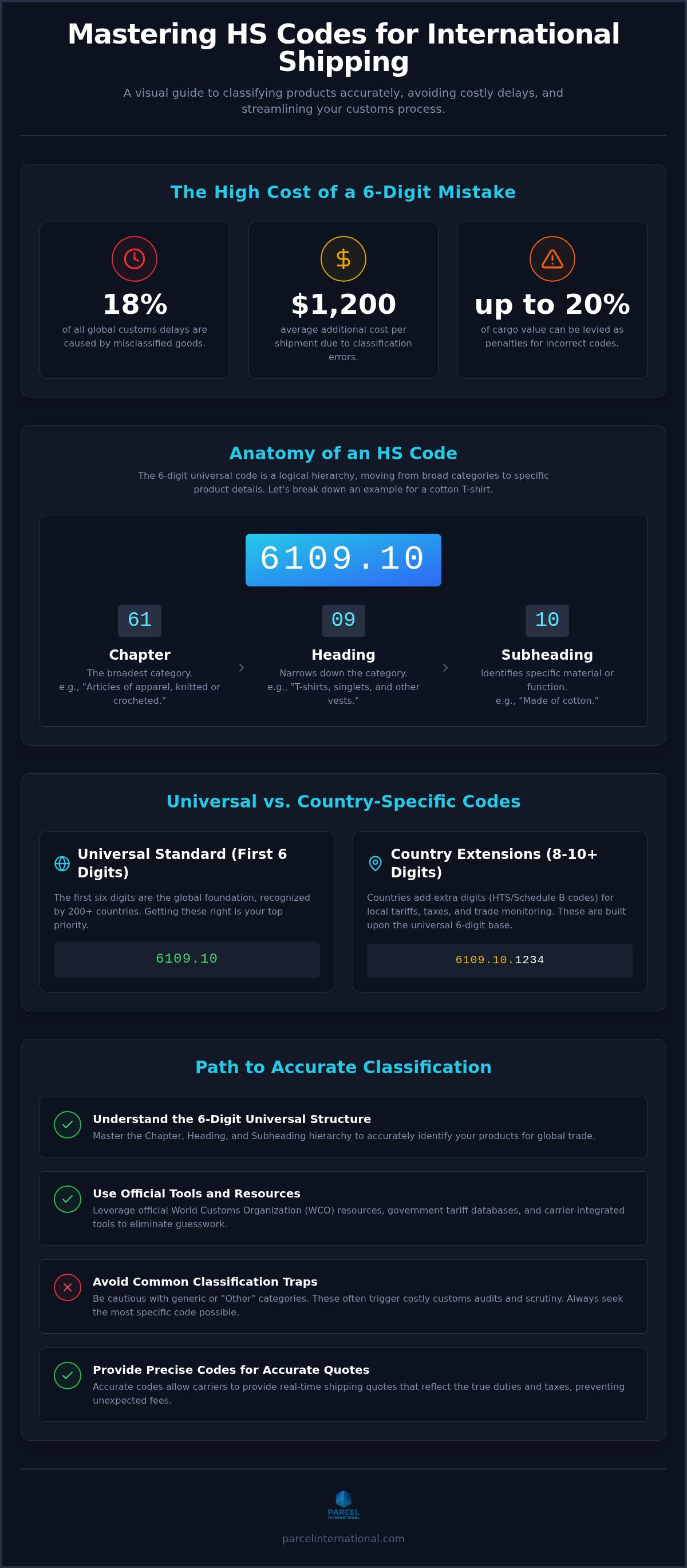
Did you know that roughly 18% of all global customs delays are caused by a single 6-digit mistake? Misclassifying your goods isn't just a minor paperwork error; it results in average additional costs of $1,200 per shipment and can trigger penalties reaching 20% of your cargo's value. It's understandable why so many shippers feel overwhelmed by technical jargon and the 18,000 different commodity codes found in the current 2026 HTS Revision 16. You want your goods to move, not sit in a warehouse racking up fines while you're stuck on hold with a consultant.
This guide will show you exactly how to find hs code for international shipping so you can classify products with confidence and stop overpaying duties by up to 30% annually. We'll break down the difference between universal and country-specific codes, show you how to navigate the latest 2026 updates, and provide a clear path to fast, accurate documentation. By mastering this process, you ensure your cross-border deliveries remain smooth, predictable, and compliant. Let's strip away the complexity and get your shipments moving through customs without the friction.
Table of Contents
What is an HS Code and Why is it Critical for Shipping?
The Harmonized System (HS) acts as the foundation of global trade. It is a 6-digit numerical code used to identify products moving across borders. Think of it as a universal language. While two customs officers might not speak the same tongue, they both understand what "6109.10" represents: a cotton T-shirt. This shared vocabulary allows authorities to process millions of entries efficiently. In fiscal year 2024 alone, U.S. Customs and Border Protection processed 38.3 million entry summaries worth $3.36 trillion. Accuracy is the only way to keep this massive machine moving.
Customs authorities require these codes for three primary reasons. They determine the duty and tax rates applied to your shipment, help governments track trade statistics, and facilitate security screenings by identifying restricted materials. If you don't know how to find hs code for international shipping, you risk your cargo being flagged for manual inspection. Incorrect codes lead to more than just minor paperwork headaches. They cause seizures, heavy fines, and significant delays that damage your reputation with customers. Negligent misclassification can carry penalties ranging from 5% to 80% of the merchandise value, depending on the severity of the error.
Universal vs. Country-Specific Codes
Look at the first six digits as your universal standard. Whether you are shipping to India, Germany, or the United States, these initial numbers remain identical across 200 plus countries. However, many nations add "extension" digits to create 8-digit or 10-digit codes. These are often called Harmonized Tariff Schedule (HTS) or Schedule B codes. These extra digits provide more specificity for local tax laws and trade monitoring. For basic international shipping, your primary focus should always be getting those first six digits exactly right. Once those are established, country-specific extensions follow a logical local framework.
The Role of HS Codes in Global Logistics
HS codes are the gatekeepers of your supply chain. They directly dictate the percentage of import duty you'll pay, which impacts your final landed cost and profit margins. Accuracy here ensures you don't face unexpected fees or legal complications. Beyond taxes, these codes are linked to "Prohibited and Restricted" item lists. If you misclassify a product that requires a specific license, customs may seize the entire shipment. For a deeper look at how these codes fit into your paperwork, read our International Shipping Customs Documentation: The Complete 2026 Guide. Proper classification is the simplest way to turn a chaotic customs process into an orderly delivery.
Anatomy of an HS Code: Breaking Down the Digits
Understanding the structure of an HS code is the first step in learning how to find hs code for international shipping without the usual stress. These numbers aren't random. They follow a logical hierarchy that moves from broad categories to specific product details. By breaking down the digits, you can verify that your classification reflects the physical reality of your goods. This precision is what keeps your shipments moving through customs checkpoints without unnecessary inspections.
The first six digits are the universal standard. Let's look at a common example: 6109.10 for a cotton T-shirt.
Chapter (First 2 digits): 61. This represents the broad category. In this case, it covers "Articles of apparel and clothing accessories, knitted or crocheted."
Heading (Next 2 digits): 09. This narrows the category down to "T-shirts, singlets and other vests, knitted or crocheted."
Subheading (Final 2 digits): 10. This identifies the specific material or functional characteristic. Here, it signifies the garment is made of cotton.
Beyond these six digits, countries often add "extension" digits for their own tariff and statistical purposes. If you're feeling overwhelmed by these strings of numbers, you can use customs support to simplify the classification process and ensure your documentation is accurate from the start.
Schedule B vs. HTS Codes
If you're shipping from the United States, you'll encounter two different 10-digit systems. Schedule B numbers are used specifically for exports leaving the U.S., while the Harmonized Tariff Schedule (HTS) is used for imports entering the country. A simple rule of thumb for 2026 exporters: use the Schedule B number on your export declarations and the destination country's HTS code for the import side. You can find official guidance on these Harmonized System (HS) Codes through the International Trade Administration to ensure you're using the right version for your specific direction of trade.
The 2026 WCO Updates
The World Customs Organization (WCO) updates the Harmonized System every five years to account for new technologies and changing trade patterns. We're currently operating under the 2026 HTS Revision 16, which became effective on August 15, 2026. This revision includes specific modifications to units of quantity and new U.S. notes that could impact your shipments. Using an outdated code from 2020 or earlier is a fast way to trigger a customs rejection. Staying current with WCO cycles prevents logistics friction by ensuring your product descriptions match the latest global standards.
How to Find Your HS Code: 3 Proven Methods
Finding the right classification isn't about luck; it's a systematic process of deduction. If you're wondering how to find hs code for international shipping, start by focusing on what the product is made of and what it does. Avoid searching for brand names or marketing terms. A customs officer doesn't care if you're shipping an "iPhone 16 Pro"; they care that you're shipping a "cellular telephone."
First, consult the official resources. The World Customs Organization manages the nomenclature, but national tools like the U.S. Census Bureau’s Schedule B search provide the most localized accuracy. Second, utilize carrier-provided lookup tools from providers like DHL, FedEx, or UPS. These companies have a vested interest in your accuracy because it reduces their operational liability. Third, for complex or multi-component items, apply the General Rules of Interpretation (GRI). These six rules provide a legal framework to classify products that don't fit neatly into a single category.
Keyword Optimization for HS Lookup Tools
Search engines for customs codes often struggle with modern slang. If you search for "Smartphone," you might get zero results. Instead, use the term "Cellular telephone." Follow the "Noun-Adjective" rule by searching for "Shirt, cotton" rather than "Blue shirt." This forces the tool to prioritize the primary material, which is usually the "essential character" of the product. If an item is made of multiple materials, classify it based on the component that gives it its primary function or value.
Using the US Census Bureau Search Tool
The "Global Reach" search interface is a powerful resource for identifying Schedule B numbers. Don't just rely on the keyword bar. Use the "drill-down" method by selecting a broad chapter and clicking through the subheadings. This visual hierarchy helps you see related categories you might have missed. Always verify your final choice against the "Section Notes" provided by the tool to ensure your item isn't explicitly excluded from that chapter.
Leveraging Carrier Databases
Major carriers provide their own databases to help you avoid the manual headache of searching government PDFs. It's a smart practice to compare results across two different tools when learning how to find hs code for international shipping for a new product line. If the results match, you can be confident in your documentation. For more details on moving from classification to actual transit, check our guide on International Parcel Shipping: The Ultimate 2026 Guide. Cross-referencing ensures 100% accuracy and protects you from unexpected fees at the border.
Common Mistakes and How to Verify Your Code
Even with the right tools, classification errors are frequent and costly. Learning how to find hs code for international shipping requires a disciplined approach to avoid common pitfalls that trigger manual inspections. You don't want to be part of the group facing average penalties of 20% of your shipment's value due to a simple oversight. Accuracy is your best defense against the procedural friction that stalls global supply chains.
The 'Other' Trap: Many shippers default to codes ending in .90 or .99 when they're unsure. Customs authorities view these "basket" categories as high-risk. Overusing them is a fast way to get flagged for an audit.
Blindly Trusting Buyers: Your customer might suggest a code that carries a lower duty rate. Don't take their word for it. The shipper of record is legally responsible for code accuracy.
End-Use Confusion: You must classify products based on their physical makeup, not how they'll be used. A decorative glass bottle is classified as glass packaging, even if your customer intends to use it as a flower vase.
To verify your selection, check official ruling databases like the U.S. Customs and Border Protection’s CROSS system. These databases contain thousands of previous decisions that provide a clear precedent for how specific items should be categorized. If you're still uncertain, you can access expert customs support to review your classification before you ship.
The Risk of 'Mis-Classification'
Customs authorities use AI and data analytics to spot inconsistencies in documentation. An audit can happen months or even years after your delivery is complete. If you've underpaid duties through mis-classification, you'll be hit with back-taxes and interest. This is especially critical for products subject to "Anti-Dumping" or "Countervailing" duties, which can exceed 100% of the product's value. Proactive verification protects your profit margins from these retroactive expenses.
When in Doubt: Professional Rulings
For high-value or recurring shipments, a formal ruling provides the ultimate peace of mind. In the European Union, you can apply for a Binding Tariff Information (BTI) decision. This is a legal document that guarantees your classification is accepted across all EU member states for a specific period. In the United States, you can request a formal ruling from the CBP. While these take time to process, they remove all ambiguity and ensure your goods clear customs without the fear of seizures or unexpected fines.
Simplify Customs with Parcel International
Manual classification is a significant bottleneck for growing businesses. While previous sections explained how to find hs code for international shipping using government databases, Parcel International replaces that fragmented process with a single, unified workflow. Our platform automates the generation of commercial invoices by pulling accurate data directly into your shipping documents. This eliminates the need to cross-reference multiple spreadsheets or outdated PDFs every time you book a shipment. You save time and reduce the manual data entry that often leads to costly errors.
By providing accurate classification data upfront, you effectively eliminate the risk of "hidden" customs fees that often surprise shippers weeks after a delivery is complete. Our system integrates real-time rate comparisons from major carriers like DHL, FedEx, and UPS. Because these rates are based on precise HS codes, the quotes you see are reliable and transparent. If you encounter a product that defies standard classification, you can access our expert customs support to navigate the complexity. We provide the professional guidance needed to ensure your goods move across borders without the usual anxiety.
Automated Tools for Trade Compliance
The Parcel International interface guides you through every step of the documentation process with logical, action-oriented prompts. Instead of guessing which digits to use, you can rely on built-in validation tools that align with current 2026 standards. For businesses looking to scale, integrating these codes into your e-commerce checkout is essential for landed cost transparency. This ensures your customers aren't hit with unexpected taxes at their door, which protects your brand reputation. To learn more about optimizing your online store's logistics, see our International Shipping for Ecommerce: The 2026 Buying Guide.
Why a Logistics Broker is Your Best Ally
Relying on a single carrier often means following rigid, one-size-fits-all rules. As a logistics intermediary, we provide the flexibility to choose the best route and carrier for your specific needs across 220 plus countries. We strip away the procedural friction by acting as a stable bridge between your business and complex global regulations. You don't have to deal with subscription requirements or volume minimums to access professional-grade tools. Take control of your global logistics and ensure every shipment is compliant from the start. Book your shipment with Parcel International today and experience the relief of a streamlined customs process.
Master Your Global Classification Strategy
Accurate product classification is no longer just a legal requirement; it's a competitive advantage that ensures your supply chain remains resilient. By understanding the 6-digit hierarchy and avoiding common "basket" category traps, you protect your business from the significant delays caused by documentation errors. You now have the framework for how to find hs code for international shipping using official tools and expert rulings. This knowledge prevents the unexpected costs associated with misclassified shipments and keeps your cross-border operations predictable.
Don't let technical jargon or complex 2026 updates slow your growth. Move away from fragmented workflows and embrace a singular solution that prioritizes your peace of mind. Streamline your international shipping and customs with Parcel International to access automated customs documentation generation and real-time rates for 220 plus countries. With no hidden subscription fees, you can scale your global reach with total transparency. Your goods deserve a clear path through customs, and you deserve a partner that makes the process orderly and efficient. Take the first step toward frictionless trade today.
Frequently Asked Questions
Is an HS code the same as a HTS code?
An HS code is not identical to an HTS code, though they share the same foundation. The Harmonized System (HS) provides the first six digits used universally across 200 plus countries. The Harmonized Tariff Schedule (HTS) is a country-specific extension, such as the 10-digit codes used in the United States. While the HS code identifies the product globally, the HTS code determines the specific duty rates for imports into a particular nation.
How many digits of the HS code do I need for international shipping?
You need at least the first six digits for any international shipment to be recognized by global customs authorities. These digits form the universal standard for product classification. However, for specific import declarations or to calculate exact duty rates, most countries require a full 10-digit code. If you are unsure how to find hs code for international shipping at the 10-digit level, start with the 6-digit universal base to ensure basic compliance.
What happens if I use the wrong HS code on my customs form?
Using the wrong code can lead to shipment seizures, significant delivery delays, and heavy financial penalties. Customs authorities may charge back-taxes or fines averaging 20% of the goods' value. In cases of gross negligence, these penalties can escalate to 40% or more. Incorrect classification also results in inaccurate duty assessments, meaning you might overpay or face legal action for underpayment. Accuracy is essential to maintain a reliable and compliant supply chain.
Where can I find a free HS code lookup tool in 2026?
You can access free lookup tools through official government portals like the U.S. Census Bureau’s Schedule B search or the World Customs Organization’s website. Most major carriers also offer basic search bars for their customers. For a more integrated experience, Parcel International provides automated tools that help you identify codes while generating your documentation. These resources help you learn how to find hs code for international shipping without the need for expensive third-party consultants.
Do I need an HS code for shipping personal gifts abroad?
Yes, most countries now require a valid HS code even for personal gifts to ensure smooth customs clearance. While some regions were historically more lenient, modern security and statistical requirements mean that nearly all cross-border parcels must be classified. Providing a 6-digit code on your commercial invoice or gift declaration prevents the recipient from facing unexpected delays or administrative fees. It is a simple step that ensures your gift arrives on time.
Can I change an HS code once the shipment has been sent?
Changing a code after the shipment has departed is difficult and often requires a formal manifest amendment. You must contact your carrier or customs broker immediately to submit a correction to the local customs authority. This process frequently incurs administrative fees and can stall your shipment at the border while the new data is verified. It is always more efficient to verify your classification data before the goods leave your facility to avoid these complications.
How often are HS codes updated by the World Customs Organization?
The World Customs Organization updates the Harmonized System every five years to reflect changes in technology and global trade patterns. The most recent major revision was implemented in 2022, with the next significant overhaul scheduled for 2027. However, national authorities often release smaller revisions more frequently, such as the 2026 HTS Revision 16. Staying informed about these cycles is vital to prevent using outdated codes that lead to automatic customs rejections.
Does every country use the same HS codes?
Every country uses the same first six digits for product classification, as these are the universal standard managed by the WCO. This shared foundation allows for consistent trade statistics and basic security screening globally. However, individual nations add their own digits after the initial six to create 8-digit or 10-digit codes for local taxation and monitoring. While the beginning of the code is identical everywhere, the full string of numbers will vary by destination.


Comments