
International Parcel Tracking: A Business Guide to Global Visibility in 2026
- Alex
- 2 days ago
- 11 min read
Last Tuesday, a logistics manager discovered that forty shipments to Berlin had vanished from the dashboard the moment they crossed the border. For many businesses in 2026, international parcel tracking feels like a game of telephone where the connection drops right when you need it most. You're left fielding calls from anxious customers while staring at conflicting status updates that don't tell you if a package is stuck in customs or simply sitting on a tarmac.
We know that fragmented workflows and "black hole" transit zones are more than just an inconvenience; they're a direct threat to your customer loyalty. This guide provides the blueprint for mastering cross-border visibility from Rotterdam to the final mile. You'll learn how to navigate the 2026 elimination of de minimis thresholds in the EU and the US while maintaining a single source of truth for every carrier. We'll show you how to automate customs documentation and identify the exact moment to intervene in a delay, ensuring your support team spends less time answering "where is my package?" and more time growing your business.
Table of Contents
The Complexity of International Parcel Tracking in 2026
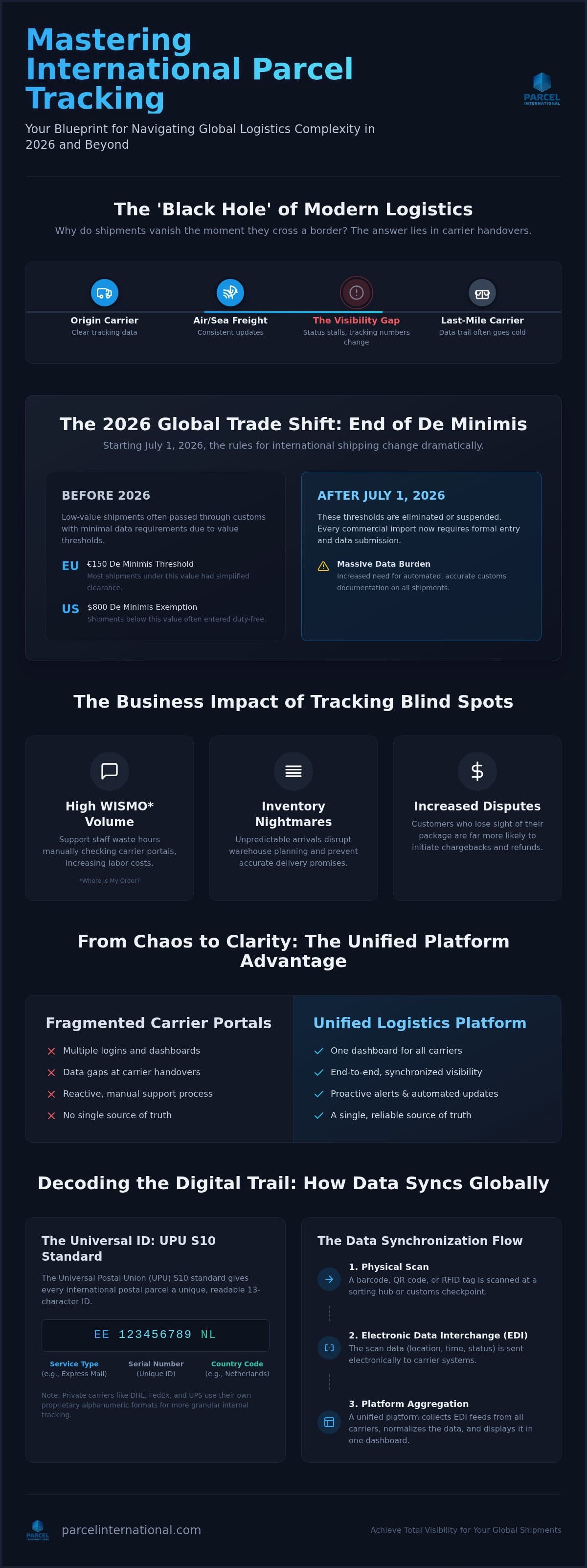
International parcel tracking in 2026 is no longer a simple convenience; it's a regulatory necessity. Recent shifts in global trade, specifically the EU eliminating the €150 de minimis threshold on July 1, 2026, and the United States codifying the suspension of the $800 de minimis exemption, mean every commercial import now faces formal entry. This creates a massive data burden for your logistics team. Domestic monitoring is straightforward because one carrier usually owns the entire journey. In contrast, global shipping is a relay. Visibility gaps appear the moment a parcel moves from air freight into the hands of a local customs broker or a regional courier.
To manage these high-stakes transitions, businesses rely on international parcel tracking to act as a bridge between different jurisdictions. Understanding the technical foundation of how package tracking works through barcode synchronization helps clarify why data often stalls at the border. Without digital synchronization between carriers, the digital trail goes cold while the physical package is still moving.
Understanding Carrier Handovers
The handover is the "black hole" of modern logistics. When an express carrier passes a parcel to a local postal service, tracking numbers often change mid-transit. You might see an "arrived in destination country" status for a week with no further movement. These discrepancies exist because "inbound" milestones in one system don't always trigger "outbound" updates in another. This lack of communication is why a package can be physically cleared by customs but appear "stuck" in your dashboard. You need a system that recognizes these milestone shifts to provide accurate delivery windows to your customers.
The Cost of Poor Visibility for Businesses
Blind spots in your supply chain drain your profits and your team's time. High volumes of "Where is my order?" (WISMO) calls force your support staff to waste hours manually checking individual carrier portals. This reactive labor is expensive and preventable. Unpredictable arrival times also create inventory management nightmares. If you can't see when a shipment clears customs, you can't plan your warehouse labor or promise accurate delivery dates to your next set of customers. Ultimately, tracking failures lead to higher dispute and refund rates. Customers who lose sight of their package are significantly more likely to initiate a chargeback, even if the shipment is only delayed by 48 hours.
How Global Tracking Systems Work: A Technical Overview
Effective international parcel tracking is the digital synchronization of shipment data across multiple carrier networks. It isn't a single stream of information. Instead, it's a complex aggregation of data points from diverse logistics providers. To manage this complexity, the industry relies on standardized protocols that allow different systems to "talk" to one another. Without these standards, a tracking number generated in Tokyo would be unreadable by a scanner in London. This technical harmony is what allows you to see the progress of a shipment even when it changes hands three times before delivery.
UPU S10 Standards and Global ID Formats
The Universal Postal Union establishes the S10 standard, which is the 13-character identifier used by most national postal services. This format is highly logical. It begins with a two-letter prefix indicating the service type (like "EE" for Express Mail), followed by an eight-digit serial number and a check digit. It concludes with a two-letter ISO 3166 country code, such as "NL" for the Netherlands. This structure ensures that every parcel has a unique global identity.
Private express carriers like DHL, FedEx, and UPS often use proprietary alphanumeric formats. These aren't restricted by postal standards and can contain more data, such as internal routing codes or specific account identifiers. In 2026, we're seeing a significant shift toward QR codes and RFID tags for high-value express shipping. These technologies allow for touchless scanning and more granular data capture than traditional linear barcodes, which reduces human error during sortation.
Data Synchronization Points
Tracking data moves through two primary channels: physical scans and Electronic Data Interchange (EDI). When a parcel arrives at a distribution hub, a physical scan triggers a status update. This information is then transmitted via EDI to the central logistics dashboard. Most systems in 2026 operate on "batched" updates, meaning data is pushed at specific intervals rather than in a constant real-time stream. Milestone tracking serves as the definitive industry standard for 2026, providing verified updates at critical transit junctions. To simplify these complex data points, you can compare rates and track shipments through a single, unified interface that aggregates multiple carrier feeds automatically.
Carrier Portals vs. Unified Logistics Platforms
Managing a global supply chain shouldn't feel like a part-time job in tab management. If your business ships via multiple providers, you've likely experienced the "portal fatigue" of jumping between DHL, FedEx, and UPS websites to piece together a shipment's history. While individual carrier sites provide data for their own legs of the journey, they fail to offer a holistic view of your entire logistics network. This fragmentation is particularly problematic for international parcel tracking when shipments involve sea or air freight alongside road legs. A unified platform acts as a single source of truth, stripping away the procedural friction of fragmented data and providing the relief of a singular, orderly workflow.
Visibility needs differ significantly based on the mode of transport. Express shipping requires high-frequency updates to manage customer expectations for 24-48 hour windows. In contrast, sea and air freight tracking must focus on port-to-port milestones and customs clearance statuses. A broker-led platform aggregates these diverse data streams, ensuring you don't lose sight of a container just because it transitioned from a vessel to a local truck. This oversight is vital for maintaining the punctuality and reliability your customers expect in 2026.
When to Use Carrier-Specific Portals
Carrier portals remain useful for granular, last-mile actions. If you need a digital proof-of-delivery (POD) signature for a high-value shipment or need to redirect a package to a local "hold at location" point, the carrier's own system is the most direct route. However, these portals lose utility the moment a shipment involves sub-contractors or third-party logistics partners. They don't account for the visibility gaps discussed earlier, often leaving you blind to the status of your freight until it re-enters the carrier's primary network. Use these portals for specific customer requests, but don't rely on them for your high-level logistics strategy.
The Advantage of Unified Broker Dashboards
Brokers like Parcel International provide a strategic layer that individual carriers cannot match. By consolidating data from 220+ countries and territories, a unified dashboard removes the need for manual cross-referencing. This isn't just about a tracking bar; it's about linking real-time data directly to automated customs documentation. In 2026, the real value lies in proactive exception management. Instead of waiting for a customer to report a missing package, unified platforms alert you to "Exception" statuses immediately. This allows you to intervene in customs delays or routing errors before they impact the final delivery date. You move from a reactive stance to a position of control, ensuring your business remains an efficient, reliable partner in the global market.
Business Checklist: Best Practices for Tracking Express Parcels
Success in global logistics follows one golden rule: never wait for the customer to complain. In 2026, the complexity of international parcel tracking has increased due to the elimination of de minimis thresholds in the EU and the suspension of the $800 exemption in the United States. These regulatory shifts mean more shipments face formal entry, leading to a higher frequency of customs holds. To maintain your reputation for reliability, you must transition from a reactive stance to a proactive, data-driven workflow.
Proactive Monitoring Workflow
Establish a routine to audit all "In Transit" shipments every 48 hours. If a parcel shows no movement within this window, it's a signal to investigate before the customer notices. Pay close attention to "Customs Hold" statuses. Use these milestones as a trigger to verify your international shipping customs documentation for accuracy. Often, a simple missing HS code or an incorrect commodity description is the only barrier to clearance. By resolving these issues early, you strip away procedural friction and ensure the parcel stays on schedule.
Additionally, integrate "Delivery Today" notifications into your automated customer communication. These alerts significantly reduce first-time delivery failures, which are a major source of hidden costs. Providing this level of transparency gives your customers peace of mind and reduces the volume of support inquiries hitting your inbox.
Handling Tracking Exceptions
When a parcel remains "Stuck in Customs" for more than three days, take immediate action. This delay usually indicates a need for additional information or a duty payment from the recipient. Contact the carrier or your broker to identify the specific requirement. You should also be aware of recycled tracking numbers. Carriers occasionally reuse identifiers from previous shipments, which can cause confusing historical data to appear in your dashboard. If the origin or destination looks incorrect, verify the ship date immediately to confirm you're viewing current data.
Communicate delays to your customers using a direct, transparent tone. Instead of using corporate jargon, state the facts clearly: identify the cause of the delay and provide a revised delivery estimate. This honesty creates a sense of relief for the buyer, as they value a straightforward answer over a vague promise. To optimize your entire tracking process, you can access our unified dashboard to monitor all your express shipments in one place.
Achieving Total Visibility with Parcel International
Parcel International takes the chaotic, multi-carrier process of global logistics and makes it orderly. As an aggregator and broker, we provide the singular, unified solution that businesses need to move away from fragmented workflows. By consolidating access to more than 220 countries and territories into a single dashboard, we remove the procedural friction that often stalls growth. You no longer have to manage separate logins for various carriers or guess which provider offers the best value for a specific route. Our platform allows you to compare international shipping rates and manage your international parcel tracking in one centralized tool, providing the relief of total oversight.
Our 2026 approach to logistics emphasizes radical transparency. We provide automated customs support that generates the necessary documentation to navigate the latest EU and US trade regulations. This proactive system identifies potential data gaps before they cause a border delay. Real-time alerts keep your team informed of every milestone, ensuring you remain the stable intermediary your customers trust. Choosing a broker means you gain end-to-end reliability without the overhead of managing individual carrier relationships.
Unified Tracking for Every Mode of Transport
Visibility shouldn't be limited by how your goods move. Our dashboard allows you to monitor Express parcels alongside Sea, Air, and Road freight shipments in a single view. This is a significant advantage for small and medium businesses that require professional-grade logistics without the need for complex, expensive API integrations. If a tracking milestone is missed or a status becomes unclear, you have direct access to our industry experts who can intervene immediately. This human-centric support ensures your international parcel tracking data is always actionable and accurate.
Scaling Your Global Reach
Building a successful e-commerce presence depends on trust, and trust is built through visibility. When you provide customers with clear, consistent updates, you reduce anxiety and first-time delivery failures. We leverage our deep industry heritage, dating back to 2007, to help you navigate the most complex international parcel shipping routes with confidence. Our partnerships with leaders like DHL, FedEx, and UPS mean you get the reach of a global giant with the dedicated service of a specialist partner. Optimize your logistics today by switching to a platform designed for speed, clarity, and reliability.
Future-Proof Your Global Visibility
The logistics landscape of 2026 demands more than just a tracking number; it requires a strategic approach to data. You've seen how bridging visibility gaps and adopting proactive monitoring can transform your customer support from a cost center into a trust-building asset. By moving away from fragmented carrier portals and toward a unified dashboard, you eliminate the procedural friction that slows your business down. Mastering international parcel tracking is the first step toward reclaiming your time and ensuring every shipment arrives as promised.
Reliability in global shipping is built on stable partnerships and radical transparency. Since 2007, we've acted as a dedicated intermediary, offering automated customs documentation support and direct partnerships with DHL, FedEx, and UPS. This infrastructure allows you to navigate tightening trade regulations without the typical anxieties of cross-border logistics. You don't have to manage the complexity of the global relay alone.
Simplify your global logistics and track every shipment with Parcel International
Take control of your supply chain today and provide your customers with the orderly, transparent experience they expect. Your global expansion is within reach.
Frequently Asked Questions
Why has my international tracking status not updated in 5 days?
Delays often occur during carrier handovers or customs inspections. In 2026, the removal of de minimis thresholds means more parcels are held for formal entry. Physical scanning might be paused while paperwork is verified. If movement stops for more than 48 hours, audit your documentation. Don't wait for a customer complaint to investigate potential "black holes" in the transit relay where data synchronization might have stalled.
Does 'Processed through Facility' mean my parcel has cleared customs?
No, this status usually indicates the parcel has arrived at a sortation center or a distribution hub. It's an operational milestone, not a legal clearance. Customs clearance is typically marked by "Cleared Customs" or "Import Release." Until you see those specific terms, the package is still subject to regulatory checks. Always cross-reference this with your automated customs support dashboard to confirm if duties are paid or if more data is required.
Can I track an international parcel without a tracking number?
Tracking without a number is generally impossible for standard international parcel tracking systems. However, some carriers allow searches using a shipper reference number or a Bill of Lading (BOL) for freight. If you've lost the identifier, check your order confirmation emails or the merchant's outbound shipping log. Without a unique ID, scanners cannot link the physical box to your digital dashboard, leaving the shipment invisible to both you and the customer.
What is the difference between 'In Transit' and 'Out for Delivery' internationally?
"In Transit" means the shipment is moving between major hubs, vessels, or aircraft. It's the longest phase of the journey. "Out for Delivery" signifies the parcel is on the final-mile vehicle heading to the recipient's door. For international shipments, "In Transit" often involves multiple carriers across different countries, whereas "Out for Delivery" is typically handled by a local postal service or a regional courier partner in the destination country.
Why does my tracking number show as 'Not Found' on the carrier's website?
This error usually occurs if the label was just created and the carrier hasn't performed the first physical scan. It can also happen if the tracking number is recycled or entered incorrectly. Wait 24 hours for the system to synchronize. If the status remains "Not Found," verify the number with your shipping broker to ensure the data has been transmitted correctly via Electronic Data Interchange (EDI) to the carrier's central database.
How do I track a large sea freight container vs. a small express parcel?
Sea freight is tracked using container numbers or Bill of Lading identifiers, focusing on port milestones and vessel names. Express parcels use 13-character UPU S10 standards or proprietary alphanumeric codes for hub-to-hub visibility. Using a unified platform allows you to monitor both modes in one view. This eliminates the need to jump between maritime tracking sites and express carrier portals, providing a single source of truth for your entire global supply chain.
What should I do if the tracking shows 'Delivered' but the customer hasn't received it?
Check the digital proof-of-delivery (POD) signature or GPS coordinates if available. Sometimes parcels are left with a neighbor or at a local pickup point. If the customer still can't find it, initiate a carrier investigation immediately. Don't rely on automated status updates alone. Direct communication with the carrier's local branch can often resolve discrepancies where a driver marked a package as delivered before the actual drop-off occurred at the destination.
Are third-party universal tracking sites safe for business use?
Most consumer-facing sites are safe for quick checks but lack the security and depth required for professional international parcel tracking. They often show delayed data and don't integrate with your internal inventory or customs workflows. For business operations, a broker-led platform is superior. It provides real-time data synchronization and direct support, ensuring your sensitive shipment information remains secure while offering more granular visibility than generic, ad-supported search bars found on the open web.


Comments