
International Shipping Checklist: 2026 Small Business Guide
- Alex
- 1 day ago
- 12 min read
The era of duty-free international e-commerce is officially over now that the U.S. has suspended the 800 dollar de minimis exemption and the EU has removed its 150 euro customs duty threshold. If you're searching for a definitive international shipping checklist for small business, it's because you've likely felt the sting of these changes through unexpected duties and complex paperwork. It's exhausting to manage administrative hurdles only to have packages delayed by customs or hit with hidden fees that erase your profits. You shouldn't need the volume of a multinational corporation just to get fair treatment from major carriers.
We've designed this guide to help you reclaim control over your logistics and ship to 220 plus countries without the traditional headaches. We promise to provide a repeatable, automated workflow that grants you access to wholesale shipping rates and ensures your packages clear customs every time. This guide covers everything from the new EU packaging space limits to automated customs documentation, giving you the confidence to scale globally without the friction.
Table of Contents
The 2026 Small Business International Shipping Landscape
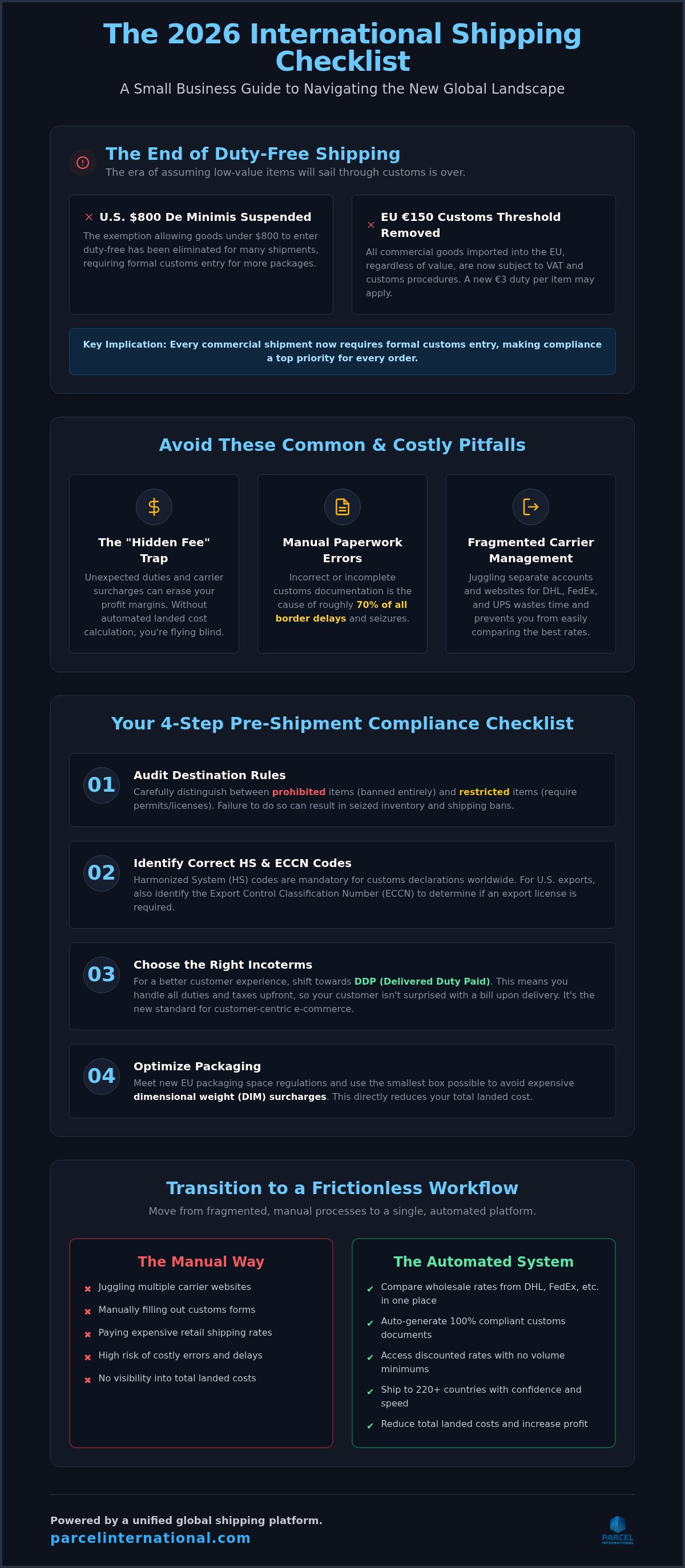
International shipping for small and medium businesses (SMBs) represents the strategic transition from local sales to a global marketplace. It involves more than just putting a box in the mail; it's about navigating a complex global trade framework with speed and precision. In 2026, the landscape has shifted significantly. The suspension of the 800 dollar de minimis exemption in the U.S. and the removal of the 150 euro threshold in the EU mean every commercial shipment now requires formal entry. This makes an international shipping checklist for small business an essential survival tool rather than an optional resource.
Small exporters are moving away from manual, fragmented processes toward automated international parcel shipping solutions. This shift is driven by a need for "frictionless" logistics. You don't have time to research individual country laws for every order. A logistics broker levels the playing field by providing the technology to compare real-time wholesale rates and automate compliance. This allows a three-person startup to ship with the same efficiency as a multinational corporation. By acting as a stable intermediary, these platforms remove the high-stakes anxiety of global trade and replace it with a predictable, orderly process.
Why Your Business Needs a Global Strategy Now
With access to 220 plus countries and territories, your potential customer base is virtually limitless. Relying solely on a domestic market leaves you vulnerable to local economic dips. Diversification is your best defense. By reaching international buyers, you distribute your risk and increase your brand's resilience. Expanding your reach ensures that your business remains active and successful in the real world, regardless of local trends. A global-first mindset for 2026 startups means building fulfillment around international accessibility from the very first day of operations.
Common Pitfalls of Manual International Shipping
The "Hidden Fee" trap is the most common margin killer. Without automated tools, it's easy to overlook new duties like the 3 euro per-item fee now applied to small parcels entering the EU. Manual international shipping customs documentation is another major hurdle, contributing to roughly 70% of all border delays. It's simply inefficient to manage separate accounts for DHL, FedEx, and UPS. This fragmented approach forces you to spend hours on different portals instead of focusing on growth. Using a singular international shipping checklist for small business helps you avoid these procedural frictions and keeps your packages moving. You need a solution that strips away the jargon and provides honest, straightforward guidance through every step of the journey.
Pre-Shipment Compliance: Your Regulatory Checklist
Compliance isn't a hurdle; it's a safeguard. Every international shipping checklist for small business must begin with a thorough audit of destination-specific rules. In 2026, the global trend toward eliminating de minimis thresholds means you can no longer assume low-value items will sail through customs. You must distinguish between prohibited items, which are banned entirely, and restricted items that require specific permits or licenses. Failing to make this distinction often leads to seized inventory and permanent shipping bans.
Identifying the correct Export Control Classification Number (ECCN) is vital for shipments originating from or passing through the United States. While it sounds technical, it simply helps authorities determine if your product requires an export license for national security or trade reasons. Similarly, choosing between DDU (Delivered Duty Unpaid) and DDP (Delivered Duty Paid) affects your margins and customer experience. With the removal of EU customs exemptions on July 1, 2026, many SMBs are shifting to DDP to ensure customers aren't surprised by the new 3 euro duty per item at their doorstep.
Mastering Incoterms 2026 for Small Business
Incoterms are the standardized trade terms (Incoterms) that define which party is responsible for costs, insurance, and transport at every stage. For most small businesses, three terms are most relevant:
EXW (Ex Works): The buyer handles everything from your door. This is the lowest risk for the seller but can be a barrier for international customers.
FOB (Free on Board): You deliver the goods to the shipping terminal; the buyer takes over from there.
DAP (Delivered at Place): You take responsibility for delivery to the buyer's location, excluding import clearance.
Choosing the right term protects you from unexpected liability and clarifies exactly where your financial risk ends. It's a fundamental part of your international shipping checklist for small business that ensures transparency for both you and your customer.
Compliance and Trade Regulations
You're legally required to ensure you aren't shipping to individuals or entities on the Denied Persons List. This is a critical step to avoid heavy fines or legal repercussions. Additionally, pay close attention to the EU’s Packaging and Packaging Waste Regulation (PPWR), which as of August 12, 2026, limits empty space in transport packaging to 50%. Our platform's automated tools check for restricted items and compliance risks in real-time, so you don't have to be a legal expert to stay safe. If you're ready to simplify this process, you can compare real-time wholesale rates and generate compliant labels in one step.
Packing and Automated Documentation for Global Success
Packing isn't just about protection; it's about cost control. Carriers calculate shipping costs based on dimensional weight, which means you pay for the space your box occupies rather than just its actual weight. If you ship a small item in a large box, you're essentially paying to ship air. This is why an international shipping checklist for small business must include a strict strategy for box sizing. As of August 12, 2026, the EU Packaging and Packaging Waste Regulation (PPWR) mandates that e-commerce transport packaging contains no more than 50% empty space. Failing to meet this standard doesn't just lead to higher carrier rates; it can result in regulatory fines at the border.
Leveraging automated documentation tools is the only way to eliminate human error in high-volume environments. Manual entry for every shipment is a recipe for customs delays. By using a platform that integrates with your e-commerce store, you can generate compliant labels and invoices instantly. This ensures that every piece of data, from the recipient's phone number to the item description, is accurate and formatted for the destination country's requirements. It's the difference between a package that clears customs in hours and one that gets stuck for weeks.
The Anatomy of a Perfect International Parcel
Use double-walled corrugated boxes for all international shipments to withstand the rigors of long-haul transit. Moisture-resistant materials are also essential because cargo holds experience extreme temperature shifts that can weaken standard cardboard. Follow the "2-inch rule" by ensuring at least two inches of cushioning exists between your product and the box walls. This is the minimum standard for most insurance claims; if you use less, carriers will likely deny damage payouts. Place your primary label on the largest flat surface of the box, and always tuck a duplicate label inside the package in case the exterior one is damaged.
Automating Your Customs Paperwork
The Commercial Invoice is the most important document you'll ever sign because it tells customs exactly what's inside and who's paying the duties. Our platform generates this documentation automatically during the booking process, pulling data directly from your order. This includes the mandatory "Harmonized System" (HS) codes, which are the universal language for identifying goods. Transitioning to HS code automation ensures you aren't guessing at duty rates or risking misclassification. For additional support on federal compliance, consult these SBA exporting resources to ensure your operations align with global standards. Automation replaces manual friction with a logical, orderly workflow.
Comparing Carriers and Optimizing Shipping Rates
Sticking to a single carrier is a common mistake that often leads to inflated logistics budgets. An effective international shipping checklist for small business requires you to compare multiple carriers for every specific lane you service. While major carriers announced a headline rate increase of 5.9% for 2026, many small businesses are experiencing actual cost increases of around 12% due to adjusted surcharges. You must look beyond the base rate and calculate the total landed cost. This includes the shipping price, duties, taxes, and specific fees like the 6.95 dollar UPS residential surcharge or remote area fees that can start at a minimum of 61.00 dollars per shipment.
Accessing wholesale rates no longer requires shipping thousands of units per month. By partnering with a logistics broker, you benefit from aggregated volume that allows for significant discounts with DHL, FedEx, and UPS. This model provides the transparency you need to avoid the "fuel surcharge" surprise, such as the 0.40 dollar per pound international fuel surcharge applied by DHL eCommerce as of August 2026. A unified interface simplifies your workflow and replaces the anxiety of checking three different carrier portals with the relief of a singular, orderly solution.
Express vs. Economy: Finding the Sweet Spot
Choosing the right mode of transport is a balance between customer expectations and your profit margins. Your international shipping checklist for small business should categorize shipments based on these three primary options:
Express Shipping: This is the best choice for high-value, time-sensitive parcels that require delivery within 1 to 3 business days.
Economy and Road Freight: These are ideal for optimizing costs within European cross-border trade where transit times are less critical than the bottom line.
Sea Freight: When you're moving bulk inventory or heavy items, the significant cost savings of sea transport often justify the longer lead times.
The Power of a Logistics Broker
A logistics broker acts as a reliable bridge in complex markets, offering you a platform to compare international shipping rates in real-time. This approach eliminates the need for expensive subscriptions or volume minimums, making global trade accessible to startups and established SMBs alike. You gain the modern flexibility to switch between carriers based on who offers the best reliability and price for a specific destination. If you want to see how much you can save on your next global order, you can get an instant shipping quote and compare the world’s leading carriers in seconds. This shift from manual comparison to automated brokerage is the most effective way to protect your margins in a high-stakes industry.
Scaling Globally with the Parcel International Platform
An international shipping checklist for small business provides the necessary foundation, but scaling your reach requires a system that handles the heavy lifting. Integrating our platform into your e-commerce workflow removes the need for manual data entry and fragmented processes. You won't have to manage multiple carrier logins or deal with the friction of separate billing cycles. Instead, you get a unified dashboard where every order is processed with precision. This transition from a manual checklist to an automated workflow is what allows a small team to manage a global customer base without increasing their administrative burden.
Real-time tracking keeps the "relief" alive for both you and your customers. Automated updates ensure that buyers know exactly where their package is at every stage of its journey. This transparency reduces support inquiries and builds the trust necessary for repeat international sales. We believe that small businesses shouldn't be penalized for their size. That's why we maintain a "no-barrier" approach to global logistics. You don't need a subscription, and you don't need to meet volume minimums to access our wholesale rates. You get the flexibility to ship when you need to, with the confidence that you're always getting the best possible price.
From Rotterdam to the World: Our Global Network
We leverage over 19 years of industry experience to act as your stable intermediary in a volatile global market. Our established partnerships with DHL, FedEx, and UPS mean you benefit from a reliable network without the high-stakes negotiation usually required for deep discounts. We act as your protector, ensuring your shipments are prioritized and handled with care. Our platform provides a reliable bridge to over 220 countries and territories worldwide. This global reach ensures that no market is off-limits to your business, regardless of your current size or shipping volume. For businesses that need to source inventory from specific regions, Stork Japan株式會社 provides specialized consolidation and proxy shopping services that simplify logistics from Japanese marketplaces to global destinations.
Booking your first shipment takes less than three minutes through a simple three-step process: Compare, Book, and Print. You get the same professional-grade tools used by large-scale exporters without the corporate jargon or complex setup. This speed is essential for maintaining momentum as you expand into new regions. If a shipment feels complex or a specific destination has unique requirements, you can access direct support from our logistics experts. They're here to help you navigate the nuances of your international shipping checklist for small business. Stop letting logistical anxiety hold your growth back. You can compare international shipping rates and book your first parcel today to see how easy global expansion can be when you have the right partner.
Master Your Global Growth in 2026
International logistics doesn't have to be a source of friction for your company. By implementing a modern international shipping checklist for small business, you move from a reactive state of managing customs delays to a proactive strategy of automated growth. You've seen how the 2026 landscape requires precise documentation and strategic carrier comparison to protect your margins. Transitioning to a unified platform ensures that you aren't overpaying for surcharges or struggling with complex regulatory changes in the U.S. or EU.
We provide a reliable bridge to over 220 countries and territories without the burden of subscription fees or volume minimums. Our platform includes automated customs documentation to ensure your parcels clear borders with punctuality and security. You deserve the relief of a streamlined workflow that lets you focus on your customers instead of your paperwork. Start comparing real-time international shipping rates now and take the first step toward a simpler, more profitable global operation. The world is waiting for your products, and we're here to help you reach it.
Frequently Asked Questions
What is the most important document for international shipping?
The Commercial Invoice is the single most important document. It acts as the legal declaration of your goods to customs authorities. Without an accurate invoice containing the correct Harmonized System (HS) codes and transaction values, your shipment will likely face immediate delays or rejection. Including a detailed Commercial Invoice is a non-negotiable step on every international shipping checklist for small business to ensure your goods move across borders without procedural friction.
How do I calculate import duties for my small business?
Calculating duties requires knowing the HS code for your product and the specific tax rates of the destination country. Since the 2026 removal of de minimis exemptions in the U.S. and EU, almost every commercial shipment is subject to duties. You must calculate the total landed cost, which includes the shipping rate, insurance, and all applicable taxes. Using an automated platform helps you estimate these costs accurately before you finalize the booking.
Can I get discounted shipping rates without a high volume of orders?
You absolutely can access wholesale rates without high volumes. Logistics brokers aggregate shipments from thousands of small businesses to negotiate deep discounts with major carriers like DHL, FedEx, and UPS. This egalitarian model allows you to ship a single parcel using the same discounted rates typically reserved for multinational corporations. Our platform requires no subscription fees or volume minimums, giving you modern flexibility to scale your global operations at your own pace.
What are HS codes and why does my business need them?
Harmonized System (HS) codes are a universal six to ten digit numbering system used to classify traded products. Customs authorities use these codes to determine exactly what is inside your package and apply the correct duty rates. Your business needs them because incorrect classification is a primary cause of customs seizures and fines. Automating the HS code selection process through your shipping platform reduces human error and ensures compliance with global trade regulations.
Is insurance necessary for international small business shipments?
While not legally mandatory, insurance is vital for protecting your margins during long haul transit. Standard carrier liability is often based on weight rather than the actual value of your goods, which can leave you with a significant loss if an item is damaged. To ensure your insurance claims are valid, always follow the 2-inch rule for internal cushioning. Protecting your shipments with comprehensive coverage provides the peace of mind necessary for scaling internationally.
How long does customs clearance usually take in 2026?
In 2026, customs clearance for shipments with automated documentation typically takes between 24 and 48 hours. However, manual paperwork errors still cause approximately 70% of all international delivery delays. If your data is electronically submitted and your HS codes are accurate, many packages clear within hours. Conversely, missing information or regulatory flags can lead to inspections that extend the process for several days, highlighting the importance of a precise digital workflow.
What happens if my international shipment is rejected by customs?
If customs rejects your shipment, the authorities will either return the package to the sender or destroy it. You remain responsible for all return shipping costs, storage fees, and any administrative penalties. This outcome usually stems from shipping restricted items or failing to provide accurate documentation. This is why a thorough international shipping checklist for small business must include a pre-shipment audit of the destination country’s specific prohibited and restricted goods lists.
Which carrier is best for shipping from the US to Europe?
The best carrier depends on your specific balance of speed and budget. DHL is widely regarded as the leader for European deliveries due to its extensive regional network and infrastructure. However, FedEx and UPS offer highly competitive express services for time-sensitive parcels. Instead of staying loyal to a single provider, use a broker interface to compare real-time wholesale rates. This allows you to select the most efficient carrier for each specific European destination.


Comments