
How to Find the Cheapest Way to Ship a Small Box Internationally in 2026
- Alex
- Jun 9
- 12 min read
The era of simple, duty-free international shipping officially ended this year. With major carriers implementing 5.9 percent average rate hikes and the suspension of the 800 dollar U.S. de minimis exemption, finding the cheapest way to ship a small box internationally in 2026 is no longer about picking the first name you recognize. It's about outsmarting a system designed to add surcharges at every turn.
We know how discouraging it's to see a shipping quote that exceeds the value of your parcel. Between new trade surcharges and complex HTS classifications, the logistics landscape feels more like a minefield than a service. You deserve a clear path that prioritizes your budget without risking customs delays or hidden residential fees. Transparency is the only way to move forward in this high-stakes environment.
This article promises to simplify your shipping strategy by revealing the most cost-effective carrier tiers for 2026. We'll explore when to utilize flat rate boxes versus weight-based pricing and how to manage the new EU duty requirements. You'll gain a clear framework to secure reliable delivery while keeping your total spend under control.
Key Takeaways
Master the international zone system and keep parcels under 2kg to qualify for the most competitive small-box shipping tiers.
Identify the cheapest way to ship a small box internationally by comparing traditional postal services against modern volume aggregators.
Determine if flat rate options provide better value than weight-based pricing for your specific destination to avoid unexpected surcharges.
Cut expenses by optimizing your packaging dimensions and ensuring every gram is accounted for before you book your shipment.
Leverage wholesale rates through a broker to bypass the traditional subscription fees and volume minimums often required by major carriers.
Table of Contents
What Determines the Cost of International Small Box Shipping?
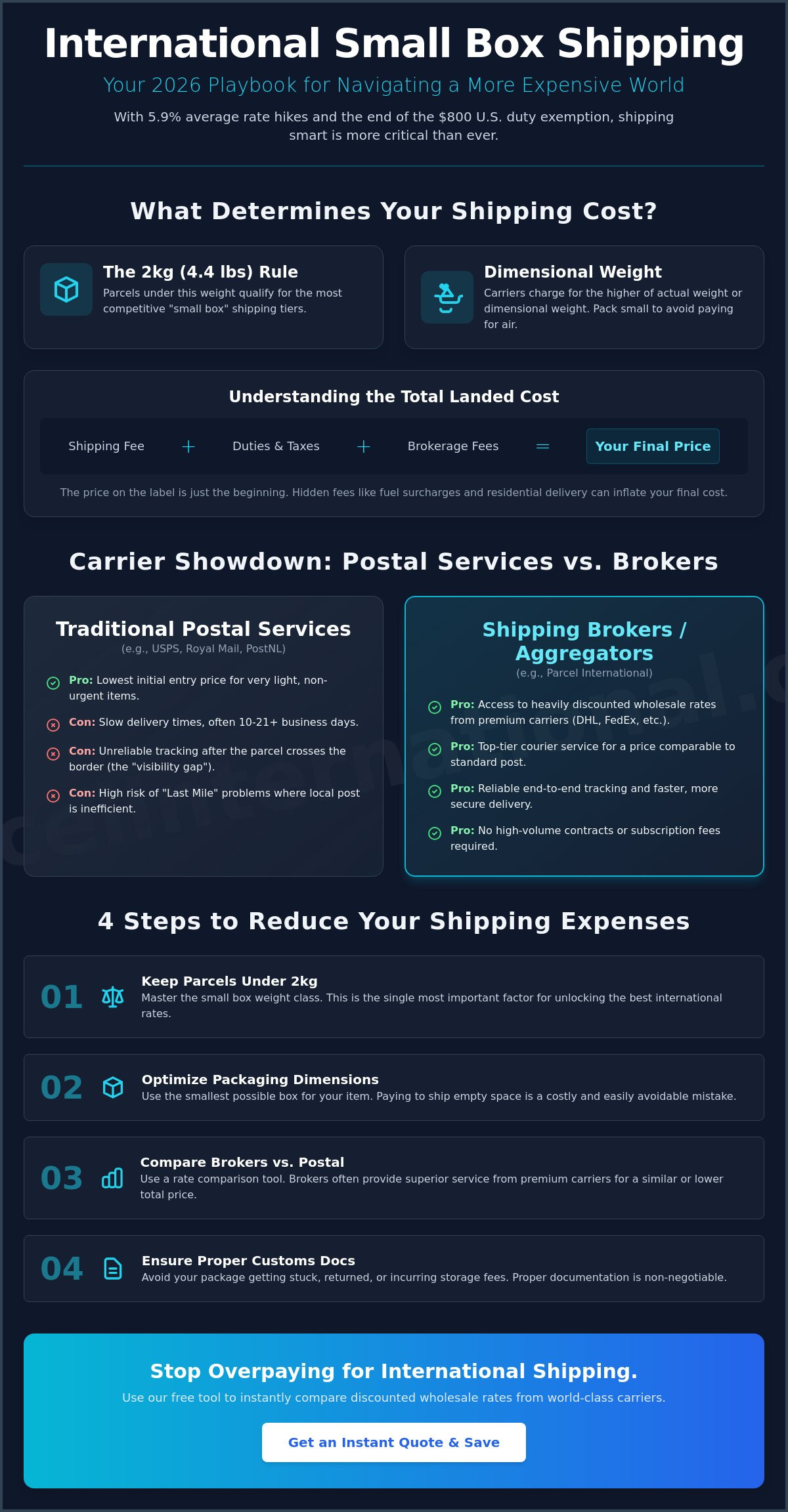
Shipping a small box across borders requires a different strategy than bulk freight. In the industry, we typically define small box shipping as parcels weighing under 2kg, or about 4.4lbs. Understanding this threshold is vital because many carriers offer specialized rates specifically for this weight class. To find the cheapest way to ship a small box internationally, you must first look at how carriers calculate their base rates. Most providers use a Zone system. Instead of charging by the exact mile, they group countries into regions. Shipping from New York to London might be Zone 5, while New York to Sydney could be Zone 9. The higher the zone number, the higher the cost.
The history of parcel post shows that international agreements have long focused on standardizing these regions to keep global trade moving. However, don't confuse the shipping label price with the total cost. You need to consider the landed cost, which includes the shipping fee plus any duties, taxes, and brokerage charges. For small items, Express Shipping can sometimes be more economical than Economy. Because small boxes take up minimal space, the price difference between a three-day delivery and a fourteen-day delivery might only be a few dollars. The added reliability often outweighs the minor savings of a slower service.
The Impact of Weight vs. Dimensions
Carrier pricing isn't just about what the scale says. You must account for both actual weight and dimensional weight. A box filled with lead is heavy but small; a box filled with pillows is light but large. Carriers charge you based on whichever number is higher. Dimensional weight is the amount of space a package occupies relative to its weight. If you use a box that's too big for your item, you're paying to ship air. Always choose the smallest possible packaging to keep your costs down.
Hidden Costs: Surcharges and Customs Fees
Base rates are often misleading because they don't include surcharges. Fuel adjustments change weekly based on global oil prices, and residential delivery fees apply if you aren't shipping to a commercial warehouse. Many shippers use DDU, or Delivered Duty Unpaid. This means your recipient must pay customs fees before they can receive the box. To avoid these surprises, utilize professional customs support. Proper documentation ensures your parcel clears the border without incurring storage fees or return shipping costs, which can double your initial investment. Don't let a simple paperwork error turn a cheap shipment into an expensive nightmare.
Comparing the Cheapest Carriers for Small International Parcels
Finding the cheapest way to ship a small box internationally requires looking beyond your local post office. While USPS in the United States, PostNL in the Netherlands, and Royal Mail in the UK offer the lowest entry prices, they aren't always the best total value. These national carriers work through the Universal Postal Union, which means they hand off your parcel to the destination country’s local post. This hand-off often creates a visibility gap where tracking becomes unreliable once the box crosses the border. For many, the low cost isn't worth the anxiety of a lost package.
Consolidators provide the cheapest way to ship a small box internationally for many individuals and small businesses because they remove the need for high-volume contracts. These brokers aggregate thousands of shipments to negotiate wholesale rates with premium couriers. By using an international shipping rates comparison tool, you can access these discounted prices instantly. This strategy allows you to use a top-tier courier for nearly the same price as a standard postal service. To start saving immediately, get a quick quote and see how broker rates compare to standard retail pricing.
Postal Services: The Budget Choice
Postal services remain the primary choice for non-urgent, low-value items. First Class Mail International is typically the most affordable tier for boxes under 2kg. However, you must accept longer delivery windows. In 2026, economy international post usually takes between 10 and 21 business days, depending on the destination's infrastructure. The main drawback is the "Last Mile" problem; if the local post in the receiving country is inefficient, your parcel may sit in a sorting facility for weeks without a tracking update.
Express Couriers: Speed vs. Value
Global couriers like DHL, FedEx, and UPS offer a level of security that postal services cannot match. DHL is often the leader for small boxes heading to Europe and Asia due to its massive regional hubs. FedEx and UPS leverage their own aircraft fleets, which ensures your parcel stays within one system from pickup to delivery. This closed-loop network provides superior tracking and reliability. Express services often include customs clearance assistance in their base price, which simplifies the process of following customs and import regulations. While the sticker price is higher, the reduction in lost parcels and customs delays often makes express the smarter financial choice for high-value goods.
Flat Rate vs. Weight-Based Shipping: Which Saves You More?
Deciding between a flat rate box and weight-based pricing is the most critical choice you'll make when seeking the cheapest way to ship a small box internationally. Flat rate shipping offers a predictable, one-price-fits-all model. You pay a single fee regardless of how much the item weighs, provided it stays under the carrier's maximum limit, which is often 4lbs (1.8kg) for small international parcels. This predictability is a massive relief for those who want to avoid the anxiety of fluctuating quotes. However, it isn't always the most economical path.
Weight-based shipping, or using your "own packaging," calculates the cost based on the exact grams and dimensions of your parcel. To find the cheapest way to ship a small box internationally, you need to identify the "Magic Weight." For most international destinations, the breakeven point sits around 1lb (0.45kg). If your item is lighter than this, paying for a flat rate box means you're subsidizing the carrier's costs. If your item is heavy and dense, the flat rate is almost always the winner. You should also consider the de minimis value of your destination country; while shipping rates vary, staying below this threshold ensures you don't add duties to your total bill.
When to Use the USPS Small Flat Rate Box
The usps small flat rate box is a powerful tool for specific scenarios. It's the ideal choice for heavy, compact items like small hand tools, dense electronics, or books. Since the price is fixed, you don't have to worry about the "Zone" pricing mentioned earlier in this guide. The primary limitation is the rigid dimension of the box. There's very little room for protective padding, so it's less suitable for fragile glassware or delicate instruments. Achieving cheap parcel shipping often requires moving away from these rigid boxes when your item is exceptionally light or requires bulky cushioning.
The Advantages of Custom Packaging
Custom packaging allows for "right-sizing," which is the process of matching the box size exactly to the item. If you're shipping a t-shirt or soft goods, switching from a box to a poly mailer can drop your parcel into a significantly lower weight bracket. You aren't just saving on the weight of the cardboard; you're also reducing the dimensional weight. This is where the real savings live. Before you commit to a label, use a shipping cost calculator to run the numbers for both a flat rate box and your own custom mailer. Seeing the side-by-side comparison takes the guesswork out of the process and ensures you never pay for empty space.
A Step-by-Step Guide to Reducing Small Box Shipping Expenses
Reducing your logistics costs requires a systematic approach that starts long before you print a label. With general rate increases averaging 5.9 percent in 2026, every millimeter and gram counts toward your final bill. Follow these five steps to ensure you're utilizing the cheapest way to ship a small box internationally without sacrificing reliability.
Step 1: Precision Measurement. Weigh and measure your item to the exact gram and millimeter. Carriers round up to the nearest whole unit. A box that's one millimeter over a threshold can trigger a higher price tier or dimensional weight surcharge.
Step 2: Optimize Packaging. Choose the smallest possible protective container. If an item fits safely in a bubble mailer, don't use a box. This reduces both actual weight and the volume the parcel occupies.
Step 3: Access Broker Rates. Stop paying retail prices at the counter. Use a broker or aggregator to access wholesale commercial rates that are usually reserved for high-volume enterprises.
Step 4: Automate Customs. Use digital tools to generate your customs forms. This prevents "Correction Fees" that carriers charge when they have to manually fix your documentation at the border.
Step 5: Choose Drop-off. Whenever possible, drop your parcel at a designated point rather than scheduling a pickup. Many couriers apply a surcharge for residential pickups that can be easily avoided.
Execution is everything. You can find the cheapest way to ship a small box internationally by combining these small tactical wins into a single workflow. Start optimizing your logistics today by accessing our wholesale rates.
Packaging Hacks for Small Parcels
The physical makeup of your parcel is where most "hidden" costs originate. Don't use double-walled boxes unless the item is extremely fragile; the extra cardboard increases the tare weight and can push you into a more expensive bracket. If you're shipping items in their original retail packaging, consider removing it if it's bulky. Placing the product directly into a standard, smaller shipping box often saves more in postage than the retail box is worth. Finally, follow the "Tape Rule." Use only enough high-quality tape to secure the seams. Excessive layers of heavy-duty tape can add enough weight to trigger the next price tier on a sensitive digital scale.
Documentation and Compliance
Accuracy in your paperwork is just as important as the size of your box. Every item you ship must have a correct HS Code (Harmonized System Code). If you provide a vague description, customs officials may apply a higher duty rate by default, or the carrier may charge a brokerage adjustment fee. Utilize Electronic Trade Documents (ETD) to send your invoices digitally. This ensures the data reaches the destination country before the box does, speeding up the clearance process. For a full list of required paperwork, refer to our comprehensive ship international guide to ensure your parcel meets every regulatory standard.
Scaling Your Global Reach with Parcel International’s Broker Rates
Parcel International functions as a stable intermediary in a fragmented market. We aggregate the shipping volume of thousands of users to negotiate wholesale rates with the world's leading couriers. This collective bargaining power is the cheapest way to ship a small box internationally for those who don't ship enough to secure their own enterprise contracts. Instead of being locked into a single carrier's retail pricing, you gain access to a competitive marketplace where DHL, FedEx, and UPS compete for your business on a single dashboard. Our goal is to strip away the typical anxieties associated with global logistics by providing a singular, unified solution.
Wholesale Rates Without the Volume Commitment
The traditional logistics model often forces you to choose between high retail costs or expensive monthly subscriptions. We eliminate that barrier. Our platform operates on a transparent model with no hidden fees or minimum volume requirements. This egalitarian approach ensures that a single individual sending a gift receives the same professional-grade rates as a commercial enterprise moving hundreds of parcels. Parcel International serves over 220 countries from strategic hubs like Rotterdam and the US, providing a truly global reach. You can compare international shipping rates in real-time to find the best balance between speed and cost for every unique shipment. This flexibility is the cheapest way to ship a small box internationally while maintaining high service standards.
Simplified Global Logistics for 2026
Managing global logistics in 2026 shouldn't feel like a second job. We've built automated customs tools directly into the booking process to remove procedural friction. When you enter your parcel details, the system guides you through the necessary documentation, ensuring your small box meets the specific requirements of the destination country. This unified workflow provides immediate relief from the complexities of varying international regulations and prevents the hidden surcharges often found in fragmented shipping processes.
Reliability is a central pillar of our service. You won't have to deal with multiple support teams or fragmented tracking systems. We provide a single point of contact for all your shipments, regardless of which carrier is handling the final delivery. You receive real-time tracking and proactive notifications, ensuring you and your recipient remain informed at every stage. We value your peace of mind over corporate jargon. Find the cheapest rate for your small box today and experience the efficiency of a professional broker service.
Master Your International Logistics Today
You've now seen that the cheapest way to ship a small box internationally isn't found through a single carrier, but through a combination of precise packaging and wholesale access. By right-sizing your parcels and choosing between flat-rate and weight-based pricing based on the "Magic Weight" threshold, you can protect your margins. Moving away from fragmented workflows and high retail prices is the final step in mastering your 2026 logistics strategy. Efficiency doesn't have to be complicated or expensive.
You don't need high volumes or monthly subscriptions to access the same tools used by global corporations. Transparency in pricing and automated documentation are now accessible to everyone, ensuring your parcels move across borders without procedural friction. You can finally stop overpaying for delivery and start focusing on your global growth.
Access wholesale international shipping rates for your small box today. Our platform allows you to compare rates from DHL, FedEx, and UPS in seconds. There are no monthly subscription fees or volume minimums, and we include automated customs documentation to ensure your parcels clear borders without delay. Take control of your international delivery costs and ship with confidence.
Frequently Asked Questions
Is USPS First Class the cheapest way to ship internationally?
Yes, USPS First-Class Package International Service is typically the baseline for the lowest price on parcels weighing under 4 lbs. Prices in 2026 start at $19.40 for the lightest weight tiers. While it offers the lowest entry cost, you must accept longer delivery windows and less reliable tracking once the box leaves the United States. For many, this remains the cheapest way to ship a small box internationally when speed is not a priority.
How much does it cost to ship a 1lb box internationally in 2026?
Shipping a 1lb box currently starts around $19.40 via USPS First-Class, while Priority Mail International flat rate options start at approximately $32.65. If you are shipping to Canada or the UK, specialized services like FedEx International Connect Plus offer rates between $18.96 and $29.51 for small parcels. Always check for current fuel surcharges, as these can add 20 percent or more to the base quote at the time of booking.
What is the cheapest way to ship a small box to Europe?
Economy postal services like USPS or Royal Mail offer the lowest sticker price, but consolidators often provide better value. These brokers use high-volume discounts to offer DHL or PostNL services at rates that rival standard post. This approach gives you the security of a global courier network without the high retail cost. It's often the most effective balance of price and visibility for European destinations.
Does the USPS small flat rate box include tracking?
It includes tracking to the destination for most major countries, but visibility isn't guaranteed in every region. Once the parcel is handed off to a local postal service, tracking updates may become infrequent or stop entirely. If you require door-to-door visibility with high reliability, an express courier service is a safer choice than the standard postal flat rate system.
How can I avoid customs duties on small international shipments?
Stay under the destination country's "de minimis" threshold to avoid duties and taxes. Be aware that these rules are tightening globally; for example, the EU removed its €150 customs duty exemption for low-value imports on July 1, 2026. Additionally, the U.S. has suspended its $800 de minimis threshold. Always research the specific tax laws of your recipient's country before you ship to avoid unexpected fees.
What is the most reliable cheap international shipping service?
The most reliable cheapest way to ship a small box internationally is using a broker to access commercial express rates. While postal services are cheaper, express carriers like DHL and FedEx offer superior reliability because they maintain control of the parcel through their own hubs. By booking through an aggregator, you can often secure these premium services for a price similar to standard priority mail.
Can I use my own box for international flat rate shipping?
No, you cannot use your own packaging for flat rate services. Carriers like USPS require you to use their specific branded boxes to qualify for the flat rate price. If you prefer to use a custom box or a poly mailer, you must use weight-based or dimensional pricing. Using your own packaging is often cheaper for very light items that don't fill a standard flat rate box.
Why is international shipping so expensive for small items?
International shipping costs are driven by more than just distance. In 2026, carriers implemented average rate increases of 5.9 percent, and surcharges for fuel and residential delivery add significant weight to the final bill. Stricter customs enforcement and the elimination of duty-free loopholes have also increased the administrative costs of moving even the smallest parcels across borders.


Comments