
How to Reduce International Shipping Costs: A 2026 Strategic Guide
- Alex
- 4 hours ago
- 15 min read
The cheapest carrier is rarely the cheapest option. That's the uncomfortable truth most businesses discover too late, buried under fuel surcharges, dimensional weight penalties, and customs delays that nobody warned them about. If you've been searching for how to reduce international shipping costs and keep hitting the same wall, the problem probably isn't which carrier you're using. It's that you're accessing retail rates while your larger competitors pay wholesale.
You already know international shipping is expensive and unpredictable. Surcharges spike without warning, a single paperwork error can stall a shipment for days, and comparing rates across DHL, FedEx, and UPS feels like a part-time job. That frustration is valid, and it's shared by businesses of every size.
This guide cuts through the noise. You'll walk away with practical strategies to lower your cost-per-shipment, simplify carrier comparison, and clear customs faster by eliminating the administrative friction that quietly inflates your logistics spend. From smarter dimensional weight packaging to automated customs documentation, here's what actually moves the needle in 2026.
Table of Contents
Understanding the Hidden Drivers of International Shipping Costs in 2026
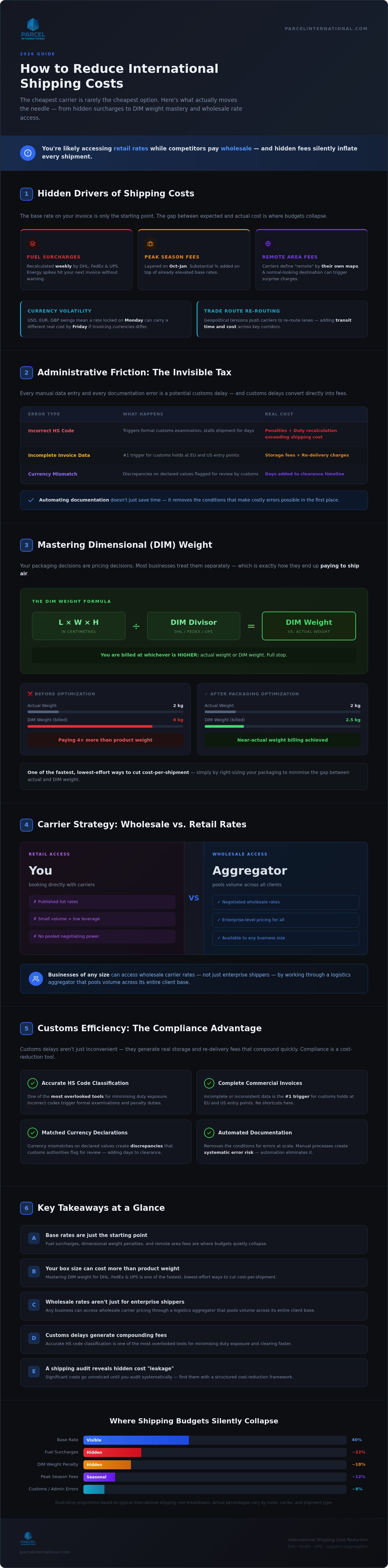
Most businesses quote their shipping costs using the figure on their carrier invoice. That's a mistake. The base rate is the starting point of a much longer calculation, and the gap between what you expect to pay and what you actually pay is where logistics budgets quietly collapse. Understanding that gap is the foundation of any serious strategy for how to reduce international shipping costs in 2026.
The 2026 logistics environment has added new layers of complexity. Ongoing geopolitical trade tensions have pushed carriers to re-route certain lanes, adding transit time and cost. Currency volatility in key trading corridors, particularly between USD, EUR, and GBP, means that a rate locked in on Monday can carry a meaningfully different real cost by Friday if your invoicing currency differs from your payment currency. These aren't edge cases; they're weekly realities for cross-border shippers.
The Reality of Surcharges and Fees
Carrier surcharges aren't static. Fuel surcharges are recalculated weekly by major carriers including DHL, FedEx, and UPS, indexed to published fuel price benchmarks. When energy markets spike, those adjustments hit your next invoice without warning. Peak season surcharges, typically layered on from October through January, can add a substantial percentage on top of already elevated base rates during the highest-demand shipping windows. Remote area delivery fees are another frequent surprise: carriers define "remote" by their own internal zone maps, and a destination that looks straightforward on a map may trigger an additional charge you didn't anticipate when you booked.
Before booking any shipment, check the carrier's current surcharge schedule directly. Rates published on aggregator platforms like Parcel International's real-time comparison dashboard reflect these surcharges in the quoted total, which removes the guesswork. Carriers publishing base rates alone are showing you an incomplete number.
It's also worth understanding how dimensional weight pricing functions as a de facto surcharge on poorly optimized packaging. Carriers charge based on whichever is greater: actual weight or volumetric weight. A light but bulky shipment can cost significantly more than its physical weight suggests.
Why Administrative Friction is a Cost Driver
Administrative friction is the invisible tax on international trade: every manual data entry, every misclassified HS code, and every incomplete commercial invoice is a potential customs delay that converts into storage fees, re-delivery charges, and lost customer trust. A single incorrect HS code can trigger a formal customs examination, stalling a shipment for days and generating warehouse storage fees that accumulate by the day. These aren't rare occurrences. Manual documentation processes create the conditions for error at scale, and the financial consequences compound faster than most businesses track.
Incorrect HS codes can result in customs penalties and duty recalculations that exceed the original shipping cost.
Missing or inconsistent commercial invoice data is one of the most common triggers for customs holds across EU and US entry points.
Currency mismatches on declared values create discrepancies that customs authorities flag for review, adding days to clearance timelines.
Automating documentation doesn't just save time. It removes the conditions that make costly errors possible in the first place.
Optimizing Packaging and Mastering Dimensional Weight
Your packaging decisions are pricing decisions. Most businesses treat them separately, which is exactly how they end up paying to ship air. Dimensional weight, often called DIM weight or volumetric weight, is the mechanism carriers use to charge for the space a package occupies, not just how heavy it is. If your actual weight is lower than your DIM weight, you're billed at the higher figure. Full stop.
The DIM Weight Formula Explained
The calculation is straightforward. Multiply your package's length by its width by its height in centimetres, then divide by the carrier's DIM divisor. In 2026, the standard divisor used by DHL, FedEx, and UPS for international shipments is 5,000 (when measuring in centimetres), giving you a DIM weight in kilograms. Some domestic or economy services use a divisor of 4,000, which produces a higher billed weight from the same box, so always confirm which divisor applies to your specific service level before booking.
Here's a concrete example. A box measuring 40cm x 35cm x 30cm has a volume of 42,000 cubic centimetres. Divide by 5,000 and you get a DIM weight of 8.4kg. If the actual contents weigh 3kg, you're billed for 8.4kg regardless. Now shave 2cm off each dimension: 38cm x 33cm x 28cm gives a volume of 35,112 cubic centimetres, or a DIM weight of approximately 7.02kg. That single right-sizing decision reduces your billed weight by more than 1.4kg, multiplied across every shipment you send. At scale, this is one of the most direct answers to how to reduce international shipping costs without changing carriers or renegotiating contracts.
Advanced Packaging Strategies
Right-sizing starts with an honest audit of your current boxes. Most businesses default to a handful of standard box sizes and fill the gaps with void fill. That void fill is costing you money twice: once in materials, and again in DIM weight penalties.
Custom-fit boxes eliminate internal air by matching box dimensions to your product's actual footprint. The upfront cost of custom packaging is typically recovered quickly through reduced billed weights across volume shipments.
Corrugated cardboard offers a better strength-to-weight ratio than standard single-wall cardboard, meaning you can protect goods adequately with less material mass contributing to actual weight.
Soft-shell poly mailers are the right call for non-fragile items: clothing, documents, fabric goods, and similar products. A mailer that weighs grams instead of hundreds of grams can meaningfully reduce both actual and DIM weight simultaneously.
Lightweight void fill alternatives like paper-based cushioning weigh less than bubble wrap and are increasingly preferred by carriers and recipients alike.
Packaging optimization also intersects with customs compliance requirements, since declared package dimensions and weights must match what's physically presented. Discrepancies between booking data and actual measurements can trigger re-weighing fees or documentation flags at the border, adding friction you don't need.
Knowing how to reduce international shipping costs through packaging is one lever. Accessing the right rate for that optimized shipment is another. Comparing what DHL, FedEx, and UPS will charge for your specific dimensions and destination, side by side, before you book, removes the guesswork entirely. Real-time freight rate comparison makes that a two-minute task rather than a research project.
Carrier Strategy: Accessing Wholesale Rates Through Aggregation
Here's the rate structure reality that most guides skip over: DHL, FedEx, and UPS operate tiered pricing models where the rate you're quoted depends almost entirely on how much volume you commit. Enterprise shippers with dedicated account teams negotiate Tier 1 rates that can be substantially lower than what a small or mid-sized business sees at the counter. That gap isn't fixed. It's closeable, and you don't need to triple your shipment volume to close it.
The Power of Volume Aggregation
Logistics aggregators like Parcel International, established in 2007, solve this problem structurally. Instead of negotiating as a single business, you ship under the aggregator's umbrella, benefiting from rates secured across their entire client base. The carriers see one high-volume account. You get the pricing that comes with it, without volume minimums or long-term commitments.
This is fundamentally different from how traditional freight forwarders operate. Freight forwarders often work with limited carrier panels and don't always disclose the margin between their buy rate and your sell rate. The aggregator model flips that dynamic: you compare live rates from DHL, FedEx, and UPS in a single dashboard, see the total landed cost including surcharges, and book the best option. No phone calls. No hidden markups obscured behind a quote PDF.
For businesses researching how to reduce international shipping costs, this is often the single highest-impact lever available, particularly if your current volume sits below the threshold where carriers will negotiate directly with you. Parcel International's access to international shipping rates that were previously reserved for high-volume retailers reflects exactly this model in practice.
Comparing Express vs. Standard Services
Speed isn't always the expensive choice. When you factor in the total cost of delivery, including storage fees from customs holds, customer service costs from delayed orders, and the reputational impact of late shipments, a slower service can end up costing more in aggregate than a faster one that clears cleanly.
The practical tool here is a shipping cost calculator that models both express and standard options against your specific dimensions, destination, and timeline. That side-by-side view removes the guesswork from what's genuinely a nuanced decision.
Hybrid models are worth considering for high-volume corridors. Combining air freight for the international leg with road freight for final distribution in destination markets can reduce cost-per-shipment on routes where full express coverage isn't necessary. This approach works particularly well for B2B shipments where delivery windows are flexible. Reviewing U.S. Customs and Border Protection import and export guidelines before selecting your service level also helps you anticipate documentation requirements that vary by mode of transport, preventing the kind of clearance friction that quietly inflates what looked like the cheaper option.
Multi-carrier access prevents carrier lock-in, the quiet cost of having no alternative when your primary carrier raises rates or degrades service quality on a specific lane.
Real-time comparison means you're always booking on current pricing, not rates cached from last week's quote.
No volume minimums means the same Tier 1 access is available whether you're shipping five parcels a month or five hundred.
Carrier strategy, done right, isn't about loyalty to a single provider. It's about knowing how to reduce international shipping costs by treating carrier selection as a dynamic decision made shipment by shipment, with full visibility into what each option actually costs.
Customs Efficiency: Reducing Costs Through Compliance
Customs delays aren't an administrative inconvenience. They're a direct financial liability. When a shipment stalls at the border, storage fees begin accumulating immediately, often charged by the day at the destination warehouse. Add re-delivery costs, potential duty recalculations, and the customer service burden of explaining a late order, and what looked like a manageable documentation oversight becomes a measurable loss. Compliance isn't a box-ticking exercise; it's one of the most concrete answers to how to reduce international shipping costs at the point where most businesses aren't looking.
HS code accuracy sits at the centre of this. The Harmonized System code assigned to your product determines the duty rate applied at the destination border. A misclassification doesn't just risk a penalty; it can mean you're paying a higher duty rate than your product legally attracts. Systematic HS code review, particularly for product lines that span multiple categories, is one of the most overlooked duty minimization tools available to exporters of any size.
Automating the Paperwork Trail
Manual documentation creates the conditions for error at scale. Missing fields, inconsistent declared values, and mismatched product descriptions are among the most common triggers for customs holds across EU and US entry points. Automated commercial invoice generators remove the human error variable from a process that directly controls your clearance speed. Beyond accuracy, digital documentation enables pre-clearance submission in markets where customs authorities accept advance electronic data, which means your shipment can be cleared before it physically arrives. That single efficiency can eliminate days from your transit timeline. Parcel International's international shipping customs documentation tools are built around exactly this workflow, reducing the administrative friction that quietly inflates logistics spend.
Strategic Incoterm Selection
Incoterms define who pays what, and when, across the international shipping journey. The choice between DAP (Delivered at Place) and DDP (Delivered Duty Paid) has direct cash flow implications for your business and direct experience implications for your customer.
DAP places import duty and tax responsibility on the buyer. It's simpler for the exporter, but it exposes your customer to unexpected charges at delivery, which is a leading driver of refusals and returns in cross-border e-commerce.
DDP absorbs all duties and taxes into the landed cost you control. It removes the "surprise invoice" moment for your customer, reduces returns, and strengthens repeat purchase behaviour, though it requires accurate duty pre-calculation to protect your margins.
For B2C shipments, DDP almost always produces better commercial outcomes despite the upfront complexity. For B2B shipments with sophisticated buyers who prefer to manage their own import accounting, DAP can be the cleaner arrangement. The right Incoterm isn't universal; it's specific to your customer profile, your destination market's tax structure, and your own operational capacity to manage duty pre-payment.
Getting this decision right is part of a broader compliance strategy that directly controls cost. Explore Parcel International's customs support services to see how automated documentation and expert guidance work together to keep your shipments moving without the holds that turn compliance gaps into budget problems.
Implementing a Cost-Reduction Framework with Parcel International
Strategy without structure is just good intentions. The sections above have covered the levers: dimensional weight, surcharge awareness, carrier aggregation, and customs compliance. Now it's time to pull them in sequence. A four-step framework turns those individual tactics into a repeatable system for how to reduce international shipping costs across your entire operation, not just on your next shipment.
Step 1: Audit your current spend. Pull three months of carrier invoices and map every line item beyond the base rate. You're looking for surcharge creep, dimensional weight penalties, and remote area fees that have accumulated quietly. This is your cost baseline.
Step 2: Integrate a real-time comparison platform. Once you know what you're paying, you need live visibility into what you should be paying. Booking from a single carrier's portal without comparing alternatives is how overpayment becomes habitual.
Step 3: Automate your customs documentation. Replace manual invoice generation with automated workflows. Every field that gets filled correctly by a system is a field that can't trigger a customs hold.
Step 4: Consolidate into a single dashboard. Managing express parcels through one platform, freight forwarder relationships through another, and customs queries through email is how administrative costs compound invisibly. A unified platform removes that fragmentation entirely.
The 30-Day Shipping Audit
A focused 30-day audit gives you three things: a surcharge map, a carrier performance breakdown by destination, and a cost-per-kilogram benchmark by region. Track every surcharge applied across your shipments in that window, then group them by carrier and lane. Patterns emerge quickly. You'll likely find two or three destination corridors where your current carrier consistently underperforms on price or transit time, and those are your immediate switching opportunities. Set a cost-per-kilogram benchmark for each major region you ship to, then use that figure as your ongoing performance standard, not the carrier's published rate.
Why Parcel International is the Optimizer's Choice
Parcel International's model is built around the friction points this guide has covered. There are no subscription fees and no volume minimums: you access wholesale rates from DHL, FedEx, and UPS whether you're shipping five parcels or five hundred. The platform covers Express, Sea, Air, and Road freight in a single dashboard, which means your parcel and freight decisions sit side by side rather than in separate workflows. Customs support is integrated, not bolted on. And with reach across 220+ countries, the same platform that handles your highest-volume lanes also covers the edge cases that typically fall through the gaps.
Knowing how to reduce international shipping costs is one thing. Having the infrastructure to act on that knowledge, shipment by shipment, without switching between platforms or negotiating blind, is what actually moves your cost-per-shipment in the right direction. Start comparing rates with Parcel International and see what your next shipment should actually cost.
Your Next Shipment Should Cost Less Than Your Last
Knowing how to reduce international shipping costs comes down to three things: understanding what you're actually paying for, accessing rates that reflect your true negotiating power, and keeping your shipments moving through customs without friction. Those aren't abstract goals. They're operational decisions you can act on today.
The businesses consistently winning on logistics aren't necessarily shipping more volume. They're shipping smarter: right-sized packaging, live carrier comparison, and documentation that clears first time. That combination compounds quickly across every shipment you send.
Parcel International gives you the infrastructure to do exactly that. No subscription fees. No volume minimums. Just real-time comparison of DHL, FedEx, and UPS rates in a single dashboard, with automated customs documentation included. Whether you're shipping five parcels or five hundred, you're accessing the same wholesale rates.
Start comparing wholesale international shipping rates today with Parcel International and find out what your next shipment should actually cost. The savings are already there; you just need the right platform to reach them.
Frequently Asked Questions About Reducing International Shipping Costs
What is the cheapest way to ship internationally in 2026?
The cheapest option depends on your shipment's weight, dimensions, destination, and how urgently it needs to arrive. Sea freight is generally the lowest cost-per-kilogram for heavy or bulky cargo, while economy air services offer a middle ground between speed and price for lighter parcels. The consistent mistake businesses make is checking a single carrier's rate rather than comparing DHL, FedEx, and UPS simultaneously, which is where the real savings surface.
Accessing wholesale rates through a logistics aggregator like Parcel International compounds those savings further. You're not paying retail pricing, and you're not locked into one carrier's network. That combination, right-sized packaging plus aggregated rates plus live comparison, is the practical answer to finding the lowest landed cost on any given shipment.
How do I calculate dimensional weight for my packages?
Multiply your package's length by its width by its height in centimetres, then divide by the carrier's DIM divisor. For international express services with DHL, FedEx, and UPS in 2026, that divisor is typically 5,000, giving you a DIM weight in kilograms. If that figure exceeds your actual weight, you're billed at the DIM weight. Always confirm the divisor for your specific service level, since economy services sometimes use 4,000, which produces a higher billed weight from the same box.
The practical implication is straightforward: shaving even a few centimetres off each dimension reduces your DIM weight across every shipment you send. A box that's 5cm smaller in each direction can drop your billed weight by a kilogram or more, and that saving multiplies across your entire shipping volume without any carrier negotiation required.
Why are fuel surcharges so high for international shipping right now?
Fuel surcharges are recalculated weekly by major carriers and indexed to published energy price benchmarks, so they move directly with global oil and jet fuel markets. When energy prices rise, surcharges follow within days, not at your next contract renewal. Geopolitical pressures and ongoing supply chain re-routing in several key trade corridors have kept baseline fuel costs elevated, which flows straight through to carrier surcharge schedules.
The important thing to understand is that surcharges aren't fixed additions to your base rate; they're a variable that can shift meaningfully between the time you quote a shipment and when you actually book it. Using a platform that shows the total landed cost, surcharges included, rather than a base rate alone, removes that uncertainty from your planning.
Can a small business get the same shipping rates as a large corporation?
Yes, and this is one of the most important things to understand about how to reduce international shipping costs as a smaller shipper. Carriers set tiered pricing based on committed volume, which means businesses shipping below certain thresholds typically see retail rates. A logistics aggregator solves this structurally by pooling volume across its entire client base, so carriers see one high-volume account and price accordingly.
Parcel International operates exactly this model with no volume minimums. Whether you're shipping five parcels a month or five hundred, you access the same wholesale rates from DHL, FedEx, and UPS that would otherwise require enterprise-level commitments. The playing field isn't level by default, but aggregation makes it level in practice.
What are the most common customs mistakes that increase shipping costs?
Incorrect HS code classification is the most financially damaging error. The wrong code can mean you're paying a higher duty rate than your product legally attracts, and it can trigger a formal customs examination that stalls your shipment for days while storage fees accumulate. Missing or inconsistent data on commercial invoices, particularly mismatched declared values or incomplete product descriptions, is the most common trigger for customs holds at EU and US entry points.
Currency mismatches between declared values and invoice currencies are a frequently overlooked issue that customs authorities flag for review. Each of these errors is avoidable through automated documentation workflows that validate data before submission, removing the human error variable from a process that directly controls your clearance speed and your total shipping cost.
How does using a shipping broker save me money compared to going direct?
Going direct to a carrier means you're negotiating as a single business with whatever volume you ship. A broker, or logistics aggregator, negotiates on behalf of its entire client portfolio, which means the rates it secures reflect far greater collective volume than any individual SME could achieve alone. That structural advantage translates into a lower base rate before any other optimisation is applied.
There's also a comparison benefit that's easy to underestimate. Booking direct through a single carrier's portal means you only see that carrier's pricing. A platform like Parcel International shows DHL, FedEx, and UPS rates side by side in real time, including all surcharges, so you're always booking the best available option rather than the most familiar one. The time saved on manual rate research is a secondary cost reduction that compounds across every booking.
What is the difference between DAP and DDP in terms of cost?
Under DAP (Delivered at Place), import duties and taxes are the buyer's responsibility on arrival. It's simpler for the exporter to manage, but it exposes your customer to unexpected charges at the point of delivery, which drives refusals and returns, both of which carry real costs. Under DDP (Delivered Duty Paid), you absorb all duties and taxes into the landed cost you control, which removes the surprise invoice moment for your customer entirely.
For B2C cross-border shipments, DDP typically produces better commercial outcomes despite requiring accurate duty pre-calculation to protect your margins. Fewer returns, fewer customer service escalations, and stronger repeat purchase behaviour offset the administrative complexity. For B2B shipments where buyers prefer to manage their own import accounting, DAP is often the cleaner arrangement. Neither Incoterm is universally cheaper; the right choice depends on your customer profile and destination market.
Is sea freight always cheaper than air freight for international delivery?
Not always, and the comparison is more nuanced than it first appears. Sea freight has a lower cost-per-kilogram for heavy, bulky, or non-urgent cargo, often substantially so. But transit times measured in weeks rather than days mean your capital is tied up in goods in transit for longer, and any customs delays at the destination port compound that timeline significantly. For time-sensitive products, perishables, or high-value items where holding costs matter, air freight's higher base rate can produce a lower total cost when you factor in the full picture.
The most cost-effective approach for high-volume corridors is often a hybrid model: air freight for the international leg where speed is critical, combined with road freight for final distribution in the destination market. Comparing both options side by side against your specific cargo dimensions, destination, and delivery window, rather than assuming one mode is always cheaper, is the disciplined way to make that call.


Comments