
How to Reduce International Shipping Costs: The 2026 Strategic Guide
- Alex
- Jul 13
- 12 min read
Updated: Jul 16
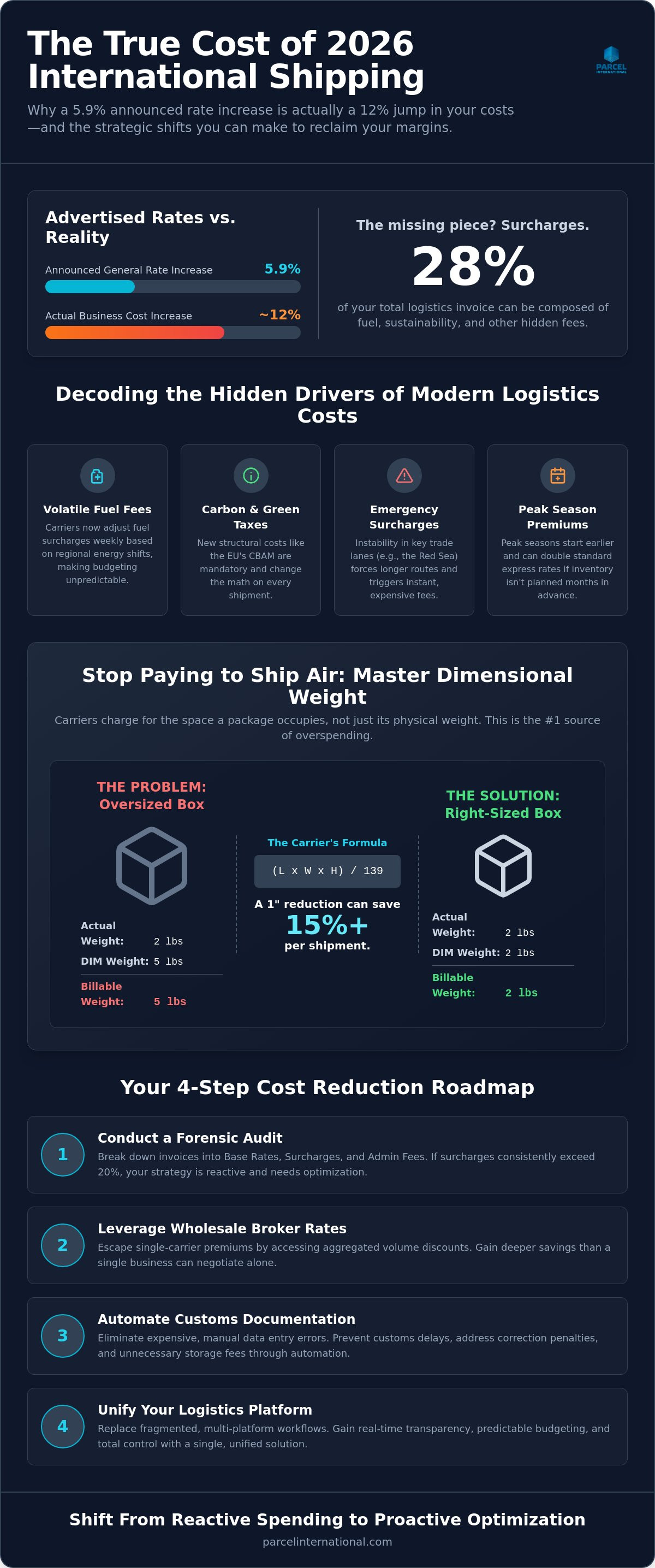
Did you know that in 2026, surcharges alone now account for up to 28% of your total logistics invoice? While major carriers announced a 5.9% general rate increase this year, most businesses are actually seeing their costs jump by 12% after factoring in fuel, sustainability fees, and new dimensional weight calculations. It's exhausting to manage a global supply chain when the rules change every month and your margins disappear into a black hole of hidden fees and procedural friction.
You don't have to accept these unpredictable spikes as the cost of doing business. Learning how to reduce international shipping costs in today's market requires a shift from reactive shipping to proactive optimization. This guide provides the tactical roadmap you need to strip away the administrative friction that leads to customs delays and storage penalties. You'll learn how to access wholesale rates and automate your documentation to ensure your budget remains predictable. We will explore the impact of recent dimensional weight standardizations, the removal of EU duty exemptions, and the specific strategic shifts that allow you to slash spend while maintaining the reliability your customers demand.
Table of Contents
Analyzing the 2026 International Shipping Cost Landscape
The 2026 logistics market isn't a simple transaction of moving goods from point A to point B. It's a complex network of fluctuating surcharges and regulatory mandates. While major carriers announced a 5.9% general rate increase for this year, the reality for most shippers is an 8% to 12% hike. This discrepancy occurs because base rates are only a fraction of the story. Surcharges now account for 15% to 28% of total costs, depending on your specific route and choice of modes of freight transport.
New carbon taxes, such as the EU Carbon Border Adjustment Mechanism (CBAM) that went into full effect on January 1, 2026, add another layer of expense. These aren't just "green fees"; they're structural costs that change the math on every shipment. If you're wondering how to reduce international shipping costs, you must start by acknowledging that loyalty to a single carrier is often a financial trap. Carriers prioritize high-volume enterprise contracts, leaving small and medium businesses to pay retail premiums plus every available surcharge. Breaking this cycle requires transparency and a willingness to diversify your carrier mix based on real-time data.
The Hidden Drivers of Modern Logistics Costs
Fuel index calculations have become more volatile in 2026. Carriers now adjust these weekly based on regional energy shifts, making it difficult to maintain a predictable monthly budget. Geopolitical instability in the Red Sea continues to force longer transit times, which triggers "emergency" trade lane surcharges. You must also account for the rush tax. Peak shipping seasons are starting earlier as retailers pull inventory forward to avoid potential tariff changes. If you don't plan your inventory cycles at least three months in advance, you'll be hit with peak surcharges that can double your standard express rates.
Auditing Your Current Shipping Spend
Stop guessing where your money goes. Conduct a 30-day audit by breaking your invoices into three distinct buckets: base rates, surcharges, and administrative fees. Look for zombie fees, such as address correction penalties or residential delivery surcharges, that you can eliminate through better data entry. Compare your current spend against 2026 industry benchmarks. If your surcharges consistently exceed 20% of your total bill, your strategy is reactive rather than optimized. Understanding how to reduce international shipping costs starts with this level of transparency. It's the only way to move from a chaotic workflow to a predictable, unified solution that protects your profit margins.
Mastering Dimensional Weight to Minimize Waste
In 2026, shipping "air" is one of the most expensive mistakes a business can make. Carriers have standardized their pricing models to prioritize the space a package occupies over the actual weight on the scale. As of July 12, 2026, major industry standardizations have shifted the dimensional (DIM) weight divisor to 139, matching the strict requirements of global express leaders. This change means that lightweight, bulky items are now significantly more expensive to move across borders. If you want to know how to reduce international shipping costs, you must start by shrinking your footprint.
DIM weight is the volume of a package relative to its actual weight. To calculate your billable weight, multiply the length, width, and height of your parcel and divide the total by 139 (or 5,000 if you use metric measurements). Carriers compare this result to the actual weight and bill you for whichever is higher. Even a one-inch reduction in a box's height can shift a package into a lower pricing tier, potentially saving you 15% or more per shipment. Precision in packaging isn't just about protection; it's a core financial strategy, and you can discover Packaging For Industry (PFI) to see how custom-engineered solutions help minimize these billable dimensions.
DIM Weight vs. Actual Weight: The Math of Savings
Calculating your billable weight should be a mandatory step in your fulfillment workflow. Follow this simple process: measure the exterior of your package at its widest points, rounding up to the next whole inch as per 2026 carrier rules. Multiply those three numbers to find the cubic volume. When you divide that volume by 139, you'll see the weight the carrier expects to be paid for. If your actual product weighs 2 lbs but the DIM calculation says 5 lbs, you're paying for 3 lbs of empty space. Small adjustments to your inner packaging can bridge this gap and keep your budget intact.
Packaging Strategies for the Modern Exporter
Stop using oversized boxes for non-fragile items. Switching to poly mailers or padded envelopes for apparel and soft goods is a fast way to eliminate the rigid volume that triggers DIM weight charges. For fragile items, consider custom-fit boxes rather than standard off-the-shelf sizes. While custom packaging requires an initial investment, it pays for itself by reducing the need for excessive "void fill" materials like bubble wrap or foam peanuts. This leaner approach also aligns with the new 2026 sustainability mandates mentioned earlier, helping you avoid carbon-related surcharges. When you use a platform that offers real-time rate transparency, you can see exactly how these minor packaging tweaks impact your final invoice before you hit print on a label. Understanding how to reduce international shipping costs requires this level of tactical discipline in every box you pack.
Diversifying Carriers and Leveraging Wholesale Broker Rates
Many businesses believe that sticking with a single carrier is the best way to secure deep discounts. This is a common misconception. For most small and medium enterprises, this "loyalty" actually prevents them from seeing the best market rates. Unless you're moving thousands of parcels daily, you're likely paying a retail premium. If you want to know how to reduce international shipping costs, you must stop behaving like a single-carrier customer and start acting like a volume aggregator. Diversification isn't just about backup plans; it's about price competition.
By using a platform that aggregates volume, you gain the collective bargaining power of thousands of shippers. This allows you to bypass the standard entry-level pricing and access the same Tier 1 rates that global corporations enjoy. Real-time comparison tools are essential here. They allow you to see exactly which carrier offers the best rate for a specific lane on any given day. One carrier might have a surplus of capacity to Singapore while another is overbooked; a diversified strategy lets you capitalize on those fluctuations instantly.
The Broker Advantage for Small and Medium Businesses
Parcel International acts as an optimizer by bridging the gap between your business and industry giants like DHL, FedEx, and UPS. We aggregate the shipping volume of our entire user base to unlock wholesale rates that are typically out of reach for individual SMBs. There are no subscription requirements or volume minimums to navigate. This level of radical transparency removes the barriers to entry, allowing you to move from fragmented workflows to a singular, unified solution. You get the reliability of major carriers without the high-stakes contract negotiations or hidden fees.
Choosing the Right Transport Mode
Choosing between Express Shipping, Air Freight, and Sea Freight is a balance of cost and urgency. In 2026, air freight costs for standard cargo range from $2.50 to $6.00 per kg, while ocean freight remains as low as $0.03 per kg. If your lead times allow for a slower transit, pivoting from parcel shipping to LCL (Less than Container Load) sea freight can slash your spend by a significant margin. For regional distribution within the EU, leveraging Road Freight from a central hub like Rotterdam is often the most cost-effective way to move goods across the continent. Understanding how to reduce international shipping costs means knowing when speed is a luxury you don't need to pay for. Use Sea Freight for your bulk replenishment and save Express Shipping for urgent, high-value orders.
Reducing Costs Through Automated Customs Compliance
Administrative friction is a silent profit killer in global logistics. When a shipment is flagged for inaccurate data, the clock doesn't just stop; it starts charging you. Between storage fees, fines, and the high cost of return-to-sender logistics, a single paperwork error can negate any savings you found on freight rates. If you're searching for how to reduce international shipping costs, you must look beyond the carrier label and focus on the data behind it. In 2026, customs authorities in the U.S. and EU have intensified their scrutiny, making manual data entry a liability your budget can't afford.
The rollout of the EU Import Control System 2 (ICS2) on June 1, 2026, and the U.S. Customs Enforcement Executive Order from June 3, 2026, have made detailed pre-arrival data mandatory. Incomplete descriptions or incorrect values now lead to immediate delays. Automating your commercial invoices ensures that every field is populated correctly and matches the requirements of the destination country. This digital precision speeds up clearance times, allowing your goods to move through hubs without the friction of manual inspections or administrative holds.
Incoterms 2026: Selecting the Most Cost-Effective Terms
Your choice of Incoterms dictates who bears the risk and the cost at every stage of the journey. In a DAP (Delivered at Place) agreement, the buyer handles duties and taxes, which can lead to refused deliveries if the customer is surprised by the bill. Conversely, DDP (Delivered Duty Paid) means you handle everything upfront. DDP can improve customer experience while requiring careful cost-modeling to ensure your margins remain intact. Selecting the wrong term often results in "bill-to-sender" surcharges, where carriers charge you a premium for processing payments that should have been handled by the receiver. Align your Incoterms with your pricing strategy to avoid these unnecessary administrative spikes.
Automation as a Cost-Saving Tool
Manual data entry for international parcels is an inefficient use of man-hours and a primary source of error. Automated HS code classification tools can instantly identify the correct tariff codes for your products, preventing you from overpaying duties due to vague descriptions. This level of optimization is essential for how to reduce international shipping costs in a market that rewards accuracy. By integrating your workflow with a platform that provides automated international shipping customs documentation, you eliminate the guesswork that leads to penalties. If you're ready to strip away the procedural friction of global trade, our Customs Support tools provide the order and reliability you need to scale without the headache of customs delays.
Implementing Your Long-Term Cost Reduction Strategy
Sustainable logistics savings aren't the result of a one-time discount or a lucky break on a single trade lane. They come from a fundamental shift in how you manage your global supply chain. Moving from a reactive, fragmented approach to a centralized, proactive strategy is the most effective way to protect your margins against the volatility of 2026. If you're tired of checking five different websites for every parcel, it's time to embrace a unified solution that prioritizes order over chaos. Understanding how to reduce international shipping costs is about building a system that works for you, not against you.
Scaling your global reach doesn't have to mean increasing your logistics headcount. Automation allows your existing team to handle higher volumes with fewer errors. By removing the manual friction of price shopping and data entry, you free up resources to focus on your core business. Real-time rate transparency ensures that every shipment is optimized for cost and speed without requiring hours of research. This strategic clarity provides the peace of mind that comes from knowing you're always accessing the most competitive rates available in the 2026 market.
Centralizing Your Global Logistics
A single-window interface is the ultimate tool for the modern optimizer. By integrating your e-commerce platform with a wholesale rate aggregator, you eliminate the need for manual price comparisons. This centralized workflow provides a high-level view of your entire spend, making it easier to identify trends and stop overpaying for "air" or unnecessary express services. For platform-specific advice on streamlining your fulfillment, consult our international shipping for ecommerce guide. It's designed to help you navigate the unique challenges of 2026 while maintaining wholesale pricing across every shipment.
Follow this checklist for immediate impact on your bottom line:
Audit your data: Identify and eliminate recurring address correction or residential surcharges.
Shrink your packaging: Standardize box sizes to stay below the 2026 DIM weight thresholds.
Automate compliance: Use digital documentation to prevent expensive customs delays and storage fees.
Leverage volume: Stop paying retail rates by switching to a broker model with no minimum requirements.
Taking the First Step with Parcel International
Moving to a unified shipping solution should be a relief, not another administrative burden. We provide the stable bridge you need to navigate a complex market by offering radical transparency in our pricing and terms. There are no subscription fees and no hidden restrictions to worry about. You gain immediate access to our established partnerships with DHL, FedEx, and UPS, allowing you to benefit from aggregated volume discounts from day one. If you're ready to see the difference that wholesale rates can make for your business, you can get an international shipping estimate in seconds. This is the most direct path for any business owner looking for how to reduce international shipping costs while ensuring every package arrives punctually and securely.
Master Your Global Logistics Spend in 2026
Success in global trade requires more than just moving boxes; it requires a tactical shift toward total transparency and efficiency. Mastering how to reduce international shipping costs in 2026 involves optimizing your packaging to beat new DIM weight rules and automating your customs data to eliminate administrative friction. By leveraging a broker model, you bypass the retail premiums of single-carrier contracts and gain the bargaining power of a global volume aggregator.
You don't have to deal with hidden fees or restrictive volume minimums anymore. Our platform provides the order and reliability you need to scale, offering wholesale rates from DHL, FedEx, and UPS alongside real-time customs automation. It's time to move from fragmented workflows to a singular, unified solution that protects your profit margins and simplifies your daily operations.
Start reducing your international shipping costs with a free rate comparison today. Take control of your logistics budget and turn your global shipping into a predictable, scalable asset for your business.
Frequently Asked Questions
What is the cheapest way to ship internationally in 2026?
Sea freight remains the most economical method for large, non-urgent shipments in 2026, with costs often falling significantly below air freight rates. For smaller parcels, the most cost-effective strategy is using a logistics broker to access wholesale rates from Tier 1 carriers like DHL or FedEx. This allows you to bypass high retail markups even when you need the speed of express delivery.
How does dimensional weight affect my total shipping cost?
Dimensional weight shifts your billing from the actual mass of a package to the volume it occupies in a carrier's vehicle. If your box is large but contains lightweight items, you'll be billed based on its dimensions rather than its scale weight. Mastering this calculation is a fundamental step in how to reduce international shipping costs because it forces you to eliminate wasted space.
Can I get discounted shipping rates if I don't ship in high volumes?
Yes, you can access wholesale pricing by using a shipping platform that aggregates volume from thousands of small businesses. This model allows you to benefit from the collective bargaining power of a larger group to unlock Tier 1 carrier discounts. You don't need to sign high-stakes contracts or meet strict volume minimums to start saving on every international label you print.
What are the most common hidden fees in international shipping?
The most frequent hidden costs are fuel surcharges, residential delivery fees, and peak season adjustments, which can account for over 25% of your total invoice. You should also watch out for "zombie fees" like address correction penalties or remote area surcharges. Choosing a partner that prioritizes radical transparency regarding these terms is the only way to keep your logistics budget predictable.
How do customs delays increase my overall logistics spend?
Customs delays trigger immediate secondary costs such as warehouse storage fees and administrative fines that accrue every day a package is held. These avoidable expenses are a major barrier for businesses trying to figure out how to reduce international shipping costs effectively. Inaccurate documentation can also lead to expensive return-to-sender charges, which often cost more than the original outbound shipment.
Is sea freight always cheaper than air freight for business shipping?
While sea freight offers the lowest per-kg price for bulk cargo, it isn't always the best financial choice when you factor in the cost of time. Long transit times tie up your capital in inventory that isn't yet available for sale. For smaller shipments or high-value goods, the speed of air freight or express parcel delivery often provides better overall value by keeping your supply chain lean.
How can automated documentation help me save money on exports?
Automated documentation saves money by removing the man-hours spent on manual data entry and ensuring 100% accuracy on commercial invoices. This digital precision prevents the expensive holds and fines associated with incorrect HS codes or missing pre-arrival data. By moving to a singular, unified solution for your paperwork, you eliminate the procedural friction that typically leads to unexpected logistics spikes.


It also feels like a good reminder that cutting costs usually begins with a solid strategy, not with those last-minute choices that happen when things are already messy. In the same way, in the transportation industry, like trucking business plan writers who help new entrepreneurs put together structured blueprints that support smoother in daily operations and steady long-term growth.