
How to Ship a Car from USA to Germany: The Complete 2026 Logistics Guide
- Alex
- Jul 1
- 12 min read
Updated: Jul 16
The most expensive mistake you can make when learning how to ship a car from usa to germany isn't choosing the wrong ship; it's failing to master the German customs desk. It's natural to feel anxious about potential transit damage or the confusing web of import duties that can lead to unexpected port storage fees. You need to know that your vehicle is compliant and that your total cost of ownership is predictable before the container even leaves the dock.
This 2026 logistics guide provides a transparent timeline and explains exactly what you need to stay compliant with modern regulations. We'll help you navigate the standard 10% import duty and the 19% VAT, while also highlighting the significant tax breaks available for classic cars over 30 years old. By following a structured approach, you can move your vehicle across the Atlantic without the typical procedural friction.
From choosing between sea freight and express air freight to passing the mandatory TÜV inspection, we've mapped out every step. You'll gain the assurance that your paperwork is in order and your car is protected throughout its journey to Europe. Let's start by breaking down the essential documentation you'll need to avoid delays at the port.
Table of Contents
Understanding Your Shipping Methods: RoRo vs. Container vs. Air Freight
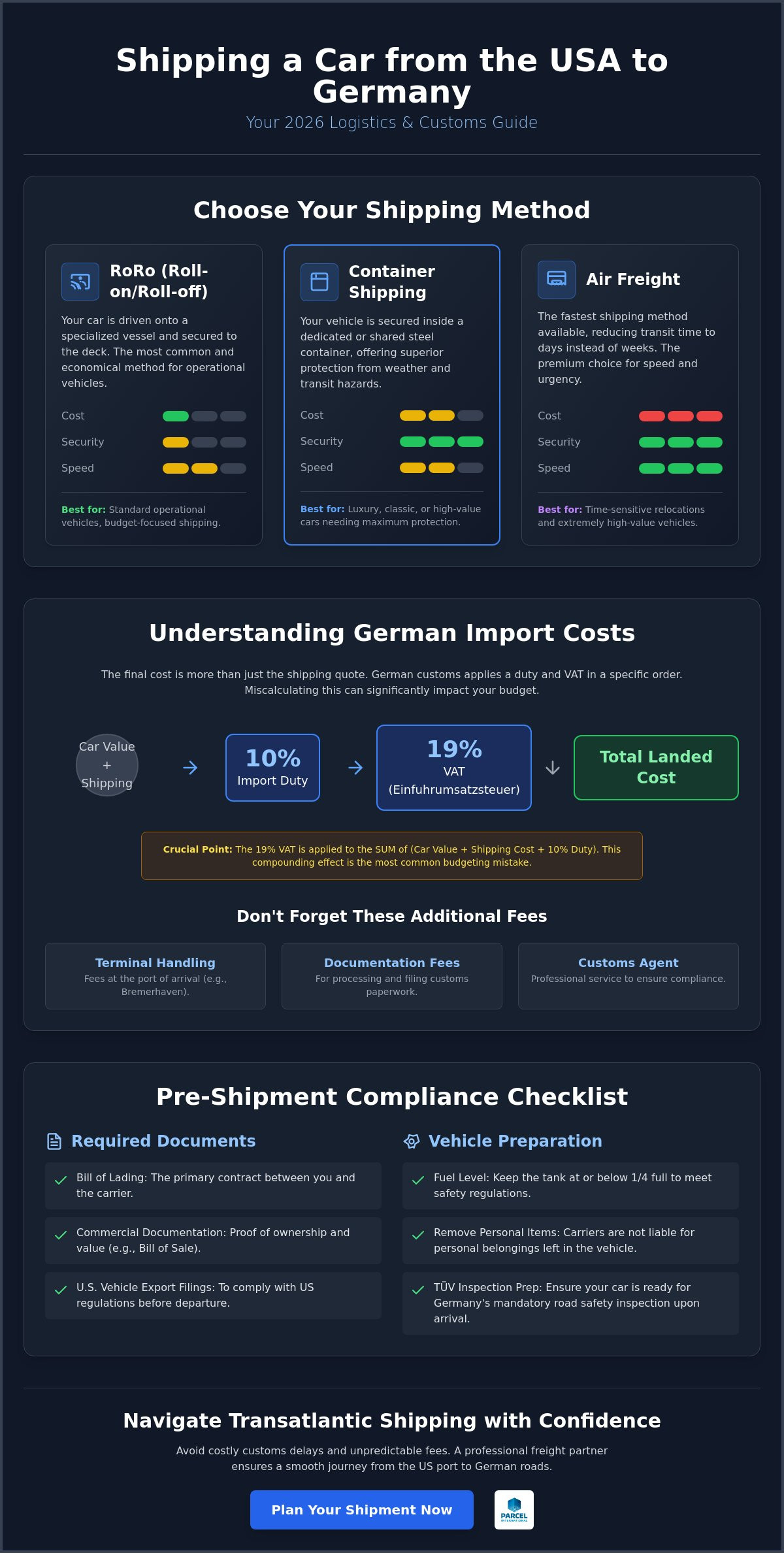
Selecting the right logistics method is the first major decision in your journey. When you research how to ship a car from usa to germany, you'll find that the choice isn't just about cost. It's about matching the transport environment to your vehicle's specific needs. A 2026 Tesla with sensitive software and high-voltage battery systems requires a different level of environmental protection than a rugged daily driver or a vintage collectible.
The Pros and Cons of RoRo Shipping
Roll-on/Roll-off, or RoRo, is the standard for operational vehicles that can be driven under their own power. Understanding RoRo Shipping helps clarify why this remains the most cost-effective option for many. Cars are driven onto the vessel, secured to the deck, and driven off at the destination port like a giant floating parking garage.
While RoRo is budget-friendly, it has specific limitations. There are fewer departure ports for RoRo compared to containerized options, which might increase your domestic trucking costs in the US. Your car is also exposed to the terminal environment and multiple handlers during the loading process; terminal and infrastructure specialists like DPP Logistics Company Ltd demonstrate the scale and precision required at these hubs to ensure the safety of global cargo. In 2026, be aware that many German ports have expanded their environmental zones. If your vehicle doesn't meet the latest Euro 6 emissions standards, you must arrange for immediate specialized transport out of the port area to avoid local fines.
Containerized Freight: FCL vs. Shared Loading
Container shipping offers a higher tier of security and protection from the elements. Full Container Load (FCL) provides a private container for your car alone. This is the gold standard for luxury models or a vintage Porsche where absolute privacy and zero contact with other cargo are paramount. It allows you to use the container space for extra parts or approved items, provided they are documented correctly.
Less than Container Load (LCL), or shared loading, serves as the modern middle ground. Your vehicle shares space with others in a 40-foot container, which significantly lowers the cost while maintaining the protection of a steel enclosure. Working with a reliable freight forwarder simplifies this booking process. They handle the technical task of blocking and bracing the vehicle to prevent movement during rough seas, giving you peace of mind throughout the transatlantic crossing.
For those who require the fastest possible delivery, Air Freight is the high-speed alternative. While it commands a premium, it reduces transit time to under 10 days. This is an excellent choice for time-sensitive relocations or high-value electric vehicles. Just remember that 2026 regulations include specific summer truck driving bans in Germany. If your car arrives on a summer weekend, it might sit at the airport until the ban lifts on Sunday evening. Plan your arrival to ensure a seamless transition from the runway to the road.
Calculating the Total Cost: Taxes, Duties, and Hidden Fees in 2026
Mastering how to ship a car from usa to germany requires a clear-eyed look at the German tax system. Don't let the freight price be the only number you track. For standard passenger vehicles, the baseline is a 10% import duty. This is calculated based on the car's value plus the shipping costs to the European border. On top of that, you must pay the 19% Einfuhrumsatzsteuer, or Import VAT. Crucially, the VAT applies to the combined total of the car value, shipping costs, and the 10% duty. This compounding effect is where many shippers miscalculate their budget.
Beyond these primary taxes, you'll encounter terminal handling charges (THC) and documentation fees at the port of arrival, such as Bremerhaven or Hamburg. Many logistics guides overlook these, but they are unavoidable costs of doing business. You'll also need to budget for a customs clearance agent to manage the filing. These professionals ensure your paperwork satisfies all U.S. Vehicle Export Requirements before the car even leaves the states, preventing costly delays or port storage fees. If you're uncertain about the math, you can access professional customs support to ensure your financial planning is accurate.
Tax Exemptions for Household Goods (Übersiedlungsgut)
If you're relocating your life to Germany, you might qualify for a total tax waiver. This "Übersiedlungsgut" status allows you to import your car duty-free and VAT-free. To qualify in 2026, you must have owned and used the vehicle in the US for at least six months prior to your move. You also need to prove you've lived outside the EU for at least 12 consecutive months. Be careful with the post-import rules; you cannot sell, rent, or lend the vehicle for 12 months after it arrives in Germany. If you do, the customs office will demand the full back-payment of all waived taxes immediately.
The Impact of 2026 Freight Rates
Global logistics in 2026 are heavily influenced by new environmental levies. These surcharges are now integrated into international shipping rates 2026 to account for carbon offset requirements and cleaner maritime fuels. Don't forget to factor in the cost of inland transport. Moving your car from a northern port to a city like Munich or Stuttgart adds another layer of expense. Using a professional shipping calculator is the most reliable way to get an accurate, all-in estimate for your specific route and vehicle type.
Navigating German Customs (Zoll) and Required Documentation
German customs authorities, known as the Zollamt, maintain a reputation for precision. When you are planning how to ship a car from usa to germany, your success depends entirely on the accuracy of your digital and physical file. The Bill of Lading serves as your vehicle's primary passport. It is a legal contract between the owner and the carrier that details the condition of the car and the terms of transport. Without a signed, original Bill of Lading, your vehicle will not clear the port gates.
You also need a Commercial Invoice. This document is not just a receipt; it is the basis for the customs valuation that determines your final tax bill. It must clearly state the purchase price, the date of sale, and the currency used. If the price seems artificially low, the Zollamt may reject it and apply their own market valuation, which often leads to higher taxes. Keep your original US Title and Registration in a secure location. You'll need the physical originals for clearance, not just digital scans. To simplify this high-stakes process, use modern tools for international shipping customs documentation to ensure every field is compliant before submission.
The Role of the Customs Broker
Don't attempt a DIY customs clearance. German authorities often reject self-filed applications from individuals due to technical errors or missing local tax IDs. A licensed customs broker acts as your stable intermediary, coordinating between the US carrier and the German Zollamt. They handle the filing of the Single Administrative Document (SAD), which is the standard form for all EU imports. Using a digital platform to manage these filings removes the friction of manual paperwork and reduces the risk of human error at the border.
2026 Compliance Updates
Stay updated on the 2026 digital filing requirements. The EU has transitioned to fully electronic customs declarations, meaning paper-based backups are no longer sufficient for primary entry. Authorities now verify every vehicle's VIN against international theft databases automatically during the clearance window. Ensure your commercial invoice reflects the actual market value as of 2026. Discrepancies between your declared value and current market trends can trigger an audit. This leads to significant storage fees while the vehicle is held at the terminal for inspection.
Mastering how to ship a car from usa to germany is a documentation-first process. By focusing on these administrative details early, you ensure that the actual physical transport of your vehicle is the easiest part of the journey. Prepare your digital files at least 30 days before the scheduled departure to allow for any necessary corrections.
Step-by-Step Preparation: From US Port to German Road Compliance
Preparing your vehicle for transit is just as critical as knowing how to ship a car from usa to germany. Start by emptying the interior completely. Most carriers strictly prohibit shipping personal items inside the car. This isn't just about theft prevention; it's a customs requirement. Any undeclared items can lead to a full inspection of the vehicle, resulting in significant delays and extra fees at the port. Your car should be a "clean" shipment to ensure it passes through the terminal without friction.
Focus on technical readiness next. Ensure the fuel tank is at exactly one-quarter capacity. Maritime safety regulations require enough fuel to move the car during loading but not enough to create a fire hazard. Check your tire pressure and ensure the battery is charged and the terminals are secure. If you're scheduling your delivery for the warmer months, be aware of the 2026 German summer truck driving bans, known as the Ferienreiseverordnung. These regulations restrict heavy vehicle movement on Saturdays during July and August. If your car arrives at the port on a Friday, it may sit until Monday before it can be trucked to your final destination. If you need professional assistance managing these technical requirements, book your road freight and customs support today.
Pre-Shipment Inspection and Insurance
Conduct a high-resolution photo report before the car leaves your driveway. Capture every angle, including the undercarriage and interior. This documentation is your only defense if a damage claim arises. When selecting insurance, don't rely solely on the carrier's standard liability, which is often limited by maritime law. Opt for specialized marine insurance. While "total loss" coverage is cheaper, it only pays out if the ship sinks. For high-value or classic cars, seek "all-risk" coverage that protects against scratches, dents, and minor handling damage during the voyage.
Post-Arrival: Registration and Modifications
Once your car clears the port, it must pass a technical inspection by the TÜV to be road-legal in Germany. US-spec vehicles require specific modifications. The most common requirement is converting red rear turn signals to amber. German law is strict about light colors and beam patterns. After the technical approval, you'll receive your Zulassungsbescheinigung Teil I and II, which are the official German registration documents. In 2026, you must also obtain the correct environmental sticker, or Umweltplakette. Many German city centers now require the highest-tier green sticker to enter, and your vehicle must meet modern emissions standards to qualify. Plan these modifications before the car arrives to minimize the time your vehicle spends in temporary storage.
Choosing the Right Freight Partner for Transatlantic Vehicle Logistics
Choosing a partner is the final hurdle in learning how to ship a car from usa to germany. Don't limit yourself to a single carrier's rigid schedule. A logistics aggregator provides the flexibility you need to compare schedules and wholesale rates across multiple steamship lines. This approach prevents you from being stranded if a specific vessel is delayed or a port becomes congested. By viewing the entire market, you can select a route that matches your specific arrival requirements in Bremerhaven or Hamburg.
You can apply the same precision used in international shipping for ecommerce to your personal vehicle transport. This logic prioritizes speed, cost-efficiency, and reliable data. In 2026, transparent, real-time tracking isn't a luxury; it's a requirement. You deserve to see exactly where your car is, whether it's at a terminal in Houston or mid-Atlantic on a container ship. High-value freight requires a partner who treats a single vehicle with the same urgency and care as a commercial inventory shipment.
Comparing Rates and Service Levels
Digital platforms allow you to view wholesale freight rates that were once reserved for large-scale commercial shippers. This transparency ensures you aren't paying hidden markups or administrative "fluff" fees. Reliability is about more than just the price; it's about the support you receive when your vehicle is in transit. Parcel International bridges the gap between US shippers and German logistics by providing 24/7 support. If a question arises while your car is on the water, you need a partner who can provide immediate, direct answers instead of an automated response.
Final Checklist Before Booking
Before you finalize your booking for how to ship a car from usa to germany, run through this critical checklist to ensure no detail is missed:
Confirm your departure port: Major hubs like New York, Savannah, Los Angeles, and Houston offer the most frequent departures and competitive rates.
Verify the arrival schedule: Check the 2026 berthing schedules for Bremerhaven to ensure they align with your personal relocation timeline.
Review carrier ratings: Only work with partners who have high reliability scores specifically for transatlantic vehicle routes.
Check insurance documents: Ensure your "all-risk" policy is active and covers the full replacement valuation of the vehicle.
Ready to move your vehicle with total confidence and zero hidden fees? Get a transparent freight quote for your vehicle today and experience a logistics process designed for your peace of mind.
Ready to Start Your Transatlantic Journey?
Mastering how to ship a car from usa to germany is a matter of aligning your documentation with German precision. You've learned that success depends on more than just the freight method; it requires a deep understanding of the 10% import duty, the 19% VAT, and the technical modifications needed for a successful TÜV inspection. By preparing your vehicle according to 2026 standards and managing your paperwork early, you eliminate the friction that causes port delays and unexpected storage fees.
You don't have to manage this complex transition alone. Simplify your logistics by moving from fragmented workflows to a unified solution that offers real-time carrier rate comparisons and automated 2026 customs documentation. With global support for over 220 countries, we ensure your vehicle arrives securely and on schedule. Our platform removes the traditional barriers to global transport, providing the radical transparency you need for a stress-free move.
Compare Transatlantic Freight Rates and Book Your Shipment today to secure a predictable, transparent path for your vehicle. Moving your car across the ocean is a significant milestone, and with the right partner, it's a journey you can take with complete peace of mind.
Frequently Asked Questions
How much does it cost to ship a car from the USA to Germany in 2026?
Total costs depend on your vehicle value, chosen freight method, and current port fees. While ocean freight typically ranges from $900 to $1,800, you must also budget for the 10% import duty and 19% VAT. Classic cars over 30 years old benefit from a 0% duty and a reduced 7% VAT rate. Always request a transparent quote to account for terminal handling fees at the German port.
How long does it take to ship a car from New York to Bremerhaven?
Ocean freight transit from New York to Bremerhaven usually takes between 3 and 6 weeks. This timeline varies based on whether you choose a direct RoRo route or a shared container service. Weather conditions and port congestion in the North Sea can also influence the final delivery date. If speed is your priority, air freight can reduce this window to 3 to 10 days for a premium.
Can I ship personal items inside my car?
No, you shouldn't leave personal items inside the vehicle during transport. Most maritime carriers and insurance providers strictly prohibit this practice to prevent theft and comply with customs regulations. Any items found inside can trigger a secondary inspection by the Zollamt, leading to significant delays and additional handling fees. Keep the car entirely empty except for the factory-installed spare tire and jack.
Do I have to pay import duty if I am moving to Germany permanently?
You can often waive import duties and VAT if you are relocating permanently under the "Übersiedlungsgut" exemption. To qualify, you must have owned the car for at least six months and lived outside the EU for at least one year. This is a vital part of understanding how to ship a car from usa to germany without unnecessary expenses. You cannot sell the vehicle for 12 months post-import.
What modifications are needed for a US car to be legal in Germany?
US vehicles must pass a TÜV inspection to meet German safety and emissions standards. Common modifications include changing red rear turn signals to amber and adjusting headlight beam patterns to avoid blinding oncoming traffic. You also need to ensure the tires have the correct European speed and load ratings. Completing these technical adjustments is mandatory before you can receive your official German registration documents and plates.
Is it better to ship a car or buy one in Germany?
Shipping is usually better for high-value electric vehicles, classic cars, or vehicles with significant sentimental value. If you own a standard daily driver with low equity, the costs of shipping, duties, and TÜV modifications might exceed the car's local market value in Germany. Calculate the total cost of ownership, including the 19% VAT, before deciding if your specific vehicle justifies the transatlantic logistics investment.
What happens if my car is damaged during sea freight?
If your vehicle is damaged, your primary protection is the "all-risk" marine insurance policy you secured before departure. Standard carrier liability is often limited by international maritime law, which may not cover the full cost of repairs. This is why a high-resolution photo report from the US port is essential. It provides the evidence needed to file a successful claim and ensures a transparent resolution.
Can I ship an electric vehicle (EV) to Germany?
Yes, you can ship electric vehicles to Germany, but they require specific handling due to their high-voltage battery systems. Carriers follow strict safety protocols for lithium-ion batteries, often requiring the battery to be at a specific state of charge, usually between 20% and 50%. When learning how to ship a car from usa to germany, ensure your chosen freight partner has experience managing EV-specific safety regulations and terminal requirements.


Comments