
International Delivery Prices 2026: The Essential Shipping Cost Checklist
- Alex
- Jun 8
- 12 min read
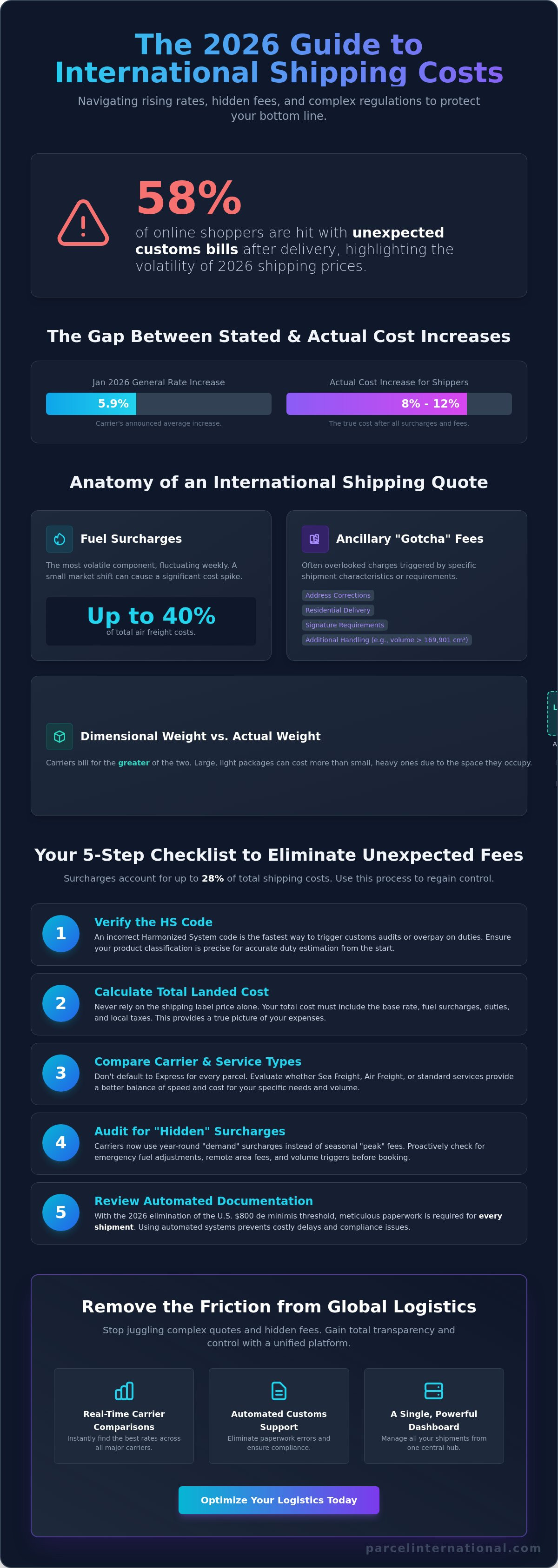
Did you know that 58% of online shoppers have been hit with unexpected customs bills after their items were delivered? It's a staggering figure that highlights how volatile international delivery prices have become in 2026. You've likely experienced the frustration of watching a simple shipping quote balloon as demand surcharges and new volume triggers are added. It's difficult to maintain a healthy bottom line when every carrier uses a different format and hidden fees lurk in the fine print.
We understand that global logistics should feel like a bridge, not a barrier. You deserve total transparency and a clear path to move your goods without the typical procedural friction. This article promises to help you master these complexities by providing our expert 2026 checklist to audit your total landed cost. We'll break down the shift from air to sea freight, explain the impact of the eliminated U.S. de minimis threshold, and give you a framework to reduce overhead while ensuring your shipments arrive on time and on budget.
Key Takeaways
Identify the core components of carrier quotes, from distance-based zones to the weekly fuel fluctuations that impact your 2026 bottom line.
Utilize our expert 2026 checklist to verify HS codes and calculate your total landed cost, ensuring no unexpected fees appear after delivery.
Navigate the complex landscape of "Emergency Situation" surcharges and new environmental levies that are currently driving up international delivery prices.
Implement "Zone Skipping" and shipment consolidation strategies to bypass expensive routes and take advantage of higher weight brackets.
Access real-time carrier comparisons and automated customs support in a single dashboard to remove procedural friction from your global logistics.
Table of Contents
Understanding the Components of International Delivery Prices
The primary determining factor for international delivery prices is the base transportation rate. Carriers like FedEx, UPS, and DHL implemented an average 5.9% general rate increase in January 2026. This base rate is calculated using a "zone" system where the distance between the origin and destination dictates the cost. However, this is only the starting point. In 2026, the actual cost increase for most shippers sits between 8% and 12% once you factor in surcharges and fees. You must understand that the base rate rarely reflects the final invoice.
Fuel surcharges represent one of the most volatile components of your shipping bill. These fees fluctuate weekly based on global oil prices and can account for up to 40% of air freight costs. In May 2026, major carriers increased their fuel surcharge rate calculations for international air imports and exports by 2 to 2.5 percentage points. Because these are indexed, a small shift in the market can lead to a significant spike in your overhead. Reliable budgeting requires tracking these indices rather than relying on static quotes.
Ancillary service fees often catch shippers off guard. These include charges for address corrections, residential delivery, and signature requirements. As of January 2026, carriers have introduced more complex triggers for these fees. For instance, FedEx now applies an additional handling surcharge to international packages with a cubic volume greater than 169,901 cm³. It's critical when auditing international delivery prices to look beyond the initial quote and identify these potential "gotchas" before you ship.
There is a massive gap between retail rates and wholesale broker pricing. Retail rates are designed for occasional shippers and carry the highest margins. By contrast, a broker-led model leverages high-volume contracts to secure deep discounts. This approach strips away the procedural friction of negotiating individual contracts and provides a singular, unified solution for comparing rates across multiple carriers instantly.
Dimensional Weight vs. Actual Weight
Dimensional weight is the industry standard for space-based pricing. Carriers calculate this by multiplying the length, width, and height of a package and dividing by a specific "dim factor." If the resulting dimensional weight is higher than the actual physical weight, you are billed for the larger number. This means large, lightweight packages often cost more than small, heavy ones because they occupy more space in a cargo plane or container. Efficiency starts with optimizing your packaging to minimize empty space.
Destination-Based Price Variables
Where your package is going matters as much as how it gets there. Remote area surcharges can easily double your price if the destination lacks standard logistics infrastructure. These variables are often tied to Incoterms rules, which define whether the buyer or seller is responsible for specific costs like local taxes or last-mile delivery fees. Logistics pricing in emerging markets is particularly sensitive to local infrastructure quality, often requiring specialized road freight or customs support to ensure a successful delivery.
The 2026 International Shipping Price Checklist
Stop guessing your final invoice totals. In a market where surcharges account for up to 28% of total shipping costs, a rigorous auditing process is the only way to protect your margins. Use this five-step checklist to regain control over your international delivery prices and eliminate the friction of unexpected fees.
Step 1: Verify the HS Code. An incorrect Harmonized System code is the fastest way to trigger a customs audit or overpay on duties. Ensure your product classification is precise to ensure accurate duty estimation from the start.
Step 2: Calculate the Total Landed Cost. Never look at the shipping label price in isolation. Your total cost must include the base rate, fuel surcharges, and local taxes. Review official Customs Duty Information to understand how these variables change by region.
Step 3: Compare Carrier Types. Don't default to Express Shipping for every parcel. Evaluate if Sea Freight or Air Freight provides a better balance of speed and cost for your specific volume.
Step 4: Audit for "Hidden" Surcharges. Carriers have rebranded "peak" fees as "demand" surcharges, allowing them to apply these costs year-round. Check for emergency fuel adjustments and cubic volume triggers before finalizing any booking.
Step 5: Review Automated Documentation. With the 2026 elimination of the U.S. $800 de minimis threshold, every shipment now requires meticulous paperwork. Automating this process prevents the delay penalties that often bloat international delivery prices.
You can simplify your global logistics by following this framework before every shipment. It moves your workflow from a fragmented, reactive state to a singular, proactive strategy.
Pre-Booking Price Audit
Before you commit to a carrier, use a multi carrier shipping calculator to identify price outliers. This tool allows you to compare real-time rates across different providers in one dashboard. During this audit, confirm your Incoterms. Choosing between Delivered Duty Paid (DDP) and Delivered At Place (DAP) determines who is responsible for taxes, which is a critical factor in your final budget calculation.
Packaging Optimization for Cost Control
Dimensional weight charges are the primary enemy of affordable shipping. Reduce "box air" by selecting packaging that closely mirrors the product's dimensions. Standardizing your package sizes helps you fit within carrier-preferred dimensions, helping you avoid the additional handling fees that apply to irregular or oversized items. By using the right materials and minimizing volume, you directly lower the space-based pricing that drives up 2026 logistics costs.
Navigating Carrier Surcharges and Trade Fees in 2026
International delivery prices are increasingly dictated by a shifting landscape of trade fees and surcharges. Carriers have moved beyond simple distance-based calculations to include "Emergency Situation" surcharges. These fees allow providers to adjust pricing instantly based on geopolitical instability or supply chain bottlenecks. For example, as of April 2026, MSC implemented emergency fuel surcharges starting at $136 per 20-foot container for shipments to the West Coast. These are no longer temporary measures; they are structural components of the 2026 logistics market.
Environmental levies and carbon taxes are also now permanent fixtures on your invoices. As the global regulatory environment tightens, carriers pass the cost of carbon compliance directly to the shipper. This trend reflects the broader data found in the WTO Trade Cost Index, which tracks how trade policy and transport barriers impact the flow of goods. You must also distinguish between a brokerage fee and a customs duty. A duty is a tax collected by the government, while a brokerage fee is what the carrier charges to process that paperwork for you. Misunderstanding this distinction leads to budget overruns.
Certain commodities, such as lithium batteries, trigger even higher costs. Because these items are classified as dangerous goods, express carriers apply specialized handling surcharges to cover the increased safety protocols and insurance requirements. If your product line includes electronics or hazardous materials, expect these line items to be non-negotiable. These specific surcharges ensure your goods move safely, but they must be factored into your initial quote to maintain transparency with your end customers.
2026 Peak Season and Demand Surcharges
The traditional holiday rush has evolved into a series of demand windows. For the US-Europe and Asia-US lanes, peak surcharges are most aggressive from late September through January. However, demand-based pricing now applies year-round to certain routes, meaning you can't rely on off-season discounts to save your budget. Book your shipments at least four to six weeks in advance to lock in non-peak rates and secure space on high-demand vessels. This proactive approach is the only way to stabilize your international delivery prices during periods of high market volatility.
Customs and Compliance Costs
Inaccurate paperwork is the primary cause of storage fees and return-to-sender charges. With the U.S. de minimis threshold eliminated in August 2025, every item is now subject to duty, making compliance non-negotiable. Using an automated shipping calculator helps you estimate these import duties before the package leaves your warehouse. Your commercial invoice is the most important document in this process; it determines the final price by providing the valuation that customs authorities use to calculate taxes. Ensure every field is populated correctly to avoid the friction of administrative penalties.
How to Audit and Reduce Your Total Landed Costs
Reducing your overhead requires a shift from reactive shipping to strategic optimization. One of the most effective methods is consolidation. By grouping multiple orders into a single shipment, you take advantage of higher weight brackets where the cost per kilogram is significantly lower. This approach reduces the frequency of base transportation charges and minimizes the impact of per-package surcharges. It transforms a chaotic, multi-platform workflow into a streamlined process that protects your margins.
The "Zone Skipping" strategy offers another layer of savings. Rather than shipping individual parcels across the globe, you move bulk inventory to a regional hub like Rotterdam for European distribution. This allows you to use local road freight for the final delivery, effectively bypassing the expensive international zones that drive up international delivery prices. It is a logical progression for businesses looking to scale without the friction of high-stakes logistics costs.
You must also evaluate the trade-off between speed and cost. While Express Shipping is essential for urgent documents, Sea Freight is the superior choice for non-urgent bulk replenishment. Research indicates that fuel can account for up to 30% of ocean freight costs, yet it remains significantly more economical than air transport for large volumes. Balancing your inventory needs with the right mode of transport is a hallmark of an efficient optimizer.
Wholesale Rates vs. Retail Pricing
Relying on published retail rates is a common mistake that inflates your budget. Logistics brokers leverage high-volume contracts to access deep discounts from major carriers like DHL and FedEx. These international shipping rates are often up to 70% lower when accessed through a unified platform. Small businesses benefit specifically from "no minimum volume" requirements, allowing them to ship like a global corporation without the traditional barriers or subscription fees. You can compare wholesale rates instantly to see where your current provider is overcharging you.
Analyzing Shipping Data for Long-Term Savings
Data is your best tool for identifying "problem lanes" where prices are consistently higher than average. By auditing your shipping history, you can pinpoint specific routes that are plagued by frequent surcharges or customs delays. Switching these lanes from Air to Sea Freight for bulk items can lead to immediate overhead reduction. Audit every invoice for billing errors. Carriers often apply unearned surcharges or fail to reflect negotiated discounts, making a manual or automated audit essential for maintaining financial accuracy.
Optimizing Your Global Logistics with Parcel International
The complexity of 2026 shipping requires a partner that transforms fragmented data into actionable savings. Parcel International serves as your stable intermediary, stripping away the procedural friction that often complicates global trade. Access real-time comparisons from major global carriers through a singular, unified dashboard. This transparency allows you to identify the most efficient routes and carriers without the traditional stress of manual quote comparisons. By consolidating your workflow, you move from a reactive state to a position of total control over your international delivery prices.
Administrative overhead is a significant hidden cost in modern logistics. Automate your customs documentation through our platform to eliminate the manual errors that lead to storage fees and delivery delays. We leverage over 15 years of industry expertise to help you navigate the rapid trade changes of 2026, including new tariff structures and environmental levies. Our solutions are designed for modern flexibility, offering robust support for everything from urgent express parcels to large-scale sea and air freight projects. You don't have to manage these high-stakes variables alone.
The Broker Advantage: Transparent and Direct
Transparency is a central pillar of our identity. We operate on a philosophy of radical honesty regarding terms and conditions, meaning you won't deal with hidden subscription fees or restrictive volume minimums. Pay only for what you ship while gaining direct access to deeply discounted express and freight rates that are typically reserved for the world's largest corporations. This egalitarian approach makes professional-grade logistics accessible to businesses of all sizes. If you have a complex project, our team provides personalized support to ensure your cargo moves punctually and securely across any border.
Getting Started with Your 2026 Shipping Strategy
Begin your optimization journey by using the Parcel International platform to audit your current spend. Our tools help you pinpoint where you are overpaying on surcharges or using inefficient transport modes. Integrate sea, air, and road freight into a unified shipping workflow to ensure every item in your inventory moves at the best possible price point. This logical progression saves time and directly protects your bottom line from the volatility of the current market. Compare international delivery prices and start saving today to experience the relief of a truly orderly logistics process.
Secure Your Global Growth for 2026
Managing global logistics doesn't have to be a source of constant anxiety. By utilizing our 2026 checklist, you've learned how to audit your total landed cost and navigate the complex web of trade fees and demand surcharges. You now have the framework to identify "zone skipping" opportunities and optimize your packaging to lower dimensional weight charges. These strategic steps are vital for stabilizing your international delivery prices in a volatile market where transparency is your greatest competitive advantage.
Parcel International provides the singular, unified solution you need to scale. We offer direct access to wholesale rates from DHL, FedEx, and UPS with reliable coverage spanning over 220 countries and territories. Our automated customs documentation tools strip away the procedural friction that often leads to costly delays and administrative penalties. This approach ensures your goods move across borders with the punctuality and security your customers expect.
Compare 2026 international delivery prices now and move your business forward with total confidence. You're ready to transform your shipping workflow into a predictable, orderly asset for the years ahead.
Frequently Asked Questions
Why are international delivery prices so high in 2026?
Market volatility and structural fee changes are the primary drivers of rising costs. Carriers have implemented general rate increases while simultaneously expanding demand-based surcharges that now apply year-round rather than just during holidays. These costs are compounded by new environmental levies and carbon taxes that are passed directly to the shipper to cover global compliance. This creates a higher baseline for all international delivery prices compared to previous years.
How is dimensional weight calculated for international parcels?
Dimensional weight is calculated by multiplying the length, width, and height of your package and dividing the result by a carrier-specific divisor. Most major carriers use this standard formula to determine how much space your parcel occupies in their cargo hold. You are then billed based on whichever is greater: the actual physical weight or the calculated dimensional weight. Optimizing your packaging to reduce "box air" is the most effective way to lower these costs.
What is the difference between DDU and DDP shipping prices?
DDP (Delivered Duty Paid) means the seller pays all import duties and taxes, while DDU (Delivered Duty Unpaid) shifts that responsibility to the recipient. DDP prices are typically higher upfront because they include these estimated costs, but they provide a smoother customer experience by preventing surprise bills at the doorstep. DDU shipments might look cheaper on the initial quote, but they often lead to delivery delays if the recipient refuses to pay the local customs fees.
Do I have to pay customs duties on every international shipment?
Yes, most shipments entering major markets like the U.S. now trigger duty requirements due to recent regulatory shifts. The elimination of the $800 de minimis threshold means that nearly all imports are subject to potential taxes and baseline tariffs regardless of value. While some preferential trade agreements still exist, you should budget for duties on every cross-border delivery to maintain total transparency in your landing cost calculations and avoid procedural friction.
Can a shipping broker really get lower rates than a direct carrier?
Yes, brokers access deep wholesale discounts by leveraging the combined volume of thousands of small and medium-sized businesses. Direct carriers often charge retail rates to occasional shippers to maintain their margins. A broker acts as a stable intermediary, providing you with the same high-quality express shipping and freight services at a fraction of the cost. This egalitarian model allows smaller companies to compete on a global scale without requiring high-volume minimums or subscription fees.
What are the most common hidden fees in international shipping?
Residential delivery surcharges, address correction fees, and remote area surcharges are the most frequent additional costs. Carriers also apply handling fees for items that aren't fully encased in corrugated cardboard or those exceeding specific cubic volume triggers. These line items often appear after the initial quote is generated. Auditing your invoices for these specific triggers is a logical step to ensure your international delivery prices remain predictable and orderly throughout the year.
How does fuel surcharge impact my final shipping invoice?
Fuel surcharges are indexed weekly and can add a significant percentage to your base transportation rate. These fees are designed to protect carriers from the volatility of global oil prices, often accounting for 20% to 40% of the total cost for air and ocean freight. Because they fluctuate so frequently, your final invoice may differ from your initial estimate if market conditions shift between the booking date and the actual departure of your goods.
Is air freight always more expensive than sea freight?
Air freight is generally more expensive for large, heavy shipments, but it can be more cost-effective for small, high-value items. While sea freight offers a lower base rate for bulk inventory, it involves longer transit times and higher port handling fees. You must evaluate the total landed cost, including insurance and storage, to determine the best value. For many businesses, the speed and reliability of air transport outweigh the lower transportation costs of ocean lanes.


Comments