
International Freight Forwarding Platform: The 2026 Guide to Digital Logistics
- Alex
- Jun 17
- 11 min read
Updated: Jul 2
What if you could eliminate the "surprise" surcharges and fragmented email chains that drain your logistics team's productivity every single week? Managing global trade in 2026 feels like hitting a moving target; especially with the EU removing the €150 duty-free exemption this July and carriers adjusting peak season surcharges on a whim. If you feel like you're drowning in manual paperwork and hidden fees, you aren't alone. Most shippers are still stuck toggling between multiple carrier sites just to find a reliable rate.
The right international freight forwarding platform turns this chaos into a unified competitive advantage. You deserve a transparent workflow where wholesale rates are visible and compliance is handled by code, not manual spreadsheets. This guide will show you how to master the complexities of global shipping by leveraging digital tools to secure the best pricing and automate your most tedious tasks. We'll explore how to compare real-time rates instantly, handle the latest IMO reporting requirements, and scale your operations without increasing your headcount.
Table of Contents
What is an International Freight Forwarding Platform?
An international freight forwarding platform is a centralized digital ecosystem designed to manage the movement of goods across borders with speed and precision. For decades, the industry relied on a fragmented web of phone calls, manual spreadsheets, and endless email chains. This "old way" of operating is slow and prone to errors. In contrast, the modern digital platform uses real-time APIs to connect shippers directly to carrier networks. To understand the baseline of this role, it's helpful to look at the traditional definition of What is a Freight Forwarder? and how their responsibilities have shifted from manual coordination to digital execution.
Think of these platforms as sophisticated logistics brokers that act as aggregators. They secure wholesale rates from air, sea, and road carriers and present them in a single, unified interface. This shift allows you to move from manual booking processes to automated logistics execution. Instead of waiting 24 to 48 hours for a quote, you get instant access to live pricing and capacity. It's about stripping away procedural friction and replacing it with a direct, transparent path to global markets.
The Evolution from Traditional Forwarding to Digital Hubs
Traditional methods fail in the 2026 market because they can't keep up with the pace of change. With fuel surcharges and regulations like the FuelEU Maritime creating new compliance deadlines, you need data that's updated by the minute, not by the week. Digital hubs provide the real-time visibility essential for modern supply chain management. They democratize access to global trade. Now, a small business can secure the same wholesale rates and shipping lanes that were once only available to high-volume enterprise shippers. It levels the playing field by removing the need for a massive in-house logistics department.
Key Differences Between Marketplaces and Integrated Platforms
It's easy to confuse a simple marketplace with a true international freight forwarding platform. Marketplaces usually focus on the transaction; they're essentially auction sites where you find the cheapest price and hope for the best. An integrated platform focuses on the entire end-to-end journey. It acts as a stable intermediary, providing a reliable bridge between you and the carrier. This distinction is vital when things go wrong. While a marketplace might offer a "no-reply" software model, an integrated platform provides a unified support structure. You get the efficiency of automation combined with the security of a partner who manages documentation and compliance from start to finish.
Key Features of a Modern Digital Logistics Hub
A high-performing international freight forwarding platform acts as more than just a search engine for shipping rates. It serves as a command center where you can compare real-time pricing across 220+ countries and territories in seconds. This level of transparency is vital in a year where fuel surcharges and carrier rates fluctuate almost daily. You need a tool that pulls live data from global carrier networks to ensure you never overpay for a lane. By centralizing your tracking and milestone alerts, these hubs remove the need to log into five different websites just to find one container.
One Dashboard, All Modes: Air, Sea, and Road
Modern logistics requires extreme flexibility. You might need Express Shipping for an urgent prototype on Monday; then Sea Freight for a bulk inventory replenishment on Tuesday. A digital hub allows you to manage both in a single view. This visibility helps you choose between speed and cost based on your cargo's priority. For regional European logistics, Road Freight often bridges the gap between major ports and the final destination. Having every mode available in one dashboard means you can pivot your strategy instantly when supply chain disruptions occur.
The Power of Automated Customs Documentation
Automated documentation tools eliminate human error by mapping shipment data directly to required legal forms. This feature is a necessity as trade regulations become more stringent. For instance, the European Union is removing its €150 duty-free exemption in July 2026. This change requires a minimum €3 duty per tariff code on every order entering the EU. Manual paperwork simply can't keep up with this volume of detail without causing massive delays at the border.
Digital platforms generate commercial invoices and packing lists instantly. They align with systems like the U.S. Single Window Platform to ensure that your data meets official government standards before your goods even leave the warehouse. This proactive approach reduces the risk of expensive "surprise" surcharges or customs seizures. If you want to simplify your workflow, you can explore these automated tools to see how they protect your bottom line. By staying updated on 2026 international trade regulations through your platform, you ensure that compliance is a competitive advantage rather than a bottleneck.
How Platforms Transform Shipping for SMBs
Small and medium-sized businesses often struggle with the "retail" side of global logistics. They pay higher rates because they lack the massive shipping volume of enterprise giants. An international freight forwarding platform changes this dynamic entirely. It aggregates the volume of thousands of small shippers to command wholesale pricing from top-tier carriers. This doesn't just save money; it protects profit margins that are often eroded by "surprise" fees. For example, General Rate Increases (GRI) from major carriers like Hapag-Lloyd reached up to $2,100 per container in June 2026. Without a platform that offers all-in, transparent pricing, these sudden costs can catch a small business off guard.
Scaling globally no longer requires the friction of traditional, manual brokerage. You can enter new markets without the overhead of a dedicated in-house logistics department. The platform handles the heavy lifting of compliance and coordination, allowing you to focus on your core product rather than chasing paperwork. It's about moving from a defensive posture to an offensive one where logistics becomes a tool for growth.
To further optimize this growth, especially for niche markets, you can visit Warenous to see how specialized 3PL partnerships can streamline your brand's scaling strategy.
Wholesale Rates for Retail Shippers
Aggregators leverage collective volume to provide competitive international shipping rates to smaller players. Instead of accepting whatever "estimate" a local broker provides, you can compare major carriers like DHL, UPS, and FedEx in one click. This transparency is vital. You see the final cost upfront, including fuel surcharges which saw significant adjustments in June 2026. For instance, UPS increased its fuel surcharge cap for Mail Innovations to 12% on June 1st. A digital hub ensures these updates are reflected in your quote immediately, so your "all-in" price actually stays all-in. You don't have to worry about hidden fees appearing on your final invoice.
Operational Efficiency and Resource Allocation
The real value of a unified freight forwarder partner is the gift of time. Stop asking your staff to spend hours tracking parcels across different carrier portals or manually filling out commercial invoices. By redirecting that energy toward growing the business, you turn a cost center into an engine for expansion. Automated notifications bridge the "anxiety gap" by providing reliable milestones. You don't have to wonder where your cargo is or if it's stuck at customs due to the new EU duty-free exemption rules. The platform alerts you if action is needed, keeping your supply chain moving while you focus on your customers.
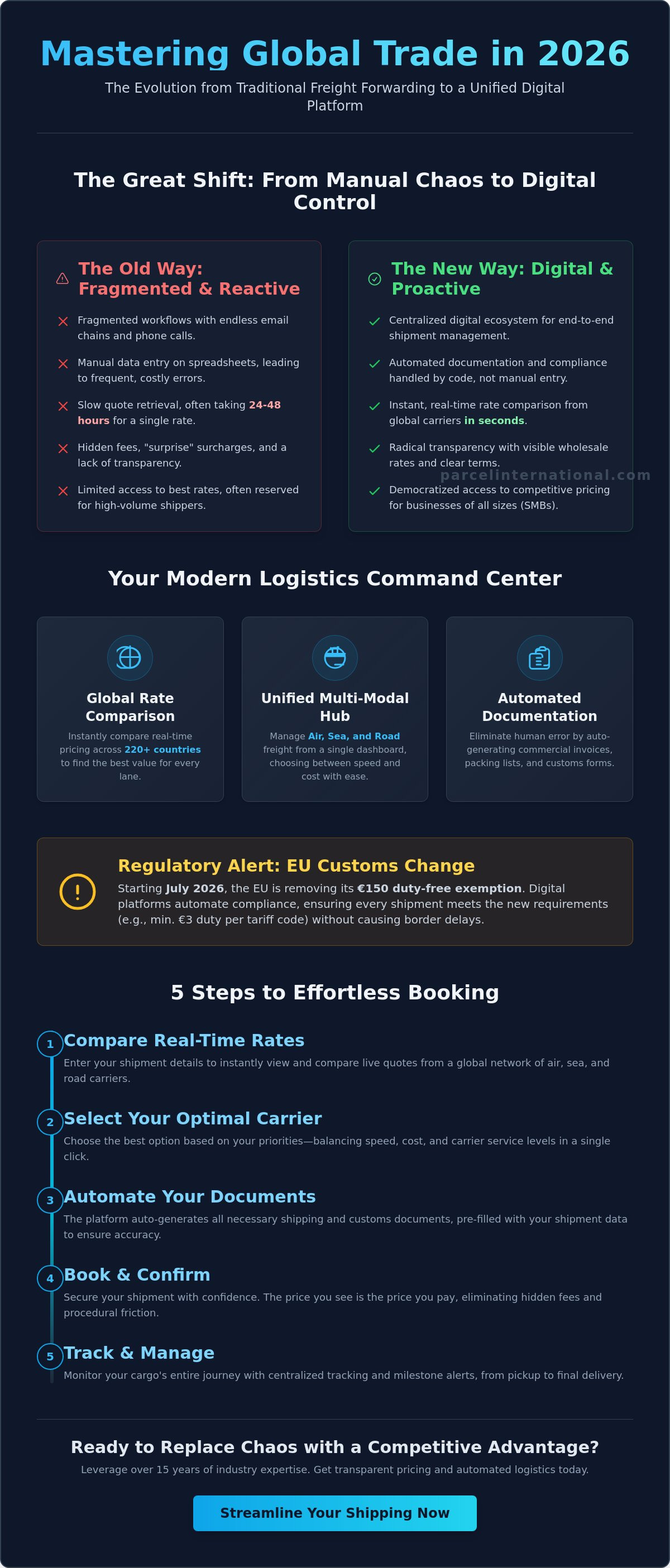
5 Steps to Booking Your First Shipment on a Freight Platform
Booking a global shipment shouldn't feel like a high-stakes gamble. By using an international freight forwarding platform, you replace guesswork with a logical, sequential workflow that ensures accuracy from the start. Follow these five steps to move your cargo from the warehouse to its destination with total confidence. This process is designed to strip away procedural friction and put you in control of your logistics strategy.
Accurate Data Entry for Precise Quotes
Start by inputting your shipment details, specifically the dimensions, weight, and destination. These are the most critical data points because carriers use them to calculate chargeable weight. Even a few centimeters of difference can change your final price. Precise destination data also dictates transit times and helps the platform identify any regional surcharges before you book. To avoid dimensional weight penalties, pack your goods as tightly as possible and use sturdy, standard-sized packaging. If your data is wrong at the start, your quote will be wrong at the end. Accuracy here ensures that the transparency of the platform remains intact.
Once your data is entered, you can compare real-time quotes from top-tier international carriers instantly. The platform allows you to select the service level that fits your specific needs. You can choose from Express Shipping for urgent parcels, Air Freight for high-value goods, or Sea Freight and Road Freight for larger, less time-sensitive shipments. This flexibility lets you balance speed and cost depending on the priority of each individual cargo load.
Navigating the Documentation Phase
The documentation phase is often where manual workflows break down. You can eliminate these errors by leveraging international shipping customs documentation tools built directly into the platform. These tools generate commercial invoices and packing lists based on your initial data entry. It's vital to verify your Harmonized System (HS) codes during this stage. Incorrect codes lead to inaccurate duty calculations and can result in your goods being held at the border. The international freight forwarding platform acts as a compliance shield, ensuring your paperwork aligns with the latest 2026 trade regulations.
Finally, finalize your booking and monitor the shipment via your centralized dashboard. You don't have to spend time manually tracking parcels across different carrier sites. The platform provides automated milestone alerts, keeping you informed of every transition from pickup to final delivery. If you are ready to simplify your global trade, start your first booking today and experience the relief of a truly automated logistics workflow.
Why Parcel International is Your Optimal Logistics Partner
Parcel International stands out as a stable intermediary with over 15 years of industry experience. In an era where digital tools often feel cold and detached, we provide a human-centric international freight forwarding platform that prioritizes your peace of mind. We don't just offer software; we offer a protective partnership designed to make global trade orderly and predictable. Our reach extends to over 220 countries and territories, ensuring that your business can scale to any market without the typical administrative friction. We act as an optimizer for your supply chain, taking a chaotic process and making it logical.
Transparent Pricing with No Hidden Fees
Directness is the core of our business model. We believe that radical transparency is the only way to build lasting trust in global logistics. When you use our platform, what you see is what you pay. We strip away the procedural friction that often leads to unexpected surcharges or "hidden" requirements found in the fine print of other providers. You can experience the relief of a unified solution for international parcel shipping where costs are locked in at the moment of booking. This approach allows you to forecast your margins accurately and protects you from the volatility of the 2026 shipping market. We don't believe in restrictive terms; we believe in providing value that keeps your business moving.
Global Reach, Local Expertise
Our headquarters are in Rotterdam, the heart of European logistics. This location gives us a unique vantage point and deep local expertise that we pass on to our customers. By maintaining strong partnerships with major global carriers like DHL, FedEx, and UPS, we ensure your cargo moves through the most efficient lanes possible. We're ready to scale alongside your business. Whether you're sending a single document via Express Shipping or managing full sea freight containers, our international freight forwarding platform adapts to your volume. We don't require subscription fees or minimum volumes, making us an egalitarian ally for both growing SMBs and established commercial projects. You get the power of a global network with the dedicated support of a partner who truly values your success.
Future-Proof Your Global Logistics Strategy
The 2026 logistics landscape rewards the prepared. By transitioning from fragmented email chains to a unified international freight forwarding platform, you regain total control over your supply chain. You've learned how digital tools democratize access to wholesale rates and how automated customs documentation removes the manual errors that lead to costly delays. These aren't just software features; they're the essential building blocks of a resilient, scalable business model that can withstand market volatility and regulatory shifts.
Since 2007, Parcel International has served as a stable intermediary for businesses looking to simplify their global reach. We've built a robust network that covers 220+ countries and territories, backed by automated tools that handle the heavy lifting of trade compliance for you. It's time to stop reacting to logistics friction and start optimizing your operations with a partner that values radical transparency. You don't have to navigate the complexities of global trade alone when you have the right digital hub at your fingertips.
Start comparing real-time freight rates on the Parcel International platform today. Take the first step toward a more transparent, efficient future for your global shipping and experience the relief of a truly unified workflow.
Frequently Asked Questions
What is the difference between a freight forwarder and a shipping platform?
A freight forwarder is the service provider that organizes the physical transport, while an international freight forwarding platform is the digital interface that automates the entire coordination process. Think of the platform as a sophisticated command center that connects you to a global carrier network. It replaces manual emails with real-time data and instant booking capabilities. This allows you to manage the entire lifecycle of a shipment without the traditional paperwork friction.
Can I ship to over 200 countries using a single platform?
You can access a global network of over 220 countries and territories through one centralized dashboard. This reach ensures that your business can scale internationally without needing to establish separate carrier relationships in every new market. Simply input the destination and the platform identifies the most efficient air, sea, or road routes available. It's a unified solution for companies looking to expand their global footprint with total confidence.
How does a platform help with customs clearance and documentation?
The platform automates the generation of commercial invoices and packing lists based on your specific shipment data. By using built-in customs support tools, you reduce the risk of human error that often leads to expensive border delays. The platform helps you verify Harmonized System (HS) codes and ensures compliance with 2026 regulations, such as the new EU duty-free exemption rules. It acts as a compliance shield for your business.
Are digital freight platforms suitable for small businesses with low volumes?
Can I compare rates from DHL, UPS, and FedEx in one place?
You can compare real-time quotes from top-tier carriers like DHL, UPS, and FedEx in a single click. This side-by-side comparison allows you to choose the best service level based on speed, cost, or reliability. Instead of logging into multiple carrier sites, you get a transparent view of all-in pricing. This includes the most current fuel surcharges and peak season fees, ensuring you never overpay for a shipping lane.
What happens if there is a delay with my international shipment?
Your dashboard provides real-time tracking and automated milestone alerts so you're informed the moment a delay occurs. If a shipment is held, the platform's support team acts as a stable intermediary to help resolve the issue with the carrier directly. You don't have to spend hours on hold with carrier call centers. We provide the human-centric support needed to navigate disruptions and keep your supply chain moving forward.
Do I need special software to use a digital freight platform?
No special software installation is required because the platform is a web-based digital ecosystem. You can access all features, from rate comparison to customs documentation, through any standard internet browser. This cloud-based approach ensures that your team can manage global logistics from anywhere in the world. It's a plug-and-play solution that integrates into your existing workflow without the need for complex IT setups or hardware maintenance.
Is it cheaper to use a platform than to go directly to a carrier?
Using an international freight forwarding platform is often cheaper because it leverages the collective volume of thousands of shippers to secure wholesale rates. Individual small shippers rarely have the leverage to negotiate these prices directly with major carriers. Additionally, the platform eliminates hidden fees and surprise surcharges by providing all-in pricing upfront. You save on both the direct shipping costs and the indirect costs of manual administrative labor.


Comments