
Least Expensive Shipping Rates: A 2026 Comparison Guide for Global Businesses
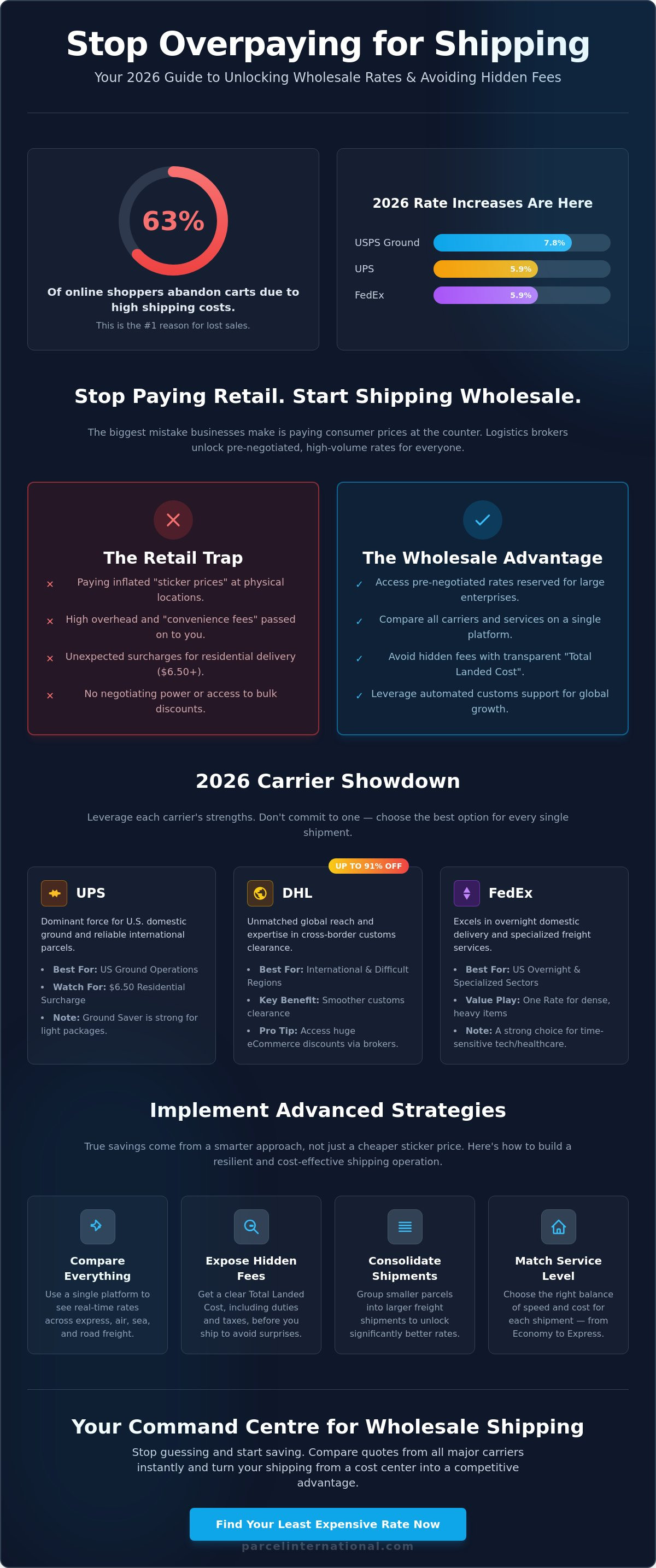
Did you know that 63% of online shoppers abandon their carts because of high delivery costs? With USPS Ground Advantage rates rising by 7.8% and both UPS and FedEx implementing 5.9% general increases in 2026, finding the least expensive shipping rates feels like a moving target. You're likely tired of seeing your margins eroded by residential surcharges that now reach $6.50 per package or getting hit with unexpected customs duties that stall your global growth. It's frustrating to manage multiple platforms just to find one fair price.
We believe global logistics should be transparent and efficient, not a source of constant anxiety. This guide shows you exactly how to secure wholesale margins by leveraging logistics brokers and automated customs support. You'll learn how to compare carriers on a single platform, avoid hidden fees, and transition from retail prices to pre-negotiated rates for express, sea, air, and road freight. Discover how to turn shipping from a cost center into a competitive advantage by accessing the same deep discounts used by the world's largest enterprises.
Key Takeaways
Stop paying retail at the counter. Learn how to move from standard sticker prices to wholesale margins that significantly reduce your operational overhead.
Compare the 2026 performance of major carriers like UPS and DHL. Identify which provider offers the best balance of speed and value for your specific international routes.
Expose hidden surcharges and the residential delivery trap before they hit your invoice. Use automated customs support to prevent delays and keep your total landed costs predictable.
Secure the least expensive shipping rates by leveraging pre-negotiated contracts. Access bulk discounts across express, air, sea, and road freight through a single, unified platform.
Implement advanced strategies like shipment consolidation to unlock better freight rates. Learn how to move goods closer to their final destination to bypass traditional logistics bottlenecks.
Table of Contents
Defining the Least Expensive Shipping Rates: Beyond the Sticker Price
Carrier Showdown: Comparing UPS, DHL, and FedEx for Global Value
The Hidden Cost of 'Cheap': Avoiding Surcharges and Customs Fees
Strategic Logistics: How to Lower Shipping Costs Without Losing Speed
Parcel International: Your Command Centre for Wholesale Shipping Rates
Defining the Least Expensive Shipping Rates: Beyond the Sticker Price
Securing the least expensive shipping rates involves more than just picking the lowest number on a carrier's website. In 2026, the "cheapest" option can quickly become a liability if it lacks reliability or adequate tracking. If a package is delayed or lost, the initial savings are wiped out by customer service costs and replacement shipments. True value in global freight transport requires a balance between the base cost and the speed of delivery. You must look at the "Total Landed Cost," which includes the shipping rate plus duties, taxes, and any hidden surcharges that might appear after the item has left your facility.
Finding the least expensive shipping rates requires a strategic shift from retail thinking to wholesale execution. While retail rates are designed for occasional shippers at a physical counter, commercial and wholesale rates are reserved for high-volume entities. Logistics brokers bridge this gap for small and medium businesses. By aggregating the shipping volume of thousands of different clients, these brokers negotiate deep discounts with major carriers. This allows a smaller business to access the same pricing tiers as a global corporation without needing to meet massive individual volume requirements.
Retail vs. Wholesale: Why You Shouldn't Pay Counter Prices
Stop walking into physical shipping centers to send your goods. Retail locations carry high operational overhead, and those costs are passed directly to you through "convenience fees" and inflated base rates. Digital platforms and aggregators bypass these physical barriers entirely. In the 2026 market, these platforms provide direct access to wholesale margins. You don't need a physical warehouse or specialized staff to qualify for these savings; the platform acts as your bargaining agent, removing the markups typical of retail environments.
Service Levels: Ground vs. Express vs. Economy
Select your service level based on the specific needs of the shipment rather than a one-size-fits-all approach. Postal services remain a cost-effective choice for lightweight, low-value items where speed isn't the primary concern. However, for time-sensitive global trade, express shipping offers superior security and automated customs support. If you need to balance speed and budget, "Economy Express" serves as a reliable middle ground. It provides the professional tracking and reliability of an express carrier but at a price point that remains competitive with standard ground services.
Carrier Showdown: Comparing UPS, DHL, and FedEx for Global Value
Selecting a primary carrier requires a deep dive into how their 2026 rate structures align with your specific shipping lanes. While UPS and FedEx both implemented a 5.9% general rate increase this year, their value propositions differ significantly depending on the destination and package profile. Finding the least expensive shipping rates often means moving away from a single-carrier mindset. You need to leverage the specific strengths of each network to avoid the surcharges that typically inflate your final invoice.
UPS: Remains the dominant force for domestic US ground operations and reliable international parcel delivery. Their Ground Saver service is a strong contender for lightweight packages, though you must watch for the $6.50 residential surcharge.
DHL: Offers unmatched global reach. Because they specialize in cross-border logistics, they often provide smoother clearance in "difficult" regions. Through wholesale platforms, businesses can access discounts of up to 91% on DHL eCommerce services.
FedEx: Excels in overnight domestic delivery and specialized sectors like healthcare and tech. Their One Rate pricing for express boxes can sometimes beat standard weight-based rates for dense, heavy items.
For businesses moving larger volumes, parcel carriers aren't always the answer. When your total shipment weight exceeds certain thresholds, transitioning to sea freight or road freight becomes the only way to maintain a healthy margin. You can compare multiple carrier quotes instantly to see where these price breaks occur for your specific routes.
International Parcel Comparison for 2026
Standard transit times for US-to-Europe routes have stabilized, but the cost of entry has changed. Success in these lanes depends on understanding import tariffs and fees before the package leaves your dock. DHL typically handles these complex regions with fewer administrative surcharges because of their established local networks. In contrast, UPS and FedEx may rely more heavily on third-party final-mile partners in rural international zones, which can lead to unexpected "out-of-area" fees.
When to Switch from Parcel to Freight Forwarding
The 70kg (approx. 150 lbs) mark is the traditional "parcel wall." Beyond this weight, individual parcel rates become prohibitively expensive due to heavy package surcharges. For regional moves within the EU or North America, check international road freight rates Europe to see how palletized shipping compares to individual boxes. If you're moving bulk goods globally, LCL (Less than Container Load) sea freight is often the secret weapon for securing the least expensive shipping rates, as it allows you to pay only for the space you use in a shared container.
The Hidden Cost of 'Cheap': Avoiding Surcharges and Customs Fees
The base rate you see on a carrier's website is often a decoy. To find the least expensive shipping rates, you must account for the secondary fees that populate the final invoice. Residential delivery surcharges are a primary culprit. In 2026, FedEx Ground Home Delivery charges $6.45 per package, while UPS charges $6.50. These fees don't apply to USPS, making them a more economical choice for residential drop-offs under certain weight classes. If you're shipping hundreds of orders, these "sneaky" fees can quietly erase your profit margins.
Fuel surcharges present another layer of complexity. These aren't flat fees; they're percentages that fluctuate weekly or monthly based on market indices. They apply not just to the base shipping cost but often to the other surcharges as well. Managing these variables requires a sophisticated approach to shipping and logistics that prioritizes data over guesswork. Without automated compliance tools, poor paperwork can lead to storage fees at customs that dwarf the original cost of transport. Our customs support helps you navigate these requirements without the typical administrative friction.
Mastering Dimensional Weight (DIM) Calculations
The size of your box often matters more than the items inside. Carriers use a DIM divisor to determine if a package's volume warrants a higher price than its actual weight. For example, if you ship a lightweight item in a large box, you'll pay for the space it occupies in the aircraft or truck. To secure the least expensive shipping rates, audit your packaging sizes. Reducing a box's dimensions by just one inch on each side can often drop the shipment into a lower price tier by avoiding the DIM penalty entirely.
Customs and Duties: Ensuring a Smooth Border Crossing
Choosing between Delivered Duty Unpaid (DDU) and Delivered Duty Paid (DDP) changes your financial responsibility and the customer's experience. DDP allows you to pay all taxes upfront, ensuring the package isn't held at the border for payment. Any accurate shipping cost calculation must include these import duties to avoid "sticker shock" for the recipient. Using automated tools to generate commercial invoices and correct HS codes ensures your goods move through customs without the administrative overhead of manual corrections or unexpected penalties.
Strategic Logistics: How to Lower Shipping Costs Without Losing Speed
Lowering costs doesn't mean you have to sacrifice the delivery speed your customers expect. In 2026, savvy businesses use consolidation to group small shipments together, unlocking bulk freight rates that are otherwise inaccessible for individual parcels. Another effective tactic is zone skipping. Instead of shipping individual packages across vast distances, you move a large volume of goods closer to the final destination via air or road freight before injecting them into a local network. This hybrid approach allows you to secure the least expensive shipping rates by utilizing private carriers for the long haul and local postal services for the final mile.
To manage this complexity, many organizations rely on a freight tool company to automate carrier selection. These platforms eliminate manual comparisons and human error by scanning hundreds of service levels in seconds to find the optimal path for every package. They provide a singular, unified solution that strips away the anxiety of fragmented workflows. If you're ready to stop overpaying for fragmented logistics, compare wholesale shipping rates today to see how much you can save through strategic automation.
Optimising Your E-commerce Fulfillment Strategy
Multi-carrier platforms are essential for scaling brands. They allow you to set up "rate shopping" rules that automatically select the cheapest valid option based on weight, destination, and delivery window. This ensures you always access the least expensive shipping rates without manual intervention. Don't forget about the cost of returns; a streamlined return process using consolidated return centers can significantly reduce total logistics expenses by grouping inbound shipments together rather than paying for individual return labels at retail prices.
Global Sourcing: Finding the Cheapest Way from the USA
If you're shipping from North America, you need specific strategies to maintain your margins. Check our guide on the cheapest way to ship a package internationally from USA for a detailed breakdown of 2026 service levels. For mid-weight cargo, air freight provides speed, but ocean freight remains the leader for non-urgent bulk items. For businesses targeting the European market, using a Rotterdam-based hub can lower distribution costs by providing a central entry point for road freight across the continent. This eliminates the need for expensive, individual cross-border parcel shipments for every customer order.
Parcel International: Your Command Centre for Wholesale Shipping Rates
Managing global logistics shouldn't feel like a high-stakes gamble with your profit margins. Parcel International acts as a stable intermediary, giving you direct access to pre-negotiated contracts with over 200 carriers. You get the least expensive shipping rates without the burden of volume commitments or complex individual contract negotiations. Our platform integrates express shipping, air freight, sea freight, and road freight into one dashboard, moving your business from a chaotic, fragmented process to an orderly, high-performance workflow.
We operate on a philosophy of radical transparency. You won't find hidden fees, mandatory subscriptions, or restrictive terms here. Our model focuses on efficiency and reliability, ensuring you only pay for the logistics you use. We provide automated customs support to ensure your international shipments clear borders without the administrative overhead that typically causes delays. By removing these traditional barriers, we make global trade accessible for both small-scale projects and large-scale commercial operations.
Why a Logistics Broker Beats a Single-Carrier Account
Success in 2026 requires neutrality. When you rely on a single-carrier account, you're locked into their specific rate increases and service gaps. We find the best rate regardless of the carrier, ensuring you always secure the least expensive shipping rates for every unique route. This approach simplifies your administrative life significantly. You'll receive just one invoice for all your global shipping needs, whether you're moving a parcel to London or a sea freight container from a Rotterdam-based hub. Our expert support team goes beyond standard call centre help, providing dedicated guidance to help you optimize your supply chain.
Get Started with Real-Time Rate Comparisons
Stop guessing what your shipping costs will be. Use our 2026 shipping calculator to get instant, accurate estimates based on current market data. You can integrate your e-commerce store directly with our platform for seamless label generation, allowing you to fulfill orders in seconds. This automation eliminates the friction of manual data entry and reduces the risk of costly address errors. Take control of your logistics costs and move your goods with confidence. Compare rates and start saving today to experience the relief of a unified, transparent shipping solution.
Take Control of Your Global Logistics Costs
Securing the least expensive shipping rates requires more than just luck; it demands a strategic shift from retail counter prices to wholesale margins. You've learned how to identify hidden residential surcharges and how to bypass the "parcel wall" by utilizing road or sea freight for bulkier shipments. By centralizing your logistics on a unified platform, you move from a reactive, fragmented process to an orderly, high-performance operation that values transparency and speed.
Parcel International acts as your stable bridge to over 220 countries. We provide automated customs documentation to eliminate administrative delays and help you avoid the storage fees that often plague international trade. Best of all, we offer this level of expertise with no monthly subscription fees, ensuring that your savings remain in your business where they belong. It's time to stop navigating complex carrier terms alone and start benefiting from pre-negotiated industry rates.
Ready to optimize your supply chain and reach new markets with confidence? Compare 2026 Shipping Rates and Save Today. We are here to help you move your goods across the globe with total peace of mind.
Frequently Asked Questions
What is the least expensive way to ship a heavy package internationally?
Sea freight is generally the most cost-effective method for bulk or heavy items exceeding the 70kg parcel limit. While slower than air or express options, Less than Container Load (LCL) shipping allows you to share space and costs with other shippers. For regional heavy moves, road freight often provides a better balance of speed and price than individual parcel carriers.
How do I avoid residential delivery surcharges on business shipments?
Use USPS for lightweight residential deliveries or ship to commercial addresses whenever possible. In 2026, major carriers like UPS and FedEx apply surcharges of approximately $6.50 per residential package. You can also utilize "Hold at Location" services at carrier-authorized pickup points to bypass these fees entirely while ensuring secure delivery for your recipients.
Is it cheaper to use a shipping broker or go directly to the carrier?
A shipping broker is almost always cheaper for small to medium businesses because they aggregate volume to access wholesale margins. Carriers typically reserve deep discounts for massive enterprises with high-volume contracts. By using a broker, you gain the least expensive shipping rates without needing to meet those strict minimum volume requirements yourself.
What is dimensional weight and how does it affect my shipping rates?
Dimensional weight (DIM) is a pricing technique that calculates cost based on the package's volume rather than its actual physical weight. Carriers use a specific divisor to determine if the space your box occupies in the vehicle warrants a higher price tier. To keep costs low, always use the smallest box possible to avoid paying for "shipped air" and triggering higher rates.
How can I get discounted UPS and DHL rates without a high-volume contract?
Access these discounts by using a multi-carrier logistics platform that has already negotiated wholesale rates. These platforms act as intermediaries, allowing you to benefit from their collective bargaining power. This model removes the traditional barriers to entry, such as subscription fees or long-term commitments, making professional express shipping affordable for businesses of any size.
Which carrier is best for shipping from the USA to Europe in 2026?
DHL is often the preferred choice for US-to-Europe routes due to their extensive local networks and established customs expertise. While UPS and FedEx are competitive, DHL's infrastructure often results in fewer administrative delays and smoother final-mile delivery. However, the least expensive shipping rates are usually found by comparing all three carriers for your specific parcel dimensions on a single platform.
Do I need to pay a monthly fee to access wholesale shipping rates?
No, modern logistics brokers often provide access to wholesale pricing without requiring a monthly subscription or membership fee. This egalitarian approach ensures that you only pay for the services you actually use. By eliminating fixed overhead costs, you can maintain more flexible margins and adapt your shipping strategy as your business volume fluctuates.
What is the difference between air freight and express parcel delivery?
Air freight involves moving large, palletized cargo on dedicated cargo planes, whereas express parcel delivery is designed for smaller, individual boxes. Air freight is typically more economical for shipments over 100kg. Express parcel services include door-to-door tracking and faster customs clearance, making them ideal for urgent, high-value global trade.


