
Parcel International vs. Shippo: The 2026 Comparison for Global Shipping
- Alex
- Jul 15
- 12 min read
Updated: Jul 16
The most popular shipping software on your screen might actually be the biggest barrier to your global growth. You've likely felt the sting of unpredictable international costs or the frustration of a manual customs error that holds up a vital delivery. It's exhausting to manage a platform that works for small boxes but fails the moment you need to scale. When looking at parcel international vs shippo, the real question is whether you need a label-printing tool or a comprehensive logistics partner.
In this 2026 comparison, we'll show you how to find the best rates for your international business while stripping away hidden monthly fees. You'll discover how to automate complex customs paperwork and move everything from express parcels to bulk sea freight through a single, reliable system. We're breaking down the data so you can move from fragmented workflows to a streamlined solution that actually supports your bottom line.
Table of Contents
Understanding the Core Difference: Logistics Brokerage vs. Shipping Software
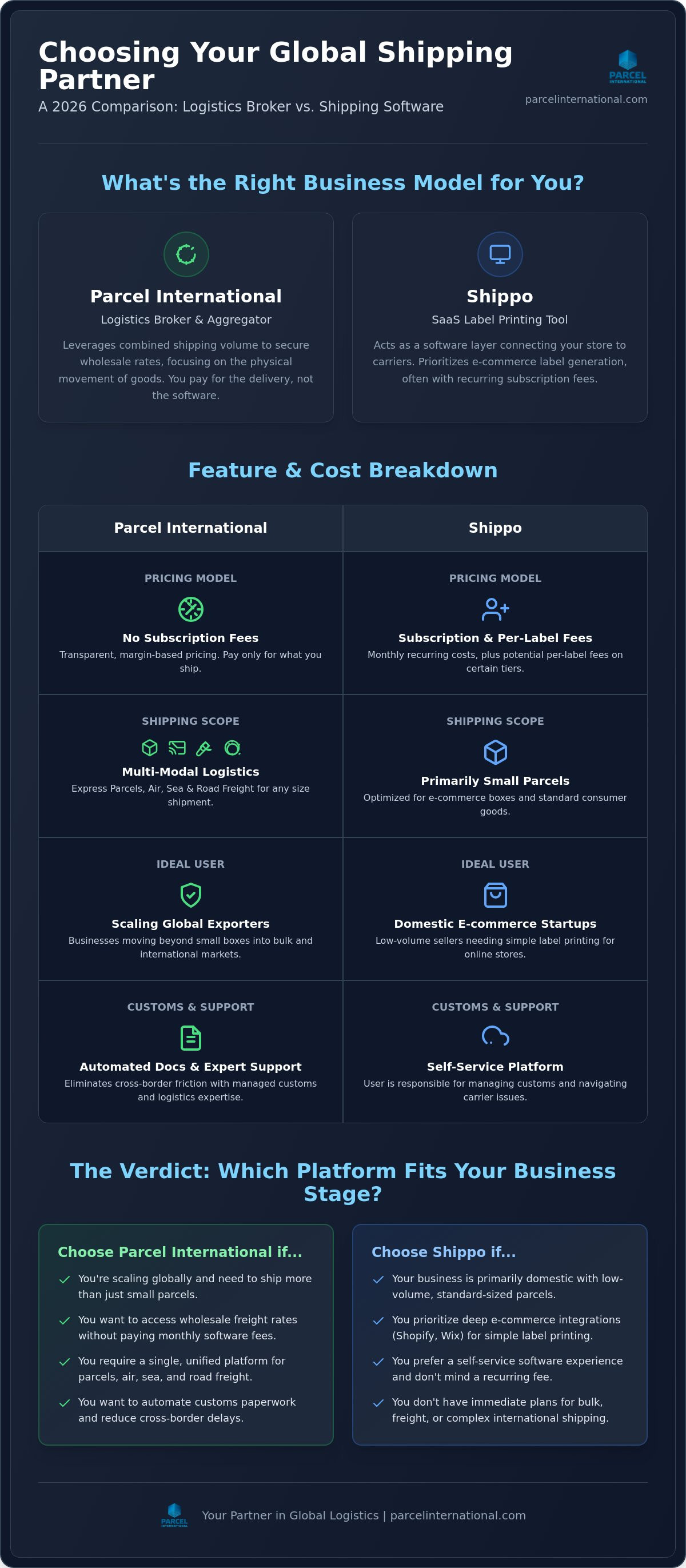
Choosing between shipping software and a logistics broker isn't just about picking a website; it's about choosing your business model. Most businesses fall into a common trap because they mistake a clean interface for actual shipping value. When you evaluate parcel international vs shippo, you're comparing a Software as a Service (SaaS) platform against a logistics brokerage. The two might look similar on a screen, but they function very differently under the hood.
Think of Shippo as a software layer. It prioritizes e-commerce label generation, acting as a digital bridge between your online store and a carrier's API. It's designed to make printing a sticker for a box as fast as possible. However, the core of their business is the software itself. You're often paying for the privilege of using the tool, regardless of how much you actually ship.
Parcel International operates as a logistics broker and aggregator. Instead of selling you a monthly subscription to a dashboard, they provide a unified gateway to the global logistics network. As an aggregator, they leverage the combined volume of thousands of shippers to secure wholesale rates that individual businesses can't access on their own. This model focuses on the physical movement of goods across 220+ countries rather than just the digital label.
The "software trap" occurs when businesses pay a monthly fee for a platform that still leaves them exposed to standard carrier surcharges. When you analyze parcel international vs shippo through the lens of long-term growth, the difference becomes clear. Relying on a broker shifts the focus from software maintenance to cost optimization. By high-volume aggregation, a broker passes savings directly into the shipping rate. You aren't paying for the software; you're paying for the delivery.
How Shippo Operates: The Subscription Model
Shippo thrives on deep e-commerce integrations with platforms like Shopify, Wix, and eBay. Their revenue model relies on monthly subscription fees and per-label costs on certain tiers. This setup is ideal for small, domestic e-commerce shops that need a simple way to print labels for standard parcels. It's a "set it and forget it" tool for low-volume sellers who don't mind a recurring fee for convenience, but it can become a financial burden as your volume grows.
How Parcel International Operates: The Aggregator Model
Parcel International provides direct access to wholesale rates from major carriers like DHL, FedEx, and UPS. Their revenue model is strictly margin-based. This means there are no monthly subscription fees, no volume minimums, and no hidden costs. It's a transparent approach designed for businesses scaling internationally. Because they handle everything from express shipping to sea, air, and road freight, it's a versatile solution for companies that need to move more than just small boxes. You get the relief of a single, unified solution without the friction of a monthly bill.
International Shipping Capabilities: Beyond Standard Parcel Labels
A shipping label is only as good as the network behind it. While Shippo excels at generating stickers for small boxes, your business will eventually outgrow a parcel-only platform. When comparing parcel international vs shippo, you must decide if you need a specialized tool for light e-commerce or a robust partner that handles everything from a 1kg envelope to a 10-ton container. Most software tools focus on the "how" of printing, but they often ignore the "where" and "how much" of global logistics.
Shippo is built for the high-speed world of small parcels. It's a great fit for domestic DTC brands shipping standard consumer goods. However, it hits a ceiling the moment you need to move bulk inventory or heavy machinery. Parcel International removes this barrier by providing a multi-modal reach across 220+ countries. This isn't just about labels; it's about localized expertise and the ability to scale without switching platforms. You shouldn't have to change your entire workflow just because your package got a bit heavier.
Express Shipping and Small Parcels
Both platforms use real-time rate engines to find the best speed for your delivery. They integrate with major carriers like DHL and FedEx to ensure your customers get their orders on time. If you're focusing specifically on the digital storefront, check out this guide on International Shipping for Ecommerce to see how rates are trending this year. The real difference lies in the support. While Shippo offers a self-service dashboard, Parcel International acts as a stable intermediary. This provides the reassurance of human expertise when a high-stakes delivery hits a snag in a foreign port.
Freight Forwarding: Air, Sea, and Road
The most significant "Shippo gap" is the lack of freight options. You simply cannot book a shipping container or a full truckload on a standard label platform. It isn't what they're built for. When looking at parcel international vs shippo for industrial or wholesale needs, the software model often falls short. If your 2026 strategy involves importing bulk stock or shipping heavy cargo across borders, you need a partner that understands What is a Freight Forwarder? and how to manage the complexities of global trade.
Parcel International provides specialized services for Sea Freight, Air Freight, and Road Freight. This versatility ensures you don't have to manage fragmented workflows across three different websites. By using a single gateway, you can compare international rates for every mode of transport in one place. This unified approach provides the relief of knowing your logistics are handled, whether you're sending a single sample or a massive bulk order. You gain the freedom to choose the most efficient route without being limited by the software you use.
Pricing Models and Hidden Costs: Subscriptions vs. Transparent Margins
In the 2026 shipping market, "free" is often a marketing term rather than a financial reality. When you compare parcel international vs shippo, the most jarring difference isn't just the shipping rate; it's the overhead required to access those rates. Software platforms often lure you in with a low entry price, but the total cost of ownership (TCO) changes quickly as your business scales. You shouldn't have to pay a monthly tax just for the right to send your products across borders.
Shippo utilizes a tiered subscription model designed for recurring volume. Their Pro plan starts at $19 per month for monthly billing, scaling up to $199 per month as your volume reaches 10,000 labels. If you need dedicated account management or custom integrations, you'll move into their Premier plan, which requires custom pricing. While they offer a free Starter tier, it limits you to 30 labels per month. This creates a "success tax" where growing your business automatically increases your fixed software costs.
Parcel International operates on a philosophy of radical transparency. There are no monthly subscription fees, no sign-up costs, and zero volume minimums. Their revenue comes from wholesale rate margins, which means they only succeed when you ship. This model provides immediate relief for businesses with seasonal fluctuations or those moving between small parcels and heavy freight. You get the stability of a logistics partner without the burden of a recurring bill that hits your bank account regardless of your sales volume.
Hidden Fees to Watch For in 2026
Beyond the subscription price, small fees can quietly erode your margins. For example, Shippo charges $0.08 per lookup for international address validation. While domestic validation is often included, global exporters can see these nickels and dimes add up. Additionally, with major carriers like FedEx increasing rates by an average of 5.9% in early 2026, every cent matters. To stay ahead of these shifts, consult our guide on International Shipping Rates 2026. Brokers typically bundle service fees into the wholesale rate, providing a single, clear price that includes the support you need when a carrier adds an unexpected surcharge.
Volume Discounts and Wholesale Access
The core advantage of a broker is aggregation. Parcel International secures deep discounts by pooling the volume of thousands of shippers, passing those enterprise-level rates down to small and mid-sized businesses. Shippo users on lower-tier plans often pay rates that are closer to retail unless they bring their own carrier accounts. However, connecting your own accounts to Shippo's Starter plan triggers a $0.05 per-label fee. By removing these barriers, a broker-led model ensures that even a one-off international shipment benefits from the same wholesale pricing as a high-volume exporter. It's a more egalitarian approach that values your business's potential over its current label count.
Feature Breakdown: Automation, Customs, and Global Reach
Efficiency in global trade isn't just about moving a box from point A to point B. It's about how you handle the "paperwork wall" that stops shipments at the border. When you weigh up parcel international vs shippo, the winner often depends on who handles the administrative burden more effectively. A clean dashboard is helpful, but a platform that proactively prevents a customs hold is invaluable. You need a system that treats international documentation as a core feature rather than a digital afterthought.
Tracking and visibility also play a critical role in 2026. While most platforms offer a standard tracking page, high-value shipments require proactive monitoring. If a sea freight container is delayed or an express parcel is flagged by a foreign customs office, you need to know immediately. Relying on a system that only updates when a barcode is scanned isn't enough for a growing exporter. You deserve a partner that acts as a stable intermediary, providing the visibility needed to keep your customers informed and your supply chain moving.
Automated Customs Documentation
Customs errors are the leading cause of international delivery delays. Parcel International simplifies this complex process by providing automated support for International Shipping Customs Documentation across 220+ territories. This system generates accurate commercial invoices and calculates duties and taxes before the package leaves your warehouse. Shippo provides similar tools for standard parcels, which is sufficient for simple e-commerce orders. However, they lack the specialized documentation support required for bulk air or sea freight. If your business moves heavy cargo, the administrative relief provided by a logistics broker is a significant advantage.
Platform Integrations and Ease of Use
Your choice between these two platforms should align with your team's technical expertise. Shippo dominates the e-commerce app store ecosystem, making it a favorite for developers and small business owners who use Shopify, Wix, or eBay. It's built for speed and digital integration. Parcel International focuses on a unified, professional logistics interface designed for logistics managers. It strips away the clutter of consumer-facing apps to provide a direct gateway to global carriers. This professional focus ensures that complex shipments don't get lost in a "one-size-fits-all" e-commerce dashboard. To see how a professional interface can streamline your workflow, you can set up a free account and explore our global carrier network today.
Ultimately, the better platform is the one that removes friction from your specific workflow. If you're a developer building a custom checkout, Shippo's API flexibility is a strong selling point. If you're a business owner who needs to move diverse goods without the headache of manual paperwork, Parcel International provides the orderly process you've been looking for. Don't let your software limit your reach; choose the tool that handles the complexity so you don't have to.
The Verdict: Which Platform Should Your Business Choose in 2026?
Your choice in the parcel international vs shippo debate depends entirely on your growth trajectory. If your business is rooted in domestic sales with only the occasional international order, a software-first approach might suffice. However, if your strategy involves aggressive global expansion, you need a partner that removes the ceiling on what you can ship and where you can send it. The right platform should feel like an asset that simplifies your day, not a recurring subscription that complicates your ledger.
For an industrial business moving both small parts and heavy machinery, the decision is clear. A platform that only prints labels for small boxes will eventually force you into a fragmented workflow. You'll end up using one tool for parcels and a separate freight forwarder for larger equipment. Choosing a logistics broker allows you to manage every mode of transport through a single gateway, providing the relief of a unified solution that handles the heavy lifting on your behalf.
When to Stick with Shippo
Shippo remains a strong contender for early-stage DTC brands shipping five to ten domestic parcels a week. If you're just starting out and rely heavily on "one-click" Shopify or Wix integrations, the software provides a gentle learning curve. It's a convenient tool for beginners who aren't yet ready to manage the complexities of global trade. Just be aware of the limitations. Once you move beyond standard parcel sizes or face the administrative wall of international customs, a label-centric platform can quickly become a bottleneck for your operations.
When to Switch to Parcel International
The moment your international volume begins to scale, the advantages of a logistics broker become undeniable. You should consider the switch when you find yourself frustrated by unpredictable cross-border costs or when you need to move bulk inventory that won't fit in a standard courier box. If your 2026 goals include regular exports to Europe and Asia, you need the wholesale rates and automated customs support that a software tool simply cannot provide.
Scaling globally shouldn't be a source of anxiety. By moving to a model with zero subscription fees and zero volume minimums, you regain control over your margins. You can start by exploring a free rate comparison to see exactly how wholesale aggregation impacts your bottom line. Whether you're sending express parcels or managing complex sea freight, choose the partner that acts as a stable bridge to the global market. It's time to stop paying for software and start investing in your delivery network.
Future-Proof Your Global Shipping Strategy
The 2026 shipping landscape requires more than just a label printer; it demands a partner that understands the nuances of global trade. When you evaluate parcel international vs shippo, it's clear that the right choice depends on your need for versatility and cost transparency. You don't have to settle for restrictive software tiers that penalize your success. Instead, you can choose a system that offers the relief of a unified solution, moving everything from small parcels to heavy freight with ease.
This desire for a unified, all-in-one solution often extends to digital entertainment as well, where platforms like iPvos provide access to thousands of global channels and titles through a single subscription.
Take the next step toward a more orderly and efficient supply chain. Compare real-time international rates on Parcel International today; no subscription required. You'll secure wholesale rates from DHL, FedEx, and UPS while benefiting from automated customs support for 220+ countries and zero monthly fees. Stop managing fragmented workflows and start building a reliable bridge to your global customers. Your business has no borders; your shipping platform shouldn't either.
Frequently Asked Questions
Is Parcel International cheaper than Shippo for international shipping?
Parcel International often provides a lower total cost for global exporters by eliminating the fixed monthly fees found in SaaS platforms. When you analyze parcel international vs shippo, you'll see that Shippo's Pro tiers cost between $19 and $199 per month. A broker uses wholesale aggregation to secure deep discounts, ensuring you only pay for the shipping itself rather than a recurring software subscription.
Does Shippo handle sea and air freight for large shipments?
No, Shippo is a parcel-centric platform and does not offer sea freight or air freight for bulk cargo. It's designed for small e-commerce boxes and standard courier deliveries. If your business needs to move heavy machinery, industrial inventory, or full containers, you require a logistics broker that provides multi-modal transport options across air, sea, and road networks.
Are there monthly subscription fees for Parcel International in 2026?
There are zero monthly subscription fees or volume minimums for Parcel International in 2026. The platform operates on a transparent, margin-based model where you only pay the quoted rate for the shipments you send. This approach provides financial relief for businesses with seasonal fluctuations that don't want to be locked into a recurring bill during slower months.
How do these platforms handle customs documentation for 220+ countries?
Both platforms utilize automated systems to generate the paperwork needed for cross-border delivery. Parcel International provides comprehensive customs support for 220+ countries, handling complex commercial invoices for both express parcels and large-scale freight. Shippo's tools are optimized for small e-commerce parcels, making them suitable for standard consumer orders but less effective for industrial-scale exports.
Can I integrate Parcel International with my e-commerce store?
Yes, you can integrate Parcel International with major e-commerce storefronts to streamline your workflow. While Shippo has a large presence in app stores like Shopify, a logistics broker provides a professional gateway that connects your business directly to wholesale carrier networks. This ensures your store can handle everything from a single sample to a bulk inventory restock without switching platforms.
Which platform is better for shipping from Europe to the United States?
Parcel International is generally the superior choice for Europe-to-US routes because of its localized European expertise and multi-modal reach. While Shippo focuses heavily on US-based e-commerce, a broker with deep roots in European logistics can better navigate transatlantic air and sea freight. This specialized knowledge helps prevent delays in foreign ports and ensures more predictable transit times for high-value goods.
What are the common hidden fees in shipping software subscriptions?
Common hidden costs include monthly overhead, address validation charges, and per-label fees for personal carrier accounts. In the parcel international vs shippo comparison, these micro-transactions add up quickly; for instance, Shippo charges $0.08 for every international address lookup. Choosing a broker-led model removes these barriers by bundling all service and support costs into a single, transparent wholesale rate.
Do I need a high shipping volume to get wholesale rates with a broker?
You don't need high individual volume to access wholesale rates when you partner with a logistics broker. Brokers pool the shipments of thousands of different users to negotiate deep discounts with major global carriers like DHL, FedEx, and UPS. This egalitarian model allows a small business sending one-off packages to benefit from the same enterprise-level pricing as a massive global exporter.


Comments