
Shipping for Small Businesses: The 2026 Strategy for Global Growth
- Alex
- Jun 23
- 11 min read
Updated: Jul 2
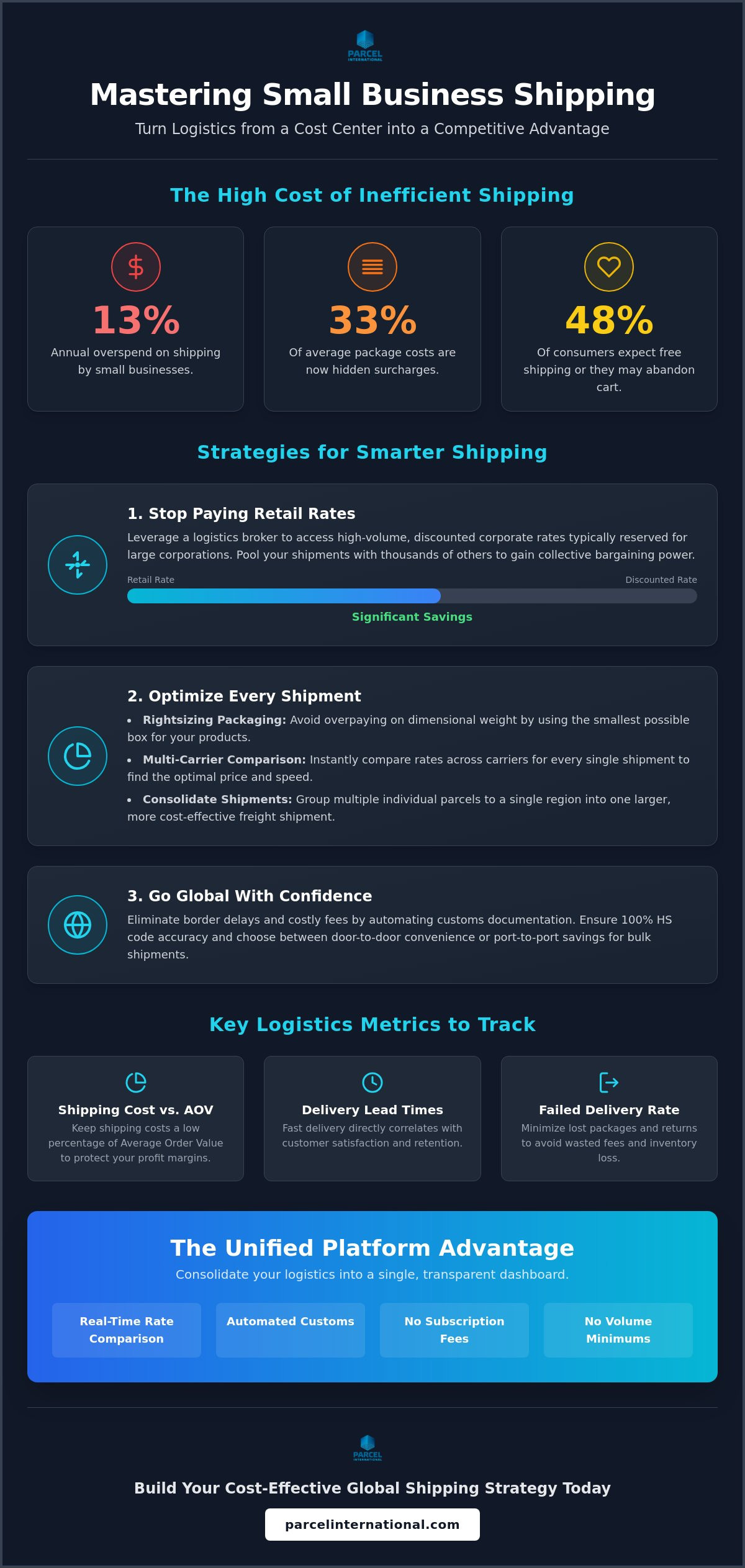
Did you know that small businesses overspend on shipping by approximately 13% every year? It's a frustrating reality when you're trying to scale, especially as surcharges now account for roughly 33% of the average package cost. You likely feel the weight of high shipping margins eating into your hard-earned profits while you juggle multiple carrier accounts. Mastering shipping for small businesses shouldn't feel like a constant battle against rising rates and complex logistics. You deserve a clear, transparent path to growth that doesn't involve getting lost in the fine print of carrier contracts.
This guide will show you how to turn your logistics from a cost center into a competitive advantage. You'll learn actionable strategies to secure discounted carrier rates, automate customs documentation, and transition smoothly from local parcels to global freight. We'll explore the 2026 landscape of unified platforms and smart automation that simplifies your workflow. From navigating the end of de minimis exemptions to rightsizing your packaging, we cover everything you need to build a reliable, cost-effective global shipping strategy.
Table of Contents
Understanding Shipping for Small Businesses in 2026
In 2026, shipping for small businesses is a high-stakes strategic pillar, not a back-office chore. Success requires a fluid mix of parcel, express, and freight services tailored to specific market demands. Relying on a single carrier or a one-size-fits-all approach is no longer sustainable. You need to move between Express Shipping for urgent orders and Sea Freight for inventory replenishment without missing a beat. The modern market rewards agility and punishes those who treat logistics as an afterthought.
Retail rates are the number one profit killer for emerging brands. When you pay the standard counter price at a local post office or courier shop, you're essentially subsidizing the discounts given to larger corporations. These high margins eat directly into your bottom line. This makes it almost impossible to compete on price or offer the "free shipping" that 48% of consumers now expect before they abandon a cart. If your shipping costs are too high, your customer acquisition costs will eventually become unmanageable.
The 2026 landscape is defined by AI-driven logistics and an absolute demand for transparent tracking. Customers don't just want their items; they want to see every milestone in real-time. Gaining a foundational Understanding Parcel Delivery systems helps you realize that manual booking is dead. Automated shipping aggregators now handle the heavy lifting, using predictive data to select the most efficient routes and carriers instantly. This shift allows you to focus on product development while the software handles the complexities of shipping for small businesses.
The Difference Between Retail and Wholesale Shipping
Carrier pricing is built on volume. If you ship ten boxes a week, you're stuck with retail rates. If you ship ten thousand, the rates drop significantly. A logistics broker acts as a volume aggregator, pooling the shipments of thousands of small businesses to unlock those corporate-level discounts for you. The "broker advantage" is the ability to leverage the collective shipping power of a global network to secure deep discounts typically reserved for multinational corporations.
Key Logistics Metrics Every SMB Should Track
Efficiency starts with data. You can't optimize what you don't measure. Track these three metrics to keep your growth on schedule:
Shipping Cost vs. AOV: Monitor your total shipping expenditure as a percentage of your Average Order Value. If this climbs too high, your business model becomes fragile.
Delivery Lead Times: Fast delivery correlates directly with customer retention. In 2026, even a one-day delay can send a loyal customer to a competitor.
Failed Delivery Rate: The hidden cost of "return to sender" or lost packages includes wasted shipping fees, lost inventory, and damaged brand reputation.
Strategies for Reducing Shipping Expenditures in 2026
Stop letting high shipping costs drain your revenue. In 2026, lowering your overhead requires a precise, data-driven approach to carrier selection. Small businesses play a critical role in supply-chain resilience, but you can only remain resilient if your logistics budget is optimized. Use multi-carrier comparison tools to find the best rate for every specific zip code. A carrier that's cheap for a local delivery might be the most expensive option for a cross-country shipment.
Consolidating your international shipments is another powerful way to reduce shipping for small businesses. Instead of sending ten individual parcels to one region, group them into a single freight shipment to access lower bulk rates. Combine this with automated customs tools to prevent packages from sitting in expensive bonded warehouses. These storage fees at the border can quickly exceed the original cost of the shipment if your documentation isn't perfect.
You should also evaluate the efficiency of door-to-door vs. port-to-port delivery. While door-to-door is the most convenient, port-to-port can offer significant savings for businesses moving larger volumes. Choosing the right service depends on your internal capacity to handle the final leg of the journey. If you have a local logistics partner at the destination, port-to-port might be your most cost-effective choice.
Accessing Discounted Express Shipping Rates
Speed is a major factor in customer satisfaction, but express services often come with a premium price tag. Parcel International solves this by providing access to wholesale rates without requiring high minimum volumes. This allows you to offer premium delivery speeds while keeping your margins healthy. For more detailed insights on securing the best pricing, check out our guide on international shipping for ecommerce. You can compare real-time rates across multiple carriers to ensure you're always getting the best deal.
Packaging Optimization and Dimensional Weight
Carriers use the Dimensional (DIM) weight formula to charge for the space a package occupies, not just its actual weight. This formula means a large, light box can cost as much as a small, heavy one. Switch from boxes to poly mailers for soft goods to eliminate empty space. By optimizing your packaging, you significantly lower the cost of shipping for small businesses across your entire product line. In 2026, consumers also prefer eco-friendly packaging; using recycled, right-sized materials reduces both your carbon footprint and your DIM weight surcharges.
Navigating International Customs and Global Documentation
The biggest anxiety in global trade is the "customs black hole." You ship a product, and then it disappears into a bureaucratic maze for weeks. This isn't just a minor delay; it's a customer service disaster that can ruin your reputation. For shipping for small businesses, international growth depends on your ability to cross borders without friction. In 2026, the rules have shifted toward total transparency. The United States suspended the $800 de minimis exemption in August 2025, and the European Union removed the €150 customs duty exemption on July 1, 2026. Every single import now requires formal entry and scrutiny.
Trade compliance starts with accurate HS codes. These numbers tell customs exactly what is in the box and what duty rate applies. Using the wrong code leads to inspections, fines, or seized goods. Don't guess. Use automated tools to verify your classifications before the package leaves your facility. A logistics broker acts as your stable intermediary here, providing the Customs Support needed to navigate these data-driven enforcement environments. They bridge the gap between your warehouse and the complex requirements of national authorities, moving your goods through the system while you focus on sales.
Automating the Paperwork Trail
Manual data entry is the primary cause of border delays. When you use the Parcel International platform, the system generates your commercial invoices and shipping labels during the booking process. This integration ensures that the data on your label matches your customs declaration perfectly. Automated documentation reduces the risk of human error and significantly speeds up clearance times. For a deep dive into the specific requirements for different regions, refer to our international shipping customs documentation guide. It's a vital resource for staying compliant in a changing regulatory landscape.
Managing Import Duties and Taxes
You must decide between DDU (Delivered Duty Unpaid) and DDP (Delivered Duty Paid). With DDU, your customer gets a surprise bill from the courier before they can receive their package. This often leads to refused deliveries and negative reviews. DDP allows you to collect duties at checkout, ensuring a seamless doorstep experience. Clear communication is key. If you're shipping to Mexico, remember that a global tax rate of 33.5% now applies to shipments up to $2,500. Radical transparency regarding landed costs is the only way to build long-term brand trust in the global market. When customers know the total price upfront, they feel secure and are far more likely to return for future purchases.
Scaling Your Logistics: From Parcels to Global Freight
As your order volume grows, the cost per unit in a single parcel eventually becomes a liability. Identifying the "inflection point" is crucial for maintaining healthy margins. This shift usually happens when your total shipment weight exceeds 100kg or when you're moving enough inventory to fill a significant portion of a shipping container. At this stage, shipping for small businesses evolves from simple courier bookings into professional logistics management. You must transition from reactive shipping to proactive supply chain planning.
High-growth brands must choose between Air Freight and Sea Freight based on their specific needs. Air freight is the fastest option, making it ideal for high-value goods or urgent stock replenishments. Sea freight remains the most economical choice for bulk inventory, though it requires longer lead times and more careful inventory forecasting. To maximize efficiency, you should also understand the difference between LCL (Less than Container Load) and FCL (Full Container Load). LCL allows you to share container space with other shippers, paying only for the volume you use, while FCL provides a dedicated container for maximum security and faster transit times.
Managing these different modes doesn't require a massive logistics department. Modern platforms allow you to manage a single parcel and a full container in the same window. This unified approach provides total visibility over your landed costs and inventory movement. You can compare rates, book shipments, and track progress without jumping between multiple carrier portals or dealing with fragmented data.
When to Switch to Professional Freight Forwarding
Once you move beyond small parcels, the complexity of your shipments increases. A freight forwarder acts as your expert architect, coordinating the movement of goods across borders and transport modes. They manage the technical details that small businesses often find overwhelming. If you are scaling into European markets, staying updated on international road freight rates is essential. This knowledge helps you keep regional distribution costs low while ensuring your products reach customers across the continent reliably.
Managing the Multi-Modal Supply Chain
Efficiency in 2026 often comes from a multi-modal approach. You might use Sea Freight for the primary haul, Road Freight for regional distribution, and Express Shipping for urgent customer orders. Parcel International simplifies this by consolidating all these services into one transparent interface. Real-time tracking across all transport modes ensures you never lose sight of your capital. Get a freight quote today and start scaling your logistics with a partner that understands the unique needs of growing businesses.
The Parcel International Advantage: Your Logistics Ally
Logistics shouldn't be a gatekept secret reserved only for massive corporations. We've built our platform on a philosophy of radical transparency and modern flexibility. This means you don't have to deal with monthly subscription fees or restrictive volume minimums. Whether you're sending one package or managing complex shipping for small businesses across multiple continents, you get the same professional treatment. This egalitarian approach removes the financial barriers that often stall growth for emerging brands. It's about providing you with the same tools the big players use, without the big player overhead.
Many businesses don't realize the fundamental difference between the "direct carrier" and "broker" models. When you go direct to a carrier, you're often at the mercy of their rigid retail pricing structures. As a stable intermediary, we aggregate the volume of thousands of shippers to negotiate wholesale rates. We then pass those significant savings directly to you. This broker model allows you to leverage massive shipping power without needing a massive budget. It's the most efficient way to keep shipping for small businesses affordable, predictable, and scalable.
A Unified Platform for Global Reach
Manage your entire supply chain across 220+ countries from one intuitive dashboard. You don't need multiple accounts or fragmented workflows to reach a global audience. You can get a shipping estimate in seconds to help you budget for international expansion with total confidence. Parcel International is the stable bridge for your global expansion.
Start Shipping Smarter Today
Ready to optimize your workflow and protect your margins? Create an account in minutes and book your first discounted shipment. If your growth requires Sea Freight or Air Freight, our logistics experts are ready to consult on your large-scale needs. Compare international shipping rates and start saving today.
Secure Your Competitive Edge in Global Logistics
The landscape of shipping for small businesses has shifted from manual guesswork to data-driven precision. Success in 2026 depends on your ability to bypass retail premiums and leverage automated compliance tools. By consolidating your parcel and freight needs into a single dashboard, you eliminate the friction of fragmented workflows and hidden surcharges. You now have the strategies to optimize packaging against DIM weight costs and the knowledge to transition from express parcels to bulk freight at the right moment.
The path to global growth is paved with transparency and professional support. You don't have to navigate these complexities alone or settle for restrictive carrier terms. It's time to reclaim your margins and scale with confidence across every border. Start comparing global shipping rates for your small business to access reliable service to 220+ countries. With real-time rates from DHL, FedEx, and UPS and automated customs support included, your global expansion is finally within reach. Your business is ready to grow; all you need is the right logistics ally to lead the way.
Frequently Asked Questions
How can a small business get the best international shipping rates?
You get the best rates by leveraging the collective volume of a logistics broker rather than booking directly with a single carrier. This approach unlocks wholesale discounts that are usually reserved for multinational corporations. By comparing real-time rates from multiple providers in one window, you ensure you aren't paying a retail premium for any specific destination or service level.
What is the cheapest way to ship internationally for a small business?
Sea Freight is typically the most economical choice for bulkier inventory or non-urgent replenishment. If you're sending smaller parcels, using a consolidation service or a multi-carrier platform helps you find the lowest available rate for every zip code. Always calculate your total landed cost, including duties and taxes, to avoid unexpected expenses that can ruin your profit margins.
Do I need a commercial account to get shipping discounts?
No, you don't need a direct commercial account with every carrier or a paid subscription to access professional rates. Modern platforms remove these traditional barriers, allowing you to book discounted shipments immediately without volume minimums. This egalitarian model ensures that shipping for small businesses is affordable and accessible from day one, regardless of your current order volume.
How do I handle customs documentation for my small business?
What is the difference between a shipping aggregator and a direct carrier?
A direct carrier owns the transport fleet and typically offers standard retail pricing to smaller accounts. A shipping aggregator, or broker, acts as a stable intermediary that pools the volume of thousands of businesses to negotiate wholesale rates. This gives you more flexibility, better pricing, and the ability to switch between different carriers like DHL, FedEx, and UPS depending on the best available deal.
Can I ship large freight items as a small business?
Yes, you can easily access Sea Freight and Air Freight services through a professional logistics partner. You have the choice between LCL (Less than Container Load) to share space with other shippers or FCL (Full Container Load) for dedicated security. This flexibility allows you to scale your logistics as your inventory grows without needing a dedicated internal shipping department.
What happens if my international shipment is delayed at customs?
Most delays result from missing data or incorrect classifications. If a shipment is held, your logistics ally provides the Customs Support necessary to communicate with authorities and resolve the issue. Having a professional intermediary helps you navigate bureaucratic maze and ensures that any requested documentation is provided promptly to get your goods moving again as quickly as possible.
Is express shipping worth the cost for a small e-commerce shop?
Express shipping is a powerful tool for building customer loyalty and reducing cart abandonment. While it has a higher upfront cost, the reliability and speed often lead to higher retention rates and better reviews. When managing shipping for small businesses, offering an express option at checkout allows you to meet modern consumer expectations for fast delivery without forcing you to absorb the cost yourself.


Comments