
Shipping from USA to Japan: Prohibited and Restricted Items Guide 2026
- Alex
- Jul 9
- 12 min read
Updated: Jul 17
Did you know that a single pack of beef jerky in your parcel could trigger a fine of up to 3 million yen, roughly $20,000 USD? Japan maintains some of the world's strictest biosecurity and chemical regulations; this makes it easy to accidentally include shipping from usa to japan prohibited items in a standard care package or commercial shipment. It's frustrating to find that common American over-the-counter medications, such as certain allergy pills or CBD products, are treated as serious contraband once they hit Tokyo customs.
For those shipping items ahead of a move or an extended visit, you can learn more about how to make better decisions for a stress-free stay in the Japanese capital.
We understand the anxiety of watching a package stall at the border or receiving a notification of rejection before it even leaves the US. You need a clear path forward without the headache of conflicting carrier lists. This guide provides the definitive list for 2026, ensuring you handle these complex import rules with total confidence. We'll break down the specific limits for prescription meds, the 24-item rule for cosmetics, and the essential "Yunyu Kakunin-sho" certificate so your shipment arrives on time and without legal friction.
For academic institutions and student groups, managing these logistics is a vital part of planning a successful study abroad program. To simplify your group's travel and logistics planning, you can discover International Student Experiences to see how they support schools and colleges with expertly organized international tours.
Table of Contents
Understanding Japan Customs: Why Compliance Matters in 2026
Japan Customs serves as a vital gatekeeper for the nation's safety and environmental health. When you send a parcel across the Pacific, it isn't just subject to a cursory glance; it undergoes a rigorous screening process designed to protect the island's unique biodiversity and public safety. By Understanding Customs Authorities and their underlying mission, you can see why certain items are flagged immediately. In 2026, this scrutiny has intensified, particularly regarding digital components and high-capacity lithium batteries, as Japan prioritizes fire safety and technological security in its logistics hubs.
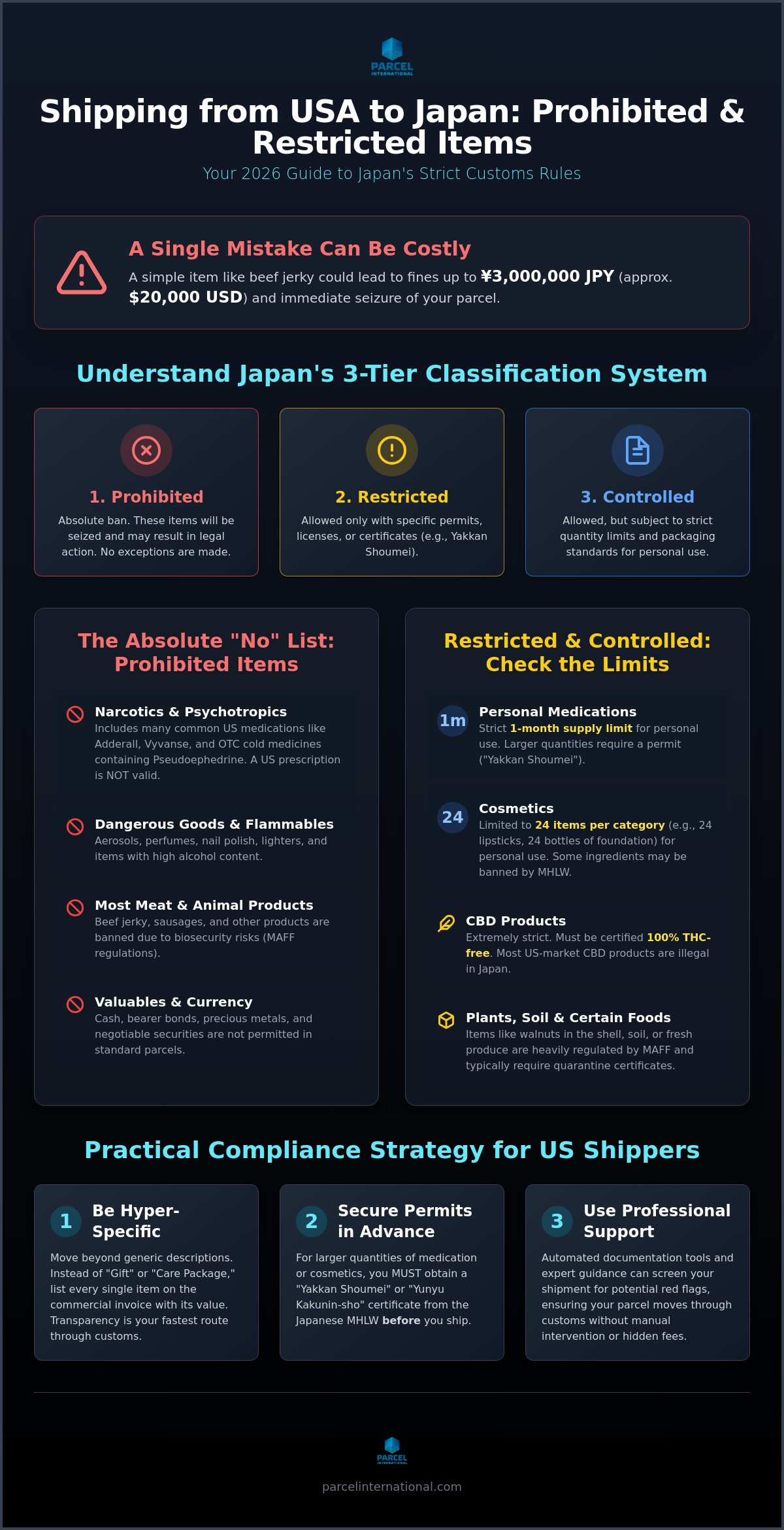
To avoid delays, you must understand the three-tier system used by officials. Prohibited items are absolute bans, such as narcotics or counterfeit currency. Restricted items require specific permits or certifications before entry. Controlled items are subject to quantity limits or specific packaging standards. Ignoring these categories leads to more than just a late delivery; you risk seizure of the goods, expensive destruction fees, or even legal prosecution in severe cases. This is why identifying shipping from usa to japan prohibited items before you book your transport is the only way to ensure a smooth arrival.
The Role of the MHLW and MAFF
Two specific agencies dictate much of what can enter the country. The Ministry of Health, Labour and Welfare (MHLW) oversees anything that touches the human body, including cosmetics, supplements, and medicines. Even if a product is "US-standard," it may contain chemicals Japan considers unauthorized. Simultaneously, the Ministry of Agriculture, Forestry and Fisheries (MAFF) works to prevent invasive species. Many "natural" US products, like walnuts in the shell or certain beef jerkies, fail Japanese biosecurity because they could carry pests or diseases that don't exist on the islands.
Universal vs. Japan-Specific Bans
While most shippers are familiar with IATA dangerous goods like explosives or flammables, Japan enforces additional cultural and safety bans. One critical concept is "Inherent Vice." This refers to items that, by their very nature, are likely to damage other cargo, such as leaking liquids or fermenting food. Precise international shipping customs documentation is your best defense against these rejections. By declaring exactly what is inside your crate, you prevent the "red flag" of generic descriptions that often trigger manual inspections and shipping from usa to japan prohibited items seizures. Don't leave your shipment to chance; transparency is the fastest route through the port.
The Absolute "No" List: Prohibited Items for Japan
Japan's customs enforcement is legendary for its precision and lack of leniency. When you prepare a shipment, you must recognize that certain items are subject to a total ban, regardless of their legality in the United States. Attempting to include these in your cargo results in immediate seizure and potential legal trouble. You can verify specific categories on the Official list of prohibited items provided by the Japanese government. In 2026, the focus has shifted toward high-tech security, meaning even "dual-use" items, such as specialized mechanical parts or high-grade sensors that could have military applications, trigger intense security alerts.
Narcotics and psychotropic drugs represent the strictest category. It's a common mistake to assume a valid US doctor's prescription protects you. Stimulants like Adderall, Vyvanse, and even certain high-strength Sudafed products containing pseudoephedrine are strictly forbidden. There are no exceptions for these shipping from usa to japan prohibited items. Similarly, standard parcels cannot contain valuables like cash, bearer bonds, or precious metal bullion. If you are unsure about a specific item's status, our team at Parcel International can help you screen your inventory before you book.
Dangerous Goods and Flammables
Many everyday household products are classified as fire hazards in the pressurized environment of an aircraft. Aerosols, perfumes, and nail polishes are frequently rejected due to their high alcohol or flammable gas content. Even "innocent" items like disposable chemical heat pads or portable lighters are banned from standard air freight. According to 2026 IATA standards, Dangerous Goods are defined as articles or substances capable of posing a risk to health, safety, property, or the environment when transported by air. These rules are non-negotiable for safety reasons.
Intellectual Property and Counterfeits
Japan has intensified its stance on intellectual property throughout 2026. Customs officials use advanced imaging and database cross-referencing to identify "replica" luxury brands, fake trademarked electronics, and counterfeit currency. If an item is suspected of infringing on a trademark, it will be destroyed at the border without compensation to the shipper. Many US residents believe that "personal use" allows for the import of one or two fake items, but this is a myth. Japan Customs treats counterfeit electronics and fashion as a threat to the national economy and will block them regardless of the quantity or the intended recipient.
Restricted Items: CBD, Medication, and Electronics
Restricted items occupy a gray area that causes the most frustration for US shippers. Unlike absolute bans, these goods are permitted only if you meet specific quantity thresholds or provide the correct documentation. Misunderstanding these nuances is the primary reason why many parcels are eventually classified as shipping from usa to japan prohibited items. Japan’s 2026 regulations place a high premium on public health and battery safety, meaning your documentation must be flawless before your crate reaches the terminal.
Personal medication is a major focal point for customs agents. You are generally allowed a one-month supply of prescription medicine without prior approval. If you need to ship more, you must secure a "Yunyu Kakunin-sho" (formerly known as Yakkan Shoumei) before the package arrives. For over-the-counter items, the limit is a two-month supply. You can find detailed U.S. guidance on restricted items for Japan to help you determine which category your specific health products fall into. Additionally, cosmetics and skincare products are capped at 24 pieces per individual item; exceeding this makes your shipment a commercial import in the eyes of the law.
The 2026 CBD and Hemp Regulation
The "CBD dilemma" remains one of the highest risks for American shippers. While CBD is legal in many US states, Japan maintains a zero-tolerance policy for even trace amounts of THC. US labels often claim "0% THC" or "THC-Free," but Japanese lab tests are sensitive enough to detect microscopic residues that fall within US legal limits. If any THC is found, the product is treated as a narcotic. Hemp-derived products now require a specific Certificate of Analysis (COA) that proves the CBD was extracted only from the stalks or seeds. CBD gummies and oils are frequently seized because they rarely meet these strict evidentiary standards.
Importing Supplements and Vitamins
Japanese law draws a sharp line between "food" and "pharmaceutical" ingredients. Many US supplements contain Melatonin or DHEA, which are restricted or require specific dosages to clear customs. If your supplement contains ingredients that Japan classifies as medicinal, it will be rejected without a pharmaceutical license. Standard personal shipments of vitamins and supplements are restricted to a two-month supply per recipient, provided no prohibited pharmaceutical stimulants are present. Always check the ingredient list against the MHLW database to ensure your daily vitamins don't trigger a border hold.
Lithium Battery Safety: PI966 and PI967
Shipping electronics requires a clear understanding of the 2026 IATA battery rules. PI967 applies to batteries contained within equipment, like a built-in laptop battery, which is generally easier to ship. PI966 covers batteries packed with equipment, such as a spare camera battery inside the same box. You must ensure the battery capacity does not exceed 100Wh for laptops or 20Wh for smaller cells. Incorrect labeling of these power sources is a leading cause of shipment rejection at the US origin before the goods even cross the ocean.
Practical Compliance Strategy for US Shippers
Begin your shipping process by conducting a rigorous audit of your physical inventory. This is the most effective way to identify potential shipping from usa to japan prohibited items before they enter the logistics chain. Once you confirm your items are eligible for import, you must focus on the precision of your paperwork. Japan Customs operates with a high degree of automation; any discrepancy between your physical goods and your digital declaration will trigger a manual inspection and significant delays. Use an international shipping rates calculator to factor in potential duties and taxes early, so there are no financial surprises upon arrival.
Selecting a carrier that provides integrated customs support is your final safeguard. While major players like DHL, FedEx, and UPS all serve Japan, their internal handling of restricted goods varies. You need a partner that doesn't just move boxes but actively validates your documentation against 2026 Japanese standards. If you want to eliminate the guesswork from your global logistics, explore our customs support solutions to ensure your cargo meets every regulatory requirement before it leaves the warehouse.
Mastering the Commercial Invoice
Stop using generic descriptions like "Samples," "Gift," or "Merchandise." These terms are red flags for inspectors and often lead to immediate shipment holds. You must provide specific Harmonized System (HS) codes for every item in your crate. This 6-to-10 digit code tells the inspector exactly what the product is and which tax rate applies. Be honest about the value of your goods; undervaluing items to avoid consumption tax is a form of fraud that can lead to blacklisting. For detailed templates and step-by-step instructions on filing, consult our international parcel shipping guide.
Biosecurity and Food Items
Japan’s "Meat Ban" is one of the most strictly enforced biosecurity measures in the world. You cannot ship beef jerky, canned meat, or even bouillon cubes containing meat extracts from the US to Japan. The penalties for non-compliance are severe, with fines reaching up to 3 million yen, or roughly $20,000 USD. If you are shipping processed foods, every ingredient must be clearly listed in English or Japanese on the packaging. Additionally, be aware of CITES regulations which prohibit items made from endangered species. This includes common luxury goods like certain exotic leathers, ivory, or specific types of rosewood often found in musical instruments. If an item lacks a CITES permit, it will be destroyed at the border without exception.
Lithium Battery and Packaging Compliance
Before sealing your box, verify the wattage of all lithium-ion batteries. Batteries exceeding 100Wh are generally prohibited in standard air freight. Ensure that all devices are powered off and protected from accidental activation. Use sturdy, double-walled corrugated boxes and avoid overpacking, which can lead to burst seams during high-altitude transit. Proper packaging isn't just about protection; it’s a requirement for clearing the initial safety checks at US export hubs.
Simplify Japan Shipping with Parcel International
Managing global logistics shouldn't feel like a high-stakes gamble. While the previous sections of this guide detailed the rigid biosecurity and pharmaceutical rules of Japan, the actual execution of these shipments requires a unified, high-performance platform. We've designed Parcel International to strip away the friction of shipping internationally by providing a single point of access for your freight needs. Instead of juggling multiple carrier portals and conflicting advice, you can compare real-time rates from industry leaders like DHL, FedEx, and UPS in one dashboard. This transparency ensures you find the most reliable service level for your specific cargo without hidden surcharges or administrative bottlenecks.
We act as a stable intermediary, bridging the gap between your warehouse and the carrier's brokerage team. When a shipment involves complex shipping from usa to japan prohibited items or restricted goods, you need more than a tracking number; you need an advocate. Our team provides dedicated customs support to ensure your documentation is processed accurately, reducing the likelihood of your goods being flagged for manual inspection at the port of entry.
Automated Compliance Tools
Our platform goes beyond simple booking. It serves as an intelligent filter for your inventory. As you enter item descriptions, our system automatically cross-references them against updated databases to flag potential shipping from usa to japan prohibited items. This proactive approach is a game-changer for SMBs that don't have the resources to track every 2026 regulatory update manually. By using a professional freight forwarder platform, you bundle your customs preparation directly with your booking. This integration minimizes human error and guarantees that your HS codes are precise before they reach a customs official's screen.
Reliability and Tracking
Trust is built on visibility, especially when your cargo is crossing the Pacific. Our real-time tracking system provides granular updates, alerting you the moment a parcel enters Japan Customs. If a shipment receives a "Held in Customs" status, we don't leave you to navigate the bureaucracy alone. Our support team works to resolve documentation queries efficiently, preventing the expensive storage fees or rejections that occur when parcels sit idle in a warehouse. We believe in radical transparency and a straightforward business model that values your peace of mind. Stop worrying about the "what-ifs" of Japanese import laws. Get an instant quote for shipping from the USA to Japan today.
Master Your Japan Logistics Strategy
Success in the Japanese market depends on your ability to navigate strict biosecurity and pharmaceutical standards without friction. You've learned that identifying shipping from usa to japan prohibited items before the booking stage is the only way to avoid the 3 million yen fines associated with meat products or the total seizure of unauthorized stimulants. By auditing your inventory and mastering the commercial invoice, you move from a place of uncertainty to a position of logistical authority.
Don't let complex import regulations slow down your growth or increase your costs. Our platform provides the automated customs documentation tools and real-time rate comparisons you need to choose the best global carrier for your specific needs. With expert support for international trade compliance, we ensure your cargo clears the border smoothly. Compare rates and book your shipment to Japan with Parcel International to experience a transparent, barrier-free shipping process. Your shipment is ready to move, and we're here to ensure it arrives on time and without complications.
Frequently Asked Questions
Can I ship vitamins and supplements from the USA to Japan?
You can ship vitamins and supplements to Japan, provided you stick to a two-month supply for personal use. Ensure the ingredients don't include restricted substances like DHEA or excessive dosages of melatonin. If your shipment exceeds these quantities, Japan Customs classifies it as a commercial import. This requires a pharmaceutical license that most individuals don't possess. Always verify the MHLW list before packing to avoid unnecessary delays.
Is CBD oil legal to ship to Japan in 2026?
Shipping CBD oil to Japan in 2026 remains extremely high-risk and is effectively prohibited by major carriers. Japan enforces a zero-tolerance policy for THC; even products labeled "THC-free" in the US often contain trace amounts detectable by Japanese lab tests. Unless you have a Certificate of Analysis proving extraction solely from stalks or seeds, the item will be seized as a narcotic. Most personal shipments of CBD are rejected at the border.
What happens if I ship a prohibited item to Japan by mistake?
If you ship shipping from usa to japan prohibited items by mistake, customs will likely seize and destroy the goods. You won't receive compensation for the lost items, and you may be charged a destruction fee. In cases involving illegal drugs or weapons, you could face legal prosecution or permanent blacklisting from importing. It's vital to audit your parcel contents against the 2026 Master List before the courier collects your package.
How much medication can I send to Japan for personal use?
You can send a one-month supply of prescription medication or a two-month supply of over-the-counter drugs for personal use. If you need to send more than a 30-day supply of a prescription, you must apply for a "Yunyu Kakunin-sho" certificate from the Ministry of Health, Labour and Welfare. Without this document, anything over the limit is confiscated. This rule applies strictly to all health-related products entering the country.
Can I ship used electronics with Lithium batteries to Japan?
Yes, you can ship used electronics, but the lithium batteries must be contained within the equipment. Ensure the battery capacity is under 100Wh for laptops or 20Wh for smaller devices like smartphones. If the batteries are loose or packed separately, they are often rejected due to fire safety regulations. Always power down the devices and protect them from accidental activation during their transit from the USA.
Why is beef jerky prohibited for import into Japan?
Beef jerky is prohibited because Japan maintains strict biosecurity measures to prevent the spread of livestock diseases like Foot-and-Mouth disease. The Ministry of Agriculture, Forestry and Fisheries (MAFF) bans almost all meat products from the US, including canned, dried, or vacuum-packed items. Violating this rule can result in fines as high as 3 million yen. Even small amounts in a gift basket will trigger a customs hold and destruction.
Do I need a special permit to ship cosmetics to Japan?
You don't need a special permit to ship cosmetics for personal use, as long as you stay under the limit of 24 pieces per individual item. For example, you can ship 24 lipsticks and 24 bottles of foundation in one parcel. If you exceed these quantities, the shipment is treated as a commercial import. This triggers a requirement for an import license and rigorous health safety testing by the MHLW.
How do I fill out a commercial invoice for Japan Customs?
Fill out your commercial invoice by providing specific descriptions and Harmonized System (HS) codes for every item. Avoid vague terms like "gift" or "merchandise," as these prompt manual inspections and delays. State the accurate market value in US dollars and ensure the recipient's contact details are correct. Using a platform that automates these declarations helps you avoid the common pitfalls of shipping from usa to japan prohibited items documentation errors.


Comments