
Shipping Furniture from USA to Australia: The 2026 Logistics Guide
- Alex
- Jun 30
- 12 min read
Updated: Jul 16
With Google searches for moving to Australia from the US jumping by 290% in early 2026, thousands of families are currently staring at their heavy oak dining tables and wondering if they are worth the voyage. You have likely realized that shipping furniture from usa to australia isn't just about the distance; it's a high-stakes puzzle of container space and strict biosecurity protocols. It is natural to feel overwhelmed by the potential for hidden costs or the fear of a quarantine officer rejecting your favorite bookshelf because of a tiny wood-boring insect.
We recognize that you need your belongings to arrive safely and legally without paying more for freight than the furniture is actually worth. This guide provides the professional clarity required to master the transpacific route. You'll learn how to navigate Australia's strict 12-month rule for duty-free imports and how to prepare your items to pass Department of Agriculture inspections. We will also provide a clear cost-benefit analysis of sea versus air freight, offering a step-by-step roadmap to get your home settled in the Land Down Under without the usual procedural friction.
Table of Contents
Is Shipping Furniture from the USA to Australia Worth It in 2026?
The decision to relocate your household across the globe is a complex financial puzzle. When you are considering shipping furniture from usa to australia, the choice often hinges on more than just a carrier quote. It requires a deep dive into the total landing cost compared to the current retail climate in major Australian cities. Understanding the fundamental mechanics of Freight transport is your first step in making a data-driven decision that protects your budget and your peace of mind.
The Replacement Cost Reality in Australia
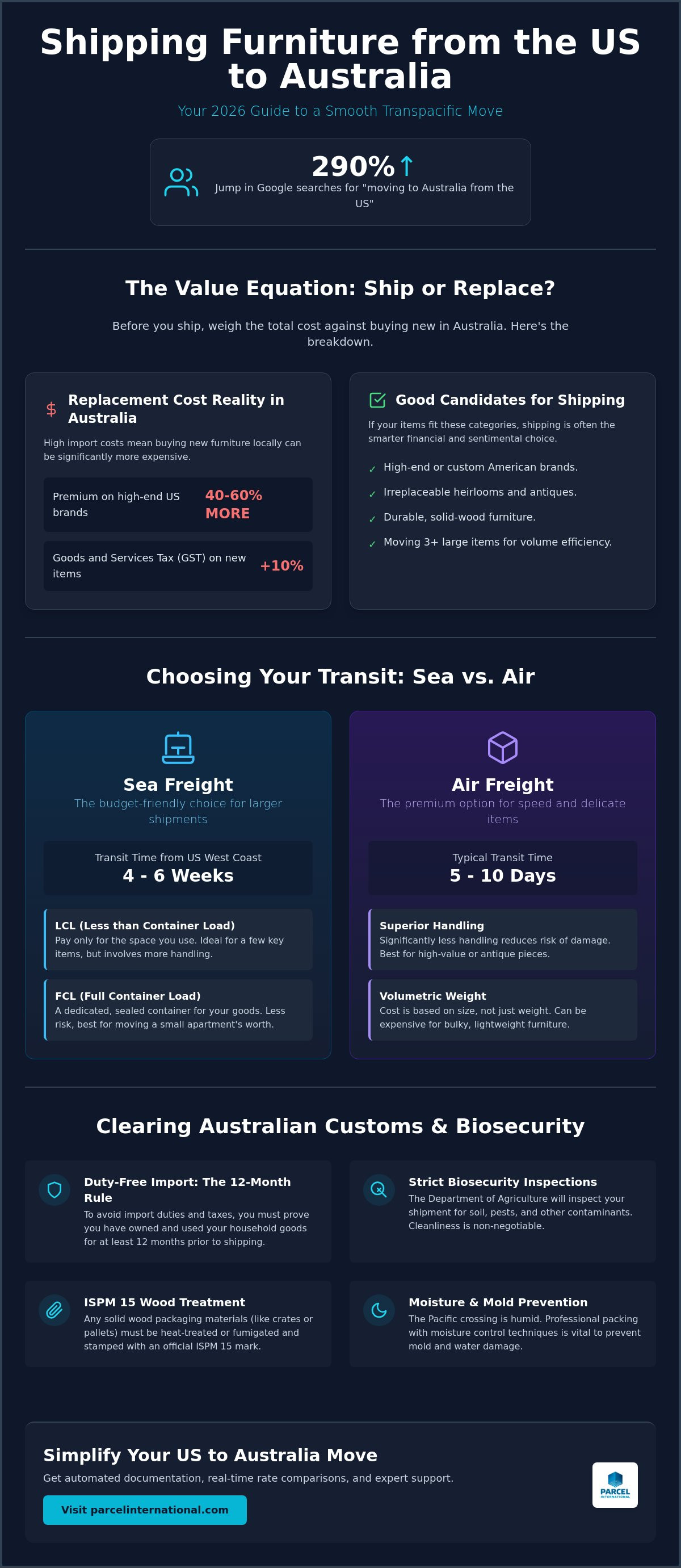
Australia’s furniture market in 2026 reflects high import costs and a smaller competitive landscape than the US. If you own high-end or custom American brands, expect to pay a premium of 40% to 60% more to buy equivalent quality once you land. This price gap exists because Australian retailers must account for their own logistics and a 10% Goods and Services Tax (GST) on all new purchases. For those accustomed to the premium outdoor living standards seen in projects by BigDecks, finding comparable craftsmanship in a new country can be challenging and expensive. While basic flat-pack items aren't worth the sea voyage, your solid wood dining sets or designer sofas often represent a significant saving if shipped rather than replaced locally. Use a simple rule: if the item's quality exceeds what you can find at a standard big-box retailer, it's likely a candidate for shipping.
The 2026 "Sentimental Value" Audit
Don't just look at the price tag; look at the history. Heirloom pieces and antiques are irreplaceable by definition. Before you book Sea Freight, perform a durability check. Solid timber and well-constructed antiques generally survive the 4-6 week voyage across the Pacific well, provided they are prepared correctly. Economically, shipping 3 or more large items often triggers a more favorable rate per cubic meter. This volume sweet spot makes it more logical to fill a portion of a container rather than sending a single, isolated piece. We recommend inventorying your must-have items first to see if you reach this efficiency threshold.
Consider the environmental impact of your move as well. New manufacturing often carries a heavier carbon footprint than moving existing goods through established shipping lanes. If you only have a few small, high-value items, Express Shipping might be your best path. It avoids the complexities of bulk freight and gets your essentials to your new home in days rather than months. For larger volumes, our Customs Support ensures you don't face unexpected barriers or hidden fees at the border. We focus on transparency so you can choose the most sustainable and cost-effective route for your lifestyle.
Air Freight vs. Sea Freight: Choosing Your Shipping Mode
Choosing the right mode for shipping furniture from usa to australia depends on your timeline and the specific volume of your shipment. Most traditional movers steer you toward sea containers; however, the logistical landscape of 2026 offers more nuanced options. You must weigh the deep cost savings of ocean transit against the speed and superior handling of air cargo. Your decision should be based on a clear understanding of how each method impacts both your budget and the physical integrity of your belongings.
Sea Freight: LCL vs. FCL Explained
Ocean transport remains the backbone of international relocation. For those moving a few select items, Less than Container Load (LCL) allows you to pay only for the cubic meters you occupy. It is an efficient way to avoid the expense of a full container. However, co-loading with other cargo increases handling at consolidation hubs. If you have enough to fill a small apartment, a 20ft Full Container Load (FCL) provides a dedicated, sealed environment for your goods. This reduces the risk of damage during the typical 4 to 6 week transit from the US West Coast to ports like Sydney or Melbourne. We recommend professional packing to mitigate the vibrations and shifting that occur during long-haul sea voyages.
For shipments departing from the US East Coast, the voyage typically includes a transit through the Panama Canal. To learn more about the specialized ship agencies that facilitate these critical maritime passages, visit Adimar Shipping, Inc..
Air Freight for High-Value Furniture
Don't dismiss Air Freight as strictly for small parcels. In 2026, many owners of high-value designer pieces or delicate antiques choose air transport to minimize handling. Air cargo significantly reduces the time your furniture spends in high-humidity environments, which helps prevent the mold and moisture damage sometimes associated with the Pacific crossing. Carriers calculate these costs based on "Volumetric Weight," a formula that considers the space an item occupies rather than just its mass. If your furniture is lightweight but bulky, air freight might carry a premium. However, for a single heirloom piece that needs to arrive in 5 to 8 days, the added security and speed are often justified.
The most successful moves in 2026 often utilize a "Hybrid Logistics" model. Send your essential home office setup or a single bed by air to ensure you are functional immediately upon arrival. The rest of your heavy dining sets and wardrobes can follow via sea freight. This approach balances immediate needs with long-term cost efficiency. To find the most effective balance for your specific inventory, you can compare real-time freight rates across multiple modes instantly. This transparency allows you to build a custom shipping plan that fits your budget without sacrificing the safety of your belongings.
Navigating Australian Customs and Biosecurity Requirements
Australia maintains some of the most rigorous biosecurity controls on the planet. When shipping furniture from usa to australia, your shipment isn't just clearing a financial hurdle; it's passing a biological safety check. The Department of Agriculture, Fisheries and Forestry (DAFF) updated their standards for 2026 to further protect the local ecosystem from invasive pests. Failure to meet these requirements doesn't just mean a delay. It can lead to expensive on-arrival treatments, the destruction of your goods, or immediate re-export at your expense.
Specific seasonal risks also dictate your shipping schedule. The Brown Marmorated Stink Bug (BMSB) seasonal measures apply to all furniture manufactured in or shipped from the US between September and May. During these months, your cargo must undergo mandatory offshore treatment before it reaches Australian waters. We provide the necessary Customs Support to ensure your goods meet these seasonal mandates without the friction of last-minute compliance issues.
Mandatory Wood Treatment and ISPM 15
Wooden crates and pallets are the primary focus of biosecurity officers. Ensure every piece of timber packaging carries the ISPM 15 stamp, which proves the wood has been heat-treated or fumigated to kill wood-boring pests. If an officer cannot find this mark, they will order on-arrival fumigation, adding significant fees to your landing costs. To eliminate this risk entirely, consider using plastic or heavy-duty cardboard pallets for your furniture. Avoid shipping items made of untreated raw wood, cane, or bamboo, as these materials are frequently flagged for high-risk pest activity and may be denied entry.
Automating Your Customs Documentation
The Australian Border Force (ABF) requires a precise paper trail to clear your household goods. You must provide an accurate Bill of Lading, a detailed Commercial Invoice, and a comprehensive Packing List. When valuing used furniture, be realistic. Use the current market value rather than the original purchase price to ensure you aren't overpaying on potential duties. Managing these forms manually often leads to errors that trigger manual inspections. You can learn more about international shipping customs documentation to see how automated tools can generate these declarations in seconds. This transparency removes the guesswork and ensures your shipment moves through the terminal with professional efficiency.
Our goal is to act as your stable intermediary in this complex market. By stripping away the typical anxieties of global logistics, we help you focus on your new life in Australia rather than the fine print of biosecurity laws. Reliability starts with clear documentation and a thorough understanding of the 2026 regulatory environment.
Packing and Preparation: Ensuring Your Furniture Survives the Pacific
The physical journey across the Pacific is the most rigorous stage of shipping furniture from usa to australia. Your belongings will spend weeks in a steel container, subject to dramatic temperature fluctuations and the constant rhythmic movement of the sea. Successful arrivals in 2026 depend on a combination of strategic disassembly and advanced moisture protection. By reducing the cubic volume of your items, you don't just lower your freight costs; you also minimize the surface area vulnerable to impact during transit.
The Art of Disassembly
Flat-packing is your most effective defense against structural failure. Remove legs from tables and sofas to prevent them from snapping under the weight of shifting cargo. Secure all hardware in labeled, heavy-duty bags and tape them directly to the underside of the corresponding furniture piece. If you still have the original assembly manuals, secure them to the item as well. This disciplined approach ensures you can rebuild your home quickly once you arrive in Sydney or Brisbane. For items that cannot be disassembled, utilize the "Nested Packing" technique. This involves placing smaller, soft items like pillows or cushions inside drawers and wardrobes to maximize every cubic inch of your paid container space.
Protection Against the Sea Environment
Standard bubble wrap is often insufficient for a transpacific voyage. We recommend "Export Wrap," a multi-layered, breathable material designed specifically for long-haul maritime transit. Unlike standard plastic films that can trap heat and cause finishes to "sweat," export wrap provides a heavy cushion while allowing the furniture to breathe. Pay special attention to pressure points on heavy wardrobes and dining tables. You should double-pad the corners with corrugated cardboard to prevent rubbing against the container walls or other cargo.
Moisture is the silent enemy of sea freight. As the container moves through different climate zones, "container rain" or condensation can form on the interior ceiling. To prevent mold, mildew, and wood warping, place high-capacity silica gel desiccants throughout the shipment. In 2026, the industry has shifted toward eco-friendly alternatives to traditional Styrofoam. Utilize biodegradable mushroom packaging or recycled honeycomb cardboard, which provide superior shock absorption without the environmental toll of plastic-based foams.
Relieving the stress of packing starts with having a logistics partner that understands the stakes. You can get a precise furniture shipping quote today to see how our Sea Freight and Air Freight options compare for your specific inventory. Our transparent process ensures you only pay for the space you use, with no hidden fees for handling or documentation.
How Parcel International Simplifies Your US-to-Australia Move
Relocation is often a fragmented process involving dozens of browser tabs and manual spreadsheets. We strip away this complexity by providing a single, unified platform for shipping furniture from usa to australia. Instead of waiting days for a manual quote, you gain immediate access to a network of global carriers. This transparency ensures you can make decisions based on real-time data rather than guesswork. We act as your stable intermediary, ensuring that your transition to the Australian market is as orderly as it is efficient.
Our system automates the most friction-heavy part of the move: the paperwork. By generating your Australian customs forms in seconds, we eliminate the risk of manual entry errors that often lead to terminal delays. You'll see the total cost upfront. We don't hide destination fees or surprise port charges in the fine print. This direct approach values your peace of mind and your budget. You get the relief of a professional workflow without the typical corporate jargon or hidden requirements.
The Broker Advantage: Finding Wholesale Rates
We leverage high shipment volumes to provide you with discounted rates that aren't typically available to individual shippers. Our platform allows you to compare real-time pricing from DHL, FedEx, and UPS alongside specialized sea freight providers. Whether you require a high-stakes "White Glove" service or a standard "Port-to-Port" option, the choice remains entirely in your hands. To understand how these costs are structured in the current market, you can Compare international shipping rates for your furniture move.
Tracking and Reliability
A transpacific voyage is a long time to be without your belongings. Our platform provides real-time tracking so you can monitor your shipment's progress across the ocean with total clarity. While we prioritize security and punctuality, the nature of global logistics makes cargo insurance a non-negotiable requirement for furniture shipments. It protects your investment against the rare but possible risks of the sea environment. Our 2026 support team is also available to provide expert guidance on US export requirements, ensuring you remain compliant at every milestone.
Don't let the complexity of global logistics stall your move. Our Customs Support and freight options are designed to be inclusive and adaptable to your specific needs. If you're ready to move from planning to action, Get an instant furniture shipping quote and start your move to Australia today.
Master Your Move to the Land Down Under
Successful relocation requires a strategic blend of volume optimization and strict adherence to biosecurity laws. By now, you understand that shipping furniture from usa to australia is a viable, cost-effective choice when you prioritize high-value items and prepare them for the long-haul sea voyage. You have the tools to calculate replacement costs, navigate the 12-month duty-free rule, and pack with the precision needed to survive the Pacific crossing. Orderly planning is your best defense against the typical anxieties of global logistics.
We provide a unified solution to replace fragmented, high-anxiety workflows. Our platform allows you to access wholesale rates from top-tier carriers and compare shipping options across 220+ countries instantly. We eliminate procedural friction with automated customs paperwork, ensuring your belongings move through the terminal without hidden fees or unexpected delays. This transparency puts the control back in your hands.
Compare 2026 Shipping Rates to Australia today and experience the relief of working with a transparent, professional logistics partner. Your new home in Australia is waiting, and we're here to ensure your favorite furniture arrives exactly when you do.
Frequently Asked Questions
How much does it cost to ship a single sofa from the USA to Australia in 2026?
The cost for shipping furniture from usa to australia, specifically a single sofa, depends on its total cubic volume and your choice of transport mode. Most sea freight carriers charge based on a minimum of one cubic meter for Less than Container Load (LCL) shipments. You should also account for terminal handling and delivery fees at the Australian destination port. Get a real-time quote to see the exact breakdown for your specific piece.
How long does sea freight take from the US West Coast to Sydney?
Sea freight from the US West Coast to Sydney typically takes between 4 and 6 weeks. This timeline covers the ocean crossing and the time required for port consolidation and customs clearance. Factors like weather conditions and port congestion in Melbourne or Sydney can impact the final arrival date. Always check the current sailing schedule when booking your shipment to ensure it aligns with your relocation timeline.
Do I have to pay import duty on my used personal furniture in Australia?
You don't have to pay import duty or GST on furniture if you have owned and used the items for at least 12 months before they arrive in Australia. This exemption applies to unaccompanied personal effects under the "12-month rule." You must provide proof of ownership and complete the B534 Unaccompanied Personal Effects Statement. The Australian Border Force will then assess your claim for a duty-free entry.
What is ISPM 15 and why does my furniture crate need it?
ISPM 15 is an international biosecurity standard that ensures the safety of shipping furniture from usa to australia by requiring timber packaging to be heat-treated. This process kills wood-boring pests that could threaten the Australian ecosystem. Ensure your shipping crates have the official ISPM 15 stamp clearly visible. If they don't, your shipment will face mandatory treatment, expensive fumigation fees, or destruction upon arrival at the port.
Can I ship furniture made of bamboo or cane to Australia?
Shipping furniture made of bamboo, cane, or rattan is possible but carries a very high risk of biosecurity intervention. The Department of Agriculture often flags these materials for manual inspection because they can harbor invasive insects. If pests are found, the items must be treated at your expense or destroyed. It's often safer to sell these items in the US rather than risking a customs rejection and the associated costs.
Is it better to ship furniture via LCL or FCL?
Choose Less than Container Load (LCL) if you are shipping just a few pieces, as you only pay for the cubic space you occupy. If you are moving the contents of a two-bedroom home or more, a Full Container Load (FCL) is usually more cost-effective. FCL also offers better protection for your belongings. Your furniture isn't co-loaded with other shippers' goods in a shared container, reducing the risk of handling damage.
What happens if my furniture arrives damaged in Australia?
If your furniture arrives damaged, you must document the condition immediately and notify your shipping provider. Take clear photos of the packaging and the item before it leaves the port or warehouse. This documentation is essential for filing a claim through your cargo insurance. We always recommend comprehensive insurance to protect against the physical risks of transpacific transit. It provides the financial relief needed if the sea environment causes unexpected structural issues.
Does Australia require fumigation for all furniture shipments from the USA?
Australia doesn't require fumigation for every shipment, but mandatory measures apply during the Brown Marmorated Stink Bug (BMSB) season from September to May. During these months, furniture manufactured in or shipped from the US must undergo offshore treatment. Outside of this season, thorough cleaning is usually enough to pass biosecurity. Officers must not find evidence of pests, soil, or organic matter during their inspection to grant clearance without treatment.


Comments