
Small Business Logistics Platform: The 2026 Guide to Integrated Freight
- Alex
- Aug 1
- 11 min read
Updated: Aug 16
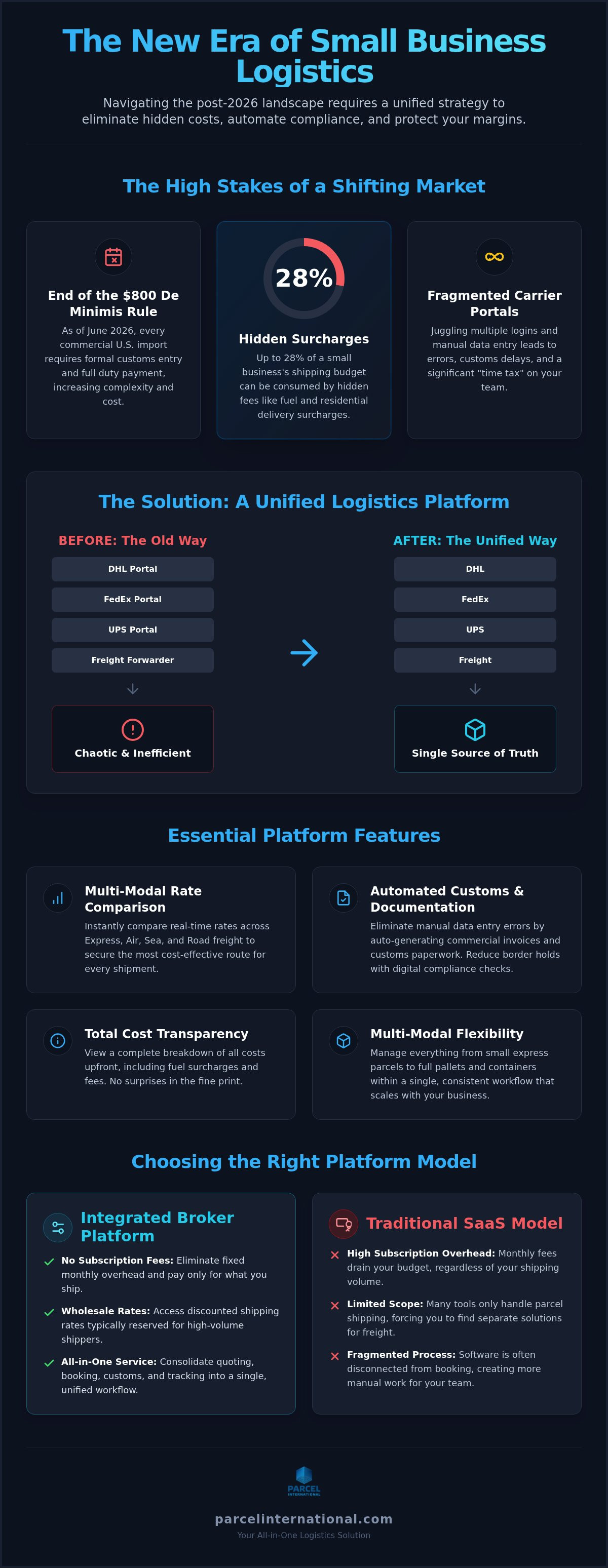
With the permanent suspension of the $800 de minimis rule as of June 2026, every commercial shipment entering the US now requires formal customs entry and full duty payment. This regulatory shift, combined with hidden surcharges that can account for up to 28% of your shipping budget, makes finding a reliable small business logistics platform more critical than ever. You likely feel the pressure of logging into multiple carrier portals just to compare rates or fix manual paperwork errors. It's a chaotic process that steals time from your core business operations and slows down your growth.
You deserve a more efficient way to move goods without the burden of high subscription overhead. This guide explains how to leverage a unified system to consolidate your express, air, sea, and road freight into one transparent dashboard. You'll learn how to automate commercial invoices, access wholesale shipping rates, and maintain total flexibility with a no-contract model. We'll break down the essential strategies to eliminate manual workflows and protect your margins in this high-stakes environment.
Table of Contents
What is a Small Business Logistics Platform?
A small business logistics platform is a digital ecosystem that centralizes quoting, booking, and tracking for every transport mode your company uses. For years, managing Logistics meant juggling dozens of browser tabs, dozens of passwords, and endless manual spreadsheets. The 2026 landscape has changed that. The industry has moved toward a "single source of truth" model. This shift allows you to manage everything from a single dashboard rather than logging into fragmented carrier portals. It's about taking a chaotic, manual process and making it orderly. Reliability is the new standard.
There is a critical distinction between parcel-only software and a comprehensive freight management solution. Many tools only handle small courier packages. A true logistics platform for growth includes Express Shipping alongside Sea, Air, and Road Freight. This integration ensures that whether you're sending a single document or a full container, the workflow remains identical. You don't need different teams or different tools for different modes of transport. It's a unified approach that scales as your inventory needs become more complex. Data drives better decisions.
The Three Pillars of Modern Logistics Tech
Modern platforms are built on three essential capabilities. First, rate aggregation brings transparency to your spending. You can view multiple carrier options in a single interface to find the best value instantly. Second, operational visibility provides end-to-end tracking. You see exactly where your goods are, from the moment they leave the warehouse until they reach the final destination. Finally, administrative automation handles the paperwork. It generates commercial invoices and customs forms automatically. This removes the administrative friction that typically blocks small businesses from expanding internationally. It's fast and efficient.
The True Cost of Manual Logistics
Relying on manual workflows creates significant financial leaks. Human error in documentation is the most common reason for expensive customs delays. A simple typo can result in your cargo sitting in a warehouse for weeks. There is also a hidden "time tax" when your team manages fragmented carrier workflows. Chasing tracking numbers and manually entering data takes hours away from high-value tasks. Beyond time, there's the direct cost of missed savings. Research shows that hidden surcharges can account for up to 28% of a small business's shipping budget. If you aren't comparing rates in real-time, you're likely overpaying for every shipment you send. Efficiency isn't just a luxury; it's a requirement for maintaining your margins.
Essential Features for Your SMB Logistics Dashboard
Your logistics operations are only as strong as the data you can see. A high-quality small business logistics platform doesn't just track packages; it provides the intelligence you need to make profitable decisions. Stop logging into multiple carrier sites to compare prices. A modern dashboard provides real-time rate comparisons across Air Freight, Sea Freight, Road Freight, and Express Shipping simultaneously. This multi-modal approach is the only way to ensure you're always choosing the most efficient route for your specific cargo. It's about taking control of your margins.
Transparency is a central pillar of any reliable system. Many brokers hide surcharges in the fine print, but an egalitarian partner displays every cost upfront. This includes fuel surcharges, residential delivery fees, and broker charges. By using a unified interface that integrates direct partnerships with carriers like DHL, FedEx, and UPS, you eliminate the procedural friction of fragmented workflows. You gain the relief of knowing your shipments are handled by industry leaders through a single, secure entry point. Efficiency is the natural result of order.
Automated Customs and Documentation
Manual data entry is the primary cause of shipping delays. Your platform must generate international shipping customs documentation automatically based on your booking details. Digital compliance checks significantly reduce the risk of border holds by ensuring every commercial invoice is accurate and complete. This automation also provides precise duty and tax estimates before the shipment leaves your facility. You don't have to guess about total landed costs. It's a straightforward process that values your peace of mind.
Multi-Modal Flexibility for Growing Brands
Growth often requires moving from small parcels to full pallets or containers. Many software solutions only handle courier packages, forcing you to find a new provider as you scale. A versatile small business logistics platform manages everything from a single envelope to a full sea container in one tool. This includes leveraging European road freight for regional distribution alongside global air routes. You can scale from domestic shipping to complex global exports without the headache of changing your software. If you want to see how this integration works in practice, you can explore unified shipping options that adapt to your specific volume needs. Reliability shouldn't be complicated.
SaaS vs. Integrated Broker Platforms: The 2026 Comparison
Choosing a small business logistics platform often feels like a choice between two distinct business models: standalone SaaS or integrated broker-tech. Standalone SaaS tools frequently offer high feature density, but they come with a recurring monthly overhead that eats into your margins. In contrast, integrated broker platforms provide enterprise-level technology as a core part of their logistics service. For agile brands, including those in the food and beverage sector like La Pino'z Pizza, the zero-subscription model is becoming the standard. It aligns your technology costs directly with your shipping volume rather than forcing you into a fixed monthly expense.
When you evaluate the Total Cost of Ownership (TCO) for your shipping tech, look beyond the initial sticker price. Consider the labor hours spent managing the software and the actual cost of the freight moving through it. A SaaS tool is often just a shell. You still have to bring your own carrier accounts and negotiate your own rates. An integrated platform acts as a stable intermediary. It gives you the dashboard and the carrier relationships simultaneously. This removes the procedural friction of managing separate contracts and invoices. It's a more orderly way to operate.
The Hidden Burden of Monthly Subscriptions
Subscriptions create a software lock-in effect. Once you've integrated a paid tool into your warehouse workflow, switching becomes difficult, even if the carrier rates are no longer competitive. You often end up paying for enterprise-grade features that your business doesn't require yet. Flexibility is a major competitive advantage in a volatile market. By removing fixed monthly costs, you can pivot your strategy without being weighed down by a financial commitment to a software vendor. It's about maintaining control over your overhead.
The Broker-Platform Advantage
Integrated platforms offer a distinct path for growth. They allow you to access international shipping for ecommerce at wholesale rates because the broker aggregates volume from thousands of small businesses. You gain professional logistics support that goes far beyond a standard software help ticket. When a shipment encounters a delay, you need a partner who understands transport modes, not just a technician. This model delivers professional-grade technology without the rigid contracts or volume minimums of traditional SaaS. It's an egalitarian approach that puts your brand on the same playing field as global corporations. Reliability becomes an accessible asset rather than a paid luxury.
How to Implement a Logistics Platform Without the Headache
Transitioning to a small business logistics platform doesn't require a total overhaul of your existing operations overnight. It's a sequential process designed to replace chaos with order. Start by conducting a 30-day audit of your current volumes and primary destinations. This data reveals where you're overpaying and which carriers consistently meet your deadlines. Once you have this baseline, you can consolidate your fragmented carrier accounts into a single dashboard. This move eliminates the need to manage multiple logins and invoices, providing immediate relief for your administrative team. It's a straightforward path to efficiency.
Automation is the next logical step in your journey. By automating your documentation workflow, you eliminate the manual data entry that leads to costly customs errors. Finally, train your fulfillment team on the centralized tracking dashboard. When everyone uses a single source of truth, communication improves and disruptions are handled faster. Reliability becomes the default state of your supply chain. You don't have to deal with the procedural friction that typically slows down growing brands. You simply follow the instructions and watch the complexity fade away.
Auditing Your Logistics Strategy
Identifying your most frequent shipping lanes is essential for rate optimization. You might find that certain regions are better served by specific transport modes you haven't explored yet. It's often helpful to consult with a freight forwarder to determine the most efficient balance between Air Freight speed and Sea Freight savings for different product lines. For instance, high-value electronics might require the urgency of air, while bulk inventory can move more economically by sea. This strategic layering ensures you aren't wasting budget on unnecessary speed. It's about being an optimizer.
Streamlining the Booking Workflow
Efficiency in the warehouse starts with the ability to compare international shipping rates instantly. Instead of waiting for manual quotes, your team can see real-time options for Express Shipping and Road Freight side-by-side. You can also set up package presets for your most common box sizes and weights. This reduces quoting time for repeat orders to just a few seconds. Combine this with "one-click" commercial invoice generation, and you've removed the primary barriers to international trade. If you're ready to stop the manual struggle, you can access a unified logistics dashboard today to see these tools in action. Order is just a click away.
Parcel International: Your All-in-One Logistics Solution
Parcel International acts as the stable bridge your company needs to navigate the complexities of global trade. As a comprehensive small business logistics platform, we offer a unified interface for every mode of transport you require:
Express Shipping
Sea Freight
Air Freight
Road Freight
You don't have to worry about recurring monthly overhead because we operate with zero subscription fees. Our model ensures your technology costs only scale when your shipping volume does. It's a transparent, orderly approach to an industry that is often intentionally opaque. By removing traditional barriers like volume minimums and restrictive contracts, we provide an egalitarian solution for brands at any stage of growth. We believe reliability should be accessible to everyone.
Radical transparency is a core pillar of our identity. You can compare real-time rates from the world's leading carriers, including DHL, FedEx, and UPS, in a single window. This eliminates the need to cross-reference multiple sites or deal with hidden surcharges. Our automated customs support handles the heavy lifting of global documentation, ensuring your cargo moves across borders without procedural friction. From our headquarters in Rotterdam, our experts provide dedicated support with a global reach that extends to over 220 countries. Established in 2007, we've spent nearly two decades refining our processes to better serve your needs.
Why 20,000+ Businesses Scale with Our Platform
Over 20,000 businesses have chosen our platform to optimize their supply chains. We take an "optimizer" approach, turning chaotic shipping workflows into streamlined, orderly processes. You gain access to enterprise-level technology that was previously reserved for global corporations. We prioritize security and punctuality, ensuring your brand's reputation remains intact with every delivery. There are no hidden fees or surprise broker charges. We simply provide the tools and direct carrier partnerships you need to succeed in a volatile market. It's fast, secure, and efficient.
Optimize Your Freight Management Today
Setting up your account takes only a few minutes. You can set up package presets and get your first international quote in seconds. This speed allows you to maintain the agility of a small business while leveraging the reach of a global logistics giant. We bridge the gap between your local operations and your international ambitions. Don't let manual workflows or high software costs hold your growth back. Register for free and optimize your freight management today to see how an integrated platform can transform your strategy. Reliability is just a click away.
Future-Proof Your Logistics Strategy
The shift toward a unified small business logistics platform is no longer a luxury for growing brands; it's a strategic necessity. You've seen how centralizing your Express, Sea, Air, and Road freight into a single dashboard eliminates the procedural friction of manual spreadsheets and fragmented carrier portals. By choosing an integrated broker model over high-overhead SaaS, you protect your margins while gaining the enterprise-level automation required for the complex regulatory environment of 2026.
Reliability and transparency are the foundations of successful global trade. You can now access direct rates from DHL, FedEx, and UPS without being weighed down by restrictive contracts or hidden fees. Automated customs documentation ensures your shipments move across borders with speed and security, providing the relief of an orderly, predictable workflow. Stop struggling with the time tax of outdated logistics and start scaling with a partner that values your peace of mind. It's a straightforward path to sustainable growth.
Streamline your logistics and get instant freight quotes now to experience the efficiency of a platform with no subscription fees required. It's time to turn your shipping operations into a competitive advantage.
Logistics and Freight FAQs
What is the best logistics platform for a very small business?
The best platform is one that provides enterprise-level tools without requiring high volume or monthly fees. For a very small business, a broker-based system offers the most value by aggregating volume to unlock wholesale rates that wouldn't be accessible otherwise. This egalitarian approach ensures you can compete with larger brands from day one. It's about finding a partner that values your growth.
Do I need to pay a monthly fee for freight management software?
No, you don't need to pay a monthly fee for professional freight management. While many SaaS providers charge recurring subscriptions, integrated broker platforms provide their technology for free as part of the service. You only pay for the actual shipments you book. This keeps your overhead low and your cash flow flexible. It's a transparent way to manage costs.
Can a logistics platform help with international customs documentation?
Yes, a modern small business logistics platform automates the creation of commercial invoices and customs forms. This automation uses your booking data to generate accurate paperwork, which significantly reduces the risk of border delays. Given the 2026 regulatory shifts, having digital compliance checks built into your workflow is essential for international growth. It provides the relief of knowing your documentation is correct.
What is the difference between shipping software and a logistics platform?
Shipping software often focuses exclusively on small parcel courier tasks and e-commerce store integrations. A logistics platform is a more comprehensive ecosystem that manages Express Shipping, Sea Freight, Air Freight, and Road Freight in one place. It serves as a single source of truth for your entire supply chain. It handles more than just last-mile deliveries; it manages the whole journey.
Can I integrate my existing DHL or UPS account into a new platform?
Most integrated platforms allow you to either use their pre-negotiated wholesale rates or integrate your own carrier accounts. This flexibility is vital if you have specific volume-based discounts with partners like DHL, FedEx, or UPS. You can manage your private contracts alongside the platform's rates. This ensures you always choose the most cost-effective option for every shipment. You stay in control.
How much can a small business save by using logistics automation?
Small businesses frequently save on direct shipping costs by eliminating hidden surcharges and comparing real-time rates. Beyond direct spend, automation removes the "time tax" of manual data entry. It also reduces expensive customs penalties caused by human error. Research indicates that hidden surcharges can account for up to 28% of a shipping budget, a cost that automation helps identify and remove.
Does a logistics platform handle Sea and Air freight or just parcels?
A comprehensive small business logistics platform handles all transport modes, including sea containers and air cargo. While some tools are limited to parcels, a growth-oriented solution scales with you as you move from small packages to full pallet shipments. This multi-modal capability allows you to manage regional road distribution and global exports through a single dashboard. Reliability shouldn't be limited by size.
How long does it take to set up a freight management platform?
Setting up a freight management platform usually takes only a few minutes. You can register for an account, set up your package presets, and generate your first international quote almost instantly. There are no complex software installations or long-term contracts to sign. You can begin optimizing your shipping workflow on the same day you sign up. It's fast and efficient.


Comments