
Small Business Shipping Software: The Complete 2026 Guide to Scaling Your Logistics
- Alex
- 13 hours ago
- 12 min read
In 2026, major carriers like UPS and FedEx implemented a 5.9% average rate increase, while USPS Ground Advantage hiked prices by 7.8%. For many entrepreneurs, these rising costs are compounded by hidden subscription fees just to access the tools needed to print a simple label. You shouldn't have to pay a monthly tax on your business growth. Finding the right small business shipping software means more than just comparing local parcel rates. It's about gaining a unified view of air, sea, and road freight without the overhead of a recurring contract.
You've likely felt the frustration of complex customs paperwork causing international delays or the headache of switching between platforms to compare a small box versus a pallet. We believe logistics should be a bridge to your customers, not a barrier of red tape and surprise invoices. This guide reveals how to automate documentation for over 220 countries and tap into wholesale carrier rates through a single, transparent dashboard. We'll walk you through the 2026 regulatory changes, including the removal of the EU de minimis exemption, and show you how to scale your logistics without adding a single line item to your monthly software budget.
Table of Contents
What is Small Business Shipping Software and Why Does it Matter in 2026?
At its core, small business shipping software is a centralized digital hub that connects your storefront to a network of global carriers. Instead of logging into individual portals for every shipment, you access a single interface to compare real-time rates, generate labels, and track packages. This technology is a specialized subset of Supply Chain Management Software, designed to strip away the procedural friction that typically stalls small-scale operations. It transforms shipping from a manual clerical task into an automated logistics strategy.
By aggregating the shipping volume of thousands of users, these platforms act as a digital broker. This allows you to access wholesale rates that were previously reserved for high-volume corporations. The best solutions in 2026 operate on a transparent, no-subscription model, ensuring you only pay for what you ship. The impact on your bottom line is immediate. You gain the ability to provide accurate shipping costs at checkout, reduce human error in address entry, and reclaim hours spent on administrative paperwork.
The Evolution of SMB Logistics
Logistics used to mean managing a stack of browser tabs and paper manifests. Today, fragmented workflows are a liability. In 2026, the global shipping market is increasingly volatile. Prices fluctuate and regulations change overnight. Modern small business shipping software must do more than just process small parcels. To scale, your business needs a dashboard that manages express shipping alongside air, sea, and road freight. Having real-time data at your fingertips ensures you never overpay for a lane or miss a delivery deadline due to outdated information.
Software vs. Traditional Freight Forwarding
Traditional freight forwarding often feels like a "black box" where quotes take days and tracking is sporadic. Digital platforms bridge this gap by providing the agility of a local courier with the global reach of a seasoned forwarder. This transparency is vital for building trust with international customers who expect to know exactly where their order is at every stage. By automating customs support and providing clear visibility across all transport modes, you eliminate the anxieties of global trade. Shipping software is the primary growth engine that allows small businesses to compete on a global stage without the need for a dedicated logistics department.
Essential Features to Look for in a Shipping Platform
Selecting the right small business shipping software requires looking past basic label generation. In 2026, a competitive advantage comes from a platform that provides no-subscription access to wholesale rates across all transport modes. You'll need a tool that scales with your order volume without imposing fixed monthly costs. It's about finding an optimizer that simplifies the chaotic parts of logistics. Look for these core capabilities to ensure your operations remain efficient:
Omnichannel Integration: Seamlessly connect your Shopify, eBay, or Amazon stores to sync orders automatically.
Branded Tracking: Maintain customer trust with proactive notifications and tracking pages that feature your own logo.
Real-Time Comparison: View live rates for express, air, sea, and road freight on a single screen.
Compliance Automation: Generate essential trade documents without manual data entry.
Building a robust global shipping strategy starts with identifying tools that automate the most time-consuming parts of the supply chain. This allows you to focus on product development while the software handles the heavy lifting of carrier selection and documentation. Don't settle for platforms that limit your reach to local couriers when global markets are within reach.
Multi-Modal Transport Capabilities
Your logistics needs will change as your business grows. A platform that only handles small parcels will eventually become a bottleneck. Modern small business shipping software should allow you to pivot between express services and sea freight based on the urgency and size of the shipment. For example, you might use express air for a restock of high-demand items while utilizing LCL (Less than Container Load) for your bulk inventory shipments. Integrating international parcel shipping into your daily workflow ensures you have the flexibility to reach customers in over 220 countries and territories. You can compare multiple shipping modes in seconds to find the best balance between cost and speed for every unique order.
Automated Customs and Trade Compliance
International borders can be a source of significant anxiety for small businesses. Manual paperwork often leads to procedural friction, resulting in delayed deliveries and frustrated customers. To mitigate this, choose a platform that offers automated international shipping customs documentation. The software should automatically generate commercial invoices and packing lists based on your order data. This automation ensures that all required fields are populated correctly, reducing the risk of customs holds. By stripping away the complexity of global trade regulations, you can ship with the same confidence as a domestic delivery.
Subscription Fees vs. Transactional Transparency: Calculating Real Cost
Many platforms market themselves as affordable while burying high-volume requirements in the fine print. For a growing company, every dollar counts. Choosing small business shipping software that charges a flat monthly fee can inadvertently create a "growth tax." You end up paying for features and capacity you aren't yet using. A transactional model, however, aligns your costs perfectly with your revenue. You only pay when you actually ship a product.
This "Optimizer" mindset is about stripping away the typical anxieties of logistics. By removing the barrier of a recurring fee, you gain the freedom to scale up or down based on market demand. You shouldn't be penalized for a slow month or forced into a higher tier just because you've reached a new level of success. Real-time transparency ensures that your logistics costs remain a variable expense rather than a fixed burden on your balance sheet.
The True Cost of Software Subscriptions
Consider the math. If you pay a $50 monthly subscription but only ship 10 parcels a week, you're effectively adding $1.25 to the cost of every package before you even account for the carrier's fee. For seasonal businesses, this model is even more punishing. You might pay for months of inactivity during your off-season just to maintain your data and store integrations. To protect your margins, you need to identify international shipping rates that are truly wholesale. These rates are achieved through aggregator volume, not through individual user fees.
Radical Transparency in Logistics
Transparency means seeing the all-in price before you commit to a label. Many traditional models hide surcharges or limit access to certain transport modes unless you upgrade to a "Pro" or "Enterprise" tier. An optimizer mindset rejects these barriers. By using a platform that functions as a digital freight forwarder, you gain access to the same economies of scale as a multinational corporation. You don't have to deal with prohibitive categories of fees or hidden administrative costs.
Focus on the total landed cost. This includes the carrier rate, any applicable duties, and the cost of the software itself. When you strip away the monthly subscription, you simplify your accounting and increase your agility. You gain a stable intermediary that values your peace of mind over corporate jargon. This approach ensures that your small business shipping software remains a tool for expansion rather than a fixed overhead burden.
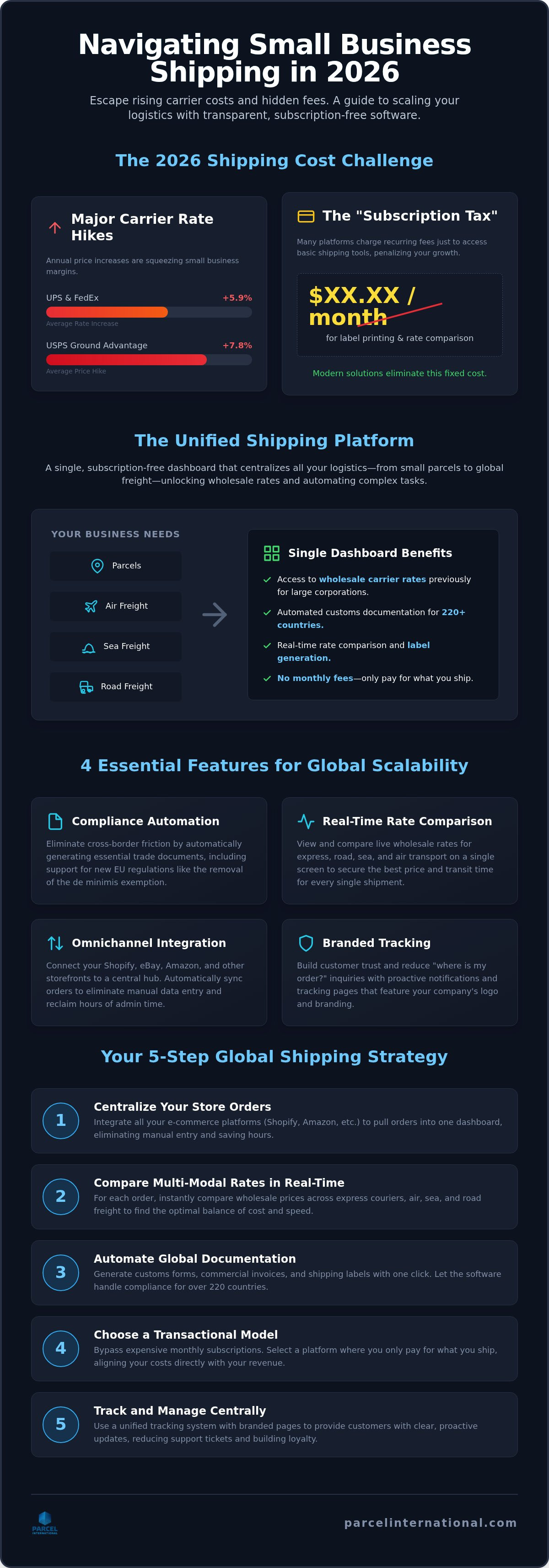
How to Implement a Global Shipping Strategy in 5 Steps
Implementing a global shipping strategy requires a shift from reactive booking to proactive management. Utilizing small business shipping software allows you to handle complexity without increasing your workload. You need a system that optimizes every lane automatically. Follow these five steps to build a scalable logistics framework:
Audit volume and destinations: Review your past shipping data to identify your most frequent and profitable shipping lanes.
Centralize order sources: Connect your Shopify, eBay, and Amazon accounts to a single dashboard to eliminate fragmented workflows.
Automate shipping rules: Set parameters based on weight, destination, and urgency so the software selects the best carrier for every order.
Pre-fill customs profiles: Ensure 100% compliance on every export by automating the generation of commercial invoices and packing lists.
Monitor performance analytics: Use real-time data to track carrier speed and identify new cost-saving opportunities as your volume grows.
This structured approach ensures that you aren't just shipping products; you're building a reliable bridge to your international customers. By automating the repetitive tasks, you reclaim the time needed to focus on business growth and product development.
Auditing Your Logistics Workflow
Identifying bottlenecks in your current label-printing process is the first step toward efficiency. If your team spends hours manually entering data, you're losing money on every shipment. Evaluate which products are best suited for international shipping for ecommerce based on their weight and value. Setting realistic delivery expectations for your global customers is equally important. When you understand your lane performance, you can promise delivery dates with total confidence.
Scaling from Local to Global
Testing new international markets shouldn't be a high-risk gamble. Use small business shipping software to trial different regions with minimal upfront investment. For regional expansion, leverage international road freight rates Europe to move inventory across borders efficiently. This allows you to scale your presence without the need for physical warehousing in every country. Address validation is a critical part of this process; verifying every destination before the label is printed significantly reduces failed deliveries and return shipping costs.
By following this structured approach, you strip away the procedural friction of global trade. You can access wholesale rates and automated customs support immediately, allowing your business to reach its full potential in 220+ countries.
Parcel International: The No-Subscription Software Solution
Parcel International serves as a stable intermediary for businesses that need to move beyond the limitations of standard parcel apps. Most small business shipping software options on the market trap users in tiered subscriptions. We've removed those barriers. You gain access to a global logistics network covering 220+ countries and territories without paying a single monthly fee or meeting volume minimums. This egalitarian approach ensures that whether you're shipping one box or ten containers, you receive the same level of professional expertise.
Our platform provides real-time rate comparisons across every mode of transport. You aren't limited to express couriers. Instead, you can evaluate costs for Sea Freight, Air Freight, and Road Freight in one unified dashboard. Automated customs documentation is bundled into every transaction to strip away the procedural friction of cross-border trade. This means your commercial invoices and packing lists are generated accurately based on your shipment data, preventing the delays that often plague international logistics. We provide the tools you need to act as an optimizer for your own supply chain.
Why 20,000+ Businesses Trust Our Platform
Reliability is built through experience and strong partnerships. Since 2007, we've helped over 20,000 businesses simplify their supply chains. By partnering with industry leaders like DHL, FedEx, and UPS, we provide the security and punctuality your customers expect. Our relief-centered approach is designed to move you from fragmented, multi-platform workflows to a singular, orderly solution. This focus on peace of mind allows you to dedicate your energy to sales and product development rather than administrative hurdles. We treat every small business with the same priority as a global enterprise, ensuring your shipments arrive safely and on time.
Get Started with Parcel International Today
We believe in radical transparency. You don't need a credit card to explore our platform or browse real-time rates. The user interface follows a logical problem-solution framework that guides you through the shipping process in seconds. By removing traditional barriers like volume restrictions and hidden surcharges, we've created a tool that's as flexible as your business needs to be. Stop overpaying for recurring software fees and start optimizing your logistics today. Compare rates for your next shipment on Parcel International to experience a truly barrier-free global shipping strategy. Our small business shipping software is ready to help you reach new markets without the typical anxieties of international trade.
Take Control of Your Global Logistics Today
Scaling your business in a volatile market requires a logistics strategy that is both flexible and transparent. You've seen how the right small business shipping software can transform a fragmented workflow into a streamlined growth engine. By moving away from restrictive monthly subscriptions and embracing a transactional model, you ensure that your shipping costs always align with your actual revenue. Automation isn't a luxury reserved for enterprise giants; it's the standard for any brand looking to eliminate the procedural friction of international trade.
Whether you're shipping express parcels or managing heavy sea freight, the ability to compare rates in real-time is vital for protecting your bottom line. You can now access wholesale pricing and automated customs support for over 220 countries without the burden of fixed overhead. It's time to strip away the anxieties of global logistics and focus on what you do best: building your brand. Start Comparing Global Shipping Rates for Free. Your growth shouldn't be limited by your software, and with the right partner, the world is within your reach.
Frequently Asked Questions
What is the best shipping software for a small business with low volume?
The best software for low volume is a platform that uses a no-subscription model. This prevents fixed overhead from eating into your small margins. Parcel International offers an egalitarian model where you only pay for what you ship. This flexibility is essential for startups that don't yet have predictable monthly volume. You get access to wholesale rates without committing to expensive high-tier plans or meeting strict volume minimums.
Do I need a separate subscription for international customs documentation?
No, you don't need a separate subscription when using a unified logistics platform. High-quality small business shipping software bundles automated customs documentation into every transaction. This feature generates commercial invoices and packing lists based on your shipment data. It strips away the anxiety of manual paperwork and ensures compliance for over 220 countries. This integration eliminates the need for third-party compliance tools or expensive, specialized consulting services.
Can I ship heavy freight like sea or air cargo through shipping software?
Yes, modern platforms allow you to manage more than just small parcels. You can compare real-time rates for Sea Freight, Air Freight, and Road Freight alongside express services. This multi-modal capability is a core feature of the Parcel International dashboard. It allows you to scale your logistics as your inventory grows. You can switch between shipping a single box and a full pallet without logging into different carrier portals.
How does shipping software help reduce international delivery delays?
Shipping software reduces delays by automating address validation and customs documentation. Incorrect paperwork is the primary cause of border friction. By generating digital commercial invoices and packing lists automatically, the software ensures that all required fields are accurate for the destination country. Real-time carrier comparison also allows you to choose the fastest route. This proactive approach helps your shipments clear customs quickly and reach customers in 220+ territories without unnecessary holds.
Is there any shipping software that does not charge a monthly fee?
Parcel International operates on a no-subscription model, meaning there are no monthly fees. You only pay for the shipments you actually book. This transactional transparency is a defining signature of our identity. It allows small businesses to access wholesale carrier rates and professional support without the burden of fixed overhead. This model is ideal for seasonal businesses that need to scale up or down without paying for idle software capacity.
What is the difference between a shipping platform and a carrier like DHL or UPS?
A carrier like DHL or UPS owns the physical transport vehicles and handles the actual delivery. A shipping platform is a digital intermediary that connects you to multiple carriers in one place. Using a platform allows you to compare rates across different providers to find the best value for every lane. It acts as an optimizer by aggregating volume to secure wholesale rates that individual small businesses usually can't access alone.
Can I integrate my Shopify or Amazon store with Parcel International?
Yes, you can centralize your order sources by integrating your e-commerce storefronts. This allows you to sync orders from Shopify, Amazon, or eBay directly into your logistics dashboard. Automating this data flow eliminates manual entry and reduces human error. Once integrated, you can manage your global shipping strategy for all your sales channels from a single, unified interface. This creates a rhythmic, instructional flow for your daily fulfillment tasks and saves hours of work.
How do I generate a commercial invoice for international shipping?
You don't have to create these documents manually. When you book a shipment through the small business shipping software, the platform automatically generates a commercial invoice and packing list. It uses the item descriptions, values, and recipient information already stored in your system. This ensures that your documentation meets the specific requirements of the destination country. It's a key part of our customs support that strips away the procedural friction of global trade.


Comments