
Understanding International Shipping Surcharges: The 2026 Business Guide
- Alex
- 2 hours ago
- 12 min read
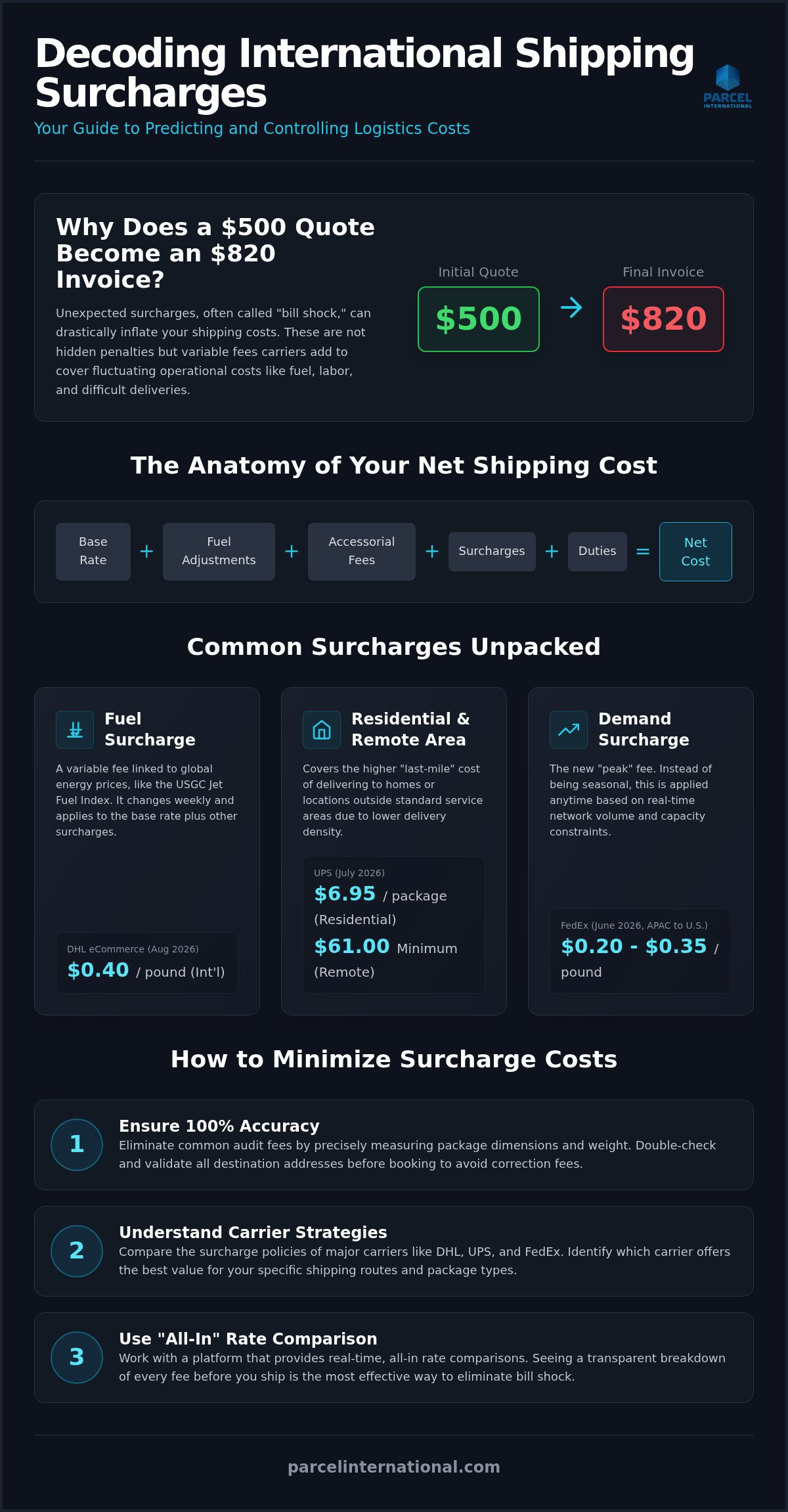
Why does a shipment quoted at $500 arrive with a month-end invoice for $820? If you're tired of "bill shock" draining your profit margins, you're not alone. Most businesses find the constant shift in carrier fees completely unpredictable. Between FedEx's 2026 volume triggers and the rebranded "demand" surcharges replacing traditional peak seasons, it feels like the goalposts are always moving. Developing a better system for understanding international shipping surcharges is the only way to regain control over your logistics budget.
We agree that logistics shouldn't feel like a high-stakes guessing game. You deserve a partner that values transparency over corporate jargon. Our guide promises to strip away the confusion and provide a clear framework for predicting fees before you hit ship. We'll break down the 2026 fuel index averages, explain the impact of new Section 301 tariffs, and show you how to compare all-in rates across carriers like DHL and UPS. By the end of this guide, you'll have the tools to eliminate hidden costs and lower your overall shipping spend through smarter, data-driven planning.
Table of Contents
What are International Shipping Surcharges and Why Do They Exist?
Surcharges are not "hidden" penalties designed to catch you off guard. Instead, they are variable fees added to the base transport rate to cover specific operational costs that fluctuate throughout the year. Carriers like DHL, FedEx, and UPS use these fees to maintain service levels when external conditions change. By understanding international shipping surcharges with a partner like Parcel International, you move from reacting to bills to predicting them. These fees bridge the gap between a static annual contract and the reality of a volatile global market. Transparency is the only way to avoid the friction of unexpected costs at the end of the month.
Carriers distinguish between fixed and index-based fees. Fixed surcharges apply to specific actions or package characteristics, such as a residential delivery or an oversized parcel. Index-based surcharges are more dynamic. They track external benchmarks, most notably fuel indices. This system ensures that the carrier doesn't lose money when jet fuel prices spike; it also means your costs can change weekly without notice. Understanding international shipping surcharges requires recognizing that these aren't arbitrary taxes, but rather necessary cost-recovery mechanisms for volatility in fuel, labor, and capacity.
Base Rate vs. Net Cost: Understanding the Difference
The initial quote you receive from a carrier is rarely the final price. This "base rate" covers the transport from point A to point B under ideal conditions. However, global shipping is rarely ideal. To calculate the final amount you'll actually pay, you must account for several stacked components:
Fuel Adjustments: Variable percentages based on current energy prices.
Accessorial Charges: Fees for extra services like signature requirements.
Administrative Fees: Costs for customs clearance or specialized documentation.
Surcharges: Additional fees for peak demand or difficult delivery zones.
Net Shipping Cost is the sum of the base rate, surcharges, and applicable duties.
The Economic Drivers of Logistics Fees in 2026
Why don't carriers just increase their base rates? Flexibility is the answer. Raising base rates requires massive administrative updates and long-term commitments. Surcharges allow carriers to respond instantly to global energy shifts or labor shortages. In 2026, we see a heavy focus on "demand" surcharges. These have largely replaced traditional seasonal peak fees, allowing carriers to adjust pricing at any time based on network volume. Security and War Risk surcharges also play a critical role, covering the increased insurance and routing costs associated with volatile trade lanes. This dynamic pricing model allows the global logistics network to remain stable even when local costs fluctuate rapidly. By using surcharges instead of base rate hikes, carriers can lower fees just as quickly as they raise them when market conditions stabilize.
The Most Common Surcharges in Global Logistics
Identifying the most frequent fees is the first step in understanding international shipping surcharges and their impact on your bottom line. These costs aren't arbitrary; they're tied to specific operational challenges. For instance, fuel surcharges are index-based and fluctuate weekly. Carriers like DHL and FedEx link these rates to the U.S. Gulf Coast (USGC) Jet Fuel Index. In August 2026, DHL eCommerce set international fuel surcharges at $0.40 per pound, while domestic products sat at $0.29 per pound. Because these rates are stackable, they apply to the base rate and any other applicable surcharges, creating a compounding effect on your final bill.
Residential and remote area fees represent the high cost of "last-mile" logistics. Delivering to a home address or a location outside a carrier’s standard hub network requires more time, labor, and fuel. As of July 6, 2026, UPS increased its Residential Surcharge for International Air Services to $6.95 per package. During the same period, UPS raised its Extended and Remote Area Surcharges to a minimum of $61.00 per shipment. These fees protect the carrier's margins in regions where delivery density is low and operational friction is high.
The 2026 logistics landscape has also seen a shift from seasonal "Peak" fees to permanent "Demand" surcharges. Carriers now adjust these based on real-time capacity. FedEx, for example, implemented demand surcharges in June 2026 ranging from $0.20 to $0.35 per pound for shipments from Asia-Pacific origins to the U.S. This flexibility allows carriers to manage volume surges without waiting for annual rate updates. When you compare real-time carrier rates, these demand-based fluctuations become visible before you commit to a shipment.
Variable Fees: Fuel and Currency Adjustment Factors
Fuel surcharges follow a strict update cycle, typically adjusted every Monday or at the start of the month. In mid-2026, FedEx consolidated its export and import fuel tables, resulting in an effective 3.5% increase for export shipments. Beyond fuel, you must monitor Currency Adjustment Factors (CAF). These fees account for exchange rate volatility when shipping between different currency zones. To minimize these variable costs, time your bulk shipments during periods of index stability and consolidate orders to reduce the frequency of per-parcel fees.
Special Handling and Dimensional Surcharges
Packaging choices directly trigger handling fees. If a parcel is non-stackable, oddly shaped, or exceeds specific volume limits, it requires manual intervention. In January 2026, FedEx Europe introduced an Additional Handling Surcharge for any parcel with a volume greater than 169,901 cm³. Additionally, dimensional (DIM) weight remains a major source of "bill shock." If your package is light but bulky, the carrier charges based on the space it occupies rather than its physical weight. Follow these International Parcel Shipping best practices to optimize your packaging and avoid triggering unauthorized package charges, which can reach €250 per shipment.
Comparing Surcharge Strategies: UPS vs. DHL vs. FedEx
A low base rate is often a decoy in the world of global logistics. While a carrier might offer an attractive initial price, their surcharge strategy can quickly make them the most expensive option. For 2026, some leading international carriers announced average list rate increases of 5.9%. Interestingly, one major provider reported an 11% increase in global yield per package during the same period. This gap proves that surcharges, not base rates, are driving the actual cost of shipping. Understanding international shipping surcharges requires looking past the first number you see and analyzing how each carrier weights their additional fees.
Different carriers prioritize different cost-recovery methods. Some global logistics firms often maintain a strong focus on security surcharges, particularly in volatile trade lanes. Another major provider, conversely, made significant changes to its fuel surcharge structure in June 2026 by consolidating export and import tables. This move simplified their billing but resulted in a 3.5% effective increase for many exporters. A third prominent carrier remains aggressive with its "Remote Area" definitions. As of July 2026, a remote delivery from this provider can trigger a minimum charge of $61.00, which might exceed the base transport cost for smaller parcels. Because each carrier defines "remote" or "extended" zones using different zip code clusters, a destination that is standard for one provider might be considered "remote" by another.
Capacity surcharges have also become permanent fixtures. In 2026, these are often rebranded as "Demand Surcharges" to allow carriers to adjust for air and sea freight constraints in real-time. Air freight capacity fees remain more volatile than sea freight, especially on trans-Pacific routes. If you don't account for these shifting demand fees, your month-end reconciliation will be a constant source of frustration.
Standard vs. Express Surcharge Structures
Express services typically carry higher percentage-based fuel fees than standard ground or sea options. This is because express networks rely heavily on air transport, which is directly tied to the volatile U.S. Gulf Coast Jet Fuel Index. Even in 2026, some "Emergency Situation Surcharges" linger from previous global disruptions, though most have been folded into standard demand fees. For a detailed breakdown of how these costs stack up, check out our comprehensive guide to international shipping rates to see which service level fits your budget.
The Impact of Incoterms on Surcharge Responsibility
Your choice of Incoterms determines who is legally responsible for paying these fees. In a DDP (Delivered Duty Paid) agreement, the seller assumes the cost of most surcharges, including those related to duties and taxes. Under DAP (Delivered at Place), the buyer is responsible for the final leg, which often includes residential or remote area fees. Incoterms dictate the legal ownership of surcharge costs. Understanding international shipping surcharges means knowing exactly when your financial responsibility ends and your customer's begins to ensure your pricing models remain profitable.
How to Predict and Minimize Surcharge Costs
Predicting your logistics spend shouldn't feel like guesswork. By understanding international shipping surcharges, you can implement specific steps to shield your profit margins from unexpected line items. Most "bill shock" stems from preventable data errors or packaging choices that trigger manual intervention. Follow this four-step framework to regain control.
Step 1: Ensure 100% accuracy in weight and dimensions. Don't guess. Carriers use automated laser scanners; if your measurements are off by even a few centimeters, you'll trigger an "Audit" fee that often exceeds the base transport cost. Step 2: Validate every address as residential or commercial before you book. Automated validation tools prevent the "Address Correction" fees that carriers apply when their drivers have to fix a zip code or realize a destination is a home rather than an office.
Step 3: Consolidate your shipments whenever possible. Many 2026 demand surcharges, such as the $1 per parcel minimum from FedEx, apply to every individual box. Shipping five small parcels separately is significantly more expensive than shipping one consolidated carton. Step 4: Always use a shipping calculator that displays "all-in" rates. If your current tool only shows the base transport rate, you're only seeing half the story. To see the full picture immediately, get a transparent, real-time shipping quote that accounts for all active surcharges.
Data Accuracy: The Best Defense Against Hidden Fees
Precision is your most effective tool for cost reduction. Automated address validation is the only way to reliably avoid the administrative friction of re-routing fees. Equally important is the use of precise HS codes. Incorrect classification leads to customs delays and "Storage" surcharges that can accumulate daily. For a deep dive into the paperwork required for 2026, read our guide on International Shipping Customs Documentation.
Smart Packaging to Avoid Handling Penalties
Your packaging material is just as important as what's inside. Use standard-sized boxes to stay within small parcel limits and avoid the "Oversize" triggers that lead to heavy handling fees. In freight shipping, ensure your pallets are stackable; non-stackable freight often incurs a surcharge because it wastes vertical space in the aircraft or container. Finally, avoid using excessive plastic wrap, loose straps, or metal bands. These materials often snag on automated sorting belts, forcing the carrier to move your parcel to a manual handling line, which triggers an "Additional Handling" fee on your final invoice.
Simplifying Surcharges with Parcel International
Managing global logistics shouldn't feel like a fragmented, multi-platform chore. While individual carrier websites often hide fees deep within technical tables, a dedicated logistics broker brings everything into a single, orderly view. Understanding international shipping surcharges becomes significantly easier when you use a platform designed to strip away procedural friction. Since 2007, Parcel International has acted as a reliable bridge between businesses and major global carriers, ensuring that "bill shock" is replaced with predictable, transparent pricing. We aggregate data from DHL, UPS, and FedEx to provide you with a singular solution for all your shipping needs.
Our platform calculates "all-in" rates in real-time, accounting for the dynamic fuel indices and demand fees discussed in previous sections. Instead of manually checking three different carrier sites to see which one has the lowest fuel adjustment this week, you can compare all options on a single screen. This side-by-side comparison reveals the true net cost immediately. Additionally, our automated customs documentation tools reduce the risk of regulatory surcharges. By guiding you through the necessary paperwork for Express Shipping or Sea Freight, we ensure your HS codes and declarations are accurate, preventing the storage fees and administrative penalties that often arise from manual errors.
Real-Time Transparency for Better Budgeting
Our tool strips away the mystery of carrier invoices by presenting fees clearly before you hit the book button. We believe in radical transparency, which is why our platform has no hidden fees, no mandatory subscription requirements, and no volume minimums. This modern flexibility makes professional-grade logistics accessible to everyone, from small-scale projects to large commercial operations. You don't have to deal with the restrictive terms of traditional carrier contracts. Instead, you can compare international shipping rates using our 2026 calculator and see exactly what you'll pay. This direct approach values your peace of mind and allows for more accurate month-end budgeting.
Expert Support for Complex Freight Needs
For businesses with large-scale requirements, we offer more than just a digital interface. Our team provides commission-based freight forwarding for bulk Sea Freight and Air Freight cargo. We act as your dedicated optimizer, taking a chaotic process and making it orderly. When you have complex global trade needs, our experts can negotiate surcharges on your behalf for large projects, leveraging our long-standing industry experience to secure the best possible terms. We provide the security and punctuality you expect from a high-stakes industry authority while remaining a welcoming, accessible partner. Don't let confusing terminology or unpredictable fees stall your growth. Book your next shipment with confidence and experience the relief of a truly unified logistics solution.
Regain Control of Your 2026 Shipping Strategy
Regaining control over your logistics budget starts with understanding international shipping surcharges as predictable variables rather than hidden penalties. We've explored how carrier strategies differ and why precision in your data remains the most effective defense against audit fees. By shifting from manual, fragmented workflows to a unified solution, you eliminate the administrative friction that leads to month-end "bill shock." You deserve a process that is orderly, transparent, and built on trust.
Logistics in 2026 requires a partner that values clarity as much as you do. You don't have to deal with obscure pricing tables or restrictive carrier contracts. Instead, rely on a platform that offers real-time rate comparisons from top global carriers and automated customs documentation support. With no hidden subscription fees or volume minimums, you have the flexibility to scale your business without the traditional barriers. It's time to move forward with a strategy that prioritizes your peace of mind and your profit margins.
Compare all-in shipping rates and avoid hidden surcharges today. Take the first step toward a more efficient, predictable global trade experience.
Frequently Asked Questions
What is a peak season surcharge in 2026?
In 2026, most major carriers have transitioned from seasonal "Peak" surcharges to dynamic "Demand" surcharges. These fees are no longer restricted to the year-end holiday rush. Instead, they trigger whenever a carrier's network experiences high volume or operating cost increases. This shift allows carriers to adjust pricing with very little advance notice. Understanding international shipping surcharges in this context means monitoring demand levels year-round rather than just during traditional peak windows.
How is the fuel surcharge calculated on my shipping invoice?
Fuel surcharges are calculated as a percentage of the base transport rate and certain accessorial fees. This percentage is not static; it fluctuates based on global energy benchmarks like the USGC Jet Fuel Index. Because this fee is stackable, it applies to the total transportation cost rather than just the physical weight of the parcel. To ensure accuracy, our platform updates these percentages in real-time to reflect the latest carrier index adjustments.
Can I avoid residential delivery surcharges by using a pickup point?
You can often avoid residential delivery surcharges by choosing a commercial pickup point or a carrier-authorized locker. Carriers apply residential fees because "last-mile" home deliveries are less efficient than dropping multiple parcels at a single business hub. By redirecting your shipment to a commercial address or a designated service point, you eliminate this specific line item. This simple change is one of the fastest ways to lower your net shipping costs.
What happens if I provide the wrong dimensions for my parcel?
Providing inaccurate dimensions leads to an automated "Audit" or "Correction" fee from the carrier. Carriers use advanced laser scanning technology to verify every parcel that enters their network. If your measurements don't match the carrier's scan, they'll adjust the weight or dimensions and apply a penalty fee. These corrections are often much higher than what you'd have paid if the dimensions were entered correctly at the time of booking.
Are shipping surcharges tax-deductible for businesses?
Shipping surcharges are typically considered a standard cost of doing business and are generally tax-deductible. Whether it's a fuel adjustment, a demand fee, or a residential surcharge, these are all part of the total expense of moving goods to your customers. While these costs impact your immediate margins, they're recognized as legitimate business expenditures in most tax jurisdictions. We recommend keeping detailed invoices for your annual tax reconciliation and accounting.
Why did my shipping cost change between the quote and the final bill?
Discrepancies between a quote and a final bill often arise from address corrections or weight audits. If a driver finds that a "Commercial" address is actually a residential home, or if the fuel index changes between the quote and the pickup, the carrier adjusts the price. Understanding international shipping surcharges involves recognizing these post-shipment adjustments as corrections for data inaccuracies or market volatility that occurred after the initial booking was made.
Does Parcel International include all surcharges in its initial quote?
Parcel International provides "all-in" rates that include all known surcharges, fuel adjustments, and fees in the initial quote. Our goal is radical transparency. We aggregate real-time data from carriers like DHL, UPS, and FedEx so you can see the true net cost before you commit. This approach removes the anxiety of hidden requirements and ensures that the price you see on our platform matches the final invoice you receive.
What is a "Remote Area" surcharge and how can I check if my destination qualifies?
A "Remote Area" surcharge applies to deliveries in zip codes that are geographically difficult to reach or fall outside a carrier's standard hub network. These areas require additional travel time and fuel, making them more expensive to service. You don't have to manually check carrier maps to see if a destination qualifies. Our comparison tool automatically detects remote zip codes and includes the specific surcharge in your real-time quote results.



Comments