
UPS vs FedEx International Shipping: 2026 Carrier Comparison for Businesses
- Alex
- Jun 11
- 12 min read
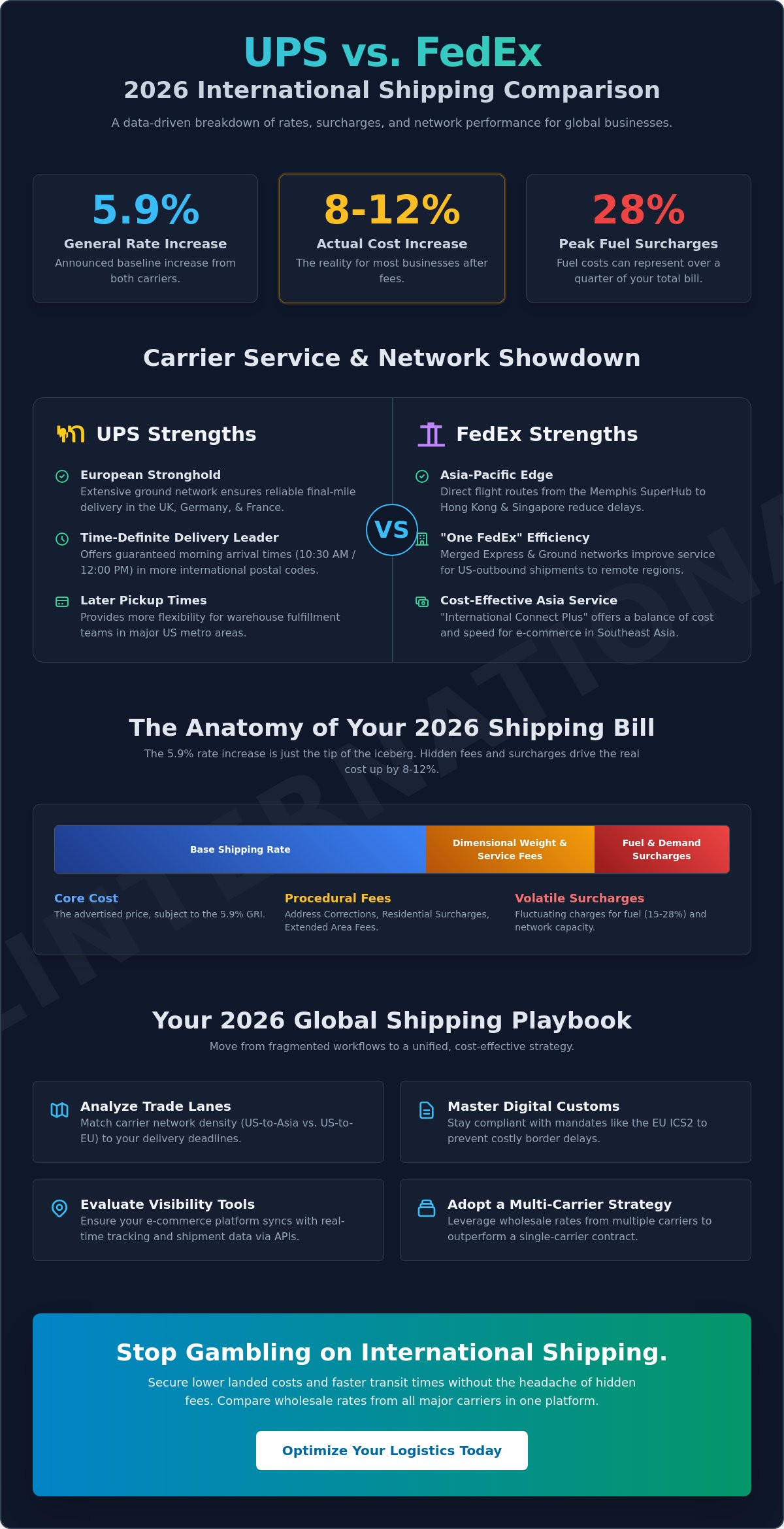
While both major carriers announced a 5.9% general rate increase for 2026, most businesses will actually see their logistics costs climb by 8% to 12% once new dimensional weight rules and international trade surcharges are factored in. Deciding between ups vs fedex international shipping has never felt more like a high-stakes gamble; especially with the EU removing customs duty exemptions and fuel surcharges hitting up to 28% of your total bill. Complex billing and hidden fees shouldn't stall your growth in Europe or Asia.
This comparison breaks down the 2026 landscape to help you secure lower landed costs and faster transit times without the headache of hidden procedural friction. We'll analyze the impact of the One FedEx integration, UPS's current pricing edge in markets like Japan and South Korea, and the specific customs strategies you need to avoid this year's most common delivery delays. By the end of this guide, you'll have a clear, data-driven strategy to move from fragmented workflows to a unified, cost-effective global shipping plan.
Key Takeaways
Compare the updated 2026 transit times for US-to-Asia and US-to-EU trade lanes to determine which carrier's network density matches your specific delivery deadlines.
Analyze how the 5.9% General Rate Increase and new dimensional weight calculations impact your total landed cost in the current ups vs fedex international shipping landscape.
Evaluate advanced supply chain visibility tools and API capabilities to ensure your e-commerce platform stays synced with real-time tracking and high-value shipment data.
Master the 2026 digital customs mandates, including the EU ICS2, to prevent costly delays at the border and simplify your global clearance process.
Discover why a multi-carrier strategy using wholesale rates often outperforms a single-carrier contract for optimizing global business logistics.
Table of Contents
UPS vs FedEx International Shipping: 2026 Network and Speed Comparison
Choosing between United Parcel Service (UPS) and FedEx in 2026 requires looking beyond basic transit times. While both carriers offer high-speed air transport, their infrastructure investments in specific trade lanes create distinct advantages. Your decision on ups vs fedex international shipping should hinge on where your customers live and how late your team needs to drop off packages. Network density is the primary driver of reliability in a market where fuel surcharges now represent up to 28% of your total cost.
UPS Worldwide Express vs. FedEx International Priority
Both flagship services target a 1 to 3 business day delivery window for global shipments. In 2026, FedEx has streamlined its operations under the "One FedEx" initiative, merging its Express and Ground networks to improve efficiency. This often results in slightly better results for US-outbound shipments to remote regions. However, UPS Worldwide Express remains the leader for time-definite deliveries. It offers specific morning arrival commitments (10:30 AM or 12:00 PM) in more international postal codes than its rival. For high-volume exporters, UPS often provides later pickup cut-off times in major US metro areas. This gives your warehouse team more time to fulfill daily orders without missing the daily air sort.
Global Reach: Regional Performance Winners
Europe remains a stronghold for UPS. Their extensive ground road network across the continent allows for seamless transitions from air hubs to final destinations. If your business ships frequently to Germany, France, or the UK, UPS often provides more consistent "end-of-day" reliability. Conversely, FedEx maintains a significant edge in the Asia-Pacific region. Their direct flight routes from the Memphis SuperHub to major Asian hubs like Hong Kong and Singapore bypass many third-party delays. For 2026, FedEx has also expanded its "International Connect Plus" service to more Southeast Asian markets. This provides a cost-effective balance for e-commerce brands that don't need overnight speed but require reliable tracking.
Regarding reliability, both carriers have fully reinstated their Money-Back Guarantees for international express services as of 2026. This provides a layer of security for your logistics budget. If a shipment arrives late due to carrier error, you can claim a refund. This protection helps mitigate the impact of the 5.9% GRI and the $0.23 to $0.32 per pound international trade surcharges introduced this year. Always verify the specific service level, as some economy tiers still lack these guarantees in certain emerging markets.
2026 Pricing Structures: GRI, Surcharges, and Hidden Costs
Budgeting for 2026 requires a shift in how you view carrier contracts. While the announced 5.9% General Rate Increase (GRI) from both carriers serves as a baseline, it rarely reflects the true cost of ups vs fedex international shipping for high-volume businesses. Most shippers should expect an actual cost increase between 8% and 12% this year. This discrepancy stems from aggressive adjustments to ancillary fees and dimensional weight rules that trigger before your package even leaves the warehouse. Stay compliant with U.S. and foreign regulations to avoid penalty fees that inflate your total landed cost.
Hidden fees remain the primary source of budget leakage. FedEx maintains a strict residential delivery surcharge and has updated its demand surcharges as recently as May 2026. UPS has introduced a per-pound international trade surcharge on all US imports and exports, with higher rates applied to shipments moving to or from China and Hong Kong. Beyond these, you must account for extended area surcharges if your customers live outside major metropolitan hubs, as well as steep address correction fees that apply the moment a courier has to manually intervene.
Understanding 2026 Surcharge Volatility
Peak season surcharges have officially evolved into permanent demand surcharges that fluctuate based on network capacity and global trade volume. A General Rate Increase (GRI) is the annual base price adjustment carriers implement to account for rising operational costs and inflation across their entire global networks. In 2026, fuel surcharges have become particularly volatile, representing between 15% and 28% of the total shipping cost. Air freight services typically sit at the higher end of this index compared to ground-based international services. Compare your options at parcelinternational.com to see how these surcharges impact your specific routes.
Weight and Volume: The DIM Weight Trap
The billable weight of your package is no longer just about what the scale says. Both carriers utilize a dimensional (DIM) weight factor, typically 139 for international parcels, to charge for the space a box occupies. For 2026, new cubic volume thresholds have been set at 10,368 cubic inches for additional handling and 17,280 cubic inches for large package surcharges. To protect your margins, audit your packaging processes to eliminate empty space. For a deeper dive into managing these expenses, consult our guide on international shipping rates. Using right-sized boxes or custom packaging can prevent your shipments from crossing these expensive volume thresholds unexpectedly.
Tracking Technology and Supply Chain Visibility in 2026
Global logistics in 2026 isn't just about moving boxes; it's about moving data. In the ongoing competition of ups vs fedex international shipping, visibility has become a primary differentiator for businesses that can't afford "black hole" periods in their supply chain. FedEx recently launched its "fdx" platform, an end-to-end e-commerce data solution designed to provide total visibility from the point of purchase to the final mile. UPS has countered by integrating more sophisticated AI-driven predictive analytics into its tracking network to better anticipate weather and port delays before they happen.
Visibility for High-Value and Sensitive Goods
For industries like pharmaceuticals or high-end electronics, simple milestone tracking is no longer sufficient. FedEx SenseAware provides real-time environmental monitoring, including temperature, light exposure, and humidity levels. This is critical for maintaining the integrity of sensitive cargo. UPS offers specialized high-value tracking solutions that prioritize proactive recovery. If a delay occurs at a major international hub, UPS's internal recovery teams are often empowered to intervene faster to reroute the package. Consistent milestone tracking is the backbone of customer experience in 2026. It transforms an anxious wait into a transparent, predictable process for your global clients.
Integration and Tech Ecosystems
Comparing native tools like FedEx Ship Manager and UPS WorldShip reveals a clear divide in user philosophy. FedEx focuses on a unified experience under its "One FedEx" model, aiming for simplicity across its integrated network. UPS WorldShip remains a robust, data-heavy tool preferred by enterprise-level warehouses that require deep customization. However, many FedEx vs UPS Shipping comparisons often overlook the friction of managing two separate carrier portals. Third-party platforms like Parcel International solve this by unifying these fragmented data streams into a single, clean dashboard.
For online retailers, API reliability is the link between your store and your customer's doorstep. If your tracking data lags, your customer support team pays the price in "Where is my order?" inquiries. For more on optimizing these digital connections, see our guide on international shipping for ecommerce.
Estimated Delivery Dates (EDD) have seen a significant reliability boost in 2026 due to better data sharing between carriers and customs authorities. While SMS updates remain a popular choice for notifications, app-based alerts are gaining ground. These apps allow customers to make real-time delivery changes, such as requesting a "hold at location" or "leave with neighbor." This flexibility reduces failed delivery attempts and significantly improves your overall delivery success rate.
Customs Clearance and International Trade Compliance
Customs clearance is the single most common bottleneck in global logistics. In the debate of ups vs fedex international shipping, your choice often depends on which carrier's digital infrastructure best handles the surge in 2026 regulatory requirements. Both carriers operate massive in-house brokerage departments, but their approach to digital compliance differs. UPS has historically maintained deep integration with European customs systems, while FedEx utilizes its unified "One FedEx" data model to streamline clearance across its global air hubs. Don't let paperwork stall your growth when automated systems can handle the heavy lifting for you.
Effective July 1, 2026, the EU will remove its €150 customs duty exemption for low-value imports. This change means every commercial shipment entering the EU will be subject to duties, regardless of value. Carriers are responding by pushing "Paperless Invoice" services as the mandatory standard. These digital tools transmit your commercial invoice data directly to customs authorities before the package even arrives at the border, significantly reducing the risk of physical inspections and delays.
The 2026 Regulatory Landscape
Customs authorities are now using data-driven enforcement to scrutinize every line item. To avoid seizures or fines, your data must be precise. The 2026 EU ICS2 mandate requires specific, high-quality data for all goods entering or transiting the European Union. Common documentation errors, such as vague item descriptions or missing HS codes, are no longer just minor inconveniences; they are triggers for immediate shipment holds. For a step-by-step breakdown of how to prepare your paperwork, consult our guide on international shipping customs documentation. Precise data is your best defense against border friction.
Brokerage Fees and Clearance Speed
While both carriers offer standard brokerage as part of their international services, expedited clearance is often necessary for time-sensitive cargo. UPS and FedEx both charge additional fees for complex entries or when they must advance duties on your behalf. For small and medium businesses (SMBs), automated customs tools are the most effective way to manage these costs without hiring a dedicated compliance team. Using these tools ensures that your paperwork is filed correctly the first time, every time.
Choosing between DDP (Delivered Duty Paid) and DDU (Delivered Duty Unpaid) is a strategic decision for your customer experience. DDP allows you to collect duties and taxes at checkout, ensuring a frictionless delivery for the recipient. DDU often leads to customer dissatisfaction when a courier demands payment at the door. If you need help navigating these complexities, explore our customs support services to simplify your global trade compliance and protect your customer relationships.
The Multi-Carrier Solution: Why You Don’t Have to Choose
Stop treating the decision of ups vs fedex international shipping as an "either/or" choice. In 2026, a rigid loyalty to a single carrier often leads to overpaying on specific routes where that provider lacks network density. If your business ships to both Paris and Tokyo, using one carrier for both zones might mean you are paying 2026 trade surcharges without receiving the benefit of the fastest possible transit times. A multi-carrier strategy allows you to pivot between providers based on real-time performance and cost data, ensuring you always use the right tool for the job.
Smart routing is the most effective way to optimize your 2026 logistics. By utilizing UPS for its dense European road network and switching to FedEx for its Memphis-to-Asia air bridge, you leverage the structural strengths of both global giants. This approach prevents your business from being trapped by a single carrier's specific surcharge updates or regional service disruptions. It replaces a fragmented, high-stakes gamble with an orderly, strategic operation that protects your margins and your customer promises.
Accessing Wholesale Rates as an SMB
Volume discounts are no longer reserved for the world's largest enterprise retailers. In 2026, logistics brokers and aggregators pool the shipping volume of thousands of small businesses to negotiate wholesale rates that individual companies couldn't access alone. This cost-benefit analysis is essential because actual shipping costs are climbing by 8% to 12% this year, far outstripping the headline 5.9% GRI. Understanding what is a freight forwarder and how they function as a stable intermediary can help you secure these lower rates without meeting restrictive volume minimums.
Automating Your Shipping Workflow
Managing multiple carrier accounts manually creates unnecessary administrative friction. Fragmented billing, separate tracking portals, and differing customs requirements consume valuable time that your team should spend on growth. Using a unified platform simplifies this chaos by providing one interface for labels, tracking, and customs documentation across all your providers. Businesses that move to a unified billing system often report reducing their administrative overhead by up to 40%. This efficiency eliminates the typical anxieties associated with complex global logistics and provides a singular, clear view of your entire supply chain.
Don't settle for the limitations of a single-carrier contract in a volatile market. Take control of your global strategy by accessing the best of both networks through a single, transparent partner. You can compare real-time UPS and FedEx rates on Parcel International today to see exactly how much you can save on your next international shipment.
Master Your Global Logistics Strategy
Optimizing global logistics requires more than just picking a favorite carrier. Success in 2026 depends on your ability to bypass hidden surcharges and manage strict digital customs requirements. The real cost of ups vs fedex international shipping often hides in the fine print of dimensional weight rules and regional trade levies. Relying on a single-carrier contract leaves you vulnerable to network gaps and price hikes. By adopting a multi-carrier model, you leverage the specific infrastructure strengths of each provider to protect your margins.
It's time to move away from fragmented workflows. You can access over 1,600 carriers and utilize automated customs documentation without the burden of subscription fees or volume minimums. Compare UPS vs FedEx rates and book your shipment today to secure the most efficient route for your business. Take the guesswork out of your global strategy and enjoy the peace of mind that comes with a unified, transparent logistics partner. Your global growth is within reach with a smarter, more flexible shipping strategy.
Frequently Asked Questions
Which is cheaper for international shipping: UPS or FedEx?
The most cost-effective choice depends on your specific trade lane and package weight. UPS holds a significant pricing advantage for imports from Japan and South Korea, with rates often 9% to 11% lower than competitors. For lighter e-commerce parcels, FedEx International Connect Plus (FICP) is typically 15% to 25% cheaper than standard economy services. Always evaluate the total landed cost, as fuel surcharges can now represent up to 28% of your final bill.
Is FedEx or UPS faster for shipping to Europe in 2026?
UPS often provides superior reliability for European deliveries due to its extensive regional road network and dense infrastructure. While both carriers target 1 to 3 business days for flagship express services, UPS offers morning delivery commitments in more European postal codes. FedEx remains highly competitive for US-outbound air express, but the UPS ground-to-air integration across the continent often results in more consistent end-of-day arrivals for major EU markets.
Do I need a separate contract for each carrier when using Parcel International?
No, you don't need to maintain individual contracts or meet volume minimums to access wholesale rates. Parcel International acts as a stable intermediary, giving you immediate access to both carriers through a single platform. This removes the traditional barriers of subscription fees and restrictive terms. You can manage your entire 2026 global strategy without the administrative burden of fragmented, multi-platform workflows.
What are the 2026 General Rate Increases for UPS and FedEx?
Both carriers announced a 5.9% General Rate Increase (GRI) for the 2026 calendar year. UPS implemented its changes on December 22, 2025, while FedEx followed on January 5, 2026. However, businesses should budget for an actual cost increase between 8% and 12%. This higher range accounts for new international trade surcharges and updated dimensional weight thresholds that trigger additional handling fees for larger parcels.
How do I handle customs documentation for international parcels?
Utilize automated "Paperless Invoice" tools to transmit your commercial data digitally to customs authorities before the package reaches the border. This is essential for complying with the 2026 EU ICS2 mandates, which require high-quality data and precise HS codes for all imports. Providing accurate digital documentation is the most effective way to prevent physical inspections and avoid the delays that cause customer dissatisfaction.
Which carrier is better for shipping heavy freight internationally?
UPS is generally more cost-effective for heavy shipments that require integrated ground and air transport. However, the 2026 landscape is shifting as FedEx plans to spin off its Freight business in June. For shipments that exceed standard parcel limits, you should compare dedicated air freight and sea freight options. These services often provide better stability and lower per-pound costs than traditional express courier networks for large commercial projects.
Can I track both UPS and FedEx shipments in one place?
Yes, you can monitor all your ups vs fedex international shipping milestones through a unified multi-carrier dashboard. This centralized view eliminates the need to toggle between different carrier portals to find your data. A single tracking stream provides your team with real-time visibility and allows for faster intervention if a shipment encounters a delay at a global hub.
What happens if my international shipment is delayed in 2026?
Both carriers have reinstated their Money-Back Guarantees for express international services, allowing you to claim a refund if a delay is caused by carrier error. If a shipment is held at customs, proactive recovery teams often work to resolve documentation issues, though accurate filing at the point of origin is your best protection. Using a platform that provides automated customs support helps ensure your paperwork meets all 2026 regulatory standards to minimize these risks.


Comments