
11 Best Alternatives to UPS International Shipping for Businesses in 2026
Relying on a single carrier like UPS for your global logistics in 2026 is no longer a strategy; it's a financial liability. With the average 5.9% rate hike and peak season surcharges kicking in as early as September 27, your margins are being squeezed from every direction. You're likely tired of the "black box" of customs paperwork and the lack of personalized support that mid-sized accounts often face. It's frustrating to watch shipping costs climb while delivery reliability feels increasingly out of your hands.
Finding effective alternatives to ups international shipping doesn't mean you have to sacrifice global reach. You can actually lower your costs and improve customs clearance success by moving away from a fragmented, single-carrier workflow. This guide explores the top-rated options that provide wholesale rates usually reserved for high-volume giants. We'll show you how to centralize your tracking, automate complex documentation, and leverage a multi-carrier platform to ensure your parcels move across borders without the typical friction or hidden fees. Discover how to transform your logistics from a source of anxiety into a competitive advantage.
Table of Contents
Why Businesses Seek Alternatives to UPS International Shipping
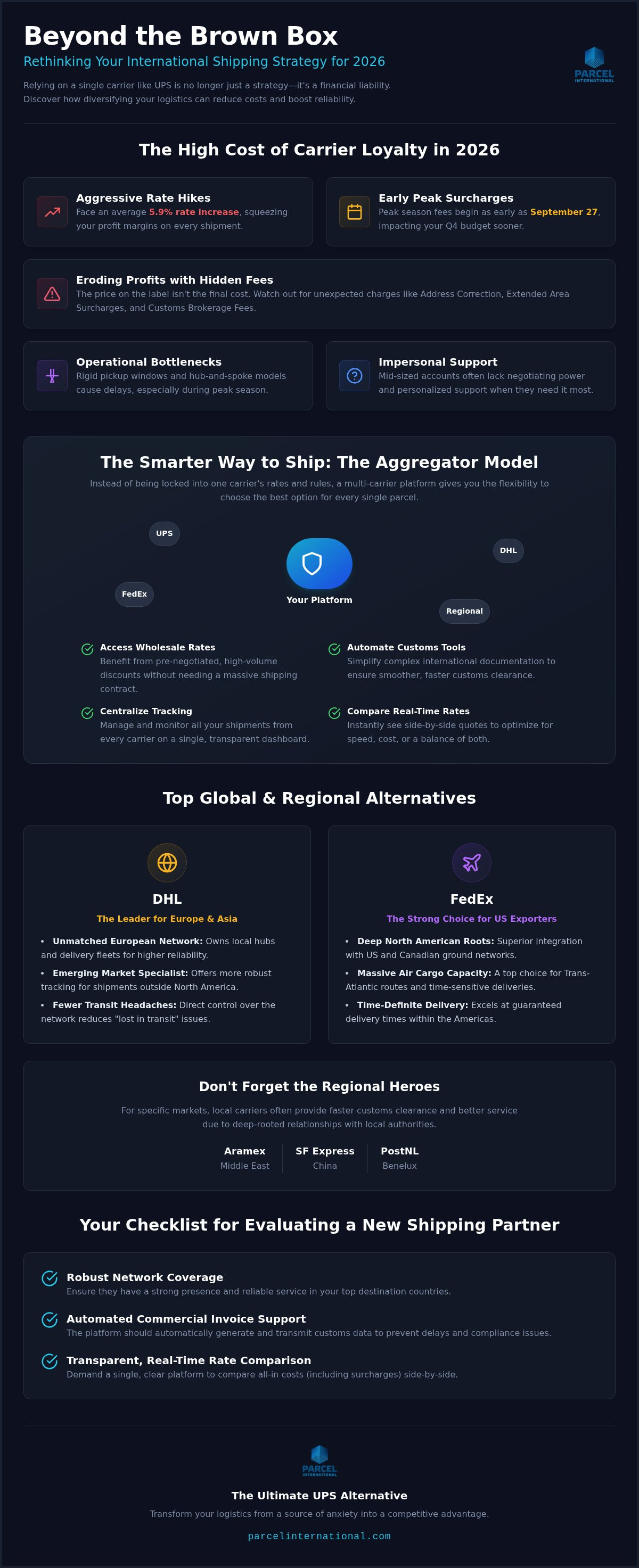
The 2026 shipping landscape is increasingly hostile toward single-carrier dependencies. UPS recently implemented an average rate increase of 5.9%, but the real impact lies in the complex layer of surcharges. For many businesses, these rising fuel costs and residential delivery fees make exploring alternatives to ups international shipping a necessity rather than an option. If you're managing a growing brand, these incremental costs can quickly outpace your revenue growth.
Rigid pickup windows often clash with the fluid nature of modern e-commerce. If your warehouse isn't ready by a fixed time, your parcels sit until the next day, slowing down your global delivery speed. Additionally, the traditional hub-and-spoke model creates bottlenecks during peak seasons. When a single central hub becomes overwhelmed, your entire supply chain stalls. Mid-sized accounts shipping under 100 parcels a month often find themselves at the bottom of the priority list when they need personalized support the most.
The Problem with Carrier Monopolies
Relying on one provider significantly limits your negotiating power. When you're locked into a single ecosystem, you have no leverage to demand better rates or improved service levels. The global parcel delivery industry is vast, yet many businesses trap themselves in a monopoly that leaves them vulnerable. Service disruptions or labor disputes within that one carrier can halt your international sales overnight. Diversification is the most effective logistics strategy for 2026; it ensures that your business remains operational even if one network fails.
Hidden Costs in International Shipping
The sticker price on a shipping label rarely reflects the final invoice. Address correction fees and extended area surcharges can quietly erode your profit margins on every international order. Customs brokerage fees are another common surprise, often appearing as "billbacks" weeks after the delivery is complete. Landed cost is the only metric that truly matters for international margins, as it accounts for every fee from the warehouse floor to the customer's doorstep. By researching alternatives to ups international shipping, you gain the flexibility to choose the right carrier for each specific lane. This proactive approach allows you to optimize for both speed and cost without being held hostage by a single carrier's rigid fee structure or operational limitations.
Top Global and Regional Alternatives to UPS
Selecting the right carrier requires looking beyond the big brown trucks. While UPS is a powerhouse, it isn't always the most efficient or cost-effective choice for every destination. DHL remains the undisputed leader for European and Asian trade lanes. It's about infrastructure. FedEx is often the strongest alternative for US-based exporters due to its deep integration with North American ground networks. When you look for alternatives to ups international shipping, you must weigh these global giants against regional specialists and national postal services.
DHL vs. FedEx: Choosing a Global Heavyweight
DHL’s European network density is unmatched. They own their hubs and local delivery fleets in markets where other carriers rely on third-party contractors. This ownership leads to higher reliability and fewer "lost in transit" headaches. Conversely, FedEx wins on the Trans-Atlantic route for many US businesses because of its massive air cargo capacity. In 2026, both carriers have matched the 5.9% average rate increase seen across the industry, but their service strengths differ. DHL typically offers more robust tracking for shipments moving into emerging markets, while FedEx provides superior time-definite delivery within the Americas. Following official guidance on the export process can help you determine which carrier’s specific strengths align with your product's regulatory needs.
Regional specialists like Aramex for the Middle East, SF Express for China, and PostNL for the Benelux region offer a "local hero" advantage. These providers often have deep-rooted relationships with local customs authorities, which can significantly speed up clearance times. For lightweight, low-value items, national postal services remain a viable option, though you must account for the 2026 regulatory shifts. The EU's removal of the €150 de minimis threshold and new U.S. customs requirements for postal shipments mean that detailed data is now mandatory for even the smallest parcels.
Regional Heroes: Better Service in Specific Markets
Local couriers often provide a better last-mile experience because they understand the nuances of their specific territories. In regions where UPS has limited physical infrastructure, a regional specialist might offer more flexible delivery windows or local pickup points that customers actually prefer. These "Regional Heroes" excel at navigating complex local geography and customs hurdles that often trip up larger, more rigid global systems. You can compare these carriers side-by-side to see which one offers the best balance of speed and cost for your specific shipping lanes.
Diversifying your carrier list allows you to pivot when one network faces a bottleneck. By integrating alternatives to ups international shipping into your logistics stack, you gain the agility to route parcels through the most efficient path possible. This strategy doesn't just save money; it builds a resilient supply chain that can withstand the surcharges and service disruptions that have become common in 2026.
The Aggregator Model: A Smarter Way to Ship Internationally
Most businesses looking for alternatives to ups international shipping assume they must replace one carrier with another. This mindset often leads back to the same frustrations: rigid contracts, high volume requirements, and hidden surcharges. A logistics aggregator, or broker, operates differently. Instead of owning a fleet of planes or trucks, they act as a stable intermediary that pools the shipping volume of thousands of businesses to secure wholesale rates. This model moves you away from fragmented, multi-platform workflows and into a singular, unified solution where you choose the best carrier for every individual parcel.
The primary advantage is the ability to compare DHL, FedEx, and regional specialists side-by-side in real-time. You aren't locked into one network's bottlenecks. If one carrier faces a strike or a hub failure, you simply click a different option. This flexibility is essential for maintaining punctuality and trust with your global customers. By centralizing your logistics, you also consolidate your billing and tracking into a single dashboard, stripping away the procedural friction that usually accompanies international expansion.
Wholesale Rates for Small Businesses
Traditional carriers reserve their best discounts for high-volume accounts shipping thousands of items monthly. This "volume barrier" often leaves mid-sized e-commerce brands paying retail prices that eat into their margins. Aggregators remove this restriction. Because the broker negotiates as a high-volume giant, they can pass those deep discounts directly to you, regardless of your monthly parcel count. There are no subscription fees or hidden setup requirements to access these rates. If you're scaling a digital storefront, following a comprehensive guide on international shipping for ecommerce can help you identify exactly where your current strategy is leaking profit.
Simplified Multi-Carrier Management
Managing five different carrier logins is an administrative nightmare that leads to data silos and tracking errors. An aggregator platform provides standardized tracking updates for all your customers, regardless of which carrier is handling the last mile. This consistency provides immense relief to your support team. Furthermore, these platforms often automate the creation of Common Export Documents, ensuring that your commercial invoices and packing lists meet 2026 regulatory standards. You don't have to be a logistics expert to ship like one. By reducing the administrative overhead in your shipping department, you can focus on growth rather than customs paperwork. It's a faster, more logical way to navigate the complexities of the global market without the typical anxieties of international logistics.
Criteria for Evaluating Your Next Shipping Partner
Selecting the right logistics partner from the available alternatives to ups international shipping requires more than a simple price comparison. You need a partner that aligns with your specific trade lanes and technical infrastructure. Begin by auditing your top five destination countries. A carrier might offer excellent rates to Canada but lack the network density required for reliable delivery in Southeast Asia or the European Union. Reliability in 2026 hinges on local infrastructure, not just a global brand name.
Scalability is equally vital. Your current needs might focus on small express parcels, but your logistics partner should be able to support your growth into air freight or sea freight without requiring a completely new platform. Switching providers every time your volume increases creates unnecessary procedural friction. Look for a solution that handles various modes of transport while maintaining a singular, transparent workflow. Ensure the platform syncs directly with your existing ERP or e-commerce stack, like Shopify or Magento, to eliminate manual data entry.
Automation of Customs and Documentation
Manual paperwork is the primary cause of international shipping delays. Inaccurate descriptions or missing harmonized codes lead to parcels being held at borders, resulting in storage fees and unhappy customers. Automated customs tools ensure trade compliance by digitally generating the necessary forms based on your order data. This automation removes the risk of human error and keeps your shipments moving through the new, stricter customs processes implemented in 2026. For a deeper dive into these requirements, consult our guide on International shipping customs documentation.
Transparency in Pricing and Surcharges
Hidden fees are the silent killer of international profit margins. When evaluating quotes, look for "all-in" pricing that accounts for fuel, residential delivery, and peak season surcharges. Many carriers bury these costs in the fine print, leading to unexpected billbacks weeks after the delivery is complete. Demand a clear "Terms of Service" policy that explicitly states when and why additional fees apply. Transparency isn't just a buzzword; it's a requirement for accurate financial planning. You can start comparing transparent rates today to ensure you never pay more than the quoted price. By prioritizing these criteria, you move from a reactive shipping model to a proactive, optimized strategy that values your peace of mind.
Parcel International: The Ultimate UPS Alternative
Managing global logistics shouldn't feel like a second job. While you've explored various alternatives to ups international shipping, the most efficient solution is a platform that combines them all. Parcel International provides a single entry point to the world's most reliable carriers. Compare real-time rates from DHL, FedEx, and other industry leaders in one click. This transparency allows you to choose the fastest or most cost-effective route for every specific destination without navigating five different websites. You gain the power of a multi-carrier strategy without the administrative headache.
We believe in removing barriers to global growth. You won't find monthly subscriptions, hidden setup fees, or restrictive volume minimums here. Whether you're sending your first international parcel or managing complex road freight across borders, our platform adapts to your scale. If you encounter a customs hurdle or a technical question, our expert support team actually picks up the phone. We act as your dedicated logistics department, providing the personalized care that major carriers often reserve for their largest corporate accounts. This human-centric approach ensures that your high-stakes shipments are never left to an automated chatbot.
Why 20,000+ Businesses Use Our Platform
Our reputation is built on reliability and radical transparency. By acting as a high-volume broker, we secure wholesale rates that were once inaccessible to mid-sized brands. Our Rotterdam-based team leverages deep industry experience to support global trade across 220 countries. We don't just provide a software tool; we offer a stable bridge between your warehouse and your international customers. This collaborative approach ensures that your logistics remain orderly and predictable, even during peak shipping seasons. Businesses frequently report that moving to a unified platform provides immediate relief from the procedural friction of fragmented workflows.
Get Started with Better International Shipping
Booking your first shipment is a logical, three-step process. Enter your parcel details, compare the available carrier options, and print your labels. Our system automatically generates the necessary documentation to keep your goods moving through customs without delay. As your business evolves, our tools grow with you. You can seamlessly transition from International parcel shipping to large-scale air freight or sea freight within the same dashboard. Integrate our freight tool into your existing business workflow today to reclaim your time and protect your margins. Stop fighting with restrictive carrier terms and start shipping with a partner that values your peace of mind.
Take Control of Your Global Logistics Strategy
The shipping landscape in 2026 demands more flexibility than a single-carrier dependency can offer. By exploring the top alternatives to ups international shipping, you move from a reactive position to a proactive one. You've learned how a multi-carrier strategy mitigates the impact of 5.9% rate increases and peak season surcharges. Centralizing your operations through an aggregator isn't just about saving money; it's about reclaiming the time lost to fragmented workflows and manual paperwork. This transition ensures your business remains resilient regardless of carrier bottlenecks or labor disputes.
Access a network that spans 220+ countries and leverage wholesale rates from DHL and FedEx that were previously reserved for high-volume giants. Our platform includes automated customs documentation to ensure your parcels clear borders without the typical procedural friction or hidden fees. It's time to simplify your export process and protect your margins. Compare international shipping rates and save today and experience the relief of a unified logistics solution. Your global expansion is within reach, and we're here to provide the stable bridge you need to succeed.
Frequently Asked Questions
What is the cheapest alternative to UPS for international shipping?
National postal services are often the most budget-friendly for small, lightweight parcels under 2kg. However, for commercial business shipments, using a logistics aggregator is the most effective way to find alternatives to ups international shipping. These platforms allow you to compare wholesale rates from multiple providers side-by-side. You get the reliability of a major carrier without the high retail price tag typically associated with one-off shipments.
Is DHL better than UPS for shipping to Europe?
DHL is widely considered superior for European trade lanes because they own a more extensive network of hubs and local delivery fleets across the continent. This infrastructure leads to higher reliability and faster transit times in many EU regions. While UPS has a strong presence, DHL's density in both Western and Eastern Europe often results in fewer delays and better local support for your customers.
Can I get discounted UPS rates without a high-volume contract?
You can access wholesale UPS rates without a high-volume contract by partnering with a logistics broker like Parcel International. We pool the shipping volume of thousands of businesses to secure deep discounts that are usually reserved for enterprise-level accounts. This model removes the volume barrier for growing brands. It allows you to ship professionally while keeping your margins intact from your very first parcel.
How do shipping aggregators save my business money?
Aggregators save your business money by providing instant access to wholesale rates and reducing administrative overhead. Instead of managing multiple carrier accounts and manual paperwork, you use a single dashboard to compare prices and automate documentation. This efficiency prevents costly errors like incorrect customs declarations. You avoid the hidden fees often found in retail shipping while gaining the flexibility to switch carriers if rates or surcharges change.
What happens if a package is lost when using a shipping broker?
If a package is lost, your shipping broker acts as a stable intermediary to manage the resolution process. You don't have to navigate the carrier's complex claims department alone. The broker's support team handles the investigation and follows up with the carrier to ensure the claim is processed efficiently. This protective layer provides peace of mind and ensures you receive the support you need without the typical corporate runaround.
Do alternatives to UPS provide the same level of tracking?
Most major alternatives to ups international shipping, such as DHL and FedEx, provide real-time tracking that is equal to or better than UPS. When you use an aggregator platform, this tracking is centralized. Your customers receive standardized updates regardless of which carrier handles the last mile. This consistency improves the post-purchase experience and reduces the number of support inquiries regarding shipment status or delivery questions.
Is FedEx or DHL faster for shipping from the US to Asia?
DHL generally offers faster and more reliable service to Asian markets due to their massive investment in regional infrastructure. They operate dedicated air hubs in cities like Hong Kong and Singapore, which speeds up the customs clearance process. While FedEx is a strong competitor for specific North American export lanes, DHL's density in the last mile across Asia often makes them the preferred choice for time-sensitive commercial shipments.
How do I automate customs forms for international shipping?
You can automate your customs forms by using a logistics platform that integrates directly with your e-commerce store or ERP. The software pulls product descriptions, values, and harmonized codes from your order data to generate commercial invoices automatically. This process ensures your documentation meets 2026 regulatory standards. It eliminates the manual entry errors that are the primary cause of international delivery delays and unexpected customs hold-ups.


