
Discounted Express Shipping for Small Business: The 2026 Buying Guide
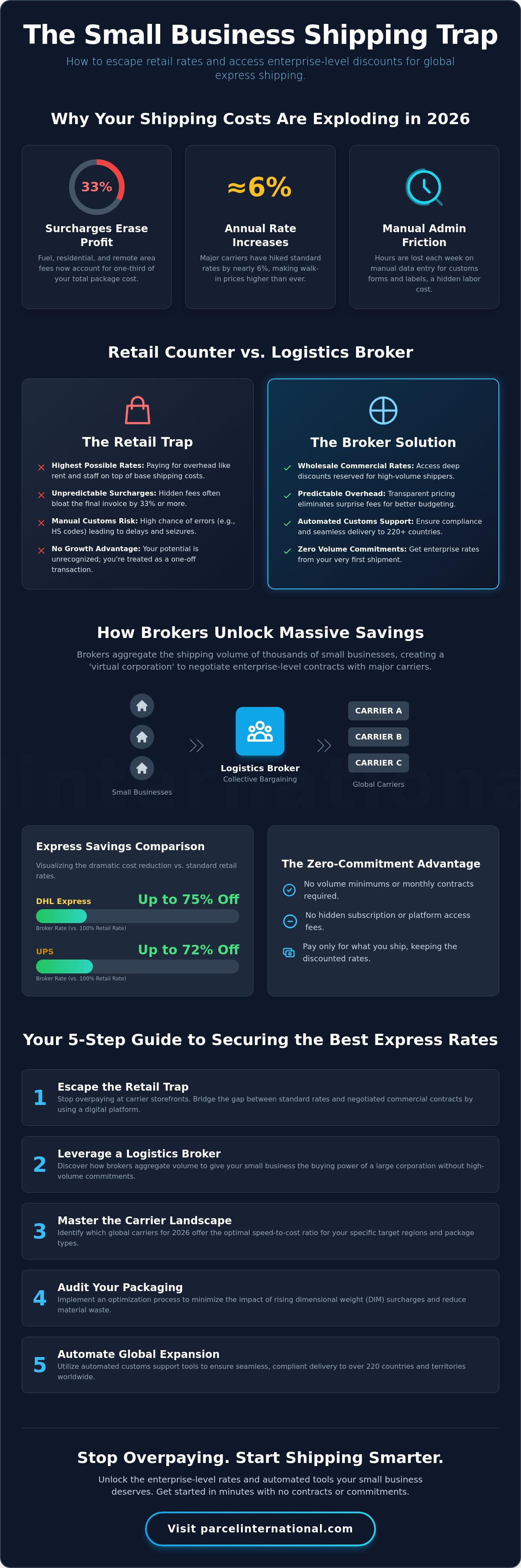
Surcharges now account for roughly 33% of your average package cost, effectively erasing the profit on many international orders. With major carrier rates climbing by nearly 6% in early 2026 and fuel fees reaching record highs, the era of predictable retail shipping is over. If you feel like you're overpaying for discounted express shipping for small business at the local counter, you're right. It's frustrating to watch your margins disappear into complex surcharges and manual customs delays while large corporations enjoy deep discounts.
This guide will show you how to access enterprise-level express shipping rates and automated customs tools without high-volume commitments. You'll learn how to secure predictable overhead, automate documentation to save time, and access multiple global carriers in one place. We'll move you from fragmented, high-stress workflows to a unified solution that treats your small business like a major player. By removing traditional barriers like volume minimums or hidden fees, we'll help you ship with the efficiency and transparency of a global leader.
Key Takeaways
Stop overpaying at retail storefronts and learn how to bridge the gap between standard rates and negotiated commercial contracts.
Discover how a logistics broker aggregates volume to provide discounted express shipping for small business without requiring high-volume commitments.
Master the 2026 landscape of global carriers to identify which providers offer the best speed-to-cost ratio for your specific target regions.
Implement a five-step audit process to optimize your packaging and minimize the impact of rising dimensional weight (DIM) surcharges.
Simplify your global expansion by utilizing automated customs support tools that ensure seamless delivery to over 220 countries.
Table of Contents
The High Cost of Standard Express: Why Small Businesses Overpay
Walking into a carrier storefront is the most expensive mistake a growing company can make. It's known as the 'Retail Trap'. These physical locations are designed for convenience, not for cost-efficiency. When you pay at the counter, you're paying for the lights, the staff, and the premium real estate. Carriers treat these walk-in customers as one-off transactions rather than partners. Understanding the history of package delivery reveals that the system was built to reward high-volume, predictable freight, leaving small shops to subsidize the infrastructure with base rates.
The 2026 logistics climate has made this gap even wider. With average rate increases hitting nearly 6% across major carriers and temporary fuel surcharges implemented by national postal networks in early 2026, retail prices are at an all-time high. Manual data entry for international labels adds a second, hidden cost to every shipment. If your team spends twenty minutes per order typing in addresses and descriptions, you're losing hours of productivity every week. This administrative friction prevents you from accessing discounted express shipping for small business because your workflow isn't optimized for the digital platforms where those rates live.
Retail vs. Commercial Pricing: The Math of Scaling
Commercial contracts aren't just slightly cheaper; they're fundamentally different. For a typical 2kg express parcel moving to Europe or Asia, the price difference between a walk-in rate and a negotiated contract is significant. Carriers prioritize high-volume contracts because they provide operational stability. Small businesses without a broker are stuck with 'base' rates that don't account for your potential growth. Beyond the base price, 'accessorial charges' like residential surcharges or remote area fees can bloat your final invoice by another 33%. These fees are often obscured until the bill arrives, making it impossible to predict your margins.
The Hidden Burden of International Customs
Shipping across borders introduces regulatory risks that retail counters aren't equipped to handle. Incorrect HS codes are a primary cause of package seizures and expensive return-to-sender fees. Staying compliant with changing 2026 trade regulations requires automated Customs Support. There's also the friction of 'delivery duty unpaid' (DDU) shipments. When a customer is surprised by a tax bill at their door, it damages your brand. To secure discounted express shipping for small business, you need a system that handles documentation automatically, ensuring your packages move through borders without manual intervention or unexpected costs.
Unlocking Wholesale Rates: How the Logistics Broker Model Works
A logistics broker acts as a high-volume intermediary. They purchase shipping capacity in massive quantities from global carriers. By aggregating the needs of thousands of small businesses, they create a 'virtual corporation.' This collective bargaining power allows a single-person shop to access the same wholesale pricing usually reserved for Fortune 500 companies. It's a shift from being a small fish in a big pond to being part of a powerful collective. You can access discounted express shipping for small business that saves up to 75% on DHL Express or 72% on UPS by using these aggregated platforms.
Major carriers like DHL, FedEx, and UPS actually prefer this arrangement. Managing thousands of individual small accounts is administratively expensive for them. Brokers handle the customer support, billing, and technical integration, allowing carriers to focus on their core strength: moving freight. In the 2026 market, this model has reached a point of radical transparency. You don't have to deal with subscription fees or restrictive volume minimums. You simply get the rates you deserve by leveraging the broker's pre-negotiated status. It's a clean, efficient way to manage Express Shipping without the corporate red tape.
Aggregation: The Secret to Enterprise-Level Discounts
The core benefit here is the removal of the 'volume gatekeeper.' Typically, deep discounts require a commitment to ship thousands of parcels a month. Through a broker, you enjoy zero-commitment shipping. You pay only for what you send while keeping the discounted rate intact. This stability is crucial for budgeting, especially when looking at international shipping rates that might fluctuate for un-negotiated shippers. It ensures your overhead remains predictable even during seasonal spikes or unexpected fuel price changes.
One Platform, Multiple Carriers
Managing multiple carrier relationships manually leads to 'platform fatigue.' Instead of logging into three different portals to compare prices, a broker provides a single dashboard. You can see DHL, UPS, and FedEx options side-by-side in a single search result. This isn't just about speed; it's a strategic advantage. If one carrier faces regional strikes or weather delays, you can switch to another with a single click. It's the ultimate insurance policy for your supply chain. You can explore these carrier options to see how a unified view simplifies your daily operations.
This model also streamlines your administrative tasks. Instead of chasing multiple invoices, you receive a single, transparent bill. All tracking information is consolidated, giving you a bird's-eye view of your entire logistics network. By stripping away the procedural friction of traditional shipping, you can focus on scaling your business rather than managing paperwork.
Top Express Carriers for 2026: Speed vs. Cost for Small Parcels
Choosing the right carrier is a strategic decision that impacts your bottom line and your customer's loyalty. While a broker provides the platform, the physical movement of your goods depends on the global networks of the "Big Three." In 2026, these carriers have fine-tuned their operations to handle the surge in cross-border e-commerce. Success lies in matching your destination to a carrier's specific regional infrastructure. Accessing discounted express shipping for small business means knowing which carrier owns the "home field advantage" in your target market. You don't want to pay for a premium global network when a regional specialist can do the job for less.
The 2026 landscape also sees a significant shift toward "Eco-Express" options. Many businesses now prioritize carbon-neutral delivery goals to meet consumer expectations and regulatory requirements. Balancing this sustainability with transit speed is easier when you use a shipping cost calculator to compare different service tiers. This tool helps you find the sweet spot where transit time meets your budget without sacrificing your environmental commitments.
Carrier Comparison: Strengths and Weaknesses
DHL: This carrier remains the undisputed leader for complex international routes and emerging markets. If you're shipping to remote parts of Asia or Africa, their established customs expertise is invaluable.
FedEx: They represent the gold standard for North American express shipments. Their time-definite reliability is unmatched for domestic US and Canadian routes, making them the go-to for urgent B2B documents.
UPS: Known for exceptional ground-to-air integration, UPS excels at handling heavy parcels and multi-package shipments. Their network is particularly robust for businesses that require consistent, high-volume ground feeds into an express air network.
Choosing the Right Service Level
Deciding between Express Worldwide and Economy services often comes down to a 48-hour window. If your product is a high-value electronic or a critical replacement part, that two-day difference justifies the higher cost. However, for routine restocks, Economy services provide the same tracking visibility at a lower price point. For B2B clients, the distinction between "Time-Definite" and "Day-Definite" is critical. Time-Definite Delivery is the industry standard for high-value e-commerce, ensuring that a package arrives by a specific hour on a predetermined date. Using discounted express shipping for small business allows you to offer these premium "Time-Definite" windows to your customers without absorbing the full retail cost yourself.
Buying Guide: 5 Steps to Securing the Best Express Rates
Audit your shipping history before you sign any new agreements. You need to know your average package weight, dimensions, and most frequent international destinations. Without this data, you cannot accurately compare quotes or identify where you're losing money to surcharges. Once you have a clear picture, you can seek out discounted express shipping for small business that aligns with your specific lane requirements. Don't let carriers default you into their most expensive retail categories because you lack your own data.
Integration is your next priority. Switch to a platform that automates international parcel shipping documentation to eliminate manual entry errors. This technology allows you to compare real-time quotes from multiple carriers for every single shipment. Finally, calculate your total 'landed cost.' This includes duties, taxes, and all surcharges, ensuring your international customers aren't hit with unexpected fees upon delivery. You can access these automated tools now to streamline your entire workflow.
Mastering Dimensional Weight (DIM)
Dimensional weight is a calculation based on a package's volume rather than its actual weight. If you ship light items in large boxes, you're paying for 'shipped air.' In 2026, carriers have tightened these rules significantly. Both UPS and FedEx now apply an additional handling charge to packages exceeding 10,368 cubic inches. To avoid these fees, right-size your packaging. Use the smallest possible box that safely protects your goods. This simple change can prevent your shipping costs from doubling overnight due to inefficient packing habits.
Automating the Compliance Workflow
Customs delays are often the result of missing or vague information on commercial invoices. Automating this process ensures every HS code is accurate and every field is pre-filled. You can learn how to send a parcel internationally with a system that handles these compliance checks for you. By integrating Customs Support directly into your shipping portal, you remove the guesswork. This proactive approach keeps your packages moving and secures the discounted express shipping for small business rates that depend on clean, digital documentation.
Why Parcel International is the Growth Engine for Your SMB
Parcel International acts as a stable bridge in a complex global market. We move your business away from the friction of retail shipping into a streamlined, professional environment. You can access discounted express shipping for small business without the traditional corporate red tape or restrictive volume requirements. Our portal connects your products to customers in over 220 countries and territories. We've automated the complex customs paperwork, turning a high-stakes administrative burden into a few simple clicks. We stand by a 'No Hidden Fees' promise. Transparent pricing is the only way to build long-term business trust, so you'll always know exactly what you're paying before you ship.
Relief comes from having a single, unified solution for all your logistics needs. Instead of managing fragmented workflows across multiple carrier sites, you manage everything from one dashboard. This efficiency allows you to focus on your core business goals while we handle the operational complexity. By stripping away hidden costs and procedural friction, we provide the security and punctuality your customers expect. It's a professional partnership designed to scale alongside your ambitions.
Beyond Just Parcels: Sea, Air, and Road
Your logistics needs will inevitably change as your business grows. Our platform scales with you, moving seamlessly from small parcels to full freight forwarder services. If you need to manage regional distribution, we provide international road freight rates Europe data to keep your overland costs competitive. Whether you require Express Shipping, Sea Freight, Air Freight, or Road Freight, having one partner simplifies your entire supply chain. You don't have to juggle five different logins or reconcile five different invoices. We provide a singular point of contact for every mode of transport.
Get Started in Minutes
We've removed every barrier to entry to ensure our services are egalitarian and accessible. There are no contracts to sign, no setup fees to pay, and no monthly subscription requirements. You can sign up and begin shipping immediately. Our Rotterdam-based support team isn't just a call center; they act as your in-house logistics department. They understand the nuances of 2026 trade regulations and provide expert Customs Support to keep your cargo moving. Stop overpaying for retail rates and start optimizing your overhead. Compare 2026 express shipping rates and start saving today.
Scale Your Business With Enterprise-Level Shipping
The logistics landscape of 2026 demands efficiency and radical transparency. You no longer have to struggle with unpredictable retail rates or manual paperwork that stalls your international growth. By moving to a unified platform, you consolidate your workflow and protect your profit margins. You've learned how to optimize packaging to beat dimensional weight surcharges and how to use a broker's collective volume to your advantage. Accessing discounted express shipping for small business is now a strategic reality rather than a corporate privilege.
Parcel International provides a reliable bridge to over 220 countries and territories. We eliminate the typical anxieties of global trade with automated customs documentation and a strict policy of no hidden fees. There are no volume commitments or subscription requirements to hold you back. You can focus on your product while we handle the operational complexity of your supply chain. It's time to ship with confidence and move your business forward. Compare real-time express rates and book your first shipment now. Your global expansion starts with a single, efficient step.
Frequently Asked Questions
How do I qualify for discounted express shipping as a small business?
You qualify for discounted express shipping for small business by using a logistics platform that aggregates volume from thousands of users. This model removes the need for individual volume commitments or corporate contracts. You simply sign up and access wholesale rates immediately. It's an egalitarian approach that levels the playing field for growing shops without requiring high-stakes negotiations.
What is the cheapest way to ship internationally in 2026?
The most cost-effective method is using a multi-carrier platform to compare rates in real-time for every shipment. In 2026, carrier pricing is highly complex due to shifting fuel surcharges and peak adjustments. Comparing services like DHL, FedEx, and UPS side-by-side ensures you always pick the lowest available rate for your specific destination and parcel size.
Is a logistics broker better than going directly to DHL or FedEx?
A logistics broker is typically better for small businesses because they offer rates you can't get directly. Large carriers reserve their deepest discounts for Fortune 500 companies with massive shipping departments. By using a broker, you join a collective that commands those same enterprise-level prices without the administrative burden of managing a direct carrier account.
How does dimensional weight affect my express shipping costs?
Dimensional weight measures the volume of your package rather than just its heaviness. Carriers charge based on whichever is greater: the actual weight or the space the box occupies. If you ship light items in oversized boxes, your costs will skyrocket. Right-sizing your packaging is the most effective way to keep your discounted express shipping for small business rates predictable.
Can I automate my customs documentation through your platform?
Yes, our platform provides automated Customs Support to turn complex paperwork into a few clicks. It generates commercial invoices and assists with HS code lookups based on your product descriptions. This automation reduces manual entry errors and helps prevent your shipments from being seized or delayed at international borders due to missing information.
Are there any hidden fees when using a shipping aggregator?
There are no hidden fees when you use a transparent platform. Our pricing model is built on radical transparency, meaning the rate you see during the quote process is the rate you pay. While carriers may apply surcharges for residential deliveries or remote areas, these are displayed clearly before you book. We don't charge subscription fees or setup costs.
What happens if my express shipment is delayed by customs?
If a delay occurs, our support team acts as your intermediary with the carrier to resolve the issue. Most delays stem from documentation errors, which our automated tools help prevent in the first place. We provide real-time tracking so you can monitor progress and address any customs inquiries before they cause significant setbacks for your customers.
Do I need a high volume of shipments to use Parcel International?
You don't need a high volume of shipments to access our platform. Our services are designed to be inclusive, allowing you to ship one parcel or one hundred with the same ease. There are no minimum requirements or long-term contracts. This flexibility makes it easy for small businesses to test new global markets without any financial risk or commitment.


