
Freight Rates News 2026: Comparing Global Logistics Solutions in a Volatile Market
- Alex
- 3 days ago
- 13 min read
Updated: 2 days ago
The national average spot flatbed rate in the U.S. reached a record $2.87 per mile in May 2026, yet many logistics managers still struggle to find a reliable baseline for their budgets. You're likely exhausted by the constant stream of conflicting freight rates news that makes it impossible to plan your next quarter with certainty. It's stressful to manage unpredictable surcharges and sudden capacity crunches while trying to keep your supply chain profitable. We understand the need for a stable partner who prioritizes transparency over corporate jargon and hidden costs.
This guide provides the expert analysis you need to move from confusion to action. We analyze why the Drewry World Container Index jumped 6% this month and how the suspension of the $800 de minimis threshold affects your customs strategy. You'll get a clear framework to compare sea, air, and road costs so you can choose the most efficient mode for every shipment. We also show you actionable ways to improve your margins by using a unified broker platform to eliminate the procedural friction and administrative barriers that often plague global logistics.
Key Takeaways
Monitor the latest freight rates news to identify the fuel and capacity drivers currently dictating global logistics costs.
Use our multi-modal framework to determine when to prioritize the speed of Air Freight or the cost-efficiency of Sea and Road Freight.
Learn how integrated Customs Support and automated documentation can reduce total landed costs and eliminate unexpected invoice surcharges.
Build a resilient supply chain by auditing carrier performance and diversifying your transport portfolio to mitigate single-point-of-failure risks.
Simplify your operations by moving to a transparent platform that consolidates wholesale rates without the burden of hidden fees or volume minimums.
Table of Contents
2026 Freight Rates News: Understanding the Global Market Landscape
The Global Freight Index acts as the industry’s weather report. It aggregates pricing data across thousands of lanes to give you a high-level view of market health. When you follow freight rates news, you're essentially checking the forecast to see if a storm of surcharges is brewing or if clear skies are ahead for your margins. At its core, understanding what are freight rates involves looking at the base cost of moving cargo between two points before carriers add their specific fees and surcharges.
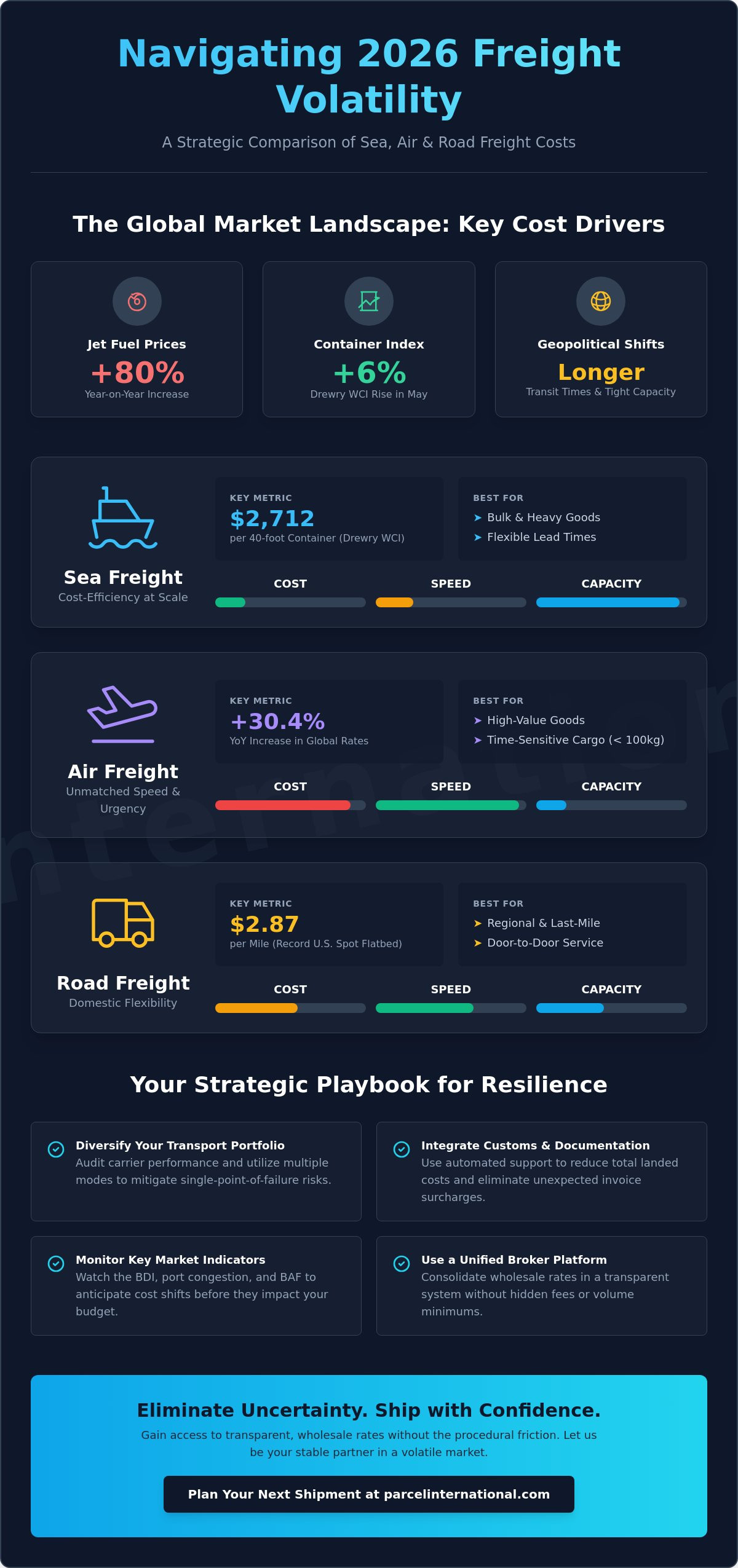
In 2026, three primary drivers dictate these numbers. First, jet fuel prices have surged by approximately 80% year-on-year as of mid-May, directly inflating costs for Air Freight. Second, geopolitical shifts continue to force longer transit times, which tightens available capacity. Finally, aggressive carrier pricing strategies have led to an early peak season, with the Drewry World Container Index rising 6% in a single week this May. This combination makes it harder for businesses to maintain stable pricing for their customers.
You also need to distinguish between spot and contract rates. Spot rates are the "buy it now" prices of the logistics world, reflecting immediate supply and demand. Contract rates are long-term agreements that offer stability but can leave you paying above-market prices if the index drops. The 2026 Containerized Freight Index serves as a critical benchmark that helps SMBs determine if their current quotes align with the broader market or if they're being overcharged during periods of high volatility.
Key Indicators to Watch in 2026
The Baltic Dry Index (BDI) remains a vital signal for raw material shipping costs, often predicting shifts in manufacturing before they hit the consumer market. Regional port congestion also plays a massive role; for example, Shanghai to Rotterdam rates jumped 15% recently due to tightening capacity in European hubs. Don't ignore the Bunker Adjustment Factor (BAF) in your invoices either. This fuel-related surcharge is highly sensitive to the current energy market and can fluctuate weekly, making it a primary source of hidden costs for unprepared shippers.
Why Rates are Volatile Right Now
Carrier pricing models have evolved. Many now use AI-driven demand forecasting to adjust capacity in real-time, which often leads to sudden "blank sailings" or skipped ports to keep rates high. New IMO 2026 regulations also add cost layers. Mandatory safety requirements, such as electronic inclinometers for large container ships and the ban on fire-extinguishing media containing PFOS, require significant vessel upgrades. Additionally, the industry-wide shift from "Just-in-Time" to "Just-in-Case" inventory strategies means businesses are shipping earlier and in larger volumes, creating artificial demand spikes that often dominate freight rates news cycles.
Comparing Freight Modes: Sea vs. Air vs. Road in 2026
Choosing the right transport mode requires more than a glance at a quote. It demands a strategic evaluation of your cargo's weight, volume, and urgency against the latest freight rates news. According to data from the Freight Transportation Services Index, volume shifts across different sectors often dictate which mode becomes the most cost-effective in any given month. If your goods are high-value and time-sensitive, Air Freight remains the logical choice despite the 30.4% year-over-year increase in global rates. However, for bulkier items where lead times are flexible, Sea Freight provides a more predictable cost structure, even with the recent 6% climb in the Drewry World Container Index to $2,712 per 40-foot container.
To maximize savings, you must use a comparison framework. For shipments under 100kg, Express Shipping or Air Freight often wins on total landed cost because they bypass the lengthy port handling fees associated with ocean travel. For larger volumes, the choice between Road Freight and Sea Freight depends on your regional infrastructure. In the U.S., road spot rates are volatile, with flatbeds hitting a record $2.87 per mile in late May. Monitoring freight rates news helps you time your shipments; for instance, booking before the June 1st rate hikes announced by major carriers like CMA CGM can save you thousands in Peak Season Surcharges (PSS).
Sea Freight: FCL vs. LCL Cost Dynamics
Full Container Load (FCL) means you rent the entire container, while Less than Container Load (LCL) involves sharing space with other shippers. LCL rates are currently more sensitive to news-driven surcharges because carriers apply flat fees per cubic meter that don't benefit from the volume discounts found in FCL. With Asia-Europe rates expected to push toward $4,700 per FEU, understanding these nuances is vital. For a deeper look at how to budget for these shifts, consult our guide on international shipping rates 2026 to ensure your procurement strategy is sound.
Air and Road Freight: Speed vs. Predictability
Transcontinental road freight across Europe is currently a stable alternative to sea travel for mid-sized shipments, offering faster transit without the extreme volatility of air cargo. While Air Freight rates from Hong Kong to Europe sit around $5.60/kg, road transport provides a middle ground for businesses that need to pivot away from seasonal port bottlenecks. You can find a detailed breakdown of these costs in our analysis of international road freight rates Europe. You can easily compare real-time quotes across all these modes to find the best balance for your next shipment.
Beyond the Headlines: The Hidden Drivers of Shipping Costs
Your latest invoice rarely reflects the clean numbers you see in freight rates news. While a benchmark rate might suggest a cost of $2,712 per container, your final bill often arrives with a 20% or 30% markup. This discrepancy isn't usually an error; it's the result of complex variables that standard market reports don't capture. One of the most common culprits is "dimensional weight." Carriers charge based on the space your cargo occupies, not just its mass. If you're shipping lightweight items in large boxes, you're effectively paying to transport air. Managing these calculations is the first step toward reclaiming your margins.
Liability and risk also play a silent role in your shipping costs. In 2026, the rise of "nuclear verdicts" in the U.S. trucking industry—where legal settlements exceed $10 million—has forced carriers to pay record-breaking insurance premiums. These costs don't stay with the carrier; they're passed down to you through increased base rates. You can't control the legal climate, but you can control your exposure by choosing partners with transparent pricing models that don't hide these escalators in the fine print.
Customs and Compliance Costs
Trade policy shifts in 2026 have fundamentally changed the cost of entry for global goods. The suspension of the U.S. $800 de minimis threshold means that almost every import is now subject to duty, regardless of value. Additionally, a 10% Section 122 global surcharge applies to most imports into the United States as of February 2026. Clerical errors in your documentation can lead to significant fines or storage fees at the port. This is why a professional freight forwarder is essential. They provide the Customs Support needed to automate documentation, ensuring you don't pay for avoidable administrative mistakes.
Surcharges and Peak Season Adjustments
Always look for General Rate Increase (GRI) patterns in the freight rates news. Carriers often announce these hikes on the 1st or 15th of the month to test market resilience. Beyond standard GRIs, 2026 has introduced "green" shipping surcharges to cover the cost of IMO compliance. These fees fund vessel upgrades and the transition to low-sulfur fuels. While a 2026 freight rate forecast may predict overall market stability, these specific surcharges can fluctuate based on regional fuel prices. Don't just accept a quote; read the fine print to identify fuel escalators and peak season adjustments that could double your expected spend during the early summer rush.
Strategic Responses to Freight Volatility: A Business Playbook
Volatility is the new baseline for global logistics. To protect your margins, you must move beyond passive observation of freight rates news and implement a proactive playbook. Start by auditing your current carrier performance against the market benchmarks established in earlier chapters. If you find your contracted rates are consistently higher than the current $2,712 per 40-foot container average, it's time to renegotiate or shift more volume to the spot market. Use your historical data to identify where surcharges are eating into your profits and hold your providers accountable for every line item on your invoice.
Diversification is your best defense against capacity crunches. Relying on a single "Big Three" carrier creates a single point of failure that can paralyze your supply chain during peak seasons. Instead, build a portfolio that mixes global giants with regional specialists. This approach allows you to pivot quickly when a specific lane experiences a sudden rate spike or a port becomes congested. For businesses operating in Europe, reviewing international freight forwarding in Rotterdam provides a strategic advantage, as local hub expertise can help you navigate regional bottlenecks more effectively than a generic global provider.
Consolidation is another powerful tool for cost control. By leveraging Less than Truckload (LTL) efficiencies, you can combine smaller shipments to fill capacity and secure better rates. This is particularly effective when U.S. road spot rates are hitting records, such as the $2.87 per mile seen in the flatbed sector this May. Stop shipping half-empty containers. Consolidate your cargo to maximize every cubic meter and minimize the impact of per-shipment administrative fees.
Carrier Diversification Strategies
Don't let a single carrier dictate your shipping budget. In a volatile 2026, you should mix and match Express Shipping for urgent parcels with heavy Road Freight or Sea Freight for bulkier inventory. Use your shipping data to identify which carriers are currently undercutting the market on specific lanes, such as the Hong Kong to Europe route. By maintaining relationships with multiple providers, you ensure that you always have a fallback option when one carrier announces a sudden Peak Season Surcharge (PSS).
Don't let a single carrier dictate your shipping budget. In a volatile 2026, you should mix and match Express Shipping for urgent parcels with heavy Road Freight or Sea Freight for bulkier inventory. Use your shipping data to identify which carriers are currently undercutting the market on specific lanes, such as the Hong Kong to Europe route, and consider specialized partners like Perimeter Global Logistics (PGL) for their comprehensive modal expertise. By maintaining relationships with multiple providers, you ensure that you always have a fallback option when one carrier announces a sudden Peak Season Surcharge (PSS).
Leveraging Digital Tools for Real-Time Pivot
Digital platforms have replaced static contracts as the primary way to manage logistics costs. Shipping calculators allow you to verify the accuracy of freight rates news by providing instant, transparent quotes based on live market conditions. Automated tracking also plays a role by reducing the "anxiety cost" of delayed freight, allowing you to update your customers with confidence. Real-time rate comparison can save you up to 20% on spot bookings by identifying the lowest available price across dozens of carriers in seconds. You can start comparing live freight rates today to see how much your business could save.
The Parcel International Edge: Navigating 2026 with Transparency
Keeping up with freight rates news is only half the battle; the real challenge is executing a strategy that protects your bottom line. Parcel International serves as a stable intermediary in a market where the Drewry World Container Index can shift 6% in a single week. We aggregate wholesale rates from top-tier providers to ensure SMBs aren't forced to pay retail prices during a capacity crunch. By leveraging our collective bargaining power, you gain access to the same competitive pricing usually reserved for high-volume enterprise shippers.
Our "No Hidden Fees" promise is a central pillar of our identity. We've seen how "dimensional weight" surprises and "green" surcharges can double a business's expected costs. We strip away the typical anxieties associated with global logistics by providing radical transparency from the first quote. You won't have to deal with fragmented workflows or procedural friction. Instead, you get a singular, unified dashboard that connects you to 220+ countries, allowing you to manage your global reach without the administrative burden of multiple carrier accounts.
With the 2026 suspension of the U.S. de minimis threshold and new Section 122 surcharges, Customs Support is no longer optional. Our platform integrates compliance directly into your shipping process. This automation eliminates the clerical errors that are the most common cause of delivery delays at the border. Whether you're moving goods via Sea Freight, Air Freight, or Road Freight, our system ensures your documentation is accurate before the cargo even leaves the warehouse.
Why a Broker Platform Beats Direct Carrier Contracts
Direct contracts often lock you into rigid terms that don't account for market volatility. A broker platform gives you the modern flexibility to switch modes within one interface. If Air Freight rates from Hong Kong spike to $7.00/kg, you can immediately pivot to Sea Freight or Express Shipping options without renegotiating a single contract. You also benefit from personalized support. Our team knows your business and its specific needs, providing a protective and dedicated level of service that generic carrier call centers simply can't match.
Getting Started with Smarter Shipping
You can use the Parcel International platform to benchmark your current rates against the 2026 market average in real-time. There's no need for long-term subscriptions or volume minimums; we believe in an egalitarian approach that values every shipment. Our booking process is designed for speed and efficiency, taking only two minutes to move from a quote to a confirmed international shipment. It's time to move from a chaotic process to an orderly one. Compare 2026 freight rates and start saving today to experience the relief of a truly transparent logistics partner.
Take Control of Your Global Shipping Strategy
The era of predictable shipping has ended, but your business doesn't have to suffer from the fallout. Success in today's market depends on your ability to filter through the noise of daily freight rates news and act on verified data. By diversifying your transport modes and automating your customs documentation, you eliminate the procedural friction that often leads to costly delays. You now have the framework to compare Sea, Air, and Road Freight with total confidence.
It's time to replace fragmented workflows with a singular, unified solution. Parcel International provides the stable bridge you need to reach 220+ countries and territories without the burden of subscription requirements or hidden fees. Our platform allows you to perform a real-time comparison of DHL, FedEx, UPS, and major freight carriers in seconds. Start comparing real-time freight rates and save on your next shipment. Take the chaos out of your logistics and start shipping with radical transparency today. You deserve the peace of mind that comes with a reliable, efficient partner.
Frequently Asked Questions
What is the current trend for ocean freight rates in 2026?
Ocean freight rates are currently on a significant upward climb due to an earlier-than-usual peak season and tightening carrier capacity. Major shipping lines have implemented aggressive pricing strategies, leading to double-digit percentage increases on key lanes like Shanghai to Rotterdam. You should expect this volatility to persist as carriers introduce new Freight All Kinds (FAK) levels and Peak Season Surcharges throughout the summer months.
How do fuel prices impact international freight rates news right now?
Rising energy costs are a primary driver in the latest freight rates news, with jet fuel prices surging approximately 80% year-on-year as of May 2026. This spike directly inflates air cargo quotes and transcontinental road freight costs. For sea freight, the Bunker Adjustment Factor (BAF) remains highly volatile, making it a critical surcharge to monitor if you want to avoid unexpected budget overruns on your international invoices.
Is it cheaper to use a freight forwarder or book directly with a carrier?
Utilizing a broker platform or freight forwarder is generally more cost-effective for SMBs than booking directly with a carrier. Platforms aggregate the shipping volume of thousands of businesses to secure wholesale rates that individual shippers couldn't access alone. This model also eliminates the need for restrictive long-term contracts, giving you the flexibility to choose the lowest-priced carrier for every individual shipment.
What is a General Rate Increase (GRI) and how can I avoid it?
A General Rate Increase (GRI) is a base rate hike that ocean carriers typically implement on the 1st or 15th of the month to test market resilience. You can often avoid these spikes by booking your cargo at least two weeks before the scheduled increase. Using a digital dashboard to compare real-time spot rates also allows you to identify carriers that haven't yet applied the GRI to your specific shipping lane.
How does the Containerized Freight Index affect small business shipping?
The Containerized Freight Index serves as a vital transparency tool that prevents small businesses from overpaying during market shifts. It provides a benchmark to verify if your carrier's quotes align with the current global average, such as the $2,712 per 40-foot container seen in May 2026. When the index signals a sharp rise, it's your cue to explore multi-modal alternatives like Road Freight to protect your margins.
Can I get wholesale shipping rates if I only ship a few times a month?
Yes, you can access wholesale pricing without meeting high-volume minimums or paying for expensive subscriptions. Modern broker platforms operate on an egalitarian model that provides the same discounted rates to occasional shippers and large-scale commercial projects alike. This removes traditional barriers to entry and ensures that your small-scale logistics remain profitable even in a volatile and expensive global market.
What are the most common surcharges in freight rates news this year?
The most frequent surcharges in freight rates news right now are the Peak Season Surcharge (PSS) and new "green" shipping fees related to IMO 2026 compliance. Additionally, U.S. importers must now account for a 10% Section 122 global surcharge. Always review your quote's fine print for these specific escalators, as they are often the primary cause of the discrepancy between benchmark news rates and your final invoice.
How do I calculate the total landed cost of my international freight?
To find your total landed cost, you must sum the base freight rate, all applicable surcharges, customs duties, and administrative fees. In 2026, this calculation must include the impact of the suspended $800 de minimis threshold, which makes almost all imports subject to duty. Integrating automated Customs Support into your workflow is the most efficient way to estimate these costs accurately and eliminate expensive clerical errors at the border.


Comments