
How to Calculate Landed Cost for International Shipping: A 2026 Guide
- Alex
- 5 days ago
- 12 min read
Updated: 2 days ago
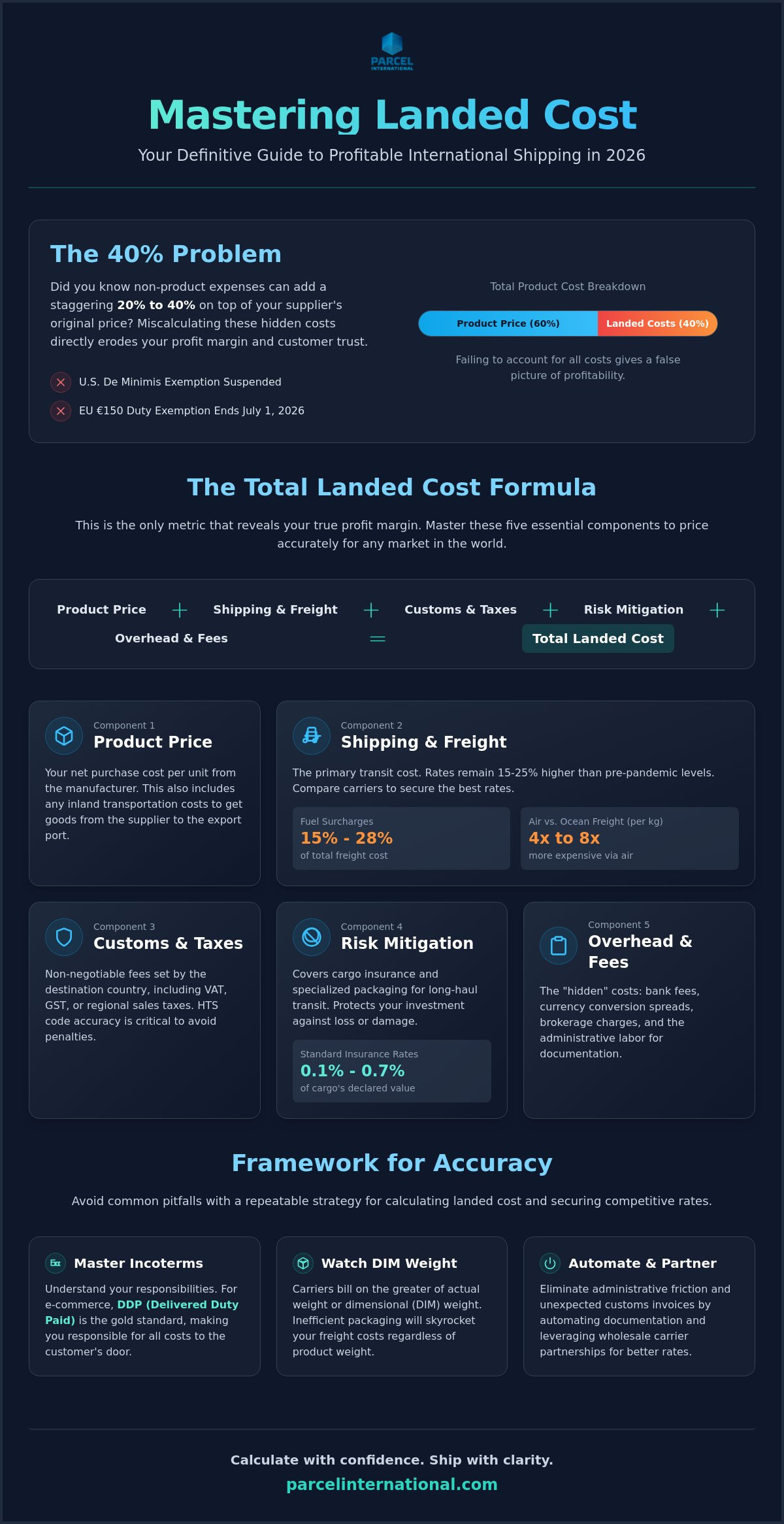
Did you know that non-product expenses can add 40% to your supplier's original price? With the U.S. de minimis exemption suspended and the EU ending its €150 duty exemption as of July 1, 2026, the margin for error has effectively disappeared. If you don't know exactly how to calculate landed cost for international shipping, you aren't just guessing your profits; you're actively risking them. Every unexpected customs invoice or miscalculated fuel surcharge is a direct hit to your bottom line.
It's frustrating to face "surprise" fees thirty days after a delivery that you thought was profitable. You deserve a logistics process that's transparent and predictable. This guide will help you master the total cost of your global shipments with our definitive landed cost formula and calculation framework. We'll break down the 2026 VAT thresholds, HTS code complexities, and regional regulations. By the end, you'll have a repeatable strategy to price your products accurately for any market in the world.
Table of Contents
What is Landed Cost in International Shipping?
Landed cost is the absolute total price of a product once it has arrived at a buyer's door. It's the only metric that reveals your true profit margin. While many businesses focus solely on the manufacturer's quote, the Landed cost includes every expense incurred during the journey. This covers the unit price, freight charges, insurance, customs duties, and local taxes. It also includes the administrative costs of brokerage fees and the labor spent on documentation, factors that many basic calculators overlook.
In 2026, the global trade environment is more fragmented than ever. With global trade growth limited to 0.5% to 1%, every cent in your supply chain counts. Shipping rates have stabilized but remain 15% to 25% higher than pre-pandemic levels. Because non-product costs frequently add 20% to 40% on top of your supplier's price, learning how to calculate landed cost for international shipping with precision is mandatory. You can't rely on simple estimates when regional VAT thresholds and duty exemptions are in a state of constant flux.
The Financial Impact of Miscalculation
A miscalculation in your landed cost is a silent profit killer. If you underestimate duties, you face the choice of eating the cost or passing a "surprise" invoice to your customer. These unexpected fees erode trust and virtually guarantee the customer won't return. From an internal perspective, inaccurate data leads to flawed inventory valuation. Your accounting team needs precise figures to report true asset value; without them, your entire financial reporting becomes unreliable. Precision protects your bottom line and your reputation simultaneously.
Landed Cost vs. FOB and CIF
Your calculation framework depends on your Incoterms. Terms like FOB (Free on Board) mean you're only responsible for costs until the goods are on the vessel. CIF (Cost, Insurance, and Freight) extends that responsibility to the destination port. However, in the modern e-commerce landscape, DDP (Delivered Duty Paid) has become the gold standard. Under DDP, you take full responsibility for all costs until the product reaches the customer's hands. This requires a deep understanding of how to calculate landed cost for international shipping to ensure your "all-in" price is both competitive and profitable. By removing the friction of customs for your buyer, you create a seamless global shopping experience that drives growth.
The Total Landed Cost Formula: 5 Key Components
To master your global margins, you need a formula that accounts for every cent from the factory floor to the customer's doorstep. Relying on a simple "price plus postage" calculation is a recipe for debt. When you analyze how to calculate landed cost for international shipping, you must integrate these five distinct pillars:
Product Price: This is your net purchase cost per unit. It includes the manufacturing price and any inland transportation costs required to get the goods from the supplier to the export port.
Shipping & Freight: This covers the primary transit cost. In 2026, fuel surcharges account for 15% to 28% of this total. Remember that air freight is typically 4 to 8 times more expensive than ocean freight per kilogram.
Customs Duties & Import Taxes: These are the non-negotiable fees set by the destination country. You must check the latest customs and duties data to account for VAT, GST, or specific regional sales taxes that apply to your product category.
Risk Mitigation: This includes specialized packaging for long-haul transit and cargo insurance. For 2026, standard insurance rates range from 0.1% to 0.7% of the cargo's declared value.
Overhead & Fees: Don't ignore bank fees, currency conversion spreads, and brokerage charges. These small percentages add up across high-volume shipments.
Securing the Baseline Shipping Rate
Your landed cost calculation is only as accurate as your starting freight quote. Many shippers make the mistake of checking a single carrier and accepting that rate as the market standard. To optimize your budget, you should compare international shipping rates across multiple providers. Pay close attention to dimensional weight (DIM weight). Carriers bill based on whichever is greater: the actual weight or the space the package occupies. If your packaging is inefficient, your landed cost will skyrocket regardless of the product's weight.
Valuing Administrative Labor
Administrative labor is a "hidden" expense that frequently stays off the balance sheet. If your team spends hours manually generating commercial invoices or researching HTS codes, those labor hours are part of your landed cost. Manual errors also carry the risk of delay penalties at customs, which can turn a profitable shipment into a loss overnight. You can protect your margins by using automated documentation tools to eliminate these manual touchpoints. This shift reduces the per-parcel admin cost and ensures your compliance is airtight before the goods even leave the warehouse. Precision in your paperwork is just as vital as precision in your math.
Overlooked Factors That Inflate Your Shipping Budget
Calculating the obvious costs like freight and product price is only half the battle. The real threat to your profitability lies in the "hidden leaks" that surface long after a shipment has left your warehouse. If you want to master how to calculate landed cost for international shipping, you must account for the granular variables that carriers often bury in the fine print. These include fluctuating exchange rates, classification errors, and the specific fees brokers charge to move your goods across borders.
Currency conversion is a prime example of an invisible expense. When you pay a supplier or a carrier in a foreign denomination, the "mid-market" rate you see on Google isn't what you'll actually pay. Banks and payment processors typically add a spread of 1% to 3%. On a large commercial shipment, this single oversight can wipe out a significant portion of your expected margin. Always use a conservative exchange rate in your initial estimates to create a financial buffer.
Demystifying HTS Codes
Precise product classification is the foundation of any accurate duty calculation. Every product you ship must be assigned a Harmonized Tariff Schedule (HTS) code. As of July 2026, the regulatory environment has tightened significantly; the EU has ended its €150 duty exemption, replacing it with a flat €3 duty per tariff classification. If you use the wrong code, you risk more than just a 20% hike in duties. Customs authorities view misclassification as a compliance failure, which can lead to heavy fines, shipment seizures, and a "red flag" on your business profile that causes future delays. Review the latest U.S. Customs and Border Protection guidelines to ensure your inventory is categorized correctly before it hits the water.
The Role of Customs Brokerage
Many shippers assume their carrier handle everything, but "carrier-inclusive" brokerage often comes with standardized fees that may not be the most cost-effective for your specific volume. You should understand how international shipping customs documentation affects your total spend. Brokers often charge "Disbursement Fees" or "Entry Fees" for the service of paying duties on your behalf. These fees are usually a percentage of the duty amount or a flat minimum fee, whichever is higher. To keep your landed cost low, consider setting up a duty deferment account or prepaying taxes to eliminate these administrative markups. When you're refining how to calculate landed cost for international shipping, these small tactical shifts often result in the largest savings.
Finally, don't forget accessorial charges. Carriers frequently apply surcharges for residential deliveries or shipments to remote areas. In 2026, as supply chains diversify into regions like Vietnam, these remote area surcharges are becoming more common. If your customer is outside a major metropolitan hub, expect to see an additional fee added to your final invoice.
Step-by-Step: How to Calculate Landed Cost in 2026
Precision is the only way to protect your global margins. When you're learning how to calculate landed cost for international shipping, you must follow a sequential process that leaves nothing to chance. Missing a single tax threshold or surcharge can turn a high-volume shipment into a financial liability. Use this five-step framework to ensure every parcel is priced for profit.
Step 1: Define the Base Value. Determine the unit price and the total quantity of the shipment. This is your starting point before any logistics costs are added.
Step 2: Secure Real-Time Freight Quotes. Get live rates across multiple modes. Remember that ocean freight costs can be as low as $0.03 per kg, while express air cargo can exceed $8.00 per kg in 2026.
Step 3: Check Regional Tax Thresholds. Identify the destination country’s de minimis value. As of July 1, 2026, the EU has removed the €150 duty exemption, so you'll need to account for duties on even small shipments.
Step 4: Apply the HTS Code. Use your product's specific code to find the duty percentage. This ensures you aren't overpaying or risking a misclassification penalty.
Step 5: Finalize the Per-Unit Cost. Sum all variables—product price, freight, duties, taxes, and insurance—and divide by the number of units.
Example Calculation: Shipping to the EU
Imagine you're shipping a $500 batch of electronics to a customer in Rotterdam. First, calculate the Dutch VAT at the standard 21% rate. Under the new July 2026 regulations, you'll also pay a flat €3 customs duty per tariff classification because the previous de minimis exemption has expired. If you're moving a larger load and using a freight forwarder, you must also add their service commission and any local handling fees at the Port of Rotterdam to your total.
Tools for Automation
Spreadsheets are the enemy of scalable growth. They're prone to manual entry errors and can't stay updated with shifting 2026 tax laws. Instead, use API-driven calculators that pull real-time duty and tax data directly into your workflow. By integrating your e-commerce platform with a shipping aggregator, you can how to calculate landed cost for international shipping instantly at the point of sale. This transparency builds trust with your customers and ensures you never lose money on a "surprise" invoice. You can compare real-time rates and automate your customs paperwork to eliminate these manual bottlenecks today.
If you are a freight operator or manage a haulage business, integrating an AI-powered transport management platform like Logivo.ai can further streamline your workflows, ensuring that every variable in the landed cost formula is tracked and optimized automatically.
Lowering Your Landed Cost with Parcel International
Understanding the variables is only the first step. Manual execution is where most global margins disappear. You shouldn't have to be a logistics expert to maintain profitability in a fragmented market. Parcel International functions as your strategic partner, offering a unified platform to manage every component of your shipment. By providing access to wholesale rates from DHL, FedEx, and UPS without requiring volume minimums, we lower the baseline freight cost immediately. This reduction is the most effective way to improve your bottom line when you analyze how to calculate landed cost for international shipping.
Beyond the rates, we eliminate the administrative "leakage" caused by manual paperwork. Our platform automates the generation of customs documentation for over 220 territories. This doesn't just save time; it removes the human error that leads to HTS misclassification and costly delay penalties at the border. You can compare Express, Air, Sea, and Road freight on a single screen, ensuring you always choose the most cost-effective mode for your specific timeline. We prioritize radical transparency, which means you won't deal with hidden subscription fees or surprise surcharges on your final invoice.
The Broker Advantage
A logistics broker provides the flexibility that single carriers simply cannot match. If one carrier's fuel surcharges spike or a specific route becomes congested, you can pivot instantly to a more efficient alternative to protect your margins. Leveraging international parcel shipping networks through a broker allows you to reach global markets with the infrastructure of a multinational corporation. Centralizing your logistics into one dashboard reduces overhead and gives you a clear, consolidated view of your total spend. It turns a chaotic process into an orderly, repeatable workflow.
Ready to Optimize Your Global Margins?
The secret to a lower landed cost is securing a better shipping rate from the start. Stop guessing your expenses and start using data-driven logistics to grow your business. We invite you to test our platform for free and see the difference transparency makes in your pricing strategy. When you're ready to master how to calculate landed cost for international shipping, let our automated tools handle the heavy lifting. Efficiency isn't just about speed; it's about the relief of knowing your costs are covered. Get a real-time shipping quote and calculate your savings today.
Take Control of Your Global Profitability
Mastering your margins in the 2026 trade environment requires more than a simple spreadsheet. You've seen how overlooked factors like HTS classification errors and currency spreads can quickly turn a profitable sale into a loss. By following a rigorous, step-by-step framework, you can eliminate the anxiety of "surprise" invoices and build a predictable pricing strategy for every market you serve. Understanding exactly how to calculate landed cost for international shipping is the difference between a business that merely survives and one that scales with confidence. To further support your expansion, utilizing professional outreach from We Mail America can help you reach and retain customers more effectively as you grow.
Don't let manual paperwork or fragmented workflows slow your growth. You can centralize your logistics and gain immediate visibility into every expense. Parcel International provides real-time comparisons of major global carriers and reaches over 220 countries with no hidden subscription fees. It's time to replace estimates with certainty. Take the next step toward a more efficient supply chain.
Compare rates and automate your customs documentation with Parcel International.
Frequently Asked Questions
What is the most common mistake in landed cost calculation?
The most common mistake is failing to account for "hidden" administrative and financial fees, such as currency conversion spreads and brokerage surcharges. Many shippers only look at the carrier's base rate and the product price. This oversight often leads to a profit margin that is 20% to 40% lower than expected once the final invoices arrive. Precision requires looking beyond the obvious shipping label cost.
How do HTS codes affect my total shipping price?
HTS codes act as the legal identifier for your goods and directly dictate the duty percentage applied by customs authorities. In 2026, even a minor classification error can lead to a 20% hike in duties or a compliance penalty. Using the correct code is the foundation of learning how to calculate landed cost for international shipping with accuracy. It ensures you aren't overpaying or risking a border delay.
Can I lower my landed cost by using a freight forwarder?
You can often lower your landed cost by using a freight forwarder to consolidate shipments or access volume-based discounts. Forwarders provide the expertise needed to navigate complex 2026 regulations, helping you avoid costly administrative errors. While they charge a service fee, the savings on freight rates and the prevention of customs penalties usually provide a net financial benefit for larger loads.
What are "de minimis" values and why do they matter for small parcels?
De minimis values are price thresholds below which no duties or taxes are collected on imports. These matter for small parcels because they can eliminate significant costs for low-value items. However, you must stay updated on current laws; for instance, the EU removed its €150 duty exemption on July 1, 2026. This means almost all shipments to the region now incur fees regardless of their value.
Is insurance included in the standard landed cost formula?
Insurance is not typically included in a carrier's standard rate and must be added as a separate component in your landed cost formula. In 2026, cargo insurance rates generally range from 0.1% to 0.7% of the cargo's declared value. Omitting this cost leaves your business vulnerable to total financial loss if a shipment is damaged or lost in transit. It's a small price for significant peace of mind.
How does dimensional weight impact the landed cost of light but large items?
Dimensional weight impacts the landed cost by charging you for the space a package occupies rather than its actual weight. If you ship light but bulky items, carriers will bill you based on the package's volume. This means inefficient packaging can double your shipping expenses. To keep your landed cost low, you must optimize box sizes to match the physical dimensions of your product as closely as possible.
Should I include the cost of returns in my landed cost calculation?
You should factor a "return rate" into your broader pricing strategy, even if it isn't part of the initial landed cost for a specific outbound parcel. International returns involve secondary shipping fees, duty drawbacks, and administrative labor. Including a small buffer for these expenses ensures your global pricing remains sustainable. This approach protects your bottom line across your entire international sales volume.
How often do international duty and tax rates change?
International duty and tax rates change whenever governments update trade policies or free trade agreements, which can happen several times a year. Freight rates and fuel surcharges are even more volatile, often fluctuating on a monthly or weekly basis. For 2026, expect a mild peak-season increase of 10% to 15% in shipping costs between August and October. Regular audits of your shipping data are essential to stay accurate.


Comments