International Road Freight Rates Europe: The Complete 2026 Business Guide
Did you know that average diesel prices across the EU jumped by 26% in a single quarter, reaching €1.96 per liter by March 2026? You're likely struggling to maintain a predictable budget when international road freight rates Europe are shifting almost weekly due to these fuel spikes and new regulatory burdens. It's difficult to decide between locking in contract rates, which hit 140.1 points in Q1, or risking the spot market where short term demand has softened.
This guide provides the direct clarity you need to secure stable, competitive pricing despite these market pressures. Stop guessing at your logistics costs and start using data-driven strategies to protect your margins. Master the July 2026 LCV tachograph requirements, understand the current cost benchmarks of €1.45 to €1.58 per kilometer, and simplify your comparisons between major providers like DHL and UPS.
Key Takeaways
Analyze the 2026 market landscape to understand how the 132.2 benchmark index influences international road freight rates Europe.
Identify the critical impact of fuel price volatility and the EU driver shortage on your logistics budget.
Compare road freight against rail and sea transport to determine the most cost-effective mode for your specific cargo.
Learn how shipment consolidation and smart route optimization can reduce your freight expenses by up to 50%.
Discover how to use independent brokerage platforms to eliminate hidden fees and simplify carrier comparisons.
Table of Contents
The State of European Road Freight Rates in 2026
The European freight market in 2026 presents a stabilized but complex environment for shippers. We're seeing a significant "convergence" where the traditional gap between on-demand pricing and long-term agreements has narrowed. For your 2026 budgeting, the 132.2 benchmark index is the most critical figure to watch. It represents the point where the market has found its new floor after years of volatility. While this stability is reassuring, it requires a shift in how you evaluate international road freight rates Europe. You can't rely on simple year-over-year adjustments; instead, you must look at the total "all-in" rate. This comprehensive figure includes fuel surcharges, road tolls, and regulatory compliance fees that base rates often hide. Understanding this distinction is the first step toward removing the friction from your logistics planning.
Spot Rates vs. Contract Rates: The 2026 Convergence
Currently, spot and contract rates are meeting at nearly the same price point. This convergence happens because carriers are repricing long-term contracts upward to cover rising operational costs, while spot market demand has cooled slightly. Relying solely on the spot market might seem cheaper today, but it carries a high risk during peak seasons when capacity disappears. Many businesses are finding success with hybrid models that mirror the efficiency found in regional Transport in the European Union frameworks. These models provide the flexibility of on-demand shipping for regional routes while maintaining the security of contracted space for primary corridors. It's a reliable way to hedge against sudden price spikes without being locked into rigid, expensive contracts.
The Economic Pulse: Tonnage and Demand Trends
The economic rebound in major hubs like Germany, France, and Poland is driving a steady but cautious demand for road transport. Interestingly, international tonnage exchanges in early 2026 remain lower than the historical highs of the early 2020s. This isn't a sign of weakness; it's a result of a more efficient, consolidated market where empty miles are being minimized. Retail recovery is the primary engine behind the current demand, particularly in high-growth Eastern European corridors. While Western European routes remain stable, the real movement is happening in cross-border trade involving Poland and neighboring markets. These regional fluctuations dictate where capacity will be tightest. Track these trends to negotiate from a position of strength and secure the most competitive rates for your cargo.
Top 5 Factors Influencing Road Freight Costs in Europe
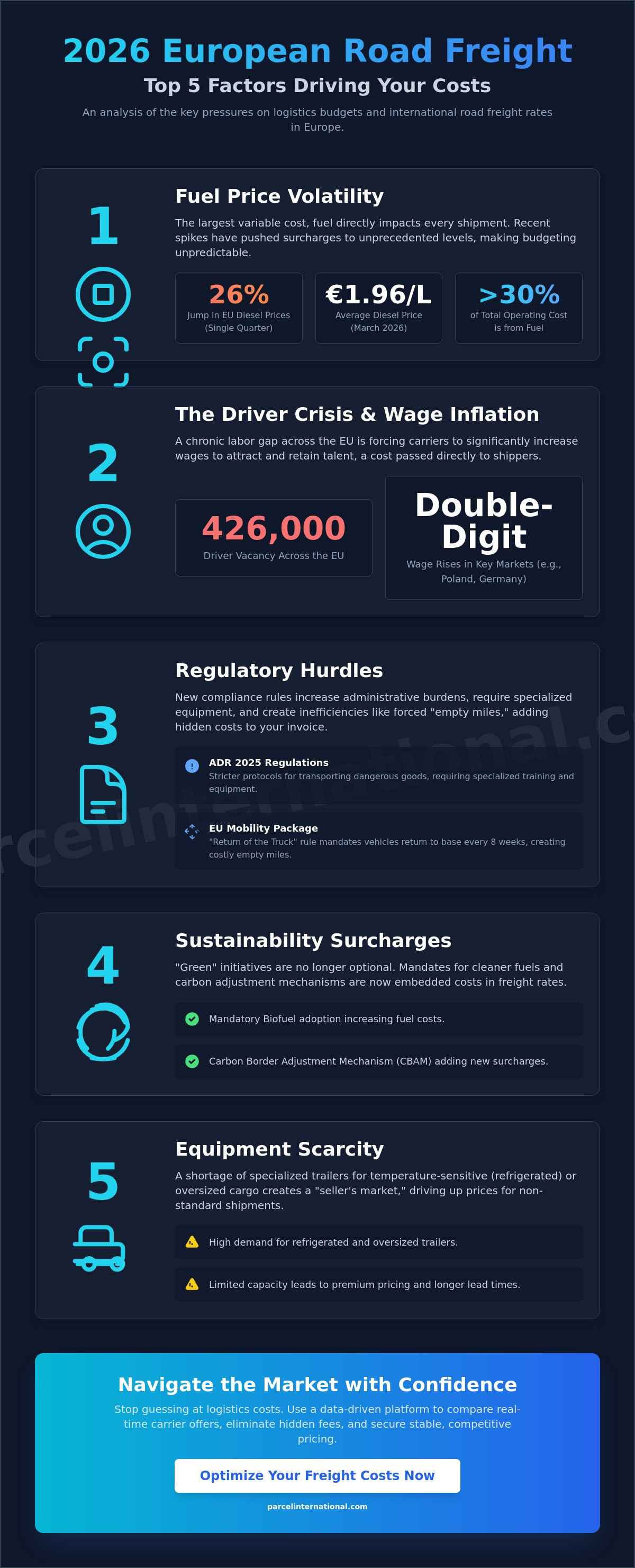
Global volatility isn't just a headline; it's a direct tax on your supply chain. When crude oil prices push past $100 a barrel, diesel benchmarks follow immediately. Fuel is the single largest variable component in international road freight rates Europe, often accounting for over 30% of the total operating cost. Carriers can't absorb these 26% price spikes, so they pass them to you through fluctuating fuel surcharges. Beyond the pump, a chronic shortage of 426,000 drivers across the EU is forcing base rates upward. This labor gap, combined with equipment scarcity for refrigerated units, creates a "seller's market" for transport capacity.
The Driver Crisis and Wage Inflation
The 426,000 driver vacancy figure is a floor for pricing, not a ceiling. It represents a systemic challenge in attracting new talent to the industry. As a result, carrier wages are rising by double digits in markets like Poland and Germany to retain existing staff. These costs flow directly into your shipping invoice. While automated logistics and AI-driven route planning help optimize driver hours, they can't replace the physical presence required for most hauls. If you want to see how these labor costs impact your specific routes, you can compare real-time carrier offers to find the most efficient balance.
Regulatory Hurdles: ADR 2025 and the EU Mobility Package
Compliance is becoming a heavy administrative and financial burden. The new ADR 2025 regulations introduce stricter protocols for transporting dangerous goods, requiring specialized training and equipment. Simultaneously, the EU Mobility Package's "Return of the Truck" rule mandates that vehicles return to their home base every eight weeks. This creates thousands of empty miles that shippers ultimately pay for. According to recent Road freight transport statistics, these regulatory shifts are fundamentally altering modal shares and efficiency benchmarks across the continent.
Sustainability surcharges are the newest addition to your bill. Biofuel mandates and the Carbon Border Adjustment Mechanism (CBAM) are no longer optional "green" extras; they're embedded costs. When you add the shortage of specialized trailers for oversized or temperature-sensitive cargo, the complexity of securing a fair rate becomes clear. Success in 2026 requires looking past the base freight fee to see the regulatory and environmental drivers underneath. By identifying these factors early, you can adjust your procurement strategy before the next price hike hits.
Comparing Road Freight vs. Other Transport Modes
Choosing the right transport mode requires balancing speed, cost, and reliability. While rail and sea have their place, road freight dominates the 500km to 2,500km range. In this "sweet spot," international road freight rates Europe remain the most competitive for door-to-door delivery. Unlike rail, which is tied to specific terminals, road transport offers a "Last Mile" advantage that eliminates expensive transshipment costs. It is the most flexible way to move cargo across a continent with diverse infrastructure.
Road vs. Rail: The Efficiency Gap
Rail is often touted for sustainability, but its reliability is frequently hampered by aging infrastructure and priority given to passenger trains. According to the Q1 2026 European road freight rates report, road transport continues to be the primary choice for intra-EU trade despite rising fuel costs. These market dynamics keep international road freight rates Europe as the benchmark for regional logistics efficiency. Intermodal solutions, combining rail for the long haul and road for the final leg, only become the cheapest option when distances exceed 1,500km and timelines are flexible. For most business needs, the agility of a truck outweighs the marginal savings of a train.
Air Freight vs. Express Road: When Speed is Critical
When speed is critical, you might immediately think of air freight. However, for trans-European routes like Rotterdam to Madrid, express road freight often rivals air transit times at a fraction of the price. Air freight costs per kilogram are significantly higher due to airport handling fees and security surcharges. For smaller shipments where speed is essential but the budget is tight, check out our International Parcel Shipping Guide to see how express road models can save you money.
You should also consider the ratio of speed to cost when comparing standard road parcel shipping models against traditional Less than Truckload (LTL) services. Standard road parcel shipping models often provide better tracking and faster transit for smaller, regional hauls. Traditional LTL is better suited for heavier, palletized cargo where you can trade a day of transit time for a lower rate. This choice depends entirely on your cargo's weight and the urgency of the delivery.
It is true that road freight has a higher carbon footprint per tonne-kilometer than rail or sea. However, the industry is bridging this gap through biofuel mandates and more efficient route planning. If your priority is a balance of efficiency and reliability, road transport remains the undisputed leader in the European market.
How to Secure the Best International Road Freight Rates
Securing competitive international road freight rates Europe doesn't happen by accident. It requires a tactical approach to how you package, time, and document your shipments. One of the most immediate ways to reduce your spend is through shipment consolidation. By utilizing Less than Truckload (LTL) services, you share trailer space with other businesses, which can save you between 30% and 50% compared to the cost of a Full Truckload (FTL) for a partially empty vehicle. This shift from paying for a whole truck to paying only for the space you use is a fundamental way to protect your margins.
Timing and route optimization are your next lines of defense. Aim to book your transport 7 to 14 days in advance whenever possible. This window allows carriers to plan their backhauls more effectively, helping you avoid the "urgency surcharges" that often accompany last-minute bookings. Additionally, you should double-check your data accuracy before hitting send. Providing precise weight and dimensions prevents the unexpected "re-weigh" fees that carriers often apply after pickup. These administrative adjustments might seem small, but they can quickly inflate an otherwise competitive quote.
The Power of Aggregation and Brokerage
Digital brokerage platforms like Parcel International act as a powerful bridge between your business and major global carriers. By aggregating the shipping volume of thousands of users, these platforms negotiate wholesale rates with industry leaders like DHL and UPS. You gain access to these "bulk" prices without needing to meet high-volume shipping minimums yourself. In a fragmented market, the ability to compare real-time data across 220 countries is the ultimate cost-saving tool. This transparency allows you to choose the best provider for each specific lane on a single screen, removing the friction of managing multiple carrier accounts and fragmented workflows.
Managing Customs and Surcharges
Border delays are silent profit killers that often result from poor documentation. Automated customs support is your best defense against these bottlenecks, ensuring that your paperwork is compliant before the truck even arrives. Beyond the base freight rate, you must stay aware of common surcharges like the Fuel Adjustment Factor (BAF), Currency Adjustment Factor (CAF), and Peak Season Surcharge (PSS).
To keep your shipments moving smoothly, use this "Customs Ready" checklist for every invoice:
Complete EORI numbers for both the sender and receiver.
Accurate HS codes for every product in the shipment.
A detailed commercial invoice that matches your packing list exactly.
Clear proof of origin documentation to satisfy local authorities.
If you're tired of hidden costs and unpredictable pricing, you can get a freight quote online today and see the difference transparency makes for your bottom line.
Streamlining European Logistics with Parcel International
Market volatility and regulatory shifts don't have to define your supply chain. In an industry where 26% fuel spikes and complex driver regulations are the new normal, you need a partner that acts as an optimizer. Parcel International serves as an independent broker and advanced tech platform designed to strip away the typical anxieties of global logistics. We focus on radical transparency. By maintaining a strict "No Hidden Fees" policy, we differentiate ourselves from traditional carriers who often obscure the real cost of transport in fine print. Whether you're coordinating "ups ground shipping" or high-priority express road hauls, our interface simplifies the booking process into a few clicks.
The complexity of managing international road freight rates Europe often stems from fragmented workflows. You shouldn't have to jump between multiple platforms to compare prices or track shipments. Our system integrates automated customs support directly into the booking journey. This ensures your documentation is compliant before the truck arrives, preventing the costly border delays that often plague cross-border trade. We act as a stable intermediary, providing the security and punctuality your business requires to thrive in a high-stakes market.
A Single Platform for All Modes
Transitioning from small parcel deliveries to large-scale road freight should be seamless. Our dashboard provides the relief of a unified workflow, allowing SMB logistics managers to oversee everything from a single pallet to a full load without redundant data entry. Based in our Rotterdam headquarters, we sit at the heart of the continent's most strategic transport hub. This location allows us to leverage deep industry expertise and maintain a pulse on the European road freight landscape. We remove traditional barriers like volume minimums, making professional-grade logistics accessible to businesses of all sizes.
Transparency in a Volatile Market
We believe that clear data is the best tool for cost control. Our platform provides real-time rate updates that reflect the latest market fluctuations and IRU indexes. This ensures that you're always making decisions based on the most current international road freight rates Europe. Beyond the technology, we provide personalized support that exceeds standard industry benchmarks. Our team acts as a protective ally, helping you navigate the complexities of fuel surcharges and equipment availability. Don't let unpredictable market forces dictate your shipping budget. Compare international road freight rates today and experience the efficiency of a truly transparent logistics partner.
Master Your 2026 Logistics Strategy
The 2026 landscape for international road freight rates Europe is defined by a unique convergence of spot and contract pricing. While this stability offers a breather, the rising costs of fuel and new EU regulations like the Smart Tachograph mandate require constant vigilance. You don't have to navigate these complexities alone or settle for opaque pricing structures. By leveraging shipment consolidation and comparing carriers through a unified dashboard, you turn a chaotic process into an orderly, cost-effective workflow. This strategic shift is the most reliable way to protect your bottom line against market volatility.
Take control of your shipping margins today. Our platform provides the relief of automated customs documentation and direct access to wholesale rates from industry leaders like DHL, FedEx, and UPS across more than 220 countries. Stop dealing with hidden fees and start shipping with a partner that values your peace of mind over corporate jargon. Compare Real-Time Road Freight Rates Now and secure the reliability your cargo deserves. Efficient, transparent logistics is finally within your reach.
Frequently Asked Questions
What is the average road freight rate per km in Europe for 2026?
The competitive benchmark for the average cost per kilometer in 2026 sits between €1.45 and €1.58 for an articulated truck. This figure represents the standard operational floor for carriers across the continent. Your actual costs will vary based on the specific route, the type of cargo, and the current fuel surcharges at the time of booking.
How has the EU Mobility Package affected road freight prices?
The EU Mobility Package has increased costs by mandating that trucks return to their home base every eight weeks. This requirement often creates "empty miles" that carriers must price into their services. Stricter regulations on driver rest periods and the use of Smart Tachographs have also tightened available capacity, pushing base rates higher to cover these compliance burdens.
What is the difference between LTL and FTL in European road transport?
LTL stands for Less than Truckload, where you pay only for the pallet space your cargo occupies in a shared trailer. FTL, or Full Truckload, means you reserve the entire vehicle for your exclusive use. LTL is an excellent way to manage international road freight rates Europe for smaller shipments, while FTL provides faster, direct transit for high-volume goods.
Are fuel surcharges included in the initial freight quote?
Fuel surcharges are typically calculated as a separate percentage called the Fuel Adjustment Factor (BAF). Most initial quotes show a base freight rate, with the BAF added on top to reflect real-time diesel price fluctuations. We prioritize radical transparency, so we recommend always confirming if a quote is "all-in" or if floating surcharges will be applied later.
How do I track an international road freight shipment across borders?
You can track your shipments in real-time through digital logistics platforms that integrate GPS data from various carrier fleets. These systems provide automated updates whenever a vehicle crosses a border or reaches a major transit hub. This unified visibility removes the need for manual check-calls and provides the relief of knowing exactly where your cargo is at any moment.
Can I use UPS Ground Shipping for heavy freight in Europe?
While UPS Ground is a well-known parcel service, heavy freight is handled through specialized road freight networks. For shipments exceeding standard weight limits, you'll move to palletized LTL or FTL services. You can easily compare these different service levels on a single dashboard to decide which carrier and transit speed best fits your specific cargo requirements.
What documentation is required for road freight between the EU and non-EU countries?
Cross-border shipping requires a commercial invoice, a packing list, and valid EORI numbers for both the sender and the recipient. You must also include accurate HS codes for all goods to ensure smooth customs clearance. Using automated documentation tools is the most reliable way to prevent border delays and avoid the administrative friction of manual paperwork.
Why are spot rates currently converging with contract rates?
Spot and contract rates are meeting at a similar price point because carriers have repriced long-term contracts upward to account for 2026 labor and fuel costs. Meanwhile, a slight softening in short-term demand has kept spot rates from seeing similar spikes. This convergence means you have more flexibility to choose between on-demand and contracted capacity without a significant pricing penalty.