
International Shipping Checklist 2026: The Professional Guide to Global Logistics
- Alex
- Aug 2
- 15 min read
Your shipment clears customs without a hitch, lands on time, and costs exactly what you budgeted. Now flip that picture: a package stuck at the border for two weeks, a surprise duty bill that wipes your margin, and a frantic search through three different platforms trying to figure out what went wrong. The difference between those two outcomes almost always comes down to preparation, and a solid international shipping checklist is where that preparation starts.
If you've ever felt blindsided by customs delays, confused by HS codes, or frustrated watching shipping costs quietly eat into your profits, you're not alone. Global logistics is genuinely complex, and the paperwork alone can feel like a full-time job. The good news is that complexity doesn't have to mean chaos.
This guide turns the entire international shipping process into a repeatable, digital-first workflow built for 2026. You'll get a step-by-step checklist covering documentation, compliance, carrier selection, and cost optimization, so every shipment moves faster, costs less, and clears customs cleanly. Here's exactly what to check before your next package leaves the door.
Table of Contents
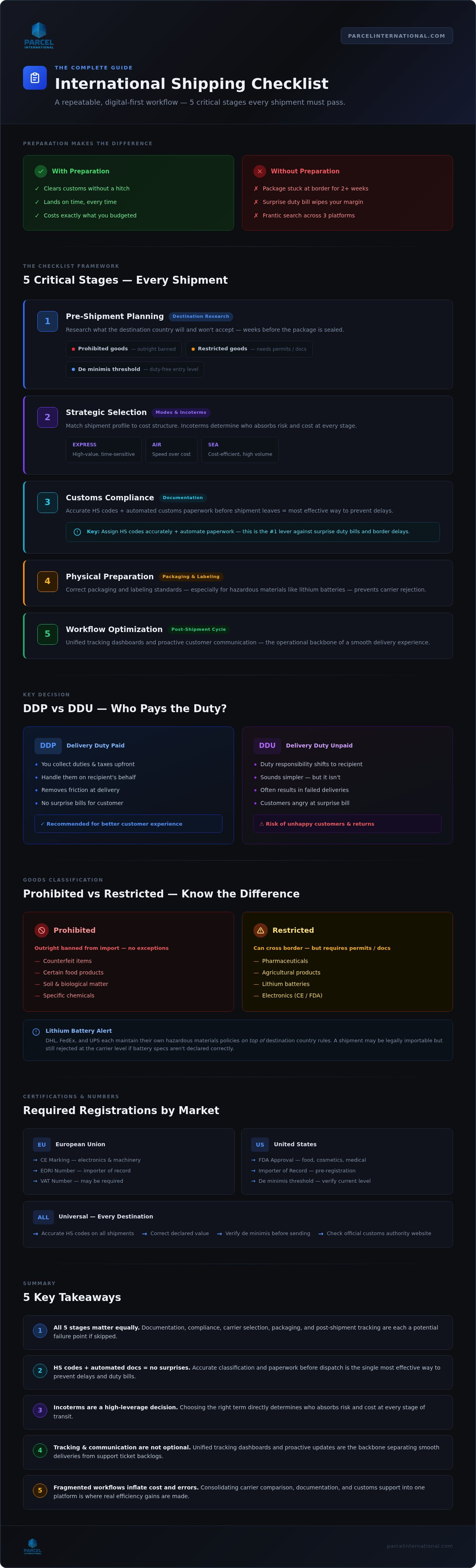
Pre-Shipment Planning: Researching Destination Regulations
Every successful international shipment starts weeks before the package is sealed. Skipping destination research is the fastest way to turn a routine delivery into a customs nightmare, and it's a mistake that shows up repeatedly in even experienced shippers' workflows. Before anything else gets added to your international shipping checklist, you need a clear picture of what the destination country will and won't accept.
Identifying Prohibited and Restricted Goods
There's a critical distinction here that trips up a lot of shippers: prohibited items are outright banned from import, while restricted items can cross the border but require specific permits, licenses, or documentation to do so. Treating them as the same category is an expensive mistake.
Common prohibited goods include certain food products, soil, counterfeit items, and specific chemicals. Restricted goods cover a much wider range, from pharmaceuticals and agricultural products to items containing lithium batteries. That last category deserves special attention. Carriers including DHL, FedEx, and UPS each maintain their own hazardous materials policies that sit on top of destination country rules. A shipment might be legally importable but still rejected at the carrier level if the battery specifications aren't declared correctly.
Check the destination country's official customs authority website for its prohibited and restricted goods list.
Cross-reference with your chosen carrier's dangerous goods policy, not just national regulations.
For regional nuances across specific markets, the international parcel shipping 2026 guide breaks down country-level rules that generic customs databases often miss.
Confirm whether your product requires a country-specific certification. CE marking is mandatory for electronics and machinery entering the EU; FDA approval applies to food, cosmetics, and medical devices heading into the US.
Understanding Import Duties and Taxes
Duty and tax exposure varies dramatically by product category, destination, and declared value. Research the applicable VAT or GST rate for your specific goods, not just a general country rate, because different product categories attract different rates within the same country.
The de minimis threshold is where many e-commerce shippers get caught off guard. This is the declared value below which a shipment enters duty-free. Several major markets have adjusted these thresholds in recent years, and low-value e-commerce shipments that previously cleared without duty may no longer qualify for that exemption. Verify the current threshold for your destination before assuming a small parcel will slip through untaxed.
You also need to decide early whether you're shipping Delivery Duty Paid (DDP) or Delivery Duty Unpaid (DDU). DDP means you collect duties and taxes upfront and handle them on the recipient's behalf, which removes friction at delivery. DDU pushes that responsibility to the recipient, which sounds simpler but often results in failed deliveries and unhappy customers who weren't expecting a surprise bill at their door.
Finally, confirm whether your recipient needs a VAT number, EORI number, or specific import license before the shipment moves. Some countries require the importer of record to be pre-registered, and finding that out after the goods are in transit creates delays that no amount of documentation can fix quickly.
Strategic Selection: Choosing Modes and Incoterms
Once you know what the destination will accept and what duties apply, the next decision on your international shipping checklist is deceptively simple on the surface: how does the shipment actually get there, and who's responsible for it along the way? Get these two decisions wrong and you'll either overpay significantly or hand off risk to a party that isn't equipped to manage it.
Selecting the Right Mode of Transport
The choice between express, air, and sea freight isn't just about speed. It's about matching your shipment profile to the right cost structure. Here's how to think through each option:
Express shipping is built for high-value, time-sensitive parcels typically under 70kg. Think electronics, medical samples, or urgent commercial documents. You're paying a premium for speed and door-to-door accountability, which is often justified when the cost of delay exceeds the cost of the service itself.
Air freight occupies the middle ground. It's faster than sea and cheaper than express for mid-sized commercial shipments, making it the default for manufacturers and retailers moving seasonal inventory on tight timelines without the volume to fill a container.
Sea freight is the cost-effective backbone of global trade for bulk goods and large volumes. Transit times are longer, but the per-unit economics are hard to beat when you're moving full or consolidated container loads.
One factor that catches shippers off guard across all three modes: dimensional weight. Carriers calculate the billable weight as whichever is greater, actual weight or volumetric weight. A lightweight but bulky product can trigger an "oversize" surcharge that inflates your quote well beyond the original estimate. Always calculate dimensional weight before comparing carrier rates, not after.
Comparing real-time rates across multiple carriers, rather than defaulting to a single provider, is where meaningful cost savings are found. Platforms that aggregate wholesale rates from DHL, FedEx, UPS, and others in a single view eliminate the manual quote-gathering that fragments most shipping workflows and quietly inflates costs.
Navigating 2026 Incoterms for Businesses
Incoterms define exactly where your responsibility ends and the buyer's begins. Choosing the wrong one doesn't just create legal ambiguity; it creates real financial exposure.
DAP (Delivered at Place) is the most widely used term in e-commerce. You cover transport to the destination, but the buyer handles import duties and taxes on arrival. It's straightforward, but it creates the same friction problem as DDU: recipients receive an unexpected bill at their door, which drives failed deliveries and negative reviews.
DDP (Delivered Duty Paid) solves that friction. You collect all duties and taxes upfront, and the recipient receives their package without any additional payment required. For consumer-facing businesses, DDP consistently produces better delivery completion rates and stronger customer satisfaction scores.
Calculating your true landed cost under each Incoterm requires factoring in duties, taxes, insurance, and freight together. The buying guide for international shipping rates walks through exactly how to model these costs before you commit to a shipping term or a carrier.
If you want to compare carrier rates and model landed costs without juggling multiple platforms, Parcel International's rate comparison tools bring everything into a single workflow, no subscriptions or volume minimums required.
Customs Compliance: Automating Documentation
Documentation errors are the leading cause of preventable customs holds. Not prohibited goods, not misdeclared values, not carrier mix-ups. Paperwork mistakes. And the reason they happen so consistently is simple: most shippers still treat customs documentation as a manual task, copying product details by hand across multiple forms and hoping nothing gets lost in translation. Your international shipping checklist needs to treat documentation as a system, not a to-do item.
The Anatomy of a Perfect Commercial Invoice
The commercial invoice is the single most scrutinized document in any cross-border shipment. Customs officers use it to verify the shipment's contents, assess duties, and confirm the transaction is legitimate. Vague descriptions are the fastest route to a hold.
Every commercial invoice must include:
Full contact details for both shipper and consignee, including phone numbers and tax identification numbers where required
A fact-dense description for each line item that specifies material composition, intended use, and brand or model where applicable. "Electronic device" fails. "Wireless Bluetooth headphones, plastic and metal construction, model XR-200" clears.
Itemized values in the currency of the sale, not converted estimates
Country of origin for each product, which may differ from your shipping origin
Exact quantities and units of measure that match the packing list precisely
That last point matters more than most shippers realize. A mismatch between your commercial invoice and your shipping label is an immediate red flag for customs authorities. The two documents must agree on every detail, including spelling of the consignee's name and address.
HS Codes and Digital Compliance
Every product that crosses an international border is assigned a Harmonized System (HS) code, a globally standardized numerical classification that determines applicable duty rates. The first six digits are universal; individual countries extend this to eight, ten, or more digits for their own tariff schedules. Getting the code wrong doesn't just risk a reclassification at the border; it can mean paying the wrong duty rate or triggering a compliance review.
Manual classification is where errors compound. A shipper who classifies a product correctly for one destination may apply the same code to a different market where a more specific sub-heading exists and attracts a higher rate. AI-driven classification tools have made this significantly more reliable, cross-referencing product descriptions against current tariff databases to surface the most accurate code for each destination country.
Beyond the invoice and HS codes, verify whether your shipment requires a Certificate of Origin, which is mandatory under many preferential trade agreements to qualify for reduced duty rates, or a detailed Packing List for multi-item commercial shipments. Neither document is optional when required; missing either one can hold an otherwise perfect shipment at the border.
Automating the entire documentation stack eliminates the transcription errors that manual workflows almost inevitably produce. The customs documentation guide covers automated templates for commercial invoices, packing lists, and certificates of origin, built to match the specific requirements of each destination market. Parcel International's customs support integrates this directly into the shipping workflow, so documentation is generated accurately the first time rather than corrected under pressure at the border.
Physical Preparation: Packaging and Labeling Standards
Perfect documentation means nothing if the shipment arrives damaged or gets misrouted because of a labeling error. Physical preparation is where your international shipping checklist gets tangible, and where small oversights create disproportionately large problems in transit.
Start with the box itself. Double-walled corrugated cardboard is the baseline for international freight, not single-wall. International shipments pass through multiple handling points, temperature variations, and pressure changes that domestic parcels simply don't encounter. One critical rule that gets overlooked: never reuse boxes with existing barcodes or shipping labels on them. Sorting systems at carrier hubs scan whatever barcode they find first. An old label from a previous shipment can reroute your package to the wrong facility before anyone realizes what happened.
Once the product is in the box, internal movement is your enemy. High-quality dunnage, such as bubble wrap, air pillows, or foam inserts, should fill every void so the contents can't shift during transit. A simple test: shake the sealed box. If you hear or feel movement, add more cushioning. For large-scale freight forwarding projects, palletization adds another layer of structural protection and makes handling significantly faster at each transfer point.
Place a duplicate copy of the commercial invoice inside the box, separate from the external documentation. If the outer label is damaged or detached in transit, this backup gives customs and delivery agents the information they need to process and deliver the shipment without starting a trace request.
Shipping insurance is the final physical preparation step. Base your coverage on the declared value of the goods, not a rough estimate. Underinsuring to save on premiums is a false economy that becomes painfully obvious the moment a claim is needed.
Labeling for Global Transit
Apply the shipping label to the largest flat surface of the box, using a weather-resistant label or a pouch that protects against moisture. Barcodes must lie flat; wrapping them around a corner or covering any part with tape makes them unscannable and effectively invisible to automated sorting systems.
Include the recipient's phone number prominently on the label. Local couriers in many markets attempt phone contact before marking a delivery as failed, and a missing number removes that option entirely.
Use internationally recognized handling marks for fragile, perishable, or orientation-sensitive goods. Don't assume couriers will read written instructions in English across every market.
For multi-box shipments, number each package clearly, for example, "1 of 3," so handlers know the shipment is incomplete if boxes arrive separately.
Getting both packaging and labeling right protects not just the goods but the entire delivery timeline you've built around your documentation and carrier selection. Compare carrier options and shipping rates with Parcel International to find services that match your packaging specifications and destination requirements without volume commitments or hidden fees.
Workflow Optimization: Managing the Post-Shipment Cycle
Clearing customs and handing off to a carrier isn't the finish line. It's where a lot of shippers mentally check out, and where a surprising number of delivery failures actually originate. The final stage of any solid international shipping checklist is the post-shipment cycle: tracking exceptions before they become crises, communicating proactively with customers, and using performance data to make the next shipment faster and cheaper than the last.
Proactive Tracking and Exception Management
Single-carrier tracking portals create blind spots the moment you're working with more than one provider. A unified dashboard that aggregates status updates from DHL, FedEx, UPS, and regional carriers into one view is the operational baseline, not a luxury upgrade. The goal isn't just visibility; it's speed of response when something goes wrong.
Set up automated alerts specifically for high-risk statuses: "held at customs," "delivery exception," "address query," and "return initiated." Waiting to discover these through a customer complaint adds hours or days to resolution time. Differentiate between origin milestones, such as picked up, departed facility, and cleared export customs, and destination milestones like arrived in country, cleared import customs, and out for delivery. Each stage has a different resolution path when it stalls, and conflating them slows down your response.
For consumer shipments, give customers a direct link to the carrier's local tracking portal rather than routing everything through your own interface. Local portals update faster in the destination country and reduce inbound support contacts significantly.
Continuous Improvement and Scaling
Post-shipment data is where your logistics operation either stagnates or compounds its efficiency. Run a monthly audit of shipping spend broken down by carrier, route, and service level. Patterns emerge quickly: a lane where one carrier consistently underperforms on transit time, a product category where dimensional weight surcharges inflate costs, or a destination market where customs holds cluster around a specific documentation gap.
Compare transit time performance across air and road freight on the same routes. The cheapest option on paper isn't always the cheapest option when you factor in delay-related costs like customer refunds, expedited replacements, or lost repeat business. When volume on a specific lane grows, that data also becomes your leverage for wholesale rate negotiation.
Scaling beyond a certain shipment volume is also the point where partnering with a global freight forwarder shifts from optional to strategic. Freight forwarders consolidate shipments, manage carrier relationships across 220+ countries and territories, and handle compliance complexity that would otherwise require dedicated in-house expertise.
Ready to simplify? Compare rates and automate your documentation with Parcel International today, no subscriptions, no volume minimums, and no hidden fees obscuring your true shipping costs.
Your Next Shipment Starts Here
Every stage of this international shipping checklist builds on the last. Destination research prevents prohibited goods from reaching the border. Accurate Incoterms protect your margins. Automated documentation stops customs holds before they start. Proper packaging keeps goods intact through multiple handling points. And proactive post-shipment tracking closes the loop before a delay becomes a customer complaint.
The shippers who execute this consistently aren't working harder; they're working from a single, unified workflow instead of juggling disconnected platforms and manual paperwork. That's exactly what separates a smooth delivery from a support ticket backlog.
Parcel International brings rate comparison, customs documentation, and carrier access together in one place. No subscription fees. No volume minimums. No hidden costs quietly inflating your landed price. You get wholesale rates from DHL, FedEx, and UPS alongside automated customs tools built for 2026 compliance requirements across 220+ countries and territories.
Start comparing international shipping rates and automate your customs paperwork today with Parcel International and make your next shipment your smoothest one yet.
Frequently Asked Questions About International Shipping
What are the most common documents needed for international shipping?
The core documents required for most international shipments are a commercial invoice, packing list, and shipping label. Depending on the destination and product type, you may also need a Certificate of Origin, a bill of lading or airway bill, and carrier-specific dangerous goods declarations. Some markets require additional permits or import licenses before goods can clear customs.
The commercial invoice carries the most weight with customs authorities, so it needs to be complete and accurate before anything else. Missing or incomplete documentation is the leading cause of preventable customs holds, which is why automating document generation rather than filling forms manually reduces error risk significantly.
How do I find the correct HS code for my products in 2026?
Start with the World Customs Organization's official HS nomenclature database, then cross-reference with the tariff schedule of your specific destination country, since countries extend the universal six-digit code with additional digits that carry different duty rates. Many customs authorities publish searchable online tools tied to their national tariff databases, which are more reliable than generic third-party code lookup sites.
AI-driven classification tools have become a practical option for shippers managing multiple product categories, automatically matching product descriptions against current tariff databases for each destination market. If you're shipping commercially and the duty difference between two similar codes is substantial, a formal binding ruling request from the destination country's customs authority gives you legal certainty before the shipment moves.
What is the difference between DDP and DAP Incoterms?
Under DDP (Delivered Duty Paid), the seller handles all costs and responsibilities, including import duties and taxes, right up to the buyer's door. Under DAP (Delivered at Place), the seller covers transport to the destination but the buyer is responsible for paying duties and taxes on arrival. The practical difference is who gets an unexpected bill at delivery.
For consumer-facing businesses, DDP consistently produces better delivery completion rates because recipients aren't surprised by additional charges they didn't budget for. DAP is simpler to administer but frequently results in failed deliveries when recipients decline to pay customs fees they weren't expecting. Your choice between the two directly affects both your logistics costs and your customer experience.
How can I avoid my package getting stuck in customs?
The most reliable way to prevent customs holds is to submit complete, accurate documentation before the shipment departs. This means fact-dense product descriptions on your commercial invoice, correctly classified HS codes for the destination country, declared values that match the actual transaction, and any required permits or certificates included upfront. Vague descriptions like "electronic device" or mismatched details between your invoice and shipping label are the most common triggers for holds.
Verifying destination-specific requirements in advance matters just as much. Some countries require the importer of record to hold a VAT or EORI number before goods can be released. Finding that out after the shipment is already in transit creates delays that no amount of correct paperwork can resolve quickly. An international shipping checklist that includes a pre-departure compliance review for each destination eliminates most of these risks before they start.
Why is dimensional weight important for international shipping costs?
Carriers charge based on whichever is greater: the actual physical weight of your shipment or its dimensional (volumetric) weight, calculated from the package's length, width, and height. A lightweight but bulky product, like a foam cushion or a large empty box, can have a dimensional weight several times higher than what it actually weighs on a scale, which means you're billed at the higher figure.
Calculating dimensional weight before comparing carrier quotes is essential, not optional. A rate that looks competitive on paper can inflate substantially once dimensional weight is applied, especially for products with high volume-to-mass ratios. Comparing rates across multiple carriers on the same shipment dimensions often reveals meaningful cost differences that a single-carrier default misses entirely.
Do I need a customs broker for small parcel shipments?
For most standard small parcel shipments sent through express carriers like DHL, FedEx, or UPS, a dedicated customs broker isn't required. These carriers handle customs clearance as part of their service, provided your documentation is accurate and complete. The carrier acts as the de facto customs agent for routine commercial and personal shipments below certain value thresholds.
A customs broker becomes worth considering when you're shipping high-value goods, regulated products, or items that require specific import licenses and permits. Businesses scaling shipment volume into a particular market also benefit from broker relationships, since brokers carry established relationships with local customs authorities and can resolve exceptions faster than a shipper working independently.
What items are generally prohibited from international shipping?
Common categories that are universally or widely prohibited include counterfeit goods, certain chemicals and hazardous materials, items that violate intellectual property rights, and goods subject to international trade sanctions. Beyond these broad categories, specific prohibitions vary significantly by destination country and by carrier policy, which adds a second layer of restrictions on top of national rules.
Lithium batteries are a practical example worth flagging: they're not universally prohibited, but they're heavily regulated across most carriers and destinations, with strict requirements around battery capacity, packaging, and declaration. A shipment that's legally importable at the country level can still be rejected by the carrier if battery specifications aren't declared correctly. Always check both the destination country's prohibited goods list and your carrier's dangerous goods policy before shipping anything in a regulated category.
How do I calculate total landed cost including duties and taxes?
Total landed cost is the sum of the product cost, international freight charges, insurance, import duties, and applicable taxes like VAT or GST. Start with the customs value of the goods, which is typically the transaction price plus freight and insurance to the border. Apply the duty rate for the correct HS code in the destination country to get your duty amount, then calculate VAT or GST on top of the customs value plus duty in markets where that applies.
The Incoterm you've chosen determines which of these costs sit with you versus your buyer, so landed cost modeling needs to be done under the specific term you're using. Rate comparison platforms that integrate duty and tax estimates alongside freight quotes give you a true cost picture before you commit to a shipment, rather than discovering the full cost after the goods have already moved.


Comments