
International Shipping for Ecommerce: The 2026 Buying Guide for Best Rates
Did you know that nearly 50% of shopping cart abandonment is now caused by unexpected shipping fees? With FedEx, UPS, and DHL all implementing 5.9% rate increases in early 2026, the cost of doing business globally has never been more volatile. Managing international shipping for ecommerce shouldn't feel like a high-stakes gamble with your profit margins. You're likely tired of hidden surcharges appearing after you've already printed a label or watching customers walk away because of customs delays. Manually entering data across three or four different carrier sites is a drain on your resources that you simply can't afford.
This guide shows you how to navigate the 2026 global logistics landscape to secure the lowest rates and fastest transit times for your online store. We will explore how using a single platform to compare major carriers and automate customs paperwork provides the predictable landed costs your customers demand. From air freight to express shipping, discover how a lane-by-lane strategy ensures you never overpay for a label again. It's time to replace fragmented workflows with a unified solution that prioritizes your peace of mind and your bottom line.
Key Takeaways
Learn why 2026 is the year of micro-globalization and how technology helps you optimize international shipping for ecommerce.
Understand the concept of Total Landed Cost to avoid hidden surcharges and maintain predictable margins on every global order.
Compare the benefits of direct carriers versus shipping platforms to determine which model offers the best multi-lane optimization for your specific volume.
Follow a two-step audit process to evaluate your current shipping lanes and confirm API compatibility with platforms like Shopify or WooCommerce.
Discover how to access wholesale rates across express, air, and sea freight without dealing with subscription fees or restrictive volume requirements.
Table of Contents
The State of International Shipping for Ecommerce in 2026
In 2026, international shipping for ecommerce is no longer just about moving a box from Point A to Point B. It's a strategic framework that uses advanced logistics technology to strip away friction and optimize every cent of your margin. We've entered the era of "micro-globalization." Small brands are now bypassing traditional retail gatekeepers to reach customers in over 220 countries and territories. This opportunity requires a shift in mindset. Customers no longer settle for "standard" delivery windows. They demand radical transparency. This includes seeing the exact landed cost at checkout and receiving real-time tracking updates that don't go dark once the parcel crosses a border.
Turning your logistics into a competitive advantage means moving beyond reactive shipping. With major carriers like FedEx, UPS, and DHL implementing 5.9% average rate increases this year, the "best rate" is a moving target. You need a system that adapts to these shifts lane-by-lane. Reliable international shipping for ecommerce isn't a fixed cost; it's a dynamic variable you must manage to stay ahead of competitors who are still using outdated, fragmented workflows.
Why Your Domestic Strategy Won't Work Abroad
Treating a shipment to Berlin like a shipment to Boston is a recipe for financial disaster. Domestic strategies often ignore the complexities of dimensional weight and zone skipping, which can quietly erode your profits. While Package forwarding services provide basic solutions for individual consumers, ecommerce businesses require integrated carrier comparison to maintain speed and reliability. You must consider how weight-based surcharges differ across international borders. For instance, UPS increased its minimum disbursement fee to $17.00 in May 2026. Even the unboxing experience changes when a package travels 5,000 miles. A damaged box or a "postage due" sticker ruins your brand reputation instantly. High-stakes logistics require a partner that ensures your parcel arrives as intended, without surprise fees for the recipient.
The 2026 Regulatory Landscape: De Minimis and Beyond
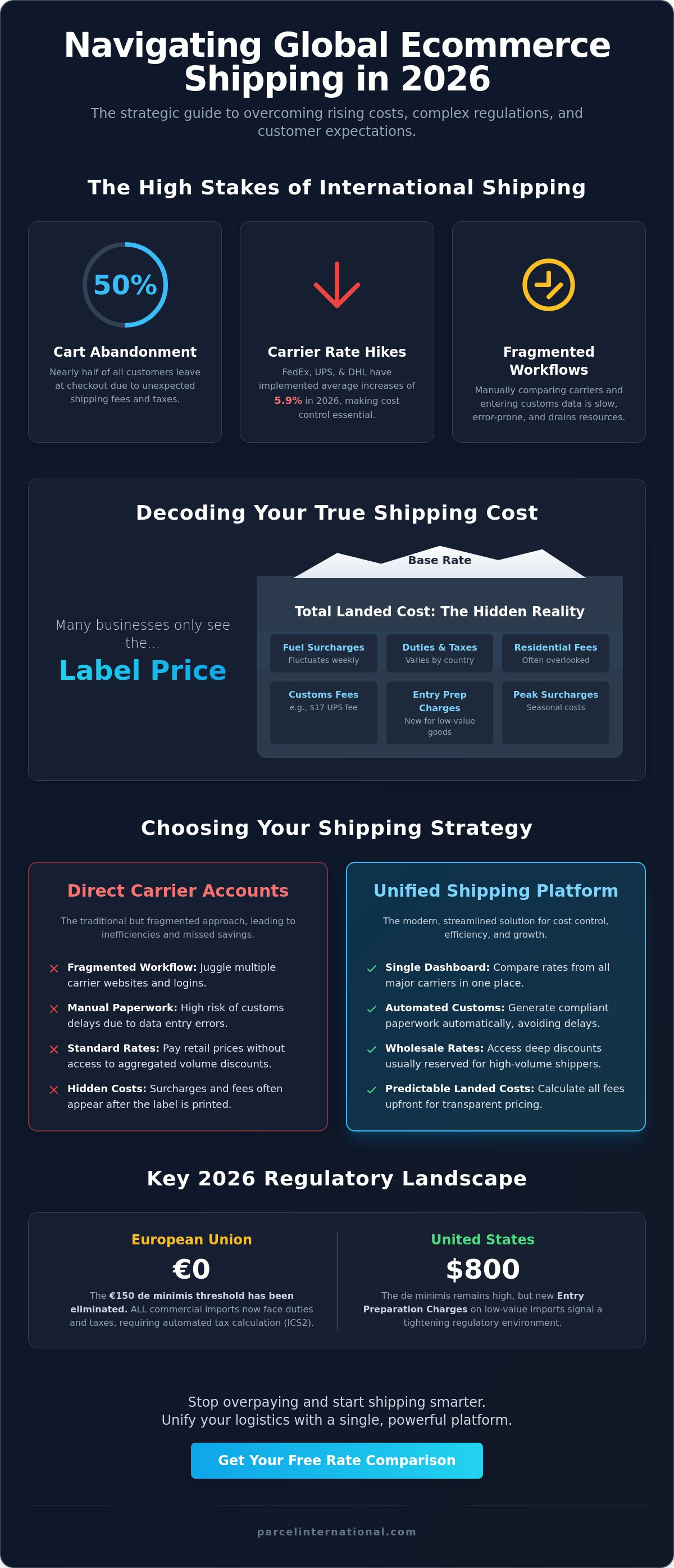
The legal landscape changed significantly this year. As of July 1, 2026, the European Union officially eliminated the €150 de minimis threshold. Every commercial shipment entering the EU now faces customs duties, often including a flat-rate duty of €3 per item type. While the U.S. de minimis remains at $800 for now, the introduction of FedEx Entry Preparation Charges on low-value imports signals a much tighter environment. You can't rely on manual paperwork anymore. Automated tax and duty calculation is essential to ensure you ship international without getting your inventory stuck in a customs warehouse. Systems like the EU Import Control System 2 (ICS2) now require high-quality cargo data before your goods even leave the ground. Using professional customs support ensures your documentation is compliant from the start.
Decoding the 'Best Shipping Rates': It's More Than the Label
Many store owners make the mistake of chasing the lowest number on a shipping label. It's a trap. A cheap label often hides a mountain of back-end costs that can quietly erase your profits. To succeed in cross-border ecommerce, you must master the concept of Total Landed Cost. This represents the final price of getting a product from your door to the customer's hands. It includes the base rate, fuel surcharges, residential fees, duties, and taxes. If you don't account for these variables, you aren't seeing the full picture of your international shipping for ecommerce expenses.
Base rates are just the starting point. In 2026, fuel surcharges fluctuate weekly, and carriers have introduced more aggressive fee structures. For example, choosing a carrier based solely on a low base rate might backfire if you're hit with a $17.00 minimum disbursement fee. Reliability and speed are often worth more than a few cents saved on a label that results in a two-week customs delay. You can access cheap parcel shipping without being a massive corporation. The secret lies in leveraging wholesale volumes through a platform that aggregates shipments, allowing you to benefit from deep discounts usually reserved for high-volume retailers.
Understanding Carrier Surcharges in 2026
Budgeting for the final quarter of the year should start in January. Peak season surcharges are now a permanent fixture of the logistics calendar, and they can spike significantly during high-demand months. Remote area surcharges are another common pitfall. Shipping to a rural territory can sometimes double your expected cost. Logistics brokers help you avoid these traps by negotiating fees away or providing alternative routing. They act as a shield, pooling volume across thousands of users to give you a level playing field against larger competitors.
The Role of Customs Support in Cost Reduction
Documentation errors are the most expensive mistakes an ecommerce brand can make. A simple typo on a commercial invoice can lead to daily storage fees at a customs warehouse. In 2026, UPS increased the Paper Commercial Invoice Services Surcharge to $40 per shipment, making digital accuracy a financial necessity. Automated systems generate these documents instantly, which reduces the risk of Delivered Duty Unpaid (DDU) friction. When a customer receives a surprise tax bill at their door, they don't blame the carrier; they blame your store. Utilizing professional customs support ensures your landed costs remain predictable and your customer experience remains seamless.
Base Rate: The initial cost of transport before any extras.
Fuel Surcharge: A variable percentage that shifts with global energy prices.
Disbursement Fee: A charge for the carrier paying duties on your behalf.
Residential Surcharge: An additional fee for delivering to a home instead of a business.
Direct Carriers vs. Shipping Platforms: Which is Better?
Choosing the right partner for international shipping for ecommerce is a decision that dictates your long-term scalability. You have two primary paths: going direct to a carrier or using a logistics platform. While high-volume retailers might find comfort in a single direct contract, modern brands are increasingly moving toward a carrier-agnostic model. This shift allows you to choose the best carrier for every specific lane rather than being forced into a one-size-fits-all solution that may not always be the most cost-effective or fastest option for a specific destination.
The "Broker Advantage" has become the gold standard for businesses that value flexibility. By using a platform that acts as a stable intermediary, you gain access to Tier 1 wholesale rates without needing to meet Tier 1 volume requirements yourself. This egalitarian approach levels the playing field, allowing smaller online stores to compete with global giants on shipping costs and delivery speed. It's about moving from a fragmented, multi-platform workflow to a singular, unified solution that prioritizes your peace of mind.
When to Go Direct to DHL, FedEx, or UPS
Negotiating directly with a major carrier usually requires a significant volume threshold before you see truly competitive rates. For many carriers, this means consistently shipping hundreds of international parcels every month. Even then, you're often locked into rigid contracts that limit your ability to pivot if service quality drops or surcharges spike. Managing multiple direct accounts simultaneously is also an administrative burden. Your team must learn different software systems and reconcile separate invoices, which creates the very procedural friction you're trying to avoid. If you don't have a dedicated logistics department, the complexity of direct accounts can quickly outweigh the perceived benefits.
The Power of an International Freight Forwarding Platform
A shipping platform simplifies the chaotic world of global logistics. At Parcel International, we aggregate the volume of thousands of businesses to secure deep discounts that we pass directly to you. Think of it as the "Expedia" of the shipping world. You use one dashboard to compare Express Shipping, Air Freight, and Sea Freight options instantly. This transparency ensures you always see the best available rate for every specific order.
Centralizing your international shipping for ecommerce on one platform removes traditional barriers like subscription fees or volume minimums. You gain the power to compare all major carriers side-by-side, ensuring your landed costs remain predictable. Whether you're sending a single document via Road Freight or a full container via Sea Freight, the process remains the same: efficient, professional, and direct. This modern approach to logistics ensures your store stays agile in a rapidly changing global market.
Buying Guide: Choosing Your Ecommerce Shipping Partner
Selecting a partner for international shipping for ecommerce requires a systematic audit of your specific business needs. You shouldn't settle for the first provider that offers a discounted label. Instead, look for a partner that functions as a reliable extension of your team. Start by auditing your most frequent shipping lanes and average package weights. A carrier that is cheap for small parcels to Canada might be prohibitively expensive for air freight to Australia. Having this data ready allows you to demand specific, lane-based pricing rather than accepting generic estimates.
Integration is the next non-negotiable step. Your shipping platform must plug directly into your store, whether you use Shopify, WooCommerce, or a custom API. Manual data entry is a relic of the past that invites human error and slows down your fulfillment. Verify the platform's customs automation features before you sign up. In 2026, you need a system that generates commercial invoices and handles Harmonized System (HS) codes automatically. Finally, test the support team. Send a complex query and see how long it takes for a human expert to reply. If you're stuck behind a chatbot during a customs crisis, your customer experience will suffer.
Always compare the "out-the-door" price. As we discussed earlier, base rates are often deceptive. A transparent partner will show you the fuel surcharges, residential fees, and disbursement costs upfront. To see how these variables impact your specific business, you can get a transparent rate comparison today.
Essential Tech Integrations for 2026
Modern tech integrations do more than just print labels. They solve the "Where Is My Order" (WISMO) problem by providing automated, branded tracking updates to your customers. Real-time rate quotes at checkout are also essential. When customers see the exact shipping cost and delivery date immediately, cart abandonment rates drop. Batch label printing allows you to process hundreds of orders in seconds, which is vital for scaling during peak seasons. These tools move your workflow from a fragmented mess to a singular, orderly process.
Evaluating Support: Beyond the Chatbot
When a shipment is delayed at a border, you don't need a script; you need an advocate. This is where the Rotterdam advantage becomes a clear differentiator. Being based in a global logistics hub like Rotterdam means our team understands the physical reality of international trade, not just the digital side. We know how port congestion and regulatory shifts impact your bottom line. Avoid partners with terms and conditions that hide "subscription fees" or "minimum volume requirements" in the fine print. Radical transparency is the only way to build a stable, long-term partnership in a volatile market.
Scale Your Store with Parcel International
Scaling a global brand requires a partner that eliminates barriers rather than creating them. Parcel International provides the infrastructure to reach customers in over 220 countries and territories without the burden of subscription fees or hidden requirements. We focus on radical transparency. You only pay for what you ship, which allows you to maintain healthy margins as you grow. By aggregating volume across our global network, we provide you with wholesale rates that are typically reserved for the world's largest retailers. This ensures that international shipping for ecommerce is no longer a cost center but a scalable engine for your business growth.
Our platform is designed to grow with you. You might start by sending small parcels via Express Shipping to test new markets. As your demand increases, you can transition seamlessly to Air Freight or Sea Freight for bulk inventory moves. This flexibility is essential in a volatile market where shipping lanes and costs shift rapidly. We act as your stable intermediary, providing a unified solution that handles the complexity of global logistics so you can focus on your product and your customers.
Automating your 2026 customs documentation is a central pillar of our service. With the removal of the EU de minimis threshold and stricter cargo reporting requirements like ICS2, manual paperwork is a liability. Our system generates the necessary commercial invoices and customs data in seconds. This precision reduces the risk of border delays and ensures your landed costs remain predictable for every shipment you send. You gain the relief of knowing your compliance is handled by experts who understand the high-stakes nature of international trade.
Getting Started in Three Clicks
Efficiency is at the heart of our technology. The Parcel International rate comparison tool allows you to see real-time quotes from all major carriers side-by-side. You don't have to jump between different carrier websites to find the best deal. Booking your first express shipment is a straightforward process that takes less than a minute. For larger operations, our platform also provides direct access to Road Freight and Air Freight options. This allows you to manage everything from individual customer orders to massive inventory restocking in one place. Your workflow moves from a fragmented mess to a logical, sequential process.
Select your destination and package details.
Compare live rates and transit times instantly.
Print your label and automate your customs forms.
The Parcel International Difference
Our heritage dates back to 2007, giving us nearly two decades of industry expertise. We've combined this deep logistics knowledge with 2026 technology to create a platform that is both powerful and accessible. Based in the global logistics hub of Rotterdam, we possess a unique perspective on cross-border trade that automated competitors simply can't match. We understand the physical reality of the supply chain. This combination of experience and innovation is why ecommerce brands globally trust us to handle their most critical shipments. Don't let fragmented workflows hold your business back. Compare your international shipping rates today and experience the relief of a unified logistics solution.
Master Your Global Logistics Strategy for 2026
Success in international shipping for ecommerce requires a move from fragmented, manual workflows to a unified, automated system. You've seen how carrier-agnostic platforms provide the flexibility to navigate the rising surcharges and regulatory shifts of 2026. By prioritizing total landed cost over base rates and automating your customs paperwork, you eliminate the procedural friction that causes customer churn. It's time to stop overpaying for labels and start scaling with a partner that values your peace of mind.
Start comparing international shipping rates for your store now to access wholesale rates for over 220 countries and territories. Our platform requires no monthly subscription fees and includes automated customs documentation to keep your shipments moving across borders without delay. Taking your store global shouldn't be a source of anxiety. With the right tools and a transparent partner, you can turn complex logistics into your brand's greatest competitive advantage. Your business is ready to grow; we're here to ensure the delivery process is as efficient as your vision.
Frequently Asked Questions
What is the cheapest way to ship internationally for ecommerce in 2026?
The most cost-effective method is using a logistics platform that leverages wholesale volume to secure discounts across multiple carriers. In 2026, relying on a single carrier is often more expensive because rates fluctuate lane-by-lane. By comparing Express Shipping and Road Freight options side-by-side, you can choose the most efficient route for every specific order. This strategy ensures you only pay for the speed you actually need without being locked into high-margin retail pricing.
How do I calculate the total landed cost for my international customers?
You calculate total landed cost by adding the base shipping rate to all applicable fuel surcharges, residential fees, and customs duties. With the EU removing the €150 de minimis threshold in July 2026, accurate duty calculation at checkout is essential for transparency. Using a platform with automated customs support allows you to provide customers with a final, all-inclusive price. This prevents surprise fees on delivery, which is a leading cause of international cart abandonment.
Do I need a special account to get discounted express shipping rates?
You don't need a high-volume direct account with a carrier to access wholesale prices. Platforms like Parcel International aggregate the shipping power of thousands of businesses to unlock Tier 1 rates for everyone. This egalitarian model removes traditional barriers like volume minimums or monthly subscription fees. You simply sign up and start comparing international shipping for ecommerce rates immediately. It's a faster way to scale without the administrative burden of negotiating individual carrier contracts.
How does a logistics broker differ from a traditional carrier like UPS?
A traditional carrier owns the trucks and planes, while a logistics broker acts as a stable intermediary that connects you to multiple asset owners. This distinction is vital for flexibility. While a carrier only offers its own services, a broker allows you to compare Express Shipping, Sea Freight, and Air Freight from various providers in one dashboard. This carrier-agnostic approach ensures you always find the best rate and fastest transit time for every specific destination.
What are the most common customs documents required for ecommerce?
Every international shipment requires a commercial invoice that accurately describes the goods, their value, and their Harmonized System (HS) codes. Depending on the destination and product type, you might also need a packing list or a certificate of origin. In 2026, digital accuracy is mandatory to comply with systems like the EU's ICS2. Automated customs support handles the generation of these documents in seconds, which significantly reduces the risk of expensive border delays.
Can I ship large freight through an international parcel service?
Parcel services are optimized for small packages, so shipping large or heavy inventory through them is usually cost-prohibitive. For bulk moves, you should utilize Air Freight or Sea Freight instead. These modes are designed for volume and offer much lower per-kilogram costs for significant shipments. A unified platform allows you to manage both individual parcel deliveries and large-scale freight moves from a single dashboard, providing a seamless transition as your store scales.
How can I avoid hidden surcharges on my international shipments?
Avoiding hidden fees requires a shift to platforms that provide radical transparency regarding all-in costs. You should look for "out-the-door" pricing that explicitly includes fuel surcharges, residential delivery fees, and disbursement costs. UPS and FedEx often update these surcharges with little notice, such as the May 2026 UPS disbursement fee increase. A reliable logistics partner reveals these costs upfront, ensuring your profit margins remain protected and your financial planning stays accurate.
Is shipping insurance necessary for international ecommerce orders?
While not mandatory, shipping insurance is a critical safety net for international shipping for ecommerce due to the higher risk of damage or loss during long-distance transit. Carrier liability is often limited and may not cover the full retail value of your products. Purchasing additional coverage provides peace of mind and protects your bottom line if a shipment goes missing. It's a small investment that ensures you can quickly reship orders to maintain customer trust without taking a financial hit.


