
The Ultimate International Parcel Checklist: A 2026 Guide to Global Shipping
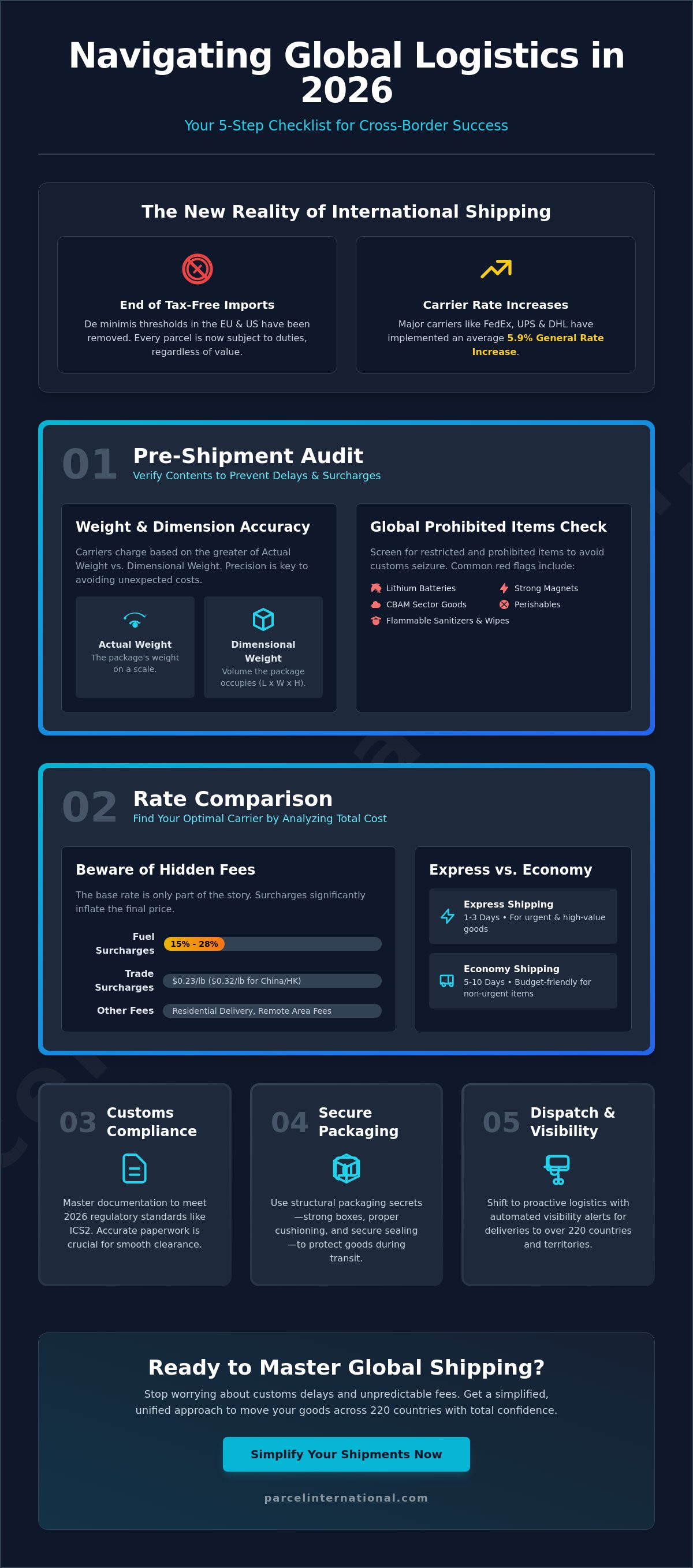
In 2026, the era of tax-free global shipping has officially ended. With the European Union and the United States removing de minimis thresholds, every international parcel now faces immediate duty requirements regardless of its value. This shift, combined with general rate increases of 5.9 percent from major carriers, means the old way of shipping just doesn't work anymore.
You're likely tired of the anxiety that comes with customs delays and the confusion of unpredictable shipping rates. It's stressful to worry about whether your package will arrive damaged or get stuck in a bureaucratic bottleneck. We understand that you need a simplified, unified approach to move your goods across 220 countries with total confidence. This guide promises to strip away that complexity by providing a definitive step-by-step checklist for global logistics success.
By following this roadmap, you'll learn how to secure predictable costs and ensure successful delivery through professional express shipping, air freight, or sea freight. We'll preview the essential data requirements for systems like ICS2 and show you how to manage customs support effectively to keep your supply chain moving without hidden friction.
Key Takeaways
Avoid border delays by identifying prohibited items and calculating dimensional weight before you book your shipment.
Use a comparison first mindset to evaluate transit speeds against costs for every international parcel you send.
Streamline the clearance process with expert documentation tips that ensure your paperwork meets 2026 regulatory standards.
Master structural packaging secrets to ensure your goods survive the rigors of high-stakes air or sea freight.
Shift from reactive to proactive logistics by setting up automated visibility alerts for delivery to 220+ countries.
Table of Contents
Step 1: Pre-Shipment Audit – Verifying Your Contents
Logistics success starts long before you hand over a box to a carrier. Precision at this stage is your best defense against hidden surcharges and customs seizures. Most shipping delays aren't caused by transport issues; they're caused by missing data or prohibited contents that should've been flagged during the initial audit. To move your goods through the global postal system or private freight networks without friction, you must first verify exactly what you're sending and where it's going. This proactive approach eliminates the procedural friction that often traps unprepared shippers.
Weight and Dimension Accuracy
Accuracy matters for your bottom line. Use a calibrated digital scale to find the exact weight of your shipment in kilograms or pounds. Don't guess. Once you have the physical weight, measure the length, width, and height of your box. These numbers are vital because carriers use the greater of the two values: actual weight or dimensional weight. Dimensional weight is a calculation that accounts for the volume your international parcel occupies in a cargo hold. If your box is large but light, you'll pay for the space it takes up rather than its gravity. This ensures that air freight and sea freight capacity is managed efficiently, but it can lead to unexpected costs if you haven't calculated it beforehand.
The Global Prohibited Items Check
Every country maintains a unique list of what can and cannot cross its borders. You must distinguish between "Restricted" items, which require specific permits or licenses, and "Prohibited" items, which are completely banned. As of 2026, regulatory updates have explicitly prohibited the international shipment of hand sanitizer and flammable sanitizing wipes across many major networks. Other common items that trigger red flags include:
Lithium Batteries: These are often classified as Dangerous Goods and require specific labeling and transport modes.
CBAM Sectors: If you're moving goods in the cement, aluminum, iron, steel, or fertilizer sectors, verify if you need to be an authorized CBAM declarant for EU entry.
Magnets: Strong magnets can interfere with aircraft navigation systems and require specialized shielding.
Perishables: Food items often face strict health and safety inspections that vary wildly by destination.
Before you book your international parcel, screen your inventory against both global standards and carrier-specific network restrictions. Some carriers may refuse items that others will accept with the right customs support. Verify the destination country’s specific import rules for your product category to avoid having your shipment returned at your expense. Taking ten minutes to audit your contents now prevents weeks of frustration later. Once you've confirmed your items are eligible for transport, you can move toward selecting the most efficient freight or express shipping route for your needs.
Step 2: Rate Comparison – Finding Your Optimal Carrier
Don't settle for the first quote you see. With FedEx, UPS, and DHL all implementing a 5.9 percent general rate increase for 2026, loyalty to a single carrier can be an expensive mistake. You need to compare real-time quotes to find the most efficient route for your international parcel. This "comparison first" mindset eliminates the friction of fragmented logistics and ensures you aren't overpaying for standard services. By looking at the market as a whole, you move from a position of uncertainty to one of professional control.
Hidden fees often inflate the base rate significantly. In 2026, fuel surcharges account for 15 percent to 28 percent of total shipping costs depending on the carrier and route. You also need to account for specific additions like the UPS per-pound trade surcharge introduced in April 2026. This adds $0.23 per pound for most shipments and up to $0.32 per pound for those moving to or from China and Hong Kong. When you evaluate international shipping companies, look beyond the initial sticker price. Factor in residential delivery surcharges and potential remote area fees before making your final selection to avoid unexpected billing adjustments later.
Express vs. Economy Shipping
Speed and cost exist in a constant trade-off. Express shipping, typically delivering in 1-3 days, is the gold standard for high-value or time-sensitive goods. It offers the most robust security and punctuality for urgent shipments. On the other hand, Economy services taking 5-10 days are ideal for non-urgent goods where budget is the primary concern. Door-to-door express services generally offer more reliable tracking than fragmented postal networks, which can be prone to visibility gaps during international handovers. Choose the service level that aligns with your recipient's expectations and the value of the contents.
Leveraging a Logistics Platform
Managing multiple carrier accounts is a logistical headache that often leads to inefficiency. A unified logistics platform acts as a stable intermediary, giving you access to discounted express shipping rates typically reserved for high-volume commercial shippers. These platforms strip away the typical anxieties of global shipping by consolidating your tracking, billing, and carrier selection into one interface. For a comprehensive breakdown of current pricing and market shifts, read our guide on International Shipping Rates 2026. Using these tools allows you to compare global carriers instantly, ensuring every shipment is optimized for both your timeline and your bottom line.
Step 3: Customs Compliance – Mastering the Documentation
Documentation is the bridge between your warehouse and your customer's doorstep. If your paperwork is incomplete, your international parcel will sit in a bonded warehouse while storage fees accumulate. In 2026, customs authorities have shifted toward a data-driven compliance model where accuracy is non-negotiable. Generic descriptions like "gift" or "sample" no longer suffice. You must provide a clear, English-language description that tells an officer exactly what the item is, what it's made of, and its intended use. This level of detail ensures that your goods move through the system without manual intervention.
For any non-document shipment, the Commercial Invoice is your most important asset. It serves as the official declaration for customs and border protection agencies to determine the legality and taxability of your goods. If you're sending a multi-box shipment via air freight or sea freight, you must also include a detailed packing list. This document should map the contents of each specific box to the master invoice. This allows inspectors to verify your cargo without unpacking every individual container, which significantly reduces the risk of damage during inspection.
The Commercial Invoice Checklist
Precision prevents delays. Every invoice must include the full contact details for both the sender and the receiver, including active phone numbers and email addresses. Customs officers often need to contact the recipient to collect duties or clarify contents. You also need to state a clear "Reason for Export." Whether it's a commercial sale, a gift, or a return for repair, this classification changes how the shipment is processed. Finally, verify that the total declared value matches your actual transaction value. Under-declaring to save on taxes is a high-risk strategy that often leads to heavy fines or the total seizure of your goods.
Understanding HS Codes and Duties
The Harmonized System (HS) code is a universal language for global trade. This 6 to 10-digit number tells customs exactly what you're shipping and determines the specific duty and tax rates applied. With the removal of de minimis thresholds in the EU and US as of 2026, even low-value items now attract duties. Use automated HS lookup tools to ensure you aren't overpaying or misclassifying your products. You must also decide who handles the bill. DDU (Delivered Duty Unpaid) means the recipient pays the taxes upon arrival, which can lead to refused deliveries. DDP (Delivered Duty Paid) allows you to cover these costs upfront, providing a seamless experience for your customer. Professional international parcel services often include customs support to help you navigate these financial complexities with total transparency.
Step 4: Secure Packaging – Protecting Your Goods Globally
Packaging is more than just wrapping an item; it's engineering a protective shell for a journey across continents. Your international parcel will endure multiple handovers, automated sorting systems, and varying pressure levels in cargo holds. If your packaging is substandard, you risk more than just physical damage. Carriers may deny insurance claims if they determine the protection was inadequate for the transport mode. High-stakes logistics require a professional approach to box selection and sealing to ensure your goods arrive in the same condition they left your facility.
Select a new, double-walled corrugated cardboard box for maximum strength. It's tempting to reuse old containers, but cardboard loses significant structural integrity after its first trip. In high-humidity environments typical of sea freight, a used box can soften and collapse under the weight of stacked cargo. A fresh, double-walled box provides the rigid vertical strength needed to withstand the rigors of global transit without buckling.
Apply the "H-Taping" method to seal your shipment. This involves taping all open seams and corners to form an "H" shape on both the top and bottom of the box. Use high-quality, pressure-sensitive tape at least two inches wide. This technique doesn't just keep the box closed; it reinforces the structural corners where most transit damage occurs. Once sealed, you can book your express shipping or freight service with the confidence that your container is structurally sound.
External Labeling Best Practices
Precision in labeling is just as important as the box itself. Ensure the barcode is placed on a flat surface. Never wrap a label around a corner or place it over a seam or tape, as this causes scanning errors in automated hubs. These errors lead to manual sorting, which adds unnecessary days to your transit time. If you must reuse a box, strip away every old label and black out any previous markings. For a detailed visual breakdown of correct label placement, consult our guide on How to Send a Parcel Internationally.
Internal Protection Strategies
Professional cushioning is non-negotiable. Use at least 5cm of bubble wrap or foam inserts around all sides of your item. Avoid using newspaper or clothing; these materials compress easily and provide almost no shock absorption during the vibrations of air freight. For electronics or exceptionally fragile goods, use the "Double-Box" method. Place the item in a smaller box, then nest that box inside a larger one with 5cm of padding between them. Perform a shake test before final sealing. If you hear the contents moving, you need more padding. Finally, place a duplicate address label inside the box. This serves as a backup if the external label is damaged, ensuring your international parcel can still be identified and delivered.
Step 5: Dispatch & Visibility – Proactive Tracking
The journey of your international parcel enters its most critical phase once it leaves your hands. Many shippers make the mistake of assuming the job is done after the carrier scans the label. In 2026, global logistics move at a rapid pace, but they also face increased scrutiny from digital customs systems. You must maintain active visibility to ensure that small delays don't turn into permanent losses. Start by scheduling a carrier pickup or locating a secure drop-off point to initiate the transit. Once the shipment is in motion, the focus shifts entirely to data and communication.
Set up automated tracking alerts for both yourself and your recipient. This transparency builds trust and ensures that everyone is aware of the package's progress in real time. Don't rely on manual checks. Instead, monitor for "Exception" or "Customs Hold" status updates daily. If a status changes, you need to act immediately. Once the delivery is complete, archive the Proof of Delivery (POD) securely. This document is essential for insurance claims and serves as vital evidence for tax audits, especially with the 2026 removal of de minimis thresholds requiring proof of duty payment for almost every shipment.
Managing Delivery Expectations
Communicate the estimated delivery date to the recipient immediately after dispatch. While express shipping offers rapid transit, the "last-mile" delivery process in remote international locations can be unpredictable. Local infrastructure and regional holidays often influence the final delivery window. For a deeper look at how these variables affect your timeline, see our International Parcel Shipping: The Ultimate 2026 Guide. Providing this context to your recipient prevents frustration and reduces the volume of support inquiries you'll need to handle.
What to Do During a Customs Delay
A "Customs Hold" isn't always a sign of a crisis; it's often a routine part of the data verification process. You need to identify whether the delay is a standard inspection or a request for missing information. With the EU’s ICS2 system now fully operational, authorities are looking for precise data matches between your commercial invoice and their security filings. If the carrier’s customs broker requests additional details, provide them within hours, not days. Responsive communication is the single most effective tool for clearing your international parcel faster when a broker requests clarification. Our customs support team can often act as a stable intermediary during these moments, ensuring that technical questions are answered with the professional expertise required to keep your goods moving.
Take Control of Your Global Logistics
Mastering global shipping in 2026 requires more than just a box and a label. It demands a commitment to data accuracy and a comparison first strategy. By following this definitive checklist, you've moved from the anxiety of the unknown to a position of professional authority. You now understand that precision in your pre-shipment audit and radical transparency in your customs documentation are the keys to avoiding costly delays. Protecting your goods with structural packaging and maintaining proactive visibility ensures they arrive safely; no matter the destination.
The complexities of 220+ countries don't have to be a barrier to your growth. You can strip away the friction of fragmented workflows by using a singular, unified solution for your express shipping and freight needs. Access real-time carrier comparisons and automated customs documentation to keep your costs predictable and your deliveries on time. Logistics success is built on order and efficiency. Compare rates and book your international parcel today at Parcel International. We're here to be the stable bridge that connects your business to the world with total confidence.
Frequently Asked Questions
How do I calculate the shipping cost for an international parcel?
Calculate your costs by comparing the physical weight against the dimensional volume of the box. Carriers like FedEx and UPS have implemented a 5.9 percent rate increase for 2026, so always use real-time comparison tools to get an accurate quote. Don't forget to factor in fuel surcharges, which currently range from 15 percent to 28 percent of the total price depending on the route.
What is the cheapest way to send a parcel internationally in 2026?
Economy road or sea freight options provide the lowest base rates for non-urgent shipments. However, the removal of de minimis thresholds in the EU and US means every international parcel now incurs duty regardless of the service level. You'll find the best value by using a logistics platform that offers wholesale rates from multiple carriers instead of paying retail prices at a counter.
What documents are mandatory for international parcel shipping?
A detailed Commercial Invoice and a comprehensive Packing List are mandatory for all non-document shipments. You must include accurate English descriptions, 10-digit HS codes, and full contact details for the recipient. For shipments entering the EU, your data must also comply with the ICS2 advance cargo information system to avoid immediate rejection at the border.
How long does express shipping take for an international parcel?
Express shipping typically delivers within 1 to 3 business days for most global routes. This timeline relies on the package clearing customs without manual intervention or data corrections. If your documentation is perfect, the transit speed is highly predictable, but missing contact information or vague item descriptions can add several days to the final delivery date.
Can I send electronics with batteries in an international parcel?
You can send electronics with lithium batteries, but they are classified as restricted goods rather than standard cargo. You must follow specific packaging and labeling requirements to comply with air freight safety regulations. Always check the individual carrier's network restrictions before booking, as some may have stricter policies for used batteries or specific sanitizing wipes.
What happens if my international parcel is held at customs?
Customs authorities will place a hold on your international parcel if they require additional data, duty payment, or a physical inspection. The carrier's customs broker usually contacts the recipient first to resolve the issue. You should monitor your tracking status daily and respond to any inquiries within hours to prevent the shipment from being returned at your expense.
Do I need insurance for my international shipment?
Insurance is highly recommended for any shipment where the value exceeds the standard carrier liability limits. Most carriers offer limited protection based on the weight of the package rather than the actual value of the goods inside. Adding comprehensive coverage protects your investment against damage or loss during the multiple handovers involved in high-stakes global transit.
How do HS codes affect my shipping costs?
HS codes categorize your products so customs can apply the correct duty and tax percentages to your shipment. Since the €150 and $800 exemptions have been removed in 2026, even small items are now subject to these specific charges. An incorrect code can lead to significant overpayment of taxes or administrative fines that increase your total landed cost.


