Best Way to Ship from USA to Mexico for Business: The 2026 Comprehensive Guide
Updated: Jul 16
With Mexico now accounting for a 16.4% share of total U.S. trade flows and officially overtaking China as the top trading partner, the border is your company's most vital artery. However, identifying the best way to ship from usa to mexico for business in 2026 requires more than just a carrier list. It demands a strategy that accounts for the January 1st Customs Law Reform and the recent 5.9% average rate hikes from major carriers. You've likely dealt with the headache of unpredictable border delays or hidden fees that inflate your landed costs at the last minute.
We understand that logistics should feel like a bridge, not a barrier. This comprehensive guide will show you how to streamline your cross-border operations, reduce customs friction, and secure the most competitive rates for express, road, and air freight. We'll preview the latest USMCA documentation requirements and show you how to automate your paperwork to keep your schedule predictable. From managing the 16% VAT to leveraging duty-free thresholds, you'll gain the clarity needed to turn complex logistics into a competitive advantage.
Table of Contents
The Strategic Importance of the US-Mexico Trade Corridor in 2026
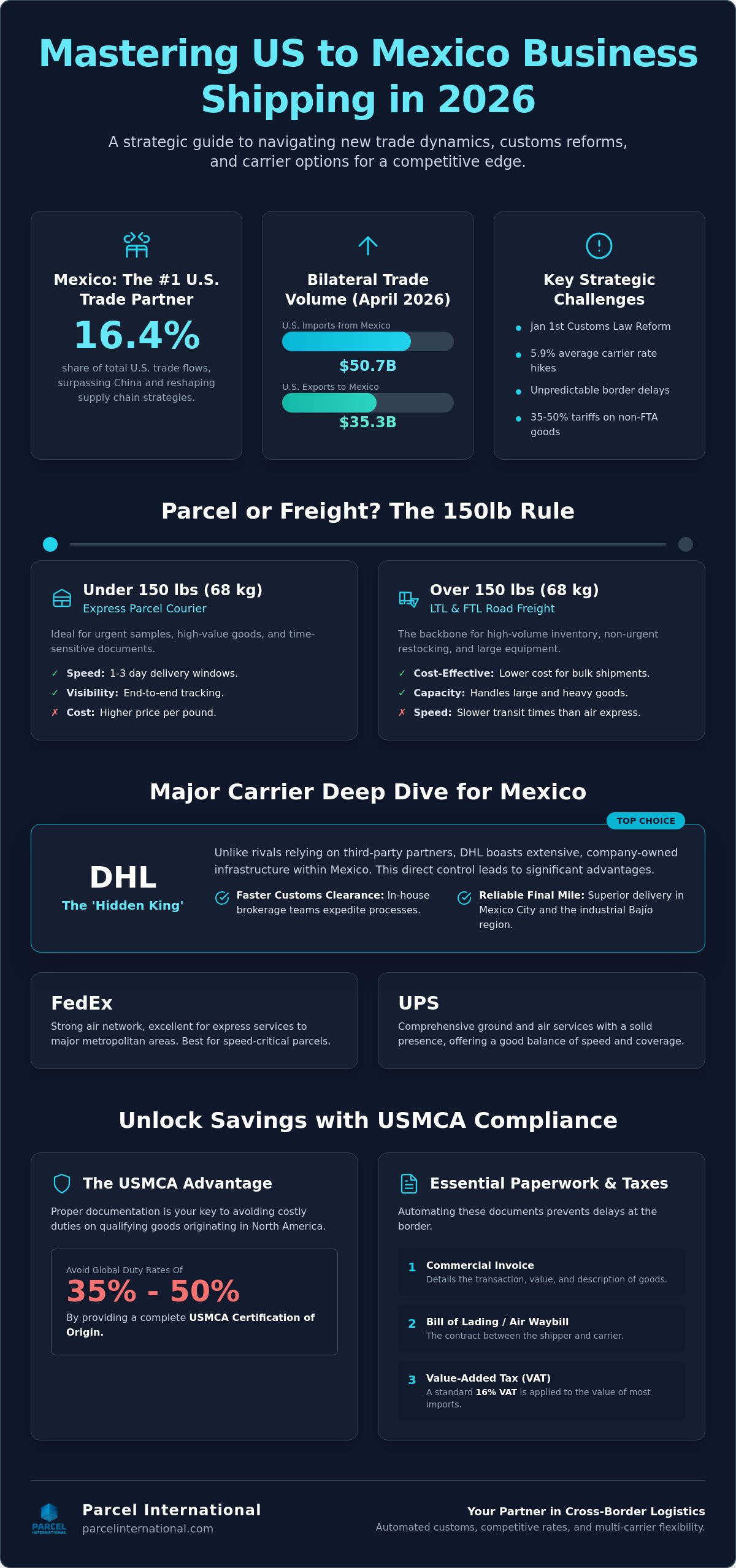
Mexico's rise to the top of the U.S. trade hierarchy isn't a temporary spike. It's a structural shift. As of early 2026, Mexico accounts for a 16.4% share of total U.S. trade flows, officially surpassing China. For your company, this means the best way to ship from usa to mexico for business is no longer a "set it and forget it" task. It requires an active strategy that balances speed with strict regulatory compliance. Business-class shipping in this environment means more than just moving boxes. It's about ensuring your goods qualify under the latest USMCA Documentation standards to avoid the 35-50% tariffs recently applied to non-FTA products. Reliability, predictable landed costs, and multi-modal flexibility are the new benchmarks for success.
Relying on a single-carrier approach often fails for growing SMBs because it creates a single point of failure. If your primary carrier faces a strike or implements a sudden 5.9% rate hike, your entire supply chain stalls. You need a diversified strategy that can pivot between express shipping for urgent samples and road freight for high-volume inventory. This flexibility allows you to bypass congestion and keep your promises to Mexican customers.
Nearshoring and the Shift in Supply Chain Dynamics
Nearshoring has turned Mexico into a manufacturing powerhouse, pushing production lines closer to the end consumer. This proximity changes your shipping profile from occasional large shipments to frequent, high-velocity movements. While Monterrey and Mexico City remain vital, new logistics hubs in regions like Querétaro and the Bajío are decentralizing the network. In April 2026, the US-Mexico trade bridge supported a total bilateral volume where the U.S. exported $35.3B to and imported $50.7B from its southern neighbor. This volume demands a logistics partner that understands these secondary hubs just as well as the primary border crossings.
The Core Challenges of Cross-Border Logistics
The "Border Black Hole" at crossings like Laredo remains the greatest threat to your schedule. Shipments often stall because of a disconnect between U.S. transit speeds and Mexican customs infrastructure. You don't just need a carrier; you need a system that anticipates these friction points. The difference between U.S. delivery expectations and Mexican infrastructure reality is often measured in days of delay.
Transparency in tracking is now the #1 requirement for business shippers. You can't manage what you can't see. Finding the best way to ship from usa to mexico for business involves bridging this visibility gap with automated paperwork and reliable road freight options. Real-time data allows you to manage customer expectations when a truck is queued at the World Trade Bridge, turning a potential crisis into a manageable delay. Without this level of insight, your cross-border logistics will remain a source of anxiety rather than a driver of growth.
Carrier Comparison: FedEx vs. UPS vs. DHL for Mexico
Selecting a carrier is the most consequential decision in your logistics chain. With the US-Mexico Trade Corridor reaching record volumes in 2026, the best way to ship from usa to mexico for business depends entirely on your cargo's destination and value. While some businesses consider national postal networks for small items, these often lack the end-to-end visibility and speed required for commercial operations. High-value business goods require the strict custody and integrated customs support provided by private couriers to ensure security and punctuality.
DHL is often called the 'Hidden King' of Mexican logistics. Unlike carriers that rely on third-party local partners in remote areas, DHL has invested heavily in its own Mexican infrastructure. This is especially true in Mexico City and the industrial Bajío region. Their local presence results in faster customs clearance and more reliable 'final mile' delivery. Finding the best way to ship from usa to mexico for business isn't about picking one carrier for everything; it's about matching the carrier's regional strength to your customer's location.
Express vs. Economy: Balancing Speed and Landed Cost
Urgent shipments justify the higher cost of express shipping when inventory turnover is at stake. If a stockout costs you a contract, paying for a 1-3 day air freight window is a smart investment. However, for non-urgent restocking, economy road freight offers significant savings despite a longer transit window. You can use an international shipping rates guide to benchmark these costs against current 2026 market averages. Balancing these options ensures you don't overpay for speed you don't need.
Carrier-Specific Strengths in the Mexican Market
Each carrier has a geographic or functional "sweet spot" you should leverage to optimize your supply chain:
FedEx: Excellent for northern Mexico and border cities like Monterrey due to their massive U.S. ground network integration.
UPS: Known for superior customs brokerage services, making them a strong choice for complex industrial parts requiring precise documentation.
DHL: The gold standard for the southern interior and dense urban centers where local knowledge is key to navigating "last mile" surcharges.
Your choice of carrier directly reflects your brand's reliability. If you want to see how these carriers stack up for your specific lane, you can compare live rates across all major providers in a single dashboard. This transparency removes the guesswork and ensures you're always getting the best deal available without the typical procedural friction.
Choosing Between International Parcel and Freight Services
Determining the best way to ship from usa to mexico for business often starts with a scale. The industry follows a strict threshold known as the 150lb Rule. If your individual package weighs more than 150 pounds (approximately 70kg), standard parcel carriers will apply heavy-weight surcharges that quickly erode your margins. At this point, your shipment transitions from "parcel" to "freight." While parcel shipping offers simplicity and "all-in" pricing, freight provides the muscle needed for industrial-scale commerce.
If you're moving heavy machinery or bulk inventory, a freight forwarder becomes an essential partner. They manage the transition between Less-than-Truckload (LTL) and Full Truckload (FTL) services. FTL is the gold standard for security since your goods stay on one dedicated trailer from origin to destination. LTL is the budget-friendly alternative for smaller palletized loads. Freight can be up to 40% cheaper for bulk orders, but it's often 100% more complex due to the specialized documentation and border coordination required.
When Parcel Shipping Makes Sense
Parcel shipping is ideal for e-commerce orders, high-value electronics, and commercial samples. It's the most straightforward path for shipments that don't require a pallet. You get the benefit of simplified tracking and door-to-door delivery without worrying about transloading at the border. For more on optimizing these smaller shipments, see our deep dive into international parcel shipping. This mode is your best bet when speed and simplicity outweigh the need for bulk cost savings.
The Freight Advantage for Industrial and Bulk Goods
For industrial goods, road freight via the Pan-American Highway is the backbone of the corridor. In 2026, land freight costs average $50-$70 per metric ton, making it highly efficient for heavy loads. However, you must decide between "through-trailer" service, where the trailer crosses the border, or the "transload" process. Transloading involves moving goods from a U.S. truck to a Mexican truck at hubs like Laredo. This is often more cost-effective but requires a steady hand to prevent damage. LTL shipping provides a significantly lower cost-per-pound compared to express parcel services because you only pay for the specific pallet space your cargo occupies on a shared trailer. Finding the best way to ship from usa to mexico for business means choosing the mode that fits your volume, not just your timeline.
To gain a deeper understanding of the ground-level challenges and opportunities within the road freight sector, you can discover The Truckermann, which provides valuable resources for professional drivers and industry stakeholders alike.
Navigating Mexican Customs and USMCA Documentation
Crossing the border requires more than a label. It's a precise data exercise. The best way to ship from usa to mexico for business is to treat customs documentation as a core part of your product delivery rather than an afterthought. Mexican customs (Aduanas) operates on three pillars: Classification, Valuation, and Origin. You must categorize your goods with the correct HS codes, declare the true CIF (Cost, Insurance, and Freight) value, and prove where the goods were made. Since the January 1, 2026 Customs Law Reform, accuracy is mandatory. Errors in these areas lead to "PAMA" (Administrative Procedure in Customs Matters), which can result in the immediate seizure of your cargo.
The USMCA is your most powerful tool for protecting profit margins. By providing a valid Certification of Origin, you can save your business from the standard 20% duties often applied to commercial imports. This is especially critical in 2026, as new tariffs of 35-50% now apply to over 1,400 products from non-FTA countries. To ensure a smooth experience for your Mexican clients, use Delivered Duty Paid (DDP) shipping. This method allows you to handle the 16% VAT and customs fees upfront. Your customer receives their order without unexpected "last-mile" invoices, which is the secret to maintaining high satisfaction in the Mexican market.
Automating Your Customs Paperwork
Manual data entry is a liability. You can significantly reduce human error by using international shipping customs documentation tools that sync your commercial invoices with Mexican SAT requirements. The 2026 shift toward paperless border crossings means digital signatures are now the standard. Transitioning to a digital workflow ensures your "Pedimento"—the official Mexican customs entry document—is generated accurately and transmitted to the authorities before the truck even reaches the bridge.
Common Pitfalls and How to Avoid Seizures
Mexico maintains strict oversight on specific "sensitive" sectors. If you're shipping textiles, footwear, or steel, expect heightened scrutiny. You must work with a licensed Mexican Customs Broker (Agente Aduanal). They're legally responsible for the accuracy of your declaration. Don't risk a "Red Light" inspection by omitting details. A "Red Light" status triggers a rigorous physical examination of your entire shipment, often causing 24-72 hour delays. Securing the best way to ship from usa to mexico for business means having your paperwork verified by experts before it leaves your warehouse. You can get expert customs support to ensure your documentation meets every 2026 regulatory standard.
Optimizing Your Mexico Strategy with Parcel International
Finding the best way to ship from usa to mexico for business shouldn't feel like a fragmented puzzle. While individual carriers offer specific regional strengths, managing multiple accounts and disparate tracking numbers creates unnecessary friction in your workflow. Parcel International eliminates this complexity by serving as a unified bridge between your warehouse and the Mexican market. Our platform provides instant rate comparisons, allowing you to see side-by-side quotes from FedEx, UPS, and DHL. This transparency ensures you aren't overpaying for express shipping or road freight based on outdated contracts or hidden surcharges.
We believe in democratizing global logistics. Through our platform, small and mid-sized businesses gain access to wholesale rates that are typically reserved for Fortune 500 companies. There are no hidden fees, no subscription requirements, and no volume minimums. This egalitarian approach allows you to scale your Mexican exports at your own pace without the burden of corporate overhead. By centralizing your logistics in one dashboard, you can track every cross-border movement in real-time. This provides the relief of a single, unified workflow, replacing the anxiety of checking multiple carrier sites to confirm a delivery in Monterrey or Querétaro.
Compare, Book, and Save in Minutes
Our shipping calculator is designed for speed and clarity. Simply enter your shipment dimensions and destination to see the most cost-effective routes available in 2026. Once you've selected a service, our automated tools generate USMCA-compliant paperwork instantly. This feature removes the risk of manual data entry errors and ensures your HS codes and commercial invoices meet strict Mexican SAT standards. It's a logical progression from inquiry to action that keeps your supply chain moving without the typical procedural friction at the border.
Expert Support for Complex Mexican Logistics
Logistics is rarely a straight line, especially with the 2026 customs reforms in place. When challenges arise at the border, you need more than a chatbot. Our team leverages a deep heritage in global trade centers like Rotterdam to act as your stable intermediary with global carriers. We handle the heavy lifting of carrier communication and customs support, giving you the peace of mind to focus on your core business growth. If you're ready to secure the best way to ship from usa to mexico for business, start comparing US to Mexico shipping rates today and see how a unified platform turns the border into a competitive advantage.
Future-Proof Your Mexican Logistics Strategy
The 2026 trade corridor between the U.S. and Mexico offers immense growth for businesses that prioritize compliance and speed. Mastering the best way to ship from usa to mexico for business means moving beyond manual paperwork and single-carrier limitations. You've learned that success hinges on leveraging USMCA benefits, choosing between parcel and LTL freight wisely, and maintaining total visibility over your landed costs. By automating your documentation and diversifying your carrier options, you turn the border into a bridge for your business.
Parcel International provides the tools to make this transition effortless. You can access wholesale rates from DHL, FedEx, and UPS without the burden of monthly subscriptions or volume requirements. Our platform generates automated USMCA documentation to keep your shipments moving without delay. Compare real-time shipping rates from the USA to Mexico now to see the difference transparency makes. Your expansion into the Mexican market is a high-stakes journey. Let us provide the stability and expertise you need to reach your destination with confidence.
Frequently Asked Questions
What is the cheapest way to ship from the US to Mexico for a business?
The most cost-effective method for commercial volumes is road freight, specifically Less-than-Truckload (LTL) shipping. For smaller items, remember that shipments valued at $50 USD or less are exempt from both duties and VAT under 2026 regulations. This de minimis threshold is often the best way to ship from usa to mexico for business when sending low-value samples or individual e-commerce orders without incurring heavy administrative costs.
How long does shipping from the USA to Mexico typically take in 2026?
Air freight offers the fastest transit, typically arriving in 1 to 3 days. Road freight via the Pan-American Highway usually takes 1 to 5 days, though this depends on congestion at the World Trade Bridge in Laredo. Sea freight remains a viable option for heavy containers, with transit times averaging 3 to 7 days including the customs clearance process. Always allow for a 24-hour buffer for paperwork verification at the border.
Do I need a customs broker to ship business goods to Mexico?
You absolutely need a licensed Mexican Customs Broker (Agente Aduanal) for commercial shipments. They're the only ones authorized to submit the Pedimento to Mexican authorities. While some express carriers offer basic support, complex business shipments require a dedicated professional to manage the 2026 tariff changes and ensure your goods aren't flagged for physical inspection. A broker acts as your legal representative to ensure all SAT requirements are met.
What documents are required for USMCA-compliant shipping to Mexico?
USMCA-compliant shipping requires a valid Certification of Origin, which can be integrated directly into your commercial invoice. You also need a detailed packing list and a Bill of Lading. In 2026, these documents must be submitted digitally to comply with paperless border initiatives, ensuring your data is verified before the truck reaches the customs gate. Accurate HS codes are mandatory to avoid the 35-50% tariffs recently applied to non-FTA goods.
Can I ship to a P.O. Box in Mexico for my business customers?
Private carriers in Mexico do not deliver to P.O. Boxes. You must provide a full street address, including the neighborhood (colonia) and a local Mexican phone number. Without a physical address, your shipment will be held at a local station or returned to the U.S., causing significant delays and extra costs for your business. Physical verification is a standard security requirement for most "last-mile" delivery partners in the region.
How are import duties and taxes calculated for shipments to Mexico?
Import costs are based on the CIF value of your goods. In 2026, most items incur a 16% VAT. However, shipments valued between $50.01 and $117 USD are exempt from duties but still pay the 16% tax. For goods over $117, global duty rates of 19% or higher may apply if you don't have proper USMCA documentation. These rates are calculated by the broker and must be paid before the goods are released from customs.
What happens if my shipment gets stuck at the Mexican border?
If a shipment is held, it's usually due to a 'Red Light' inspection or documentation errors. Your broker must act as the intermediary to resolve the issue with the SAT (Mexican Tax Administration Service). The best way to ship from usa to mexico for business without these interruptions is to pre-verify every HS code and value declaration before the goods leave your warehouse. Holds can result in daily storage fees at the customs warehouse if not resolved within 24 hours.
Is it better to ship via air freight or road freight to Mexico City?
Air freight is superior for Mexico City if you're shipping high-value electronics or time-sensitive parts. It avoids the potential for highway delays and offers direct access to the capital's central logistics hubs. Road freight is the better choice for bulk industrial materials where cost-per-pound is more critical than a 48-hour delivery window. Both modes are reliable, but air freight provides the most consistent schedule for urban destinations.