
How to Calculate International Shipping Duties and Taxes: A 2026 Business Guide
Updated: Jul 16
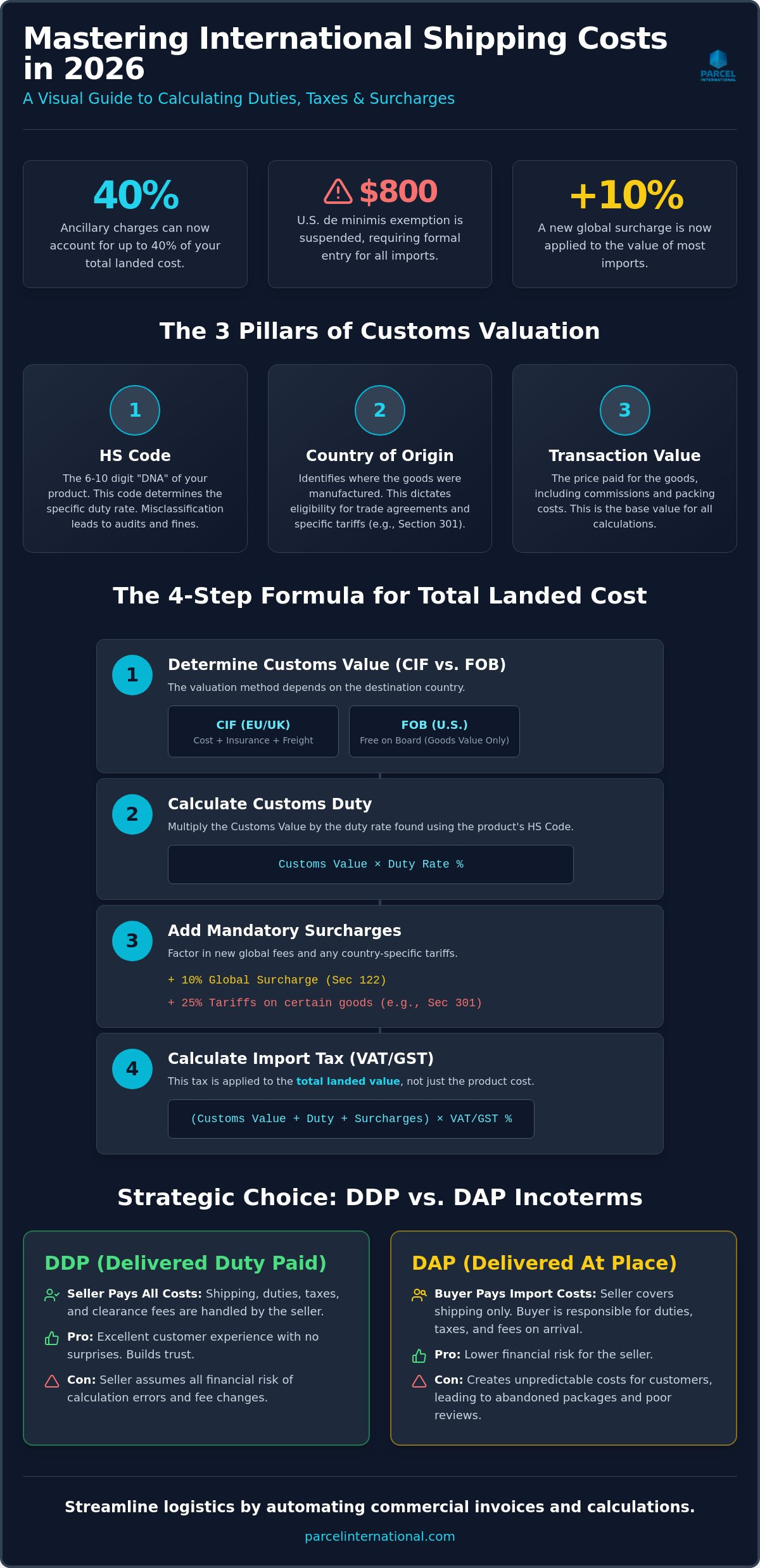
Did you know that ancillary charges can now account for up to 40% of your shipment's total landed cost? In 2026, the global trade landscape has shifted dramatically. With the suspension of the $800 U.S. de minimis exemption and the introduction of a new 10% global surcharge on imports, it's easy to feel overwhelmed by the math. You aren't alone if you're struggling with unexpected delivery delays or losing money because you aren't sure how to calculate international shipping duties and taxes accurately.
Stop guessing your margins and start building a more predictable business model. We'll help you master the complex calculations of global logistics with our clear, step-by-step framework. This guide provides a deep dive into the essential formulas for total landed costs, explains the new EU €3 duty on low-value items, and shows you how to use transparent pricing to win back customer trust and speed up customs clearance. By the end of this article, you'll have the tools to replace fragmented workflows with a unified, reliable strategy for every international shipment.
Table of Contents
The Building Blocks of Customs Valuation in 2026
Accuracy isn't just a goal; it's a legal requirement. When you're learning how to calculate international shipping duties and taxes, you must start with three variables: the Harmonized System (HS) code, the country of origin, and the transaction value. If any of these are wrong, your entire calculation collapses. This leads to the delays and hidden fees that damage customer trust. Every calculation relies on these variables to determine the applicable customs duties and tariffs. By establishing a precise valuation foundation, you move from fragmented guesswork to a unified, reliable logistics strategy.
HS Code Classification: The DNA of Your Parcel
An HS code is a 6-to-10 digit standardized numerical method of classifying traded products. The first six digits are universal, providing a standard language for customs officers worldwide. While the remaining digits vary by country to provide more granular detail, the core classification tells the government exactly what is inside your box. Don't guess here. The danger of mis-description is high. If you use a code for "plastic toys" when you're actually shipping "electronic components," you trigger mandatory customs audits. These errors lead to fines and long-term scrutiny of your business profile. Precision at the classification stage ensures your shipments clear borders without procedural friction.
De Minimis Thresholds: The "Tax-Free" Zone
Historically, de minimis thresholds allowed small shipments to enter a country duty-free to reduce administrative burdens. However, the global landscape in 2026 has shifted toward much stricter regulation. The U.S. suspended its $800 de minimis exemption in late August 2025. Now, all international shipments entering the U.S. require formal customs entry and duty payment. Similarly, the EU ended its €150 de minimis exemption on July 1, 2026. A new €3 duty per low-value item was introduced to manage the surge in e-commerce imports.
These changes mean you can no longer rely on splitting shipments to save on taxes. Strategic planning now requires you to account for taxes on every single item, regardless of its value. Understanding these regional variations is vital for maintaining a predictable landed cost model. Because the "tax-free" zones have effectively vanished in major markets, mastering how to calculate international shipping duties and taxes for every parcel is the only way to protect your profit margins. Accurate transaction valuation, which includes the price paid plus commissions and packing costs, is now the mandatory starting point for every cross-border sale.
The Step-by-Step Formula for Calculating Duties and Taxes
Transforming the building blocks of classification into a final dollar amount requires a logical, sequential formula. Accuracy protects your margins. If you miscalculate, you risk the "hidden fee" trap that leads to customer complaints and abandoned shipments. In 2026, the complexity of global trade has increased with new surcharges, making a standardized calculation process more vital than ever. You must follow a specific order: determine the customs value, apply the duty rate, add any mandatory surcharges, and finally calculate the import tax on the combined total.
CIF vs. FOB: Which Valuation Method Applies?
The first step in your calculation is determining the "Customs Value." This isn't always just the price of the item. Different regions use different valuation methods. In the United States, customs typically uses the Free on Board (FOB) method, which calculates duty based only on the value of the goods themselves. However, the EU, UK, and many other nations use the Cost, Insurance, and Freight (CIF) method. Under CIF, the taxable value includes the product price, the insurance cost, and the shipping fees. To ensure you're using the correct base for your target market, you should Know Your Incoterms® to understand exactly which costs are included in the valuation.
Identify the duty rate associated with your HS code. Multiply the Customs Value by this percentage. For example, if you're shipping to the U.S. in 2026, you must also account for the Section 122 global surcharge of 10% and any applicable Section 301 tariffs on Chinese goods, which can reach 25%. These surcharges are added to the base duty amount to create the total duty liability.
Calculating VAT and GST on Imports
Finally, calculate the Value Added Tax (VAT) or Goods and Services Tax (GST). A common mistake is applying the tax rate only to the product value. Instead, tax is almost always calculated on the "Landed Value," which is the sum of the Customs Value plus the duty and any other taxes or surcharges. The formula is: (Customs Value + Duty + Surcharges) x VAT %. In the EU and UK, where VAT rates frequently range between 20% and 25%, this compounding effect significantly impacts the final price. Australia’s 10% GST and Canada’s varying HST rates follow a similar logic, requiring you to understand the local tax base before finalizing your quote.
Don't forget that your total landed cost also includes ancillary charges. Research shows these fees, such as fuel surcharges and brokerage costs, can account for 20% to 40% of the total cost. If you want to streamline your cross-border math and avoid manual errors, using an automated system to generate commercial invoices is the most efficient way to ensure every fee is accounted for before the parcel leaves your warehouse.
Strategic Choice: DDP vs. DAP (DDU) Incoterms
Choosing the right Incoterm is as critical as the math itself. It dictates which party is legally responsible for the payment and who bears the risk of a miscalculation. According to the World Customs Organization's overview of Customs Valuation, the transaction value is the primary basis for duty, but who handles that transaction depends on your shipping terms. In 2026, offering a frictionless delivery is often the difference between a repeat customer and a one-time visitor. If you want to master international shipping for ecommerce, you must decide whether to absorb the administrative burden or pass it to your buyer.
The Case for DDP (Delivered Duty Paid)
DDP provides the "Amazon-style" experience that modern buyers expect. DDP shifts the burden of customs clearance and payment from the buyer to the seller. This means you calculate the fees upfront and include them in the checkout total. It's a powerful tool for customer retention. Research shows that unexpected fees at checkout lead to cart abandonment for 25% to 40% of international online shoppers. By using DDP, you eliminate "sticker shock" at the door. While it requires you to know exactly how to calculate international shipping duties and taxes before the item ships, the payoff is a 15% to 20% increase in conversion rates for cross-border sales. You can build these costs into your product pricing or offer them as a transparent shipping fee during the checkout process.
DAP (Delivered at Place): The Traditional Model
DAP remains the standard for B2B transactions and high-value freight where the buyer often has their own customs broker. In this model, your responsibility ends with the delivery of the goods to a named place. The buyer pays the duties and taxes upon arrival. This reduces your financial risk but creates significant friction for retail customers. If a buyer is surprised by a bill from the carrier, they may refuse the package entirely. This leads to costly return shipping fees and potential storage charges at the port. In 2026, demurrage and detention fees typically start at $100 to $350 per day if a container is not picked up within the free time. If you choose DAP, you must use clear, direct messaging at checkout to manage expectations and prevent complaints about hidden fees.
Your choice between these two models changes the entire flow of your logistics. DDP requires a proactive approach where you handle the complexity of global trade behind the scenes. DAP is a more reactive model that places the procedural burden on your customer. For most businesses looking to improve trust and speed up customs clearance, moving toward a DDP model is the most effective way to simplify how to calculate international shipping duties and taxes for the end-user.
Common Pitfalls and Hidden "Ancillary" Costs
Government duty rates are only one piece of the puzzle. If you want to know how to calculate international shipping duties and taxes with total accuracy, you must account for ancillary charges. These private fees often account for 20% to 40% of your total landed cost. They turn a profitable shipment into a loss-making one if they aren't factored into your initial quote. Transparency is your best defense against these hidden barriers.
Carrier Disbursement Fees are a frequent surprise. When a carrier pays duties to the government on your behalf to speed up clearance, they charge a "convenience" fee. This is usually a percentage of the duty amount or a flat minimum. Additionally, customs brokerage fees in 2026 typically range from $125 to $350 for standard entries. For complex shipments, such as those involving rare components sourced through SuperCars.Parts, these can climb to $500. You must also watch for currency conversion markups. Carriers often use their own exchange rates, which are less favorable than the mid-market rate, effectively adding a hidden 2% to 5% tax to your bill.
Carrier Surcharges You Didn’t See Coming
Major carriers like DHL, UPS, and FedEx apply "Advance Payment" or "Security" fees to manage the risk of unpaid duties. In the United States, you must also factor in the Merchandise Processing Fee (MPF). For 2026, the MPF for formal entries is 0.3464% of the declared value, with a minimum of $31.67 and a maximum of $614.35. To mitigate these costs, consider working with a freight forwarder who can consolidate shipments and negotiate better ancillary rates. This proactive step helps you move away from fragmented pricing toward a more stable, predictable model.
Managing Compliance to Avoid Penalties
Documentation errors are the most expensive mistakes in global trade. If your paperwork is missing or inaccurate, your goods enter "Storage in Bond." In 2026, demurrage and detention fees start at $100 to $350 per day after the initial free period. Using correct international shipping customs documentation prevents these delays from the start. Be aware of the 2026 focus on sustainability taxes, such as plastic packaging levies and carbon surcharges like the EU ETS. These are no longer optional; they are mandatory components of the modern landed cost formula. If you want to get a transparent quote that includes these hidden variables, automate your shipping process today.
Automating the Calculation with Parcel International
Manual math is a liability in a high-stakes industry where a single digit error can halt a shipment for days. While the previous sections of this guide detailed the complex variables of 2026 trade, you don't have to manage them alone. Parcel International replaces fragmented workflows with a singular, unified platform designed to simplify international parcel shipping. By utilizing a broker model instead of a single-carrier solution, we provide a level of transparency that traditional carriers often obscure. This approach allows you to compare real-time rates from multiple providers while ensuring that every estimate includes the necessary data for how to calculate international shipping duties and taxes accurately. You get the best of both worlds: competitive pricing and administrative precision.
Unified Customs Documentation Tools
Our platform automates the generation of Commercial Invoices, which are the most critical documents for any border crossing. Human error is the leading cause of customs rejection and the expensive storage fees we've previously discussed. Our system mitigates this risk with automated HS code suggestions based on your product descriptions. You gain instant access to compliance requirements across more than 220 countries and territories without performing hours of manual research. This bridge between wholesale logistics and retail delivery ensures your business remains adaptable to both small-scale projects and large commercial freight, stripping away the anxieties of procedural friction.
Protecting Your Margins with Accurate Estimates
Predictability is the foundation of customer trust and stable profit margins. When you use our international shipping rates tool, you gain total visibility into the landed cost before you commit to a shipping label. Understanding how to calculate international shipping duties and taxes shouldn't require a degree in international law. This visibility prevents the "sticker shock" at the door that leads to refused packages and lost revenue.
Our team in Rotterdam provides expert support for complex global logistics, ensuring you have a reliable ally in one of the world's most active trade hubs. We value your peace of mind over corporate jargon. Don't let the math of global trade become a barrier to your expansion. Take control of your landed costs and build a more efficient supply chain starting today. Get a transparent shipping estimate today and move your business forward with a partner that values reliability and punctuality.
Take Control of Your Global Landed Costs
The 2026 logistics landscape requires more than just a basic understanding of tariffs. You've learned that mastering the math of global trade means accounting for everything from CIF valuation to hidden carrier disbursement fees. By prioritizing transparency and choosing the right Incoterms, you protect your margins and your reputation. Knowing how to calculate international shipping duties and taxes is the first step toward a predictable supply chain, but automation is what ensures long-term scalability and speed.
Stop struggling with fragmented workflows and manual paperwork. Parcel International provides a unified platform to simplify your cross-border operations. Access automated customs documentation for over 220 countries and compare real-time rates from top carriers like DHL, FedEx, and UPS. We value your peace of mind, which is why we offer transparent pricing with no hidden subscription fees. Simplify your global logistics and calculate rates instantly with Parcel International. Take the friction out of your delivery process and start shipping with confidence today.
Frequently Asked Questions
How do I find the correct HS code for my product?
Consult the official tariff schedule of the destination country or use an automated classification tool to identify your code. The first six digits are universal standards, while the remaining digits provide country-specific detail. Accurate classification is mandatory for how to calculate international shipping duties and taxes without triggering customs audits. Don't guess here; use your commercial invoice data to ensure your description matches the numerical code exactly.
What is the difference between import duty and import tax?
Duty is a tariff specifically applied to imported goods based on their product category and country of origin. Tax, such as VAT or GST, is a broad consumption tax applied to the landed value of the shipment. While the U.S. has an average duty rate of 3.3%, taxes in the EU can reach 25%. You must calculate the duty first, as taxes are usually applied to the combined value of the goods and the duty.
Do I have to pay duties on gifts sent internationally?
Gifts are no longer exempt in major markets like the U.S. and the EU as of 2026. The U.S. suspended its $800 de minimis exemption in August 2025, and the EU introduced a €3 duty on low-value items in July 2026. You must declare the fair market value of the gift on the customs form. Failure to pay these mandatory fees will result in the shipment being held at the border.
What happens if I undervalue my items on the customs declaration?
Undervaluing items triggers mandatory audits, heavy financial penalties, and potential seizure of your goods. Customs authorities use sophisticated data modeling to flag shipments that fall below historical price benchmarks. This practice is considered tax evasion and will cause significant delivery delays. Maintaining radical transparency in your valuation is the only way to ensure faster customs clearance and build long-term trust with border authorities.
Can I get a refund on import duties if I return the item?
You can reclaim duties through a formal "drawback" process, but it requires extensive proof of export. You must provide the original import documents and the new export declaration to the customs office. Most businesses find the administrative cost of filing a claim exceeds the refund amount for low-value parcels. If you use a DDP model, your logistics provider may be able to streamline this recovery process for you.
How does the 2026 EU Carbon Border Adjustment Mechanism (CBAM) affect my shipping costs?
CBAM introduces a carbon-based levy on specific industrial goods like steel, aluminum, and cement imported into the EU. You must report the embedded emissions of these products and purchase carbon certificates to cover the difference between the production country's carbon price and the EU ETS. This adds a new layer of complexity to how to calculate international shipping duties and taxes for carbon-intensive industries, requiring precise environmental documentation.
Is insurance included in the customs valuation calculation?
Insurance is included if the destination country uses the CIF (Cost, Insurance, and Freight) valuation method. The EU and UK utilize this model, meaning you pay duties on the total cost of the goods plus the insurance and shipping fees. In contrast, the U.S. uses the FOB (Free on Board) method, which excludes insurance and freight from the duty calculation. Always verify the local valuation rules before finalizing your landed cost model.
Why did my carrier charge a "brokerage fee" on top of the taxes?
Carrier brokerage fees cover the professional service of clearing your goods through customs on your behalf. These fees are private service charges and are separate from government-mandated duties. In 2026, standard brokerage fees typically range from $125 to $350 per entry. You can avoid these surprises by using a platform that provides real-time rate comparisons and transparently lists all ancillary charges before you ship your parcel.


