
Ecommerce International Shipping Solutions: The Complete 2026 Scaling Guide
- Alex
- Jul 8
- 11 min read
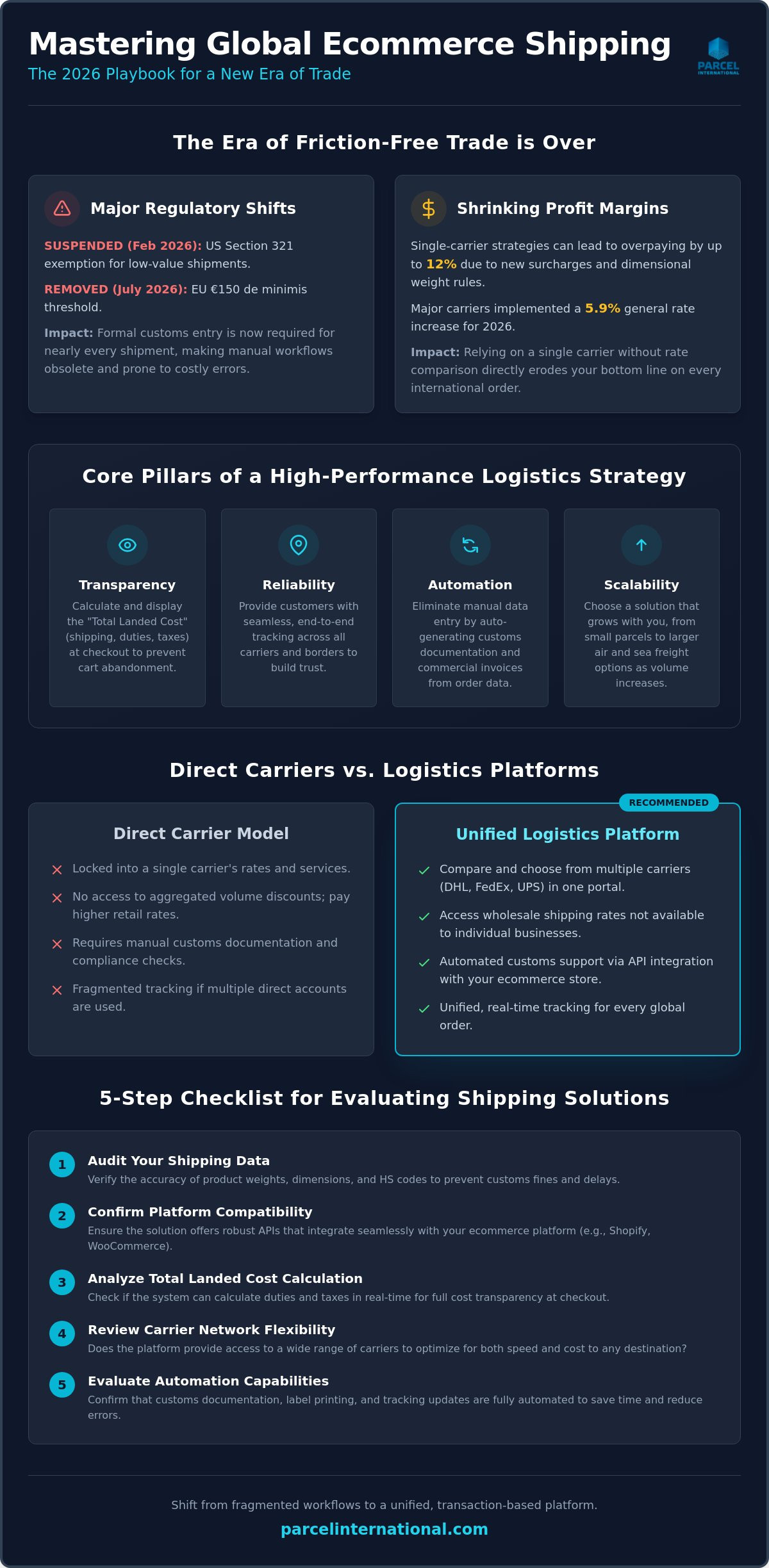
The era of friction-free, duty-free cross-border trade has officially ended. With the permanent suspension of the US Section 321 exemption and the EU's removal of the €150 de minimis threshold in July 2026, the hidden costs of global trade are now front and center. If you're still relying on a single carrier to manage your ecommerce international shipping solutions, you're likely overpaying by up to 12% once new surcharges and dimensional weight rules are applied. Global logistics is no longer just about moving boxes. It's about managing data and regulatory compliance with surgical precision.
It's exhausting to watch your profit margins shrink because of unpredictable customs delays or manual documentation errors. You deserve a logistics strategy that offers relief from fragmented workflows and high shipping costs. This guide provides a strategic framework to help you master these complexities. You'll learn how to implement automated customs documentation, secure wholesale rates, and provide unified tracking for every global order. We'll show you how to turn international expansion into a predictable, high-ROI engine for your online store.
Table of Contents
What Are Ecommerce International Shipping Solutions in 2026?
In 2026, ecommerce international shipping solutions represent far more than a simple delivery service. They are an integrated ecosystem comprising carrier networks, cloud-based software, and specialized customs expertise. The days when a merchant could simply drop a parcel at the local post office and hope for the best are gone. Today, success requires a sophisticated global logistics strategy that manages data as efficiently as it moves physical goods. This systemic approach is the only way to maintain profitability as cross-border sales are projected to represent 22% of all ecommerce shipments this year.
The regulatory landscape has shifted significantly. With the permanent suspension of the US Section 321 exemption in February 2026 and the EU's elimination of the €150 de minimis threshold in July 2026, every shipment now faces formal entry processes. This complexity makes manual shipping workflows obsolete. Modern ecommerce international shipping solutions use APIs to connect your storefront directly to global carriers, ensuring that every commercial invoice is accurate and every duty is calculated in real time. The core value proposition is clear: you must reduce your total landed costs while maintaining the delivery speeds your customers expect.
The Evolution of Cross-Border Ecommerce
Consumer expectations have fundamentally changed. Shoppers in Berlin or Sydney now demand the same "Amazon-like" delivery speeds as those in New York. To compete, you must move away from "flat rate" international shipping. This outdated model often leads to lost profit margins or abandoned carts because it doesn't account for the actual costs of the journey. Instead, use real-time rate comparison tools to offer the most cost-effective shipping option for every specific destination. This ensures transparency for the buyer and protects your bottom line.
Key Components of a Modern Shipping Stack
A high-performance stack starts with carrier aggregation. Don't waste time managing separate accounts for DHL, FedEx, and UPS. Use a single portal to access multiple carriers and compare their transit times instantly. This flexibility is vital since major carriers implemented a 5.9% general rate increase for 2026. By aggregating volume, you can access wholesale rates that aren't available to individual small businesses.
Next, prioritize automated customs support. This technology eliminates the manual data entry that causes the majority of delivery delays. Finally, your solution must be scalable. As your volume grows, you may need to pivot from small parcel shipments to larger freight options. Understanding international road freight rates Europe allows you to optimize your mid-mile logistics as your brand matures. By integrating these components, you strip away the procedural friction that holds back international growth.
Core Pillars of a High-Performance Global Logistics Strategy
Implementing modern ecommerce international shipping solutions requires a focus on four essential pillars. Without these, your expansion efforts will likely stall due to hidden costs and operational friction. Start by prioritizing transparency. In 2026, knowing your "Total Landed Cost" is non-negotiable. This figure includes shipping, duties, and taxes. If you don't present this to your customers at checkout, you risk high return rates and customer dissatisfaction. Use cross-border ecommerce resources to understand how different markets handle these calculations and stay ahead of regulatory changes.
Reliability is the next pillar. Your customers expect end-to-end tracking that works across borders without gaps in visibility. This transparency builds trust and reduces the burden on your support team. Automation then ties everything together. You shouldn't be manually typing data into commercial invoices or packing slips. A robust system generates these documents automatically based on order data, reducing the risk of human error. Finally, ensure your strategy allows for scalability. Many brands start with international parcel shipping but quickly realize they need air or sea freight as order volumes increase. If you're ready to optimize your workflow, you can explore unified shipping options that scale alongside your business.
Automating Customs and Compliance
Accuracy is everything when it comes to HS codes. Assigning the wrong code can lead to hefty fines, seized goods, or unexpected duties for your customer. Automated tools help you select the correct codes and generate international shipping customs documentation with zero manual entry. Trade Compliance is the proactive management of global import and export regulations. By automating this process, you eliminate the most common cause of delivery delays and ensure your brand remains a reliable partner in the eyes of global customs authorities.
Real-Time Rate Comparison and Carrier Mix
Relying on just one carrier is a risk you shouldn't take. If that carrier has a strike or a massive price hike, your entire business suffers. Use a broker platform to compare a diverse carrier mix. This allows you to find the best international shipping rates for specific regions like Southeast Asia or South America. Watch out for dimensional weight rules. Major carriers updated their divisors in 2026, which means light but bulky items are more expensive than ever. When you factor in surcharges, the real cost of shipping in 2026 has climbed between 8% and 12% for most merchants, making real-time comparison essential for protecting your margins.
Direct Carriers vs. Logistics Brokers: Comparing the Models
Choosing the right ecommerce international shipping solutions often comes down to a single strategic question: should you go direct or use an intermediary? Direct carriers like DHL, FedEx, or UPS are the traditional choice for massive enterprises. These organizations typically have dedicated logistics departments and the high-volume contracts necessary to negotiate favorable terms. However, for most growing brands, a direct relationship can feel restrictive. You're often treated as a "small fish" in a very large pond, which means less leverage during rate hikes and generic support when things go wrong.
Logistics brokers and aggregators offer a different path. They function as a bridge between your store and the major carriers, leveraging the total network spend of thousands of merchants to secure "Big Brand" pricing for everyone. This "Volume Advantage" is a game changer for SMBs. It allows you to access discounted rates that would be impossible to negotiate on your own. Beyond costs, brokers provide a level of personal account management that generic carrier call centers can't match. When a shipment is stuck, you need a partner who understands your business, not a script-reading agent.
When to Use a Direct Carrier
A direct relationship makes sense when your volume is high enough to justify a dedicated account team from the carrier itself. This usually happens when you're shipping thousands of parcels a day through a single lane. If your logistics are that predictable, the direct model offers simplicity. But beware of the hidden costs. Managing multiple direct carrier accounts means juggling different platforms, separate invoices, and fragmented tracking data. It's a recipe for administrative chaos that often outweighs the perceived benefits of going direct.
The Broker Advantage for Ecommerce
The biggest benefit of a broker is flexibility. You aren't locked into one carrier's network. Instead, you gain access to a multi-modal system that includes express shipping, air, sea, and road freight. This allows you to pivot your strategy as your needs change. A broker also simplifies your back-office work by providing one unified invoice for all carriers and destinations. This transparency is vital for maintaining a clean customs and compliance record. In this model, a freight forwarder acts as a strategic partner. They don't just move boxes; they optimize your entire supply chain to ensure you're always using the most efficient route available.
5-Step Checklist for Evaluating Shipping Solutions
Selecting the right ecommerce international shipping solutions shouldn't be a guessing game. It requires a methodical approach to ensure your chosen platform can handle the weight of 2026’s regulatory demands. Follow this 5-step checklist to find the right fit for your brand and strip away the anxieties of global expansion.
Audit your shipping data: Look at your last six months of orders. Identify your most frequent global destinations to ensure your provider has strong carrier partnerships in those specific regions.
Verify API compatibility: Your logistics platform must talk to your storefront. Confirm that the solution offers seamless integration with Shopify, Magento, or whatever stack you use to avoid manual data transfers.
Test the customs tool: Accuracy in duty and tax calculations is vital. Run a test shipment through the platform to see if it correctly identifies HS codes and generates precise landed costs.
Compare 'all-in' rates: Don't just look at the base price. Factor in fuel surcharges, remote area fees, and peak season adjustments to see the true impact on your margins.
Evaluate human support: Tech is great until a sea freight container is stuck in customs. Ensure you have access to expert support for complex freight or documentation issues.
Ready to streamline your process? Access our unified shipping portal to see how these steps look in action and secure your wholesale rates today.
Integration and Workflow Efficiency
Efficiency is measured by the time it takes to move from a sale to a printed label. If your workflow requires more than two clicks, you're losing money on labor. Your system should also handle international shipping for ecommerce returns as easily as outbound orders. A fragmented return process kills customer loyalty. Additionally, prioritize 'white-label' tracking pages. These keep your brand front and center throughout the delivery journey, rather than sending customers to a generic carrier website.
Hidden Costs to Watch Out For
The base rate is rarely what you actually pay. Watch out for address correction and residential delivery surcharges, as these can appear on your bill weeks after a delivery is completed. The cost of inaction is even higher. Slow shipping or unexpected fees at the door lead to high cart abandonment and lost lifetime value. Verify if your solution includes a 'Shipping Cost Calculator' to display real-time rates to your customers at checkout. This transparency prevents "sticker shock" and ensures your ecommerce international shipping solutions actually drive conversions rather than scaring away buyers.
Scaling Globally with Parcel International’s Unified Platform
Parcel International acts as the essential bridge between the agility of your small business and the raw power of a global logistics network. We've stripped away the traditional barriers that stop brands from expanding. You don't have to deal with monthly subscription fees or restrictive volume minimums. Our transaction-based model ensures you only pay for what you ship, making high-tier logistics accessible to everyone from boutique startups to established enterprises. This egalitarian approach allows you to scale at your own pace without the pressure of fixed overhead costs.
By choosing our ecommerce international shipping solutions, you move from a fragmented, multi-platform mess to a singular, orderly workflow. Whether you need express shipping for urgent parcels or large-scale sea and air freight for bulk inventory, our platform handles it all in one place. We provide the stability you need to navigate a complex global market with total confidence. Our focus on radical transparency means you'll always know exactly what you're paying, with no hidden requirements or obscured terms to worry about.
A Single Interface for Global Growth
Our platform simplifies the chaos of cross-border trade by allowing you to compare real-time rates from major carriers in a single portal. You gain the peace of mind that comes from using our automated customs documentation tools, which virtually eliminate the risk of procedural delays. Because we are based in Rotterdam, we serve as a strategic hub for European road freight. This heritage gives us unique expertise in managing the flow of goods through the world's most critical trade lanes. We take the technical burden of administrative logistics off your plate so you can focus on your customers.
Ready to Ship Smarter?
Experience the relief of a unified shipping workflow that actually works. Stop wasting time on manual data entry and start focusing on growing your brand. Getting started is easy; there are no hidden requirements or long-term contracts to sign. We believe in being a stable intermediary that protects your interests at every step of the journey. Join the thousands of businesses that trust us to be their reliable bridge to the global market. Book your first international shipment with Parcel International today and see how simple global scaling can be.
Take Command of Your Global Logistics
Global trade in 2026 is complex, but it doesn't have to be chaotic. By prioritizing total landed cost transparency and automating your customs documentation, you strip away the friction that stalls international growth. Move away from fragmented carrier accounts and embrace a unified strategy that scales with your ambition. Whether you're shipping small parcels or managing large-scale road freight, the right ecommerce international shipping solutions act as a stable bridge to your customers worldwide.
Parcel International has been helping brands navigate these waters since 2007. As Rotterdam-based logistics experts, we provide the infrastructure you need to reach 220+ countries without the burden of subscription fees or volume minimums. Our platform includes automated customs support to ensure your shipments clear borders without delay. It's time to trade uncertainty for precision and start growing your footprint today.
Compare international shipping rates and book your first shipment today. Your global audience is waiting; let's get your products to them efficiently and reliably.
Frequently Asked Questions
What is the cheapest international shipping solution for ecommerce?
The most cost-effective approach involves using a logistics aggregator to access wholesale rates that aren't available to individual merchants. In 2026, major carriers like UPS and DHL implemented 5.9% rate increases, making direct contracts expensive for SMBs. Aggregators pool volume from thousands of sellers to secure discounted pricing. This model allows you to maintain healthy profit margins without committing to high-volume minimums or expensive monthly subscriptions.
How do I automate customs documentation for my online store?
You can automate this process by integrating your storefront with a shipping platform that features an API-driven customs engine. This software automatically pulls order data to generate commercial invoices and packing slips. It's a vital tool since the EU removed the €150 de minimis threshold in July 2026. Automation ensures every shipment has the correct HS codes and documentation, which prevents expensive delays at the border.
What is the difference between a shipping aggregator and a direct carrier?
A direct carrier is a single company like FedEx that handles transport, while an aggregator is a platform providing access to multiple ecommerce international shipping solutions through one interface. Direct carriers are best for massive enterprises with dedicated logistics teams. Aggregators are ideal for growing brands because they offer flexibility, simplified billing, and discounted rates across a diverse mix of global and regional carriers.
How can I reduce shipping delays for international customers?
Reduce delays by ensuring your customs paperwork is 100% accurate and choosing carriers with strong local networks in the destination country. Most international hold-ups happen due to manual data entry errors or incorrect tax calculations. Using a platform with built-in customs support eliminates these friction points. You should also use a multi-carrier strategy to reroute shipments if one specific network faces regional backlogs or service disruptions.
Can I ship heavy freight through an ecommerce shipping platform?
Yes, comprehensive ecommerce international shipping solutions allow you to manage everything from small parcels to large-scale sea and air freight. As your business scales, you may need to move bulk inventory between regional fulfillment centers. A unified platform lets you compare freight rates and book shipments without switching to a different provider. This flexibility ensures your logistics stack grows alongside your product catalog and order volume.
What are the most important Incoterms for ecommerce sellers in 2026?
DDP (Delivered Duty Paid) is the essential Incoterm for modern ecommerce. It ensures the seller handles all duties and taxes upfront, so the customer doesn't face unexpected fees at their door. With the US permanently suspending the Section 321 exemption in 2026, using DDP is the best way to prevent cart abandonment and high return rates. It provides the transparency and relief customers expect during a global checkout experience.
Is it better to use DHL, FedEx, or UPS for international delivery?
The best carrier depends entirely on your specific shipping lanes and the required transit speed for each order. DHL typically excels in European and Asian markets, while FedEx and UPS offer extensive infrastructure across North America. Don't lock yourself into one provider. Use a broker platform to compare real-time rates and performance metrics for every shipment. This ensures you always select the most reliable option for each unique destination.
How do I calculate total landed costs for my global orders?
Calculate total landed costs by adding the product price, shipping fees, insurance, and all applicable import duties and taxes. You should use an automated calculator at checkout to present this "all-in" price to your customers. This transparency is critical in 2026 due to the removal of de minimis thresholds in the US and EU. Providing a clear total upfront builds trust and protects your business from the cost of refused deliveries.


Comments