
Common International Shipping Mistakes to Avoid: The 2026 Logistics Strategy Guide
Updated: Jun 27
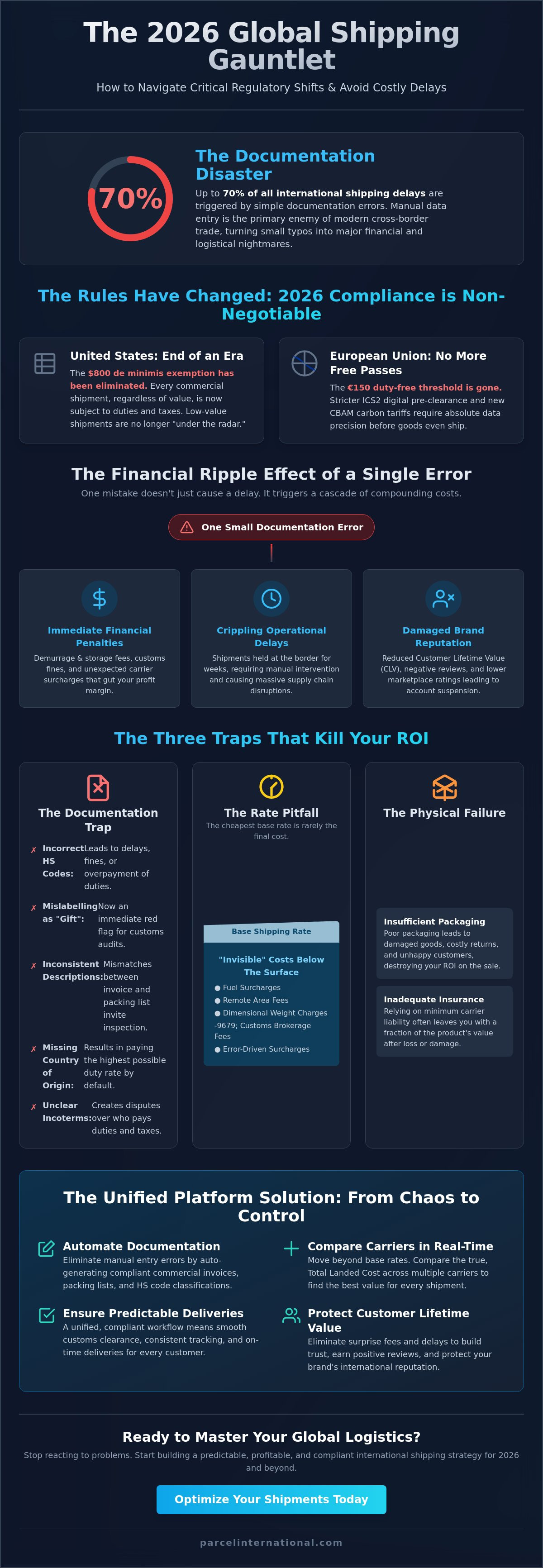
Documentation errors trigger up to 70% of all global shipping delays, yet many businesses still rely on manual processes that invite disaster. With the elimination of the $800 de minimis exemption in the US and the removal of the EU duty-free threshold, even small errors now lead to immediate financial penalties. Identifying the most common international shipping mistakes to avoid is no longer just a best practice; it's a survival requirement for your 2026 strategy.
You've likely felt the sting of unexpected customs duties or watched packages sit at borders for weeks. It's frustrating when inconsistent tracking prevents you from giving customers the answers they need. We're here to help you move from chaotic, multi-platform workflows to a unified, predictable system. This guide reveals how to eliminate hidden fees and customs headaches by mastering the latest global logistics complexities. You'll get a clear preview of the automated strategies needed to reduce overhead and ensure on-time deliveries for every international customer.
Table of Contents
Why International Shipping Mistakes Cost More Than Just Money in 2026
The Documentation Trap: Avoiding Customs Delays and Compliance Fines
Rate Pitfalls: Why the Cheapest Option Often Becomes the Most Expensive
Physical Failures: Packaging and Insurance Blunders That Kill ROI
Optimizing Your Global Supply Chain: The Unified Platform Solution
Why International Shipping Mistakes Cost More Than Just Money in 2026
The 2026 logistics landscape is faster than ever, but it's also more unforgiving. As automation speeds up the physical movement of goods, regulatory scrutiny has tightened to match. Shipping in this environment is no longer just about "moving things" from point A to point B. It's about managing the data that accompanies every parcel. Documentation errors contribute to 60-70% of all shipping delays. This makes manual data entry the primary enemy of modern cross-border trade. A single typo in a description or a weight field can halt a shipment indefinitely. Understanding the common international shipping mistakes to avoid starts with recognizing that your digital paperwork is just as important as the product inside the box.
The Financial Ripple Effect of a Border Hold
When a package is held at the border, the costs start compounding immediately. You'll face demurrage and storage fees that act as silent profit killers. These fees often exceed the original shipping cost within days. Beyond the immediate invoice, there's a deeper impact on your customer lifetime value (CLV). A customer who receives a surprise bill for duties or waits three weeks for a delivery rarely returns. Failed deliveries and customs rejections also damage your merchant rating on global marketplaces. This can lead to lower search visibility or account suspension. Total Landed Cost is the final sum of the product price, freight, insurance, duties, taxes, and any error-driven surcharges or storage fees incurred during transit.
Regulatory Evolution: Why 2026 is Different
Regulatory compliance in 2026 has entered a new era of strictness. The elimination of the $800 de minimis exemption in the United States and the €150 duty-free threshold in the EU means every commercial shipment is now subject to duties and VAT. Stricter digital pre-clearance requirements, such as the latest ICS2 updates, require precise data before the goods even leave the origin port. If you're shipping into the EU through gateways like Rotterdam, "guessing" HS codes is a recipe for disaster. Authorities now use AI-driven screening to flag inconsistencies in global freight transport. Precision is your only path to a smooth supply chain. You must also account for the EU's Carbon Border Adjustment Mechanism (CBAM), which now imposes charges on specific carbon-intensive goods. Ignoring these shifts doesn't just delay a package; it risks your entire ability to trade internationally.
The Documentation Trap: Avoiding Customs Delays and Compliance Fines
The commercial invoice is the heart of your shipment's digital identity. In 2026, customs authorities have zero tolerance for vague paperwork. One of the most common international shipping mistakes to avoid is mislabeling shipments to bypass taxes. Labeling a commercial package as a "Gift" or "Sample" used to be a frequent tactic, but it now triggers immediate red flags. With the July 1, 2026, removal of the EU's €150 duty-free exemption and the elimination of the US $800 de minimis rule, every item has a taxable value. Customs officers use automated screening to compare your declared value against market averages. If the numbers don't align, your shipment is flagged for an audit, leading to fines that far outweigh any potential tax savings. Strict compliance with international shipping regulations is the only way to keep your goods moving.
Beyond labeling, the HS code dilemma remains a significant hurdle. Assigning the wrong Harmonized System code doesn't just delay your package; it often results in overpaying duties. You're effectively leaving money on the table or risking a compliance penalty. Similarly, failing to define Incoterms 2020 clearly is a recipe for conflict. If you don't specify who pays for duties and taxes at the border, the carrier will often bill the shipper by default, leading to unexpected invoices that gut your profit margins.
Most Common Documentation Errors to Audit Today
Inconsistent Descriptions: Ensure the item description on your packing list matches the commercial invoice word-for-word. Discrepancies suggest poor oversight and invite manual inspection.
Missing Country of Origin (COO): Many trade agreements depend on a clear COO declaration. Without it, you'll pay the highest possible duty rate by default.
Incorrect Consignee Details: A missing phone number or a typo in the email address is the simplest mistake with the highest delay rate. Carriers can't clear customs if they can't contact the recipient for tax authorization.
Leveraging Automation for Customs Compliance
Manual data entry is no longer a viable way to scale. Human error is inevitable when you're typing out complex codes and addresses for dozens of countries. Platform-integrated tools solve this by generating international shipping customs documentation directly from your order data. These systems use pre-validated forms that ensure every required field is filled correctly before the label is even printed. You can simplify this further by utilizing our customs support features to automate HS code classification and duty estimates. By removing the manual element, you transition from a reactive "fix-it" mindset to a proactive, automated workflow that guarantees compliance at every border.
Rate Pitfalls: Why the Cheapest Option Often Becomes the Most Expensive
Choosing the lowest quote is one of the most common international shipping mistakes to avoid. Base rates are frequently deceptive. They don't include fuel surcharges, which can fluctuate weekly, or remote area fees that apply if your customer lives outside a major hub. When you see a price that looks too good to be true, it usually is. You'll likely receive a secondary invoice weeks later that erases your profit margin. Transparency is the only way to protect your bottom line. You need to see the full cost upfront to make an informed decision for your business.
Volume is another area where costs spiral out of control. Many shippers calculate their budget based on actual weight, ignoring the "Dimensional Weight" (Dim Weight) rule. Carriers charge based on whichever is greater: the physical weight or the space the box occupies. If you ship lightweight items in oversized boxes, you're paying for air. This is a fundamental error in e-commerce international shipping that seasoned managers learn to avoid by optimizing their packaging. Every cubic centimeter counts when you're moving goods across borders.
Calculating the True Cost of International Shipping
To get an accurate picture of your expenses, you need to use a robust shipping calculator that factors in every variable. This includes the service level required for your cargo. For instance, international shipping rates vary wildly between Express Shipping for urgent documents and Sea Freight for bulk inventory. Economy options offer a middle ground, but they often come with less granular tracking. Don't guess. Use real data to determine if a specific shipment justifies the speed of Air Freight or if Road Freight is more cost-effective for regional deliveries. Reliable data prevents the "sticker shock" of post-delivery invoices.
Carrier Diversification Strategy
Sticking to a single carrier creates a single point of failure in your supply chain. If one provider experiences a strike or a regional backlog, your entire operation stops. Diversification allows you to play to each carrier's strengths. While FedEx might offer the best coverage in North America, DHL often dominates the infrastructure in Europe and Asia. Using an aggregator lets you switch between carriers based on real-time performance and price without signing multiple high-volume contracts. This "Broker Advantage" gives you access to wholesale rates that are usually reserved for the biggest players in the market. It's about maintaining flexibility while keeping your overhead low.
Physical Failures: Packaging and Insurance Blunders That Kill ROI
Global freight damage results in an estimated $50-60 billion in annual costs. This makes physical protection a high-stakes component of your logistics strategy. One of the most common international shipping mistakes to avoid is viewing packaging as a fixed cost rather than a variable that impacts your shipping rates. If you under-package, you risk total product loss and a damaged brand reputation. If you over-package, you inflate your dimensional weight and pay for shipping air. Striking the right balance is essential for maintaining a healthy bottom line.
In 2026, physical packaging also carries regulatory weight. Many regions have implemented "green taxes" on non-recyclable plastics and excessive waste. Using sustainable, right-sized materials doesn't just protect your goods; it protects you from regional environmental surcharges. Additionally, you must label for a global audience. Handling instructions like "Fragile" or "This Side Up" should use universal symbols or multilingual text to ensure workers in every transit hub understand how to treat your cargo. Language barriers shouldn't be the reason your ROI takes a hit.
Packaging for Global Transit
Double-wall corrugated boxes remain the industry standard for a reason. They provide the structural integrity needed to survive the stacking and vibrations of long-haul transit. When prepping your international shipping for ecommerce, focus on minimizing empty space. Use high-density void fill only when necessary. By reducing the external dimensions of your parcel by even a few centimeters, you can significantly lower the volumetric costs discussed in previous sections. Efficient packaging is the simplest way to reduce overhead without compromising safety.
The Cargo Insurance Checklist
Don't fall for the "Insurance Myth." Standard carrier liability is almost never enough to cover the full value of high-value goods; it's often limited to a set amount per kilogram. For total peace of mind, opt for third-party cargo insurance. To win a claim, you need a robust paper trail. This includes high-resolution photos of the package before it leaves your facility and a signed delivery receipt that notes any external damage. Declared value for carriage represents the maximum liability the carrier assumes for loss or damage, while declared value for customs is the actual market value of the goods used to calculate duties and taxes. Clear distinctions here prevent legal headaches later. Protect your investment by selecting our Express Shipping options that include transparent insurance add-ons.
Optimizing Your Global Supply Chain: The Unified Platform Solution
The previous sections highlighted the regulatory and physical minefields of global logistics. From documentation traps to dimensional weight surprises, the risks are high. You don't have to navigate this complexity alone. Parcel International simplifies the 220+ country shipping matrix by consolidating every variable into a single, transparent interface. Instead of logging into multiple carrier portals and manually comparing quotes, you get a unified view of DHL, FedEx, and UPS. This real-time comparison allows you to select the best route based on current price and performance. This effectively neutralizes the common international shipping mistakes to avoid that stem from limited options and fragmented data.
Administrative overhead is often the silent killer of business growth. By automating customs documentation and tracking, you free your team to focus on scaling rather than managing spreadsheets. Transitioning to a scalable logistics model doesn't require a massive infrastructure overhaul. It starts with replacing manual entry with a system that validates data before it ever reaches a border. You'll move from a reactive "fix-it" mindset to a proactive, automated workflow that guarantees compliance at every transit point.
To complement your logistics strategy, a professional digital presence is essential; you can discover Africa Mall Hub for web hosting services that support your international business growth.
Why a Logistics Broker is Your Best Ally
Working with a logistics broker gives you the "Big Carrier" advantage without the big business requirements. You get access to wholesale rates typically reserved for companies shipping thousands of units monthly. There are no volume minimums or restrictive subscription fees. You also benefit from a single point of contact for all your needs, whether you're moving goods via Sea Freight, Air Freight, or Road Freight. Our Rotterdam-based expertise is a strategic asset for navigating the specific complexities of European trade. We act as a stable intermediary, ensuring your shipments comply with the latest EU regulations while you maintain your focus on your customers.
Getting Started with Parcel International
The setup process is designed for speed and clarity. You can go from sign-up to your first international quote in less than two minutes. Once you're active, the dashboard provides radical transparency. You'll see clear reporting on cost tracking, delivery times, and carrier performance. This data allows you to optimize your strategy continuously rather than reacting to problems after they occur. It's time to move away from fragmented workflows and embrace a singular solution that grows with your business. Optimize your global shipping and avoid costly mistakes with Parcel International today.
Master Your 2026 Global Logistics Strategy
The 2026 shipping landscape leaves no room for guesswork. You've seen how documentation errors and hidden fees can erode your profit margins and damage your brand's reputation. By automating your customs paperwork and diversifying your carrier mix, you neutralize the most common international shipping mistakes to avoid. It's about moving from a fragmented, manual workflow to a unified, data-driven system that ensures every package reaches its destination without friction.
We've been a trusted logistics broker since 2007, helping businesses navigate the shifting tides of global trade. Our platform provides automated customs documentation tools and access to wholesale rates for 220+ countries. You don't have to manage these complexities alone. Take control of your supply chain and enjoy the peace of mind that comes with a reliable, transparent partner. Compare real-time international shipping rates and book your first shipment today. Your global growth is just a few clicks away.
Frequently Asked Questions
What is the most common reason for international shipping delays?
Documentation errors are the leading cause of international shipping delays, accounting for up to 70% of border holds. Specifically, missing tax IDs or vague item descriptions prevent customs officers from clearing goods quickly. Ensure your commercial invoice matches your packing list exactly to avoid manual inspections. Providing a valid phone number and email for the recipient is also critical for timely tax authorization and final delivery.
How do I calculate the correct HS code for my products?
Identify the correct HS code by using the World Customs Organization database or an automated AI classification tool. Start by determining your product’s primary material and its intended use. Incorrect classification is one of the most common international shipping mistakes to avoid because it leads to overpaying duties or facing compliance fines. If you are unsure, consult our customs support team to ensure your codes meet 2026 standards.
Is it better to use DDU or DDP for international e-commerce?
Delivered Duty Paid (DDP) is the superior choice for international e-commerce because it eliminates surprise bills for your customers. Under DDP, the seller handles all duties and taxes upfront. Delivered Duty Unpaid (DDU) often leads to packages being abandoned at customs when recipients refuse to pay unexpected fees. Using DDP creates a predictable checkout experience and significantly improves your customer lifetime value.
What happens if I under-declare the value of my shipment?
Under-declaring the value of your shipment results in heavy fines, package seizures, and long-term audits of your business account. Customs authorities use automated systems to flag values that fall significantly below market averages. If caught, you'll face penalties that far exceed the original tax savings. Always declare the true transactional value to maintain a clean shipping history and avoid being blacklisted by global carriers.
How does dimensional weight affect my international shipping costs?
Dimensional weight increases your shipping costs by charging for the space a package occupies rather than its physical weight. Carriers calculate this by multiplying the length, width, and height and dividing by a specific dim factor. If your box is large but light, you'll pay the higher volumetric rate. Minimize this cost by using right-sized packaging and eliminating empty space inside your boxes before booking.
Can I ship liquids or batteries internationally without special permits?
You cannot ship most liquids or lithium batteries internationally without specific Dangerous Goods declarations and specialized packaging. These items are subject to strict IATA and IMO regulations due to safety risks during transit. Attempting to ship them as standard cargo can lead to severe legal penalties and shipment destruction. Always check the Material Safety Data Sheet for your product before booking to determine its legal status.
Why are my shipping rates higher than the initial online estimate?
Shipping rates often exceed initial estimates because of variable surcharges like fuel, peak season fees, or remote area delivery charges. Additionally, if the carrier’s scan shows a higher weight or larger dimensions than you declared, they'll issue a secondary invoice for the difference. Use a platform that provides all-in quotes to ensure transparency and prevent surprise costs from gutting your profit margins after delivery.
What documents are absolutely required for shipping from the US to Europe?
Shipping from the US to Europe requires a commercial invoice, a detailed packing list, and an Economic Operators Registration and Identification (EORI) number for the recipient. You must also include precise HS codes and a clear Country of Origin declaration. Given the 2026 removal of the €150 duty-free threshold, ensure your invoice explicitly states the VAT status to prevent the package from being held indefinitely at the border.


