
How to Properly Fill Out a Commercial Invoice: A 2026 Step-by-Step Guide
- Alex
- Jun 15
- 12 min read
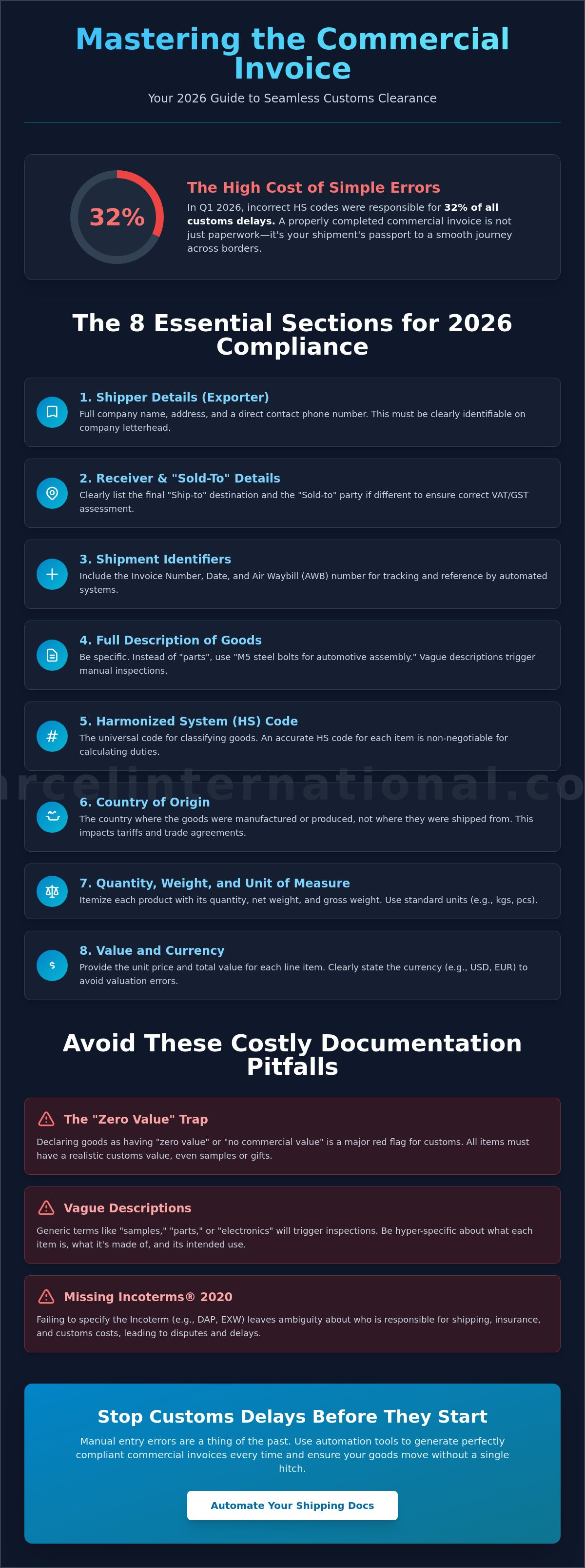
Did you know that incorrect HS codes alone accounted for 32% of all customs delays in the first quarter of 2026? It's a frustrating reality for any business moving goods across borders. You want your package to clear customs on the first attempt, but the fear of hidden fees or procedural friction often creates unnecessary anxiety. Understanding how to properly fill out a commercial invoice is no longer just a clerical task. It is a critical legal declaration that dictates your shipment's financial and regulatory fate.
We agree that the recent suspension of US de minimis thresholds and the removal of EU duty exemptions have made international shipping feel more complex than ever. You need a reliable way to calculate duties accurately and build trust with your buyers through professional documentation. This guide promises to help you master these intricacies with clear, actionable steps that eliminate errors. We will walk you through the specific data points required for 2026 compliance, from mandatory Incoterms 2020 references to CBAM requirements, ensuring your goods move through customs without a single hitch.
Key Takeaways
Understand why the commercial invoice is the primary tool for valuation and how it dictates your shipment's admissibility at the border.
Learn how to properly fill out a commercial invoice by accurately completing the eight essential sections required for 2026 regulatory compliance.
Master the language of global trade by correctly applying HS codes and Incoterms 2020 to ensure duties and taxes are billed correctly every time.
Identify and avoid the "Zero Value" trap and other common documentation errors that lead to costly customs delays and delivery failures.
Discover how to simplify your entire documentation workflow through automation tools that reduce manual entry errors and increase shipping efficiency.
Table of Contents
What is a Commercial Invoice and Why is it Critical?
A Commercial Invoice acts as the primary legal document for importation control and valuation in international trade. It is far more than a simple receipt for payment. Instead, it serves as the definitive record used by customs authorities to verify exactly what is inside a package, where it came from, and how much it is worth. This document is the foundation for determining the duties, taxes, and general admissibility of your shipment.
When you learn how to properly fill out a commercial invoice, you're essentially preparing a legal declaration. The individual who signs the invoice is legally responsible for the accuracy of the data provided. If the values or descriptions are found to be false, the consequences fall squarely on the exporter. This is a critical distinction from a pro forma invoice. While a pro forma invoice is often used as a quote or for non-sale shipments like internal transfers, the commercial invoice is the final bill of sale required for formal customs entry.
The Role of the Invoice in Customs Clearance
Think of this document as a "passport" for your goods. Without it, your products stay stuck at the border. Customs officials rely on the invoice to calculate the final landed cost for your buyer, ensuring that all local taxes and import fees are applied correctly. By 2026, digital versions have become the global standard. Most customs authorities now require electronic data interchange (EDI) to process shipments faster. This shift reduces manual handling and speeds up the clearance process, but it also means that any data entry error is flagged instantly by automated systems.
Who is Responsible for Creating the Document?
The exporter holds the primary duty to provide accurate documentation. In the vast majority of cases, this must be completed in English to ensure it's understood by international transit hubs and customs agents worldwide. Failing to get the details right can lead to severe penalties. You might face expensive storage fees while your goods wait for corrected paperwork, or in worst-case scenarios, authorities may seize the shipment entirely.
To build professional credibility with both customs agents and your buyers, always use your company letterhead. This simple step confirms the legitimacy of the transaction and provides clear contact details if questions arise. Learning how to properly fill out a commercial invoice on your own letterhead demonstrates that you're a reliable partner who understands the high stakes of global logistics. Accuracy here isn't just about compliance; it's about protecting your reputation and your bottom line.
The 8 Essential Sections of a Commercial Invoice
Precision is your best defense against border delays. When you're learning how to properly fill out a commercial invoice, you must treat every field as a critical data point for customs officials. A missing phone number or a vague description can trigger a manual inspection, adding days to your transit time. To ensure a smooth clearance, every invoice must contain these eight core elements: shipper details, receiver details, shipment identifiers, a full description of goods, HS codes, country of origin, quantity/weight, and value/currency. According to an official government organization, these documents provide the necessary information for customs to determine the correct duties and taxes.
Don't overlook the importance of contact information. While many guides focus on addresses, including a direct phone number for both the shipper and the receiver is mandatory for most modern carriers. If an agent has a question about the contents or needs to collect a payment, a working phone number is often the only thing standing between a quick release and a returned package. Ensure your 11-digit shipment IDs and waybill numbers are clearly visible to help automated systems track your cargo through every hub.
Shipper vs. Sold-To: Avoiding Tax Errors
One of the most common mistakes involves confusing the "Ship-to" entity with the "Sold-to" entity. The Ship-to address is the physical destination where the goods will land. The Sold-to entity is the party responsible for paying for the goods. In 2026, keeping these details separate is vital for VAT and GST compliance. If the buyer is in one country but the goods are delivered to another, incorrect labeling can lead to double taxation or rejected tax reclamation claims for your customer.
Itemized Breakdown and Unit Pricing
Never group different products into a single line item. If you're shipping five different components, list each one separately with its own unit price and weight. You must state the currency of sale clearly, such as USD, EUR, or GBP, to avoid valuation errors. If you've offered a discount or included freight charges, list these as separate line items rather than baking them into the product price. This transparency ensures customs agents can verify the fair market value of each item without guesswork. If you want to streamline this process, you can use dedicated customs support to automate these complex breakdowns.
Finally, double-check your weights. Total gross weight must include all packaging, while net weight refers only to the goods themselves. Precision here is mandatory. If a customs scale finds a significant discrepancy between your declared weight and the actual weight, it acts as a red flag for potential fraud. Take the time to weigh your final packed boxes to ensure your documentation matches reality exactly.
HS Codes and Incoterms: The Language of Global Trade
HS codes and Incoterms are the gears that drive the regulatory logic of global trade. While earlier sections focused on the physical data of your shipment, these codes represent the financial and legal framework that determines your final costs. If you want to master how to properly fill out a commercial invoice, you must speak this technical language with absolute precision. These identifiers tell customs agents exactly what you are shipping and, more importantly, which specific duty rate applies to those goods.
The Harmonized System (HS) is a standardized numerical method used by authorities worldwide to classify products. A typical code consists of 6 to 10 digits. The first six digits are universal across all participating countries, while the remaining digits often vary to meet local regulatory requirements. Getting these numbers right is the difference between a package that clears in hours and one that sits in a warehouse for weeks.
Finding the Correct HS Code
Classifying your products correctly is the only way to prevent overpaying duties or facing unexpected penalties. You can use digital classification tools or government databases to find the most accurate code for your items. Never use "General Merchandise" or "Gift" as a description on your invoice. These terms are too vague and act as an immediate trigger for manual inspection. In the first quarter of 2026, incorrect HS codes alone accounted for 32% of all customs delays. Misclassification doesn't just slow you down; it can lead to heavy fines and may cause customs to flag your business for increased inspection frequency in the future.
Choosing the Right Incoterm for Your Shipment
Incoterms 2020 define the exact point where the risk and cost of a shipment transfer from the seller to the buyer. Choosing between DDP (Delivered Duty Paid) and DAP (Delivered at Place) is the most critical decision you'll make for your customer’s experience. Under DDP, you take full responsibility for all import fees, ensuring your buyer isn't surprised by a bill at the door. Conversely, DAP means the customer pays the duties and taxes upon arrival.
This choice significantly impacts the "Total Declared Value" on your documentation. If you charge the customer for shipping and duties upfront, those costs must be transparently reflected to avoid double billing. Aligning your Incoterms with your international shipping rates strategy helps you maintain healthy margins while building trust with international buyers. Take the time to verify your codes and terms before you finalize the document. This step transforms your invoice from a simple list into a professional legal declaration that customs agents can process with confidence.
Common Pitfalls and How to Avoid Customs Delays
Avoiding border friction requires more than just filling in boxes; it requires absolute data integrity. Even a minor discrepancy between your invoice and your packing list can cause an automated system to flag your shipment for a manual inspection. When you're mastering how to properly fill out a commercial invoice, you must ensure that every piece of information matches your waybill exactly. Inconsistent data is one of the most frequent causes of transit interruptions in 2026.
The "Zero Value" trap is a common stumbling block for exporters shipping samples or gifts. Customs authorities don't recognize a value of $0.00. Even if no money is changing hands, you must declare a realistic value for customs purposes. If you fail to do this, agents will likely assign their own value, which often results in higher duties and significant delays. Similarly, missing Tax IDs will halt your package immediately. For shipments entering Europe, an Economic Operators Registration and Identification (EORI) number is mandatory. In the US, you must provide an Employer Identification Number (EIN) or Social Security Number (SSN).
Vague descriptions are another red flag. Replacing a generic term like "parts" with "stainless steel replacement valves for machinery" provides the clarity required for automated risk assessments. If you're unsure about the specific requirements for your destination, you can access professional customs support to verify your documentation before you ship.
The Importance of Accurate Valuation
Customs authorities use sophisticated market benchmarks to detect undervalued shipments. If your declared value is significantly lower than the average price for similar goods, you risk a formal investigation. You must remember that the cost of goods to you isn't necessarily the same as the value for customs. Fair Market Value is the price a willing buyer pays a willing seller. You must use this benchmark to ensure your documentation remains transparent and compliant with 2026 international trade laws.
Signature and Declaration Requirements
Every commercial invoice must include a formal declaration statement confirming that the information provided is true and correct. Within your organization, an authorized representative who understands the legal weight of the document should sign it. While physical signatures were once the rule, 2026 digital compliance has made digital signatures the standard for most major trade lanes. You can find more details on these requirements in our guide to international shipping customs documentation. Ensuring your signature and declaration match current standards is a final, essential step in learning how to properly fill out a commercial invoice without errors.
Simplifying Your Documentation with Parcel International
Managing international documentation shouldn't feel like a high-stakes gamble. While the previous sections detailed how to properly fill out a commercial invoice manually, the modern logistics landscape demands a more efficient approach. Parcel International strips away the typical anxieties associated with global trade by providing a singular, unified solution. Our platform automates the entire generation process, ensuring that every field is completed with surgical precision. This moves your business away from fragmented, multi-platform workflows and into a streamlined environment where accuracy is the default setting.
By integrating carrier data directly into your workflow, we eliminate the friction caused by manual entry errors. You don't have to worry about mismatched weights or missing Tax IDs because our system cross-references your shipment data automatically. If you're dealing with complex freight forwarding needs, our expert customs support is available to guide you through the most stringent regulatory environments. All your global shipping documents are centralized in one secure dashboard. This level of organization provides total visibility, allowing you to track every invoice and waybill from a single point of truth.
Automated Compliance Tools
Our platform acts as a protective layer between your business and customs authorities. It suggests accurate HS codes based on your product descriptions and verifies address data in real-time to prevent delivery failures. This automation ensures your paperwork meets the specific requirements of 220+ countries without you having to research local laws for every shipment. Users frequently report reducing the time spent on administrative logistics by up to 50%. This efficiency allows you to focus on growing your buyer relationships instead of navigating bureaucratic red tape.
Seamless Integration with Major Carriers
We generate invoices that are pre-validated for the digital systems of DHL, FedEx, and UPS. This alignment prevents technical rejections before your package even leaves the warehouse. Whether you're shipping small parcels or transitioning to large-scale freight forwarder services, our system scales with your operational needs. You can book your next shipment and generate your invoice automatically today to experience a truly friction-free workflow. Learning how to properly fill out a commercial invoice is a vital skill for any exporter, but using an optimizer like Parcel International ensures you never have to face the complexities of global trade alone.
Master Your Global Trade Documentation
Mastering your international paperwork transforms a chaotic shipping process into a predictable, orderly workflow. By focusing on precise HS codes, selecting the right Incoterms 2020, and avoiding common valuation traps, you ensure your packages clear customs without friction. Learning how to properly fill out a commercial invoice isn't just about compliance; it's about protecting your margins and building lasting trust with your international buyers. You now have the roadmap to navigate the regulatory shifts of 2026 with absolute confidence.
You don't have to manage these high-stakes logistics alone. Parcel International provides the stability you need to succeed in complex trade lanes. With automated documentation for over 220 countries and real-time carrier rate comparisons, we make global shipping accessible for every business. Our team has provided expert customs support since 2007, acting as a reliable bridge in a fragmented market. Simplify your customs paperwork with Parcel International’s automated tools and strip away the anxiety of border delays. Global trade is within your reach; start shipping with confidence today.
Frequently Asked Questions
Do I need a commercial invoice for every international shipment?
Yes, a commercial invoice is mandatory for all international shipments containing goods with a commercial value. While documents often only require a waybill, any physical product crossing a border must be accompanied by this legal declaration. This ensures customs authorities can identify the contents and assess the appropriate duties or taxes. Providing this document is a requirement regardless of whether the shipment is a sale, a gift, or a sample for a potential buyer.
What happens if I put the wrong HS code on my invoice?
Using an incorrect HS code typically results in immediate customs delays, financial penalties, or the seizure of your goods. Customs authorities rely on these codes to apply the correct tariff rates. If a discrepancy is found, your shipment will be held for manual inspection, and you may be flagged for increased scrutiny on future exports. This error can also lead to your customer being overcharged for import duties, which damages your professional reputation.
Can a commercial invoice be handwritten?
Handwritten invoices are no longer acceptable for most international trade lanes in 2026. Automated customs systems require typed or digital documentation to ensure legibility and seamless data integration. Using a printed document from a professional platform prevents transcription errors and ensures your shipment moves through electronic clearance hubs without manual intervention. Digital documentation is now the baseline for reliability and speed in modern global logistics workflows.
What is the difference between a commercial invoice and a packing list?
The commercial invoice serves as a legal bill of sale and valuation document, while the packing list details the physical contents and dimensions of each package. Customs uses the invoice to calculate duties and taxes based on the declared value. The packing list is primarily used by carriers and warehouse staff to verify the weight, quantity, and specific items inside each box. Both documents must match exactly to avoid processing errors at the border.
How do I declare the value of a gift or a free sample?
You must declare the fair market value of the item even if it is a gift or a free sample. Never list a value of $0.00 on your documentation. Instead, state the price a buyer would pay for the item on the open market. Include a clear statement like "Value for customs purposes only" to clarify that no transaction took place. This transparency helps customs agents assess the correct fees without delaying your shipment for a valuation inquiry.
Is an EORI number required on a commercial invoice for EU shipping?
Yes, an Economic Operators Registration and Identification (EORI) number is mandatory for all businesses importing or exporting goods through the European Union. Failing to include this number on your documentation will cause your package to be held at the border indefinitely. Ensure this unique identifier is clearly visible in the receiver or shipper details section. This requirement applies to all commercial shipments, regardless of the transport mode or the value of the goods themselves.
What language should a commercial invoice be written in?
English is the global standard for international trade documentation. While you may include a translation for the destination country, the primary data must be in English to ensure it is understood by carriers and customs agents at international hubs. This is a foundational step in learning how to properly fill out a commercial invoice for global reach. Using English minimizes the risk of translation errors that could lead to misclassification or valuation disputes at the border.
Does the commercial invoice need to be inside or outside the package?
You must place the commercial invoice on the outside of the package in a clear, adhesive pouch. Customs agents need to access the document without opening your shipment. It is also best practice to include a duplicate copy inside the box as a backup in case the exterior pouch is damaged or lost during transit. Learning how to properly fill out a commercial invoice also involves ensuring it remains accessible to authorities throughout every stage of the journey.


Comments