
Understanding Import Duties and Taxes for Small Business: A 2026 Guide
- Alex
- Jun 13
- 12 min read
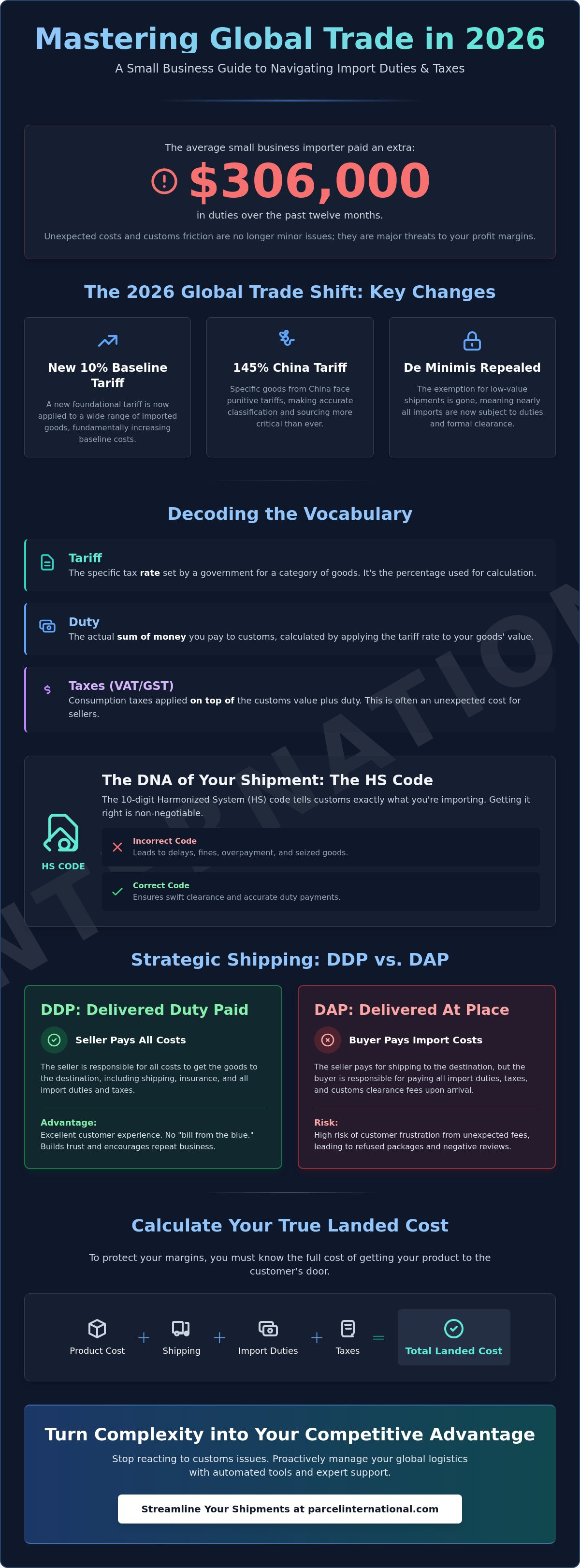
The average small business importer paid $306,000 more in duties over the past twelve months as of March 2026. With the recent repeal of the de minimis exemption and the new 10% baseline tariff, understanding import duties and taxes for small business is no longer a back-office task; it's a survival skill. It's frustrating to face an unexpected "bill from the blue" or have packages stuck in customs because of a single classification error. You deserve predictable landed costs and a seamless delivery experience that protects your margins and keeps your customers happy.
We're here to help you regain control and strip away the anxiety of global logistics. This guide provides a clear roadmap to mastering current fee structures and compliance requirements, including the latest Section 301 actions and USMCA benefits. You'll learn how to navigate confusing HS codes and Incoterms to ensure your goods move through customs with speed and precision. By the end of this article, you'll have the tools to transform complex trade regulations into a strategic advantage for your business.
Key Takeaways
Identify the specific roles of HS codes and tariffs to eliminate "bill from the blue" surprises and keep your global supply chain moving.
Calculate your total landed cost with precision by understanding import duties and taxes for small business, ensuring your pricing always covers your true expenses.
Evaluate the strategic benefits of DDP versus DAP shipping models to minimize your financial risk and improve delivery speed for international customers.
Optimize your tax liability by selecting the right valuation method, such as CIF or FOB, to keep more of your hard-earned profit.
Reduce administrative friction by using automated documentation tools and comparing live shipping rates from top-tier carriers like DHL and FedEx.
Table of Contents
The Small Business Guide to Import Duties and Taxes in 2026
Global trade in 2026 isn't just about moving boxes from one point to another; it's about managing data and dollars with extreme precision. For many entrepreneurs, the sudden shifts in trade policy have made the process feel like a minefield. Gaining a firm grasp of understanding import duties and taxes for small business is the only way to protect your bottom line from eroding under the weight of 10% baseline tariffs and high country-specific fees. If you don't know your fees, you don't know your margins.
Customs authorities serve as the gatekeepers of international commerce. They don't just collect revenue; they regulate the flow of trade to ensure compliance with national laws and safety standards. When your documentation is messy or your classifications are vague, these authorities stop your shipment. This results in delays that frustrate your customers and increase your storage costs. Transparency in these costs isn't just a legal requirement. It's a powerful tool for building customer trust and encouraging repeat business.
Why Customs Fees Feel Like a Barrier to Growth
Small business owners often live in fear of the "bill from the blue." These are the unexpected charges that appear after a shipment arrives, often because of a misunderstanding of Tariffs and duties explained by customs officials. If you haven't accounted for these in your initial pricing, you're essentially paying for the privilege of selling your product. This lack of transparency is a major conversion killer. Customers hate seeing an extra charge at their door, which leads to refused packages and negative reviews. Moving from manual, error-prone paperwork to automated digital solutions is the most effective way to remove these friction points.
The 2026 Global Trade Landscape for SMBs
The current trade environment is defined by layered complexity. Between the 145% tariff on Chinese goods and the specific rates for countries like Vietnam and Thailand, compliance has become a high-stakes game. It's no longer an administrative afterthought; it's a core business function. Success in international shipping for ecommerce requires a proactive approach to duty management that integrates tax calculations directly into your workflow. By taking this step, you ensure your business stays resilient against policy changes. Truly understanding import duties and taxes for small business allows you to operate with the same level of precision as a global corporation, even with a small team.
Decoding the Vocabulary: Duties, Taxes, and Tariffs Explained
Global trade vocabulary often feels like a secret language designed to protect the status quo. To move your business forward, you must distinguish between customs duties, tariffs, and consumption taxes. A tariff is the specific tax rate set by a government, while a duty is the actual sum of money you pay to clear your goods. Understanding import duties and taxes for small business requires looking beyond the basic price tag of your inventory. You also need to account for consumption taxes like VAT or GST, which are frequently applied on top of the standard duty.
Many guides only focus on small parcel shipping, but as your business grows, you'll likely transition to air or sea freight. This shift isn't just about volume; it changes how your taxes are assessed and which documentation is required. While a single package might have slipped through in the past, freight shipments undergo rigorous scrutiny. You'll need a partner that provides expert customs support to ensure your paperwork matches the scale of your ambition.
Customs Duties and HS Codes
The Harmonized System (HS) code is the 10-digit DNA of your shipment. It tells customs officials exactly what you're importing so they can apply the correct rate. Finding the right code is critical because classification errors are a leading cause of delays. If you misclassify a shipment, you risk overpaying or, worse, facing heavy penalties for underpayment. You can use official resources for calculating import tariffs and fees to verify your codes before the goods leave the warehouse. Accurate classification ensures you aren't paying the 145% China tariff when your goods actually qualify for a lower rate from a different region.
Import Taxes: VAT, GST, and Sales Tax
Import taxes aren't just a flat fee. In many regions, you'll face Value-Added Tax (VAT) or Goods and Services Tax (GST). Unlike duties, these are often calculated on the total landed cost, which includes the product price, shipping, and insurance. For example, the EU VAT system operates on a different logic than the Australian GST model. In the United States, you might not face VAT, but you'll still need to navigate the 10% baseline tariff established in early 2026. Understanding import duties and taxes for small business means recognizing that these regional variations can make or break your international pricing strategy. If you don't account for these consumption taxes at the point of sale, they'll eat directly into your margins at the point of entry.
How to Calculate Import Costs and Avoid Hidden Fees
Calculating your true expenses requires moving beyond the sticker price of your inventory. To protect your margins, you must master the "Landed Cost" formula. This is the sum of your product price, shipping fees, insurance, duties, and taxes. Ignoring even one of these variables leads to those "bills from the blue" that can turn a profitable quarter into a loss. Truly understanding import duties and taxes for small business means recognizing that your shipping partner's quote is often just the beginning of the financial story.
The Commercial Invoice is the most important document in this process. It acts as the source of truth for customs authorities. If your invoice lacks detail or contains valuation errors, it triggers manual inspections and additional storage fees. Ensure every line item is clear and matches the actual transaction value to prevent your goods from being held at the border.
The Valuation Formula: CIF vs. FOB
Your tax liability depends heavily on whether you use the CIF or FOB valuation method. CIF (Cost, Insurance, and Freight) means the customs duty is calculated based on the value of the goods plus the cost of shipping and insurance. In contrast, FOB (Free on Board) assesses duty only on the value of the product itself. While many providers of international parcel shipping use CIF logic by default, transitioning to FOB as you scale into air or sea freight can significantly lower your tax burden. Choosing the right method is a strategic lever that keeps your pricing competitive.
Identifying De Minimis Thresholds
The trade landscape shifted dramatically in 2025 and 2026. The once-reliable $800 de minimis threshold in the United States, which allowed many small shipments to enter duty-free, has been repealed for most countries. As of February 2026, a 10% baseline tariff applies to the majority of imports. This change means that the old strategy of breaking down bulk orders into smaller packages to avoid fees is largely obsolete. Instead of trying to slip under a threshold that no longer exists for most trade routes, focus on consolidating your shipments. Consolidation allows you to spread the fixed costs of customs entry across more units, reducing the impact of the 10% baseline fee on your per-item profit. Understanding import duties and taxes for small business in this new environment requires a shift from avoidance to optimization. You can no longer rely on tax-free entries; you must instead build these predictable costs into your business model to ensure long-term stability.
Strategic Shipping: Choosing Between DDP and DAP Models
Incoterms are the rules of engagement for international trade. They explicitly define who is responsible for risks, costs, and logistics at every stage of the journey. For an SMB, the choice between Delivered Duty Paid (DDP) and Delivered At Place (DAP) is a strategic decision that affects your cash flow and your reputation. Understanding import duties and taxes for small business requires you to decide whether you want to pay these fees upfront or leave them to your customer at the point of delivery.
Your choice determines whether your shipment follows a "Pre-paid" or "Collect" model. This isn't just an accounting preference; it directly impacts the speed of customs clearance and the final customer experience. A pre-paid model often moves through customs faster because the financial obligations are settled before the goods arrive. A collect model can cause delays while the carrier waits for the recipient to authorize payment. Balancing administrative ease with upfront cash flow requirements is a central part of your logistics strategy.
Delivered Duty Paid (DDP) for Customer Experience
DDP is the gold standard for modern ecommerce growth. In this model, you take full responsibility for all import fees. This creates a frictionless experience because the price the customer sees at checkout is the final price. There is no "doorstep friction" where a delivery driver asks for cash or a customs office sends an unexpected invoice. To make this work, you must build the 10% baseline tariff and regional taxes into your product pricing model. While this requires more upfront capital, it eliminates the risk of refused packages and negative reviews. You can get a clear quote on DDP shipping to see how it fits your current margins.
Delivered At Place (DAP) for Cost Control
DAP shifts the financial burden of duties and taxes to the recipient. This model often makes sense for B2B transactions or high-value freight where the buyer is accustomed to handling customs entries. It protects your immediate cash flow because you don't have to pay taxes for every shipment out of pocket. However, the risks are higher for consumer-facing brands. If a customer isn't expecting a bill, they might refuse the package. This leaves you responsible for return shipping costs and potential storage fees. Clear communication is the only way to manage these expectations. If you choose DAP, you must state your policy prominently on your product pages and in your checkout flow. Understanding import duties and taxes for small business means recognizing that the cheapest shipping option isn't always the most profitable one in the long run.
Automating Customs Compliance with Parcel International
The burden of managing global trade manually is a significant drain on your resources. Juggling multiple carrier portals and spreadsheets creates a fragmented workflow that invites errors and delays. You can centralize your entire operation through a single interface that strips away the complexity of international logistics. Parcel International streamlines the process of understanding import duties and taxes for small business by providing the tools you need to stay compliant without the administrative headache. You gain access to professional customs support and automated systems that handle the heavy lifting of international trade regulations.
Carrier-specific tools often lock you into a single ecosystem, which limits your ability to find the most cost-effective routes. A carrier-agnostic platform allows you to act as an optimizer, choosing the best service for each specific shipment based on real-time data. This transparency ensures you aren't paying unnecessary fees or falling into the trap of hidden surcharges that erode your profit margins. By using a unified solution, you transition from a reactive state of "putting out fires" to a proactive strategy of growth.
Real-Time Rate Comparison and Transparency
Stop guessing which carrier offers the best value for your specific lane. You can compare international shipping rates across major carriers like DHL, FedEx, and UPS within seconds. This comparison includes a full breakdown of costs, so you see the total impact of duties and taxes before you book. Transparent brokerage is the best way to avoid the "carrier surcharge" trap where unexpected fees are tacked on after the shipment is already in transit. Seeing these numbers upfront allows you to maintain predictable landed costs and protect your business from the volatility of the 2026 trade landscape.
Automated Documentation and Brokerage Support
Manual paperwork is the leading cause of customs delays. A single digit error in an HS code or a vague description on a commercial invoice can get your shipment flagged for inspection. Parcel International automates the international shipping customs documentation process to reduce human error and ensure data accuracy. Our platform generates compliant commercial invoices that meet the specific requirements of the destination country. This automation ensures your business stays trade-compliant while giving you the relief of a single partner for express shipping, air freight, and sea freight. You don't need a massive logistics department to ship like a global leader; you just need the right stable intermediary to bridge the gap between your warehouse and your customer.
Master Your Global Supply Chain
Mastering the complexities of international trade is a significant growth lever for your brand. By applying the landed cost formulas and selecting the strategic shipping models discussed, you move from reacting to fees to predicting them with precision. Gaining a firm grasp of understanding import duties and taxes for small business ensures that 2026 trade shifts, like the new baseline tariffs, won't compromise your profitability. You have the knowledge to protect your margins and deliver a seamless experience to your customers across the globe.
It's time to replace fragmented workflows with a singular, transparent solution. Start comparing real-time shipping rates and automate your customs today with Parcel International. You'll benefit from automated customs documentation and the ability to compare DHL, FedEx, and UPS in one click. With no subscription fees or volume minimums, you can scale your operations on your own terms. Take the first step toward a more orderly and efficient shipping process today.
Frequently Asked Questions
What is the difference between a duty and a tariff for my business?
A tariff is the specific tax rate established by a government policy, while a duty is the actual amount of money you pay on a specific shipment. Think of the tariff as the rule and the duty as the bill you receive. For small businesses, tariffs are often based on the country of origin and the specific product category. Understanding these rates is the first step in calculating your total landed costs accurately.
How do I find the correct HS code for the products I am exporting?
You can find the correct 10-digit HS code by using the official Harmonized Tariff Schedule database or consulting with a customs support professional. Accurate classification is vital because it determines your specific duty rate. Using an automated platform helps eliminate the human error often found in manual searches. If you use the wrong code, you risk overpaying or facing delays during the customs entry process.
Will my customer have to pay extra fees when the package arrives?
Your customer will only pay extra fees if you ship using the Delivered At Place (DAP) model. If you choose Delivered Duty Paid (DDP), you settle all costs upfront, ensuring a frictionless doorstep experience. Understanding import duties and taxes for small business requires choosing the model that best fits your customer service goals. Clear communication at checkout prevents the negative reviews associated with unexpected "bill from the blue" charges.
What happens if I declare a lower value on the commercial invoice to save on taxes?
Declaring a lower value to save on taxes is considered customs fraud and carries severe legal consequences. Under current 2026 enforcement rules, violators face a minimum penalty floor of 50% of the value of the goods. Beyond heavy fines, your business risks being blacklisted, leading to permanent shipment seizures and the total loss of your inventory. It's always safer and more sustainable to maintain radical transparency in your declarations.
Is VAT calculated on the product price or the total shipping cost?
Value-Added Tax (VAT) is typically calculated on the total landed cost of the goods, which includes the product price, shipping, and insurance. This is known as the CIF valuation method. Many small businesses mistakenly only account for the product price, which leads to unexpected costs when the final tax bill arrives at the border. Always use the total cost of getting the item to the destination when estimating your tax liability.
Do I need a customs broker if I use an express shipping service?
Most express shipping services include basic brokerage, but complex shipments often require specialized customs support to navigate layered tariffs. While carriers like DHL or FedEx handle the standard entry, having a dedicated partner ensures your HS codes are optimized for the best possible rates. This proactive step prevents your goods from getting stuck in a customs backlog. Professional support is especially valuable as you scale from parcels to freight.
What is a De Minimis value and how does it affect my shipments?
De Minimis is a valuation threshold below which goods can enter a country duty-free. As of 2026, many major trade routes, including those between the US and China, have seen these exemptions repealed. Most small businesses now face a 10% baseline tariff regardless of the shipment's value. This shift makes consolidation more cost-effective than splitting orders into small parcels. You should no longer rely on these thresholds for tax avoidance.
Can I get a refund on import duties if a customer returns the item?
You can often recover up to 99% of paid duties through a process called Duty Drawback if your customer returns the item. This requires precise record-keeping and formal documentation to prove the goods have been exported back or destroyed. Managing these refunds is a critical part of understanding import duties and taxes for small business to protect your overall margins. It ensures that a returned product doesn't result in a total financial loss for your company.


Comments