
What Happens If a Package Is Stuck in Customs? (2026 Guide)
- Alex
- 3 days ago
- 12 min read
Every commercial shipment entering the U.S. in 2026 now faces mandatory duties and taxes, following the suspension of the $800 de minimis exemption. If you're staring at a frozen tracking screen, you're likely wondering what happens if a package is stuck in customs and how much it'll cost to fix. It's a high-stakes moment where unclear messages from carriers only add to the anxiety of potential storage fees or a mandatory $5,000 late Importer Security Filing penalty. You aren't alone in this confusion; the silence from the border shouldn't be a cause for panic.
Customs is a procedural checkpoint that you can navigate with the right documentation and a direct communication strategy. This guide promises to show you exactly why your shipment is delayed and how to decipher those cryptic tracking codes. You'll learn the specific steps required to release your goods, from understanding the 0.3464% Merchandise Processing Fee to identifying whether you need to contact the carrier or a customs broker. We'll provide a clear timeline for resolution and the actionable steps you need to take right now to secure your cargo and prevent future delays.
Key Takeaways
View "stuck" statuses as procedural checkpoints rather than permanent roadblocks to minimize logistics anxiety.
Understand exactly what happens if a package is stuck in customs, from the initial hold to the final release after documentation is verified.
Decode carrier-specific tracking messages to distinguish between routine inspections and requests for additional information.
Use a structured action plan to resolve customs delays quickly by leveraging your carrier as the primary point of contact.
Reduce future risks by choosing shipping services that integrate customs support and ensure all duties are handled upfront.
Table of Contents
Understanding the 'Held in Customs' Status
Customs clearance isn't an optional step; it's a mandatory legal requirement for every item crossing an international border. When businesses or individuals ask what happens if a package is stuck in customs, they often imagine a black hole where cargo disappears. In reality, "stuck" is usually a misnomer for "processing." Customs agents manage a high-volume queue where every shipment must be vetted against local laws and trade regulations. Your carrier acts as the stable intermediary here. They handle the complex dialogue with authorities so you don't have to. It's rare for customs officials to call a recipient directly; they rely on the logistics provider to relay requests for information or payment.
What is Customs Clearance?
Think of clearance as a three-stage filter designed to maintain trade integrity and national security. First, agents verify your goods against the customs declaration form and Commercial Invoice to ensure the physical contents match the paperwork. Second, they assess duties and taxes. Since the 2025 suspension of the de minimis exemption, this step applies to almost all commercial imports regardless of value. Third, they conduct security screenings to prevent restricted or prohibited items from entering the country. If any of these steps hit a snag, the process slows down, but it doesn't mean your shipment is lost.
How to Know if Your Package is Actually Stuck
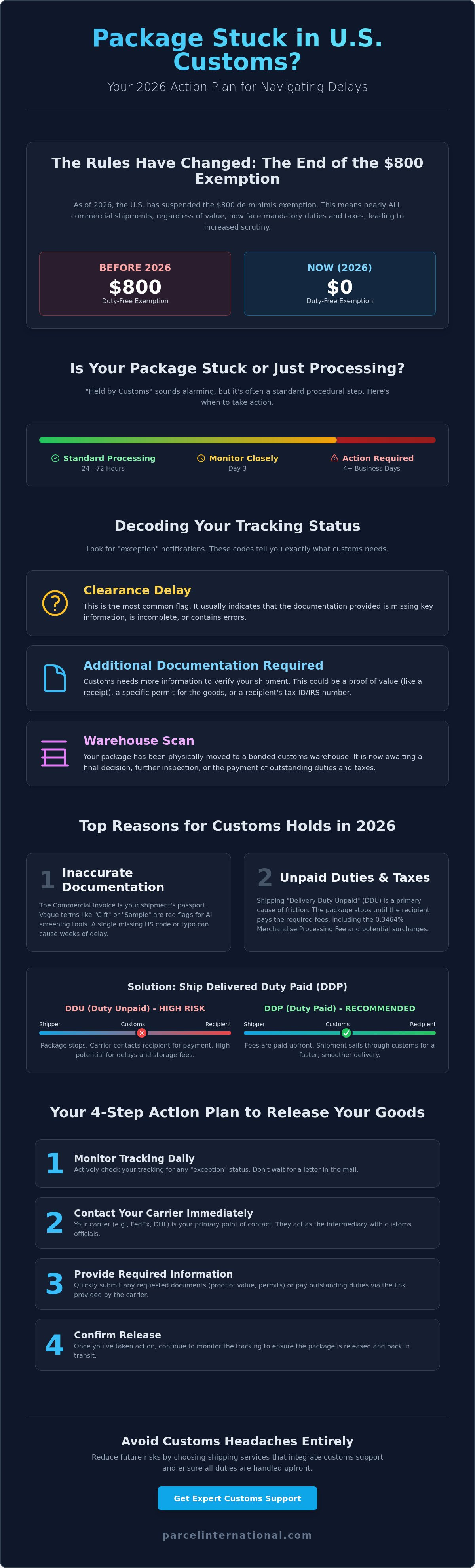
Confusion often stems from not knowing the difference between a "clearing" status and a "held" status. For routine commercial air freight in 2026, clearance typically takes 24 to 72 hours. If your tracking hasn't moved in four business days, you're likely facing an actual delay. Modern tracking systems use "exception" notifications to flag these events. You should look for specific indicators that the process has stalled:
Clearance Delay: This usually suggests that documentation is missing or incorrect.
Additional Documentation Required: Customs needs proof of value, a specific permit, or an IRS number.
Warehouse Scan: The package is physically sitting in a bonded facility awaiting a decision or payment of duties.
Understanding what happens if a package is stuck in customs starts with recognizing these signals early. Don't wait for a physical letter in the mail, which can take weeks. If you see an exception status on your digital dashboard, contact your carrier immediately to identify the specific friction point. Quick action prevents the accumulation of expensive storage fees and keeps your supply chain moving efficiently.
Common Reasons for Customs Delays in 2026
Understanding what happens if a package is stuck in customs requires looking at the two main reasons for a hold: security audits and fiscal disputes. In 2026, the era of "informal entries" for small items has ended. Since the suspension of the $800 de minimis exemption in late 2025, every commercial import now attracts scrutiny for duties and taxes. If your package isn't moving, it's likely because of a mismatch in your data or an unpaid balance. Border authorities have transitioned to AI-powered supply-chain mapping, which means they catch misclassifications and undervaluations faster than ever before.
Missing or Inaccurate Documentation
The Commercial Invoice is the most critical document in your shipment. If you use vague descriptions like "Gift" or "Sample," you're inviting an immediate hold. Modern screening tools used by U.S. Customs and Border Protection (CBP) flag these generic terms as high-risk for tax evasion. Your documentation must include precise HS codes and a detailed breakdown of the items. Check our guide on international shipping customs documentation to ensure your paperwork meets current standards. A single typo in a value or a missing tax ID number can keep your goods in a bonded warehouse for weeks.
Unpaid Duties and Taxes
Shipping via "Delivery Duty Unpaid" (DDU) is a primary cause of friction. When this happens, the carrier stops the package at the border until the recipient pays the required fees. In 2026, this includes the 0.3464% Merchandise Processing Fee and the 10% Section 122 global surcharge. If you haven't pre-paid these, the carrier will send a payment link to the recipient. To avoid these delays, businesses should prioritize "Delivered Duty Paid" (DDP) shipping. This ensures all financial obligations are cleared before the plane even lands. If you're struggling with these complexities, our Customs Support team can help streamline your clearance strategy.
Prohibited and Restricted Items
Physical inspections are mandatory for specific categories like lithium batteries, advanced computing chips, and brand-name goods. If agents suspect counterfeit items, they will seize the shipment rather than just delaying it. Regional regulations are also tightening; 2026 has seen an expanded focus on the Uyghur Forced Labor Prevention Act (UFLPA) and new Withhold Release Orders on products from multiple countries. Knowing what happens if a package is stuck in customs means acknowledging that some items simply cannot pass without specialized permits. If your shipment contains restricted components, expect a mandatory 24 to 72-hour delay for air freight as agents conduct a manual review.
Tracking Your Shipment: Deciphering Status Codes
Tracking screens can be misleading. While you see a static message on your dashboard, your goods are likely moving through a highly regulated, high-volume queue. Digital updates often lag behind the physical movement of the package because carrier systems sync at specific intervals rather than in real-time. If you're wondering what happens if a package is stuck in customs, the first step is looking past the jargon to find the actual bottleneck. Most carriers use different terminology to describe the same procedural steps, but the underlying logic remains consistent across the industry.
Common Carrier Status Messages
UPS often uses the phrase "Your package is currently at the customs clearance agency." This is usually a routine notification indicating the items are in the queue. DHL utilizes "Clearance event," which is a broad umbrella term for any interaction with border authorities. If you see this, check the specific event code; it could range from a simple document review to a request for payment. FedEx is typically more direct, labeling items as "Action required" or "No action required." If you see "Warehouse Scan," don't panic. Contrary to common internet rumors, this doesn't mean your package is lost or seized. It means the item is securely stored in a bonded facility while the carrier waits for the U.S. Customs and Border Protection (CBP) to release the hold or for you to provide more data.
Waiting Times: How Long is a 'Normal' Delay?
Timeframes for clearance vary significantly based on the mode of transport. Express courier shipments are the fastest, often clearing in under 24 hours. Routine commercial air freight typically takes between 24 and 72 hours to process. Ocean freight is a slower process, averaging 1 to 5 business days, though port congestion can push this to a week or more. You should also account for seasonal fluctuations. During the Q4 peak season and major holidays, these windows expand because of the sheer volume of imports. Follow the 5-business-day rule: if a status remains unchanged for five full work days without a request for information, it's time to intervene. Knowing what happens if a package is stuck in customs means knowing when to be patient and when to start making phone calls to your logistics partner.
How to Resolve a Customs Hold: A Step-by-Step Action Plan
Resolution starts with systematic information gathering, not frustration. If you're currently wondering what happens if a package is stuck in customs, don't wait for a physical letter to arrive in the mail. In 2026, successful international parcel shipping requires you to be the primary driver of the resolution process. Your carrier is your most important ally. They have the established channels to talk to border agents that you simply don't. Shift your focus from the delay itself to the specific data point the authorities are missing.
Step 1: Verify the Tracking Information
Log in directly to the carrier's official portal to check for an "Action Required" flag. Phishing scams targeting international shippers have surged in 2026, so never provide information through a link sent via SMS or a generic email. Verify whether the hold is at the origin country or the destination. Sometimes a package is "stuck" because the export documentation wasn't cleared before the flight, rather than a problem with the import side. If the status says "Clearance Delay," look for a specific request for a "Proof of Value" or a "Tax ID."
Step 2: Contact the Carrier (Not Customs)
Calling customs authorities directly is usually a dead end for individual parcels. Border agents handle thousands of containers daily and won't have the bandwidth to track down a single box for you. Instead, call your carrier and ask specifically for the "International Brokerage" department. This team acts as your legal representative. Have your tracking number, a detailed list of contents, and the total value ready. Ask them for the specific reason for the hold. They can tell you if the issue is a missing Customs Support document or an unpaid tax balance.
Step 3: Settle Outstanding Payments
If the hold is financial, settle the balance immediately through the carrier's secure online payment system. This usually triggers a release notification to the customs warehouse within hours. Be aware of "advancement fees." These are standard service charges that carriers like DHL or FedEx apply when they pay the government duties on your behalf to keep the package moving. Always request a formal receipt for these payments. You'll need this documentation for your tax and accounting records, especially since the 2025 suspension of the de minimis exemption means almost every commercial item now carries a tax liability.
Managing these steps efficiently ensures your cargo doesn't sit in a bonded facility longer than necessary. If you find the paperwork overwhelming or the carrier isn't providing clear answers, our team offers specialized Customs Support to handle the heavy lifting for you.
Proactive Prevention: How to Avoid Customs Issues
The most efficient way to manage a customs hold is to ensure it never happens. While previous sections detailed what happens if a package is stuck in customs, the focus must now shift to the structural improvements that prevent these delays. In 2026, border authorities use AI-powered systems to cross-reference data in seconds. This means manual paperwork is no longer just slow; it's a liability. By moving from reactive problem-solving to a proactive compliance strategy, you can strip away the typical anxieties associated with global logistics. High-quality international shipping rates often include integrated brokerage services, which provide an invisible layer of protection against procedural friction.
For businesses moving bulk shipments or high-value cargo, the role of a professional freight forwarder is essential. They act as your stable intermediary, ensuring that every regulatory requirement is met before the goods even reach the terminal. This level of oversight is particularly important given the current enforcement of the 0.3464% Merchandise Processing Fee and the mandatory tax filings required for all commercial imports. Reliability in 2026 isn't just about speed; it's about the lack of barriers during the final clearance phase.
Automated Documentation and Compliance
Human error in documentation remains the primary cause of border delays. Parcel International's tools solve this by generating accurate Commercial Invoices automatically based on your order data. This ensures that descriptions, values, and tax IDs are consistent across all forms. Digital data transmission, often called Paperless Invoice, is now the industry standard. It allows customs agents to review your cargo while it's still in the air or at sea. You must validate your HS codes before the package leaves your warehouse to avoid valuation disputes. Our platform automates this validation, removing the guesswork and ensuring your shipment is classified correctly from the start.
Choosing the Right Carrier for Your Destination
Not all carriers perform equally in every region. Some providers have established deep local relationships and dedicated clearance facilities in specific markets. For example, DHL remains a dominant force in Europe with specialized hubs that move goods through customs faster than competitors without a local footprint. Instead of choosing a carrier based solely on price, use a multi-carrier platform to compare reliability and clearance performance. This transparency allows you to pick the best bridge for your specific trade lane. Simplify your global logistics and avoid customs delays with Parcel International by accessing a unified solution that handles the complexities of 2026 trade regulations for you. Stop worrying about what happens if a package is stuck in customs and start using a system designed to keep your cargo moving.
Master Your Global Supply Chain
Navigating international trade in 2026 doesn't have to be a source of constant friction. You now understand that what happens if a package is stuck in customs is a manageable sequence of verification and communication rather than an unsolvable mystery. By shifting from manual paperwork to digital compliance and choosing carriers with strong local expertise, you remove the barriers that cause expensive warehouse scans. Reliability is built on transparency and the right technical infrastructure.
Take control of your logistics today. Compare rates and automate your customs paperwork today to access wholesale rates from DHL, UPS, and FedEx. Our platform provides automated customs documentation tools and real-time tracking for 220+ countries, ensuring your goods move efficiently across every border. You don't have to manage these complexities alone when a unified solution is available to streamline your workflow.
Global shipping is complex, but with the right tools, you can ensure your packages arrive on time, every time. Clear the path for your cargo and focus on growing your business with confidence.
Frequently Asked Questions
How long can a package be held in customs?
Routine commercial air freight typically clears in 24 to 72 hours. Express courier shipments often move through in under 24 hours. However, if your cargo is flagged for a physical inspection or missing documentation, the hold can extend to 14 days or longer. Ocean freight averages one to five business days but is more susceptible to port congestion delays.
Will customs notify me if my package is held?
Customs authorities rarely contact the recipient directly. They communicate with the carrier or the licensed customs broker listed on the manifest. You'll usually find out what happens if a package is stuck in customs by checking your carrier's tracking portal for "exception" or "action required" notifications. Always ensure your contact details are accurate on the commercial invoice to receive carrier alerts quickly.
Do I have to pay extra if my package is stuck?
Yes, delays often lead to additional costs. Since the 2025 de minimis suspension, all commercial imports incur the 0.3464% Merchandise Processing Fee and a 10% Section 122 surcharge. If your package remains in a bonded facility for more than a few days, you'll also face daily storage fees. Carriers may also charge advancement fees for paying duties to the government on your behalf.
Can I pick up my package from customs myself?
You cannot physically collect a package from a customs warehouse. These are highly secure, restricted areas. Only authorized personnel, such as carrier employees or licensed customs brokers, can handle the goods. Once the authorities release the hold, the carrier will manage the final mile delivery to your specified address. Your role is limited to providing the necessary data or payments to trigger that release.
What happens if I don't pay the customs duties?
The package will remain in a bonded warehouse until the debt is settled. If the duties stay unpaid for an extended period, usually 15 to 30 days, the authorities will mark the shipment as abandoned. At this point, the goods are either returned to the sender at your expense, destroyed, or sold at a public auction. Unpaid duties can also result in your business being flagged for future audits.
Why is my package stuck in customs for 2 weeks with no update?
A two-week silence often indicates a physical inspection or an intensive documentation audit. In 2026, customs agents use AI-powered mapping to detect fraud and misclassification. If your shipment was flagged for undervaluation, agents might be manually verifying the market price of your goods. Contact your carrier's international brokerage department immediately to see if they're waiting for a specific proof of value or a tax ID number.
What documents are usually needed to release a package?
The most common requirements are a detailed Commercial Invoice and a Packing List. You may also need to provide your IRS or EIN number for tax purposes. Specific items, like electronics or medical devices, require additional permits or certificates of origin. Ensuring these documents are digitally transmitted via "Paperless Invoice" before the goods arrive is the best way to prevent a hold.
Can a package be stuck in customs if it's a gift?
Gift status does not grant an automatic exemption from border scrutiny. In 2026, every commercial item entering the country requires a declared value for tax assessment. If the value is missing or appears unrealistically low, agents will hold the package to determine the correct duty. Knowing what happens if a package is stuck in customs means recognizing that even non-commercial gifts must follow strict labeling and valuation rules to clear the border.


Comments