
Mastering the Landed Cost Calculator for Ecommerce: A 2026 Strategy Guide
- Alex
- 1 day ago
- 12 min read
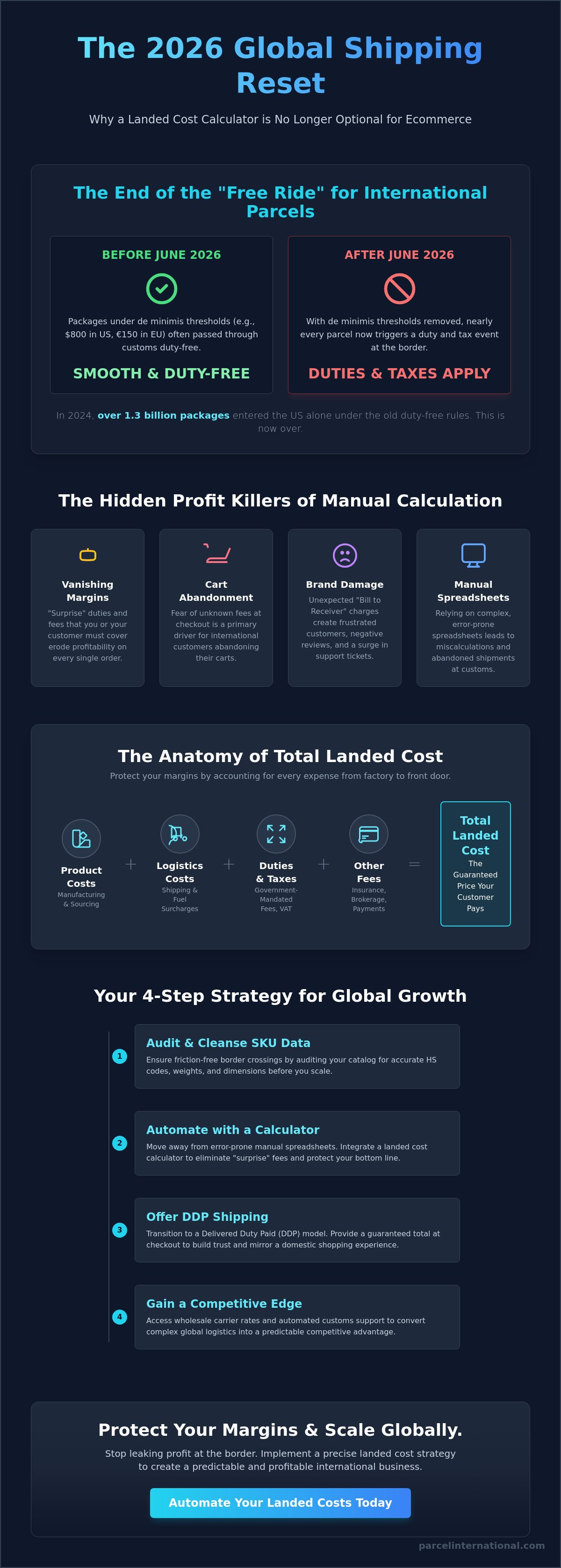
In 2024, over 1.3 billion packages entered the United States duty-free, but as of June 2026, that "free ride" is officially over. With the global removal of de minimis thresholds from the EU to Thailand, the era of guessing your international shipping costs has ended. Implementing a precise landed cost calculator for ecommerce is no longer optional if you want to stay competitive. You're likely tired of seeing your profit margins vanish into "surprise" customs duties or watching customers flee their carts when they see unexpected fees at the door. It's frustrating to manage complex spreadsheets that still result in manual errors and unhappy buyers.
We understand that cross-border logistics feels like a moving target, but it doesn't have to be a source of anxiety. This guide will show you how to eliminate hidden shipping fees and protect your margins using a precise landed cost calculator strategy. We'll explore how to automate customs compliance, provide a transparent checkout experience, and turn your global logistics into a predictable profit engine. By the end, you'll have a clear roadmap to move from fragmented workflows to a unified, reliable shipping model.
Key Takeaways
Master the comprehensive 2026 landed cost formula to account for every expense from production to final delivery, ensuring your international pricing remains profitable.
Protect your bottom line by integrating a landed cost calculator for ecommerce to eliminate "surprise" duties and provide customers with a guaranteed total at checkout.
Identify and seal "cost leaks" by auditing historical shipping data and moving away from error-prone manual spreadsheets toward automated solutions.
Ensure friction-free border crossings by auditing your SKU data for accurate HS codes, weights, and dimensions before you scale.
Access wholesale carrier rates and automated customs support to convert complex global logistics into a predictable competitive advantage for your brand.
Table of Contents
Why Every Ecommerce Brand Needs a Landed Cost Calculator in 2026
In 2026, basic math is the "hidden profit killer" of global trade. Relying solely on product price and shipping quotes fails to account for the complex web of taxes and fees that now apply to every international order. Since the suspension of major de minimis thresholds across the US and EU, your business must track the actual or landed cost of every SKU. A robust landed cost calculator for ecommerce acts as a shield for your margins. It moves your business away from guesswork and toward a model of total financial transparency. Without this precision, you aren't just shipping products; you're leaking profit with every border crossing.
Consumer expectations have shifted dramatically. Shoppers no longer accept "estimated" delivery totals that change once the package reaches their country. They demand a guaranteed total at checkout. When a customer is hit with unexpected duties at their doorstep, your brand reputation suffers immediate damage. Accuracy in these calculations directly reduces cart abandonment by removing the fear of the unknown. It also slashes the volume of customer service inquiries from frustrated buyers wondering why their package is held at a local customs office.
The Financial Risk of Incorrect Estimates
Sending shipments "Bill to Receiver" is a dangerous strategy in the current climate. If your calculations are off, customers often refuse to pay the "surprise" duties, leaving your shipments abandoned at customs. You're then stuck with return shipping fees or the total loss of the inventory. This risk is magnified by the fact that customs authorities now use AI-driven audits to flag undervalued or misclassified goods instantly. Precision is your only defense against these automated compliance checks.
Landed Cost as a Competitive Advantage
Transitioning to a DDP (Delivered Duty Paid) model turns a logistics hurdle into a powerful marketing tool. It allows your brand to mirror a domestic shopping experience for international buyers. Transparent, upfront pricing builds the trust necessary to enter new markets with confidence. To scale effectively, you need a comprehensive international shipping for ecommerce strategy. By using a landed cost calculator for ecommerce, you can access the granular data required to ensure you never under-recover costs or overcharge your loyal customers. Logistics aggregators serve as the key bridge here, providing the real-time data feeds that keep your calculator accurate and your global growth predictable.
The Anatomy of a Total Landed Cost: The 2026 Formula
Total Landed Cost represents the complete financial journey of a product from the factory floor to the customer's doorstep. In 2026, this calculation consists of four primary pillars that dictate your final margin. First, you have the core manufacturing and sourcing costs. Second, you must account for multi-carrier shipping rates, which now frequently include volatile fuel surcharges. Third, you face government-mandated duties, VAT, and local taxes. Finally, you have the often-overlooked insurance premiums, brokerage fees, and payment processing surcharges. To protect your business, you should consult official resources to Determine Total Export Price for each target market.
Each component in this formula is critical. For instance, ignoring a 3% payment processing surcharge on high-volume international orders can quickly erode a healthy 40% gross margin. A precise landed cost calculator for ecommerce ensures these small percentages don't aggregate into a significant financial loss. This level of detail is what separates a professional, scalable operation from a fragmented one that struggles with inconsistent profitability.
The Formula Explained
Total Landed Cost is the aggregate sum of manufacturing, international transport, insurance, and all government-mandated duties or taxes required to deliver a product to the end user's door. This formula is more volatile in 2026 because of the global shift away from de minimis exemptions. With the US $800 threshold suspended and the EU €150 exemption removed, almost every parcel now triggers a duty event. Your landed cost calculator for ecommerce must also account for dimensional weight. Carriers charge based on the space a package occupies, not just its mass. A large, light box can cost significantly more than a small, heavy one, making precise packaging data essential for accuracy.
HS Codes and AI Classification
Harmonized System (HS) codes are the digital DNA of your shipment. They dictate the exact duty rate applied by customs authorities. In 2026, manual classification has become the primary cause of calculation errors. It's simply too slow and prone to human slip-ups. Leading brands have moved toward AI-powered classification to ensure their international shipping customs documentation remains 100% accurate. AI can scan product descriptions and assign the correct 10-digit code in milliseconds. This precision prevents shipments from being flagged for audits or delayed at the border. If you want to simplify these complex requirements, you can access professional customs support to automate your compliance workflow and maintain an orderly global supply chain.
Comparing Landed Cost Solutions: Which is Right for You?
Manual spreadsheets are a relic of a simpler era. If your business ships more than 10 parcels a month, relying on static cells and manual data entry is a significant liability. Spreadsheets can't account for real-time tax fluctuations or the complex regulatory changes we've seen throughout 2026. You need a dynamic landed cost calculator for ecommerce that operates as an active part of your tech stack. While standalone software plugins offer duty estimations, they often work in a vacuum. They don't handle the actual physical transport, leaving you to manage fragmented workflows across multiple platforms. This fragmentation is exactly where hidden costs and procedural friction thrive.
Integrated logistics platforms offer a more orderly alternative. By using a stable intermediary to combine rate shopping with cost calculation, you gain a unified view of your global operations. These platforms aggregate all costs associated with the product and delivery into a single, transparent dashboard. This approach is far more efficient than enterprise-grade ERP solutions. Large ERP systems often introduce a level of complexity and subscription overhead that acts as a hindrance rather than a help for growing SMBs. Focus on tools that prioritize speed and reliability without the corporate jargon or restrictive terms.
Choosing Between DDU and DDP
In 2026, the choice between Delivered Duty Unpaid (DDU) and Delivered Duty Paid (DDP) is a defining factor for your brand reputation. Shoppers overwhelmingly prefer the DDP model. They don't want to receive a notification from a local post office demanding extra payment before they can claim their package. Your landed cost calculator for ecommerce must be capable of supporting DDP to mirror the domestic shopping experience. Offering DDP removes the anxiety of "surprise" fees and ensures your customers feel protected throughout the entire transaction.
Integration with Your Ecommerce Platform
Check for deep compatibility with your existing storefront, whether you use Shopify, Magento, or WooCommerce. The system must utilize real-time API calls to pull the most accurate international shipping rates directly into your checkout. Don't let a slow calculation engine ruin your conversion rate. Ensure your calculator provides near-instant responses so it doesn't add latency to the user experience. A fast, logical checkout flow is the final bridge between an interested browser and a loyal global customer.
How to Implement a Landed Cost Strategy: A Step-by-Step Guide
Stop guessing and start auditing. Your first task in building a stable global strategy is to identify "cost leaks" in your historical shipping data. Compare what you estimated at checkout against what the carriers actually billed you over the last six months. You'll likely find discrepancies in duty rates or unexpected fuel surcharges that eroded your margins. Once you've identified these gaps, clean your product catalog. Every SKU must have precise weight, dimensional data, and an accurate HS code. Without this foundational data, even the most expensive landed cost calculator for ecommerce will produce unreliable results.
Choose a calculator tool that integrates seamlessly with your primary carriers, such as DHL, UPS, or FedEx. This ensures your rates are live and reflect the most current surcharges. Configure your tax and duty rules based on your specific target regions. In 2026, you can't ignore the nuances of EU IOSS or UK VAT requirements, as these dictate how you collect and remit taxes. Finally, test and refine your pricing strategy. You might choose to absorb a portion of the landed cost as a marketing expense to drive volume in a new market, or you may pass the full cost to the customer to protect your bottom line. Use real-world data to decide which approach fits your growth goals.
Setting Up Your Product Data
Accurate dimensions are the foundation of any shipping calculator. If your box sizes are off by even a small margin, dimensional weight pricing will quickly ruin your profitability. Use AI-driven classification tools to bulk-assign HS codes for large catalogs rather than attempting this task manually. This reduces human error and ensures compliance. Always perform a "Verify" step by checking your software's calculations against actual carrier invoices from the last 30 days. This loop ensures your landed cost calculator for ecommerce remains tuned to the reality of the 2026 regulatory environment.
Automating the Customs Paperwork
A high-performing calculator should do more than just display a number at checkout. It must feed directly into your automated commercial invoice generation to ensure data consistency. Any mismatch between the calculator's data and the final shipping label is a primary cause of customs delays and extra brokerage fees. For businesses moving larger volumes, it's often more efficient to leverage a freight forwarder for bulk shipments rather than relying solely on individual parcel services. This consolidation can significantly lower your total landed cost per unit. If you're ready to stop the manual work and secure your margins, contact us for automated customs support to streamline your entire global workflow.
Optimizing Global Growth with Parcel International
Parcel International transforms the way you handle global trade by simplifying the most complex parts of the logistics chain. We provide a landed cost calculator for ecommerce that integrates directly into your workflow, removing the typical anxieties associated with international expansion. One of the biggest barriers for SMBs is accessing competitive pricing without massive shipping volumes. We solve this by offering wholesale rates from major global carriers to every user on our platform. This egalitarian approach ensures that whether you're shipping ten parcels or ten containers, you're always working with protected margins.
Our commitment to transparency means you won't deal with hidden requirements or obscure fine print. We act as a stable intermediary, bridging the gap between your store and the complex world of global customs. By utilizing our automated customs documentation, you eliminate the procedural friction that often leads to shipping delays. Every label generated through our system is backed by accurate data, ensuring your shipments move through borders without a hitch. We prioritize reliability and trust, giving you the relief of moving toward a singular, unified solution.
The Unified Solution for Cross-Border Sales
Stop juggling multiple carrier portals and manual spreadsheets. Our platform allows you to move from fragmented, multi-platform workflows to a single, unified dashboard for all your international parcels. This centralization is the key to maintaining a high level of accuracy for your landed cost calculator for ecommerce. We pull real-time data from our network of Express Shipping, Air Freight, and Sea Freight providers to keep your checkout totals precise. If you encounter a complex customs query or a specific regulatory hurdle, our professional support team is ready to act as your dedicated ally. We value your peace of mind and prioritize straightforward, honest communication over corporate jargon.
Getting Started with Global Expansion
Taking your first step into a new market should feel like a victory, not a risk. You can book your first shipment today and see our transparent pricing model in action immediately. There are no subscription barriers or complex onboarding processes to navigate. As your business grows, our services scale with you. We handle everything from small parcel Express Shipping to large-scale Road Freight projects across borders. This modern flexibility makes us the ideal partner for brands that value order and efficiency. Optimize your 2026 ecommerce strategy today by choosing a partner that turns global logistics from a cost center into a competitive advantage. Visit Parcel International to secure your margins and simplify your international shipping.
Secure Your Global Margins in 2026
The global shipping landscape of 2026 doesn't leave room for error or guesswork. You've seen how the removal of tax thresholds has made every border crossing a potential profit leak. Success now depends on your ability to provide total transparency at checkout while protecting your own bottom line. By cleaning your product data and moving away from fragmented manual workflows, you can turn complex logistics into an orderly, predictable process. This shift provides the relief you need to focus on growth rather than administrative friction.
Implementing a robust landed cost calculator for ecommerce is the final bridge to scaling your brand internationally with confidence. Don't let hidden fees or procedural friction hold back your expansion. At Parcel International, we bring over 15 years of logistics expertise to help you navigate these changes efficiently. We provide real-time rates for over 220 countries and include automated customs documentation to keep your shipments moving without delay. Our platform is built on radical transparency, ensuring you never have to deal with unexpected requirements or volume minimums.
Compare international shipping rates and start saving today. Your global customers are waiting for a reliable, transparent checkout experience. It's time to deliver it with confidence.
Frequently Asked Questions
What is the difference between landed cost and shipping cost?
Landed cost is the total price of a product once it arrives at a buyer's door, whereas shipping cost only covers the fee for transportation. The total landed cost includes the original product price, insurance, freight, and all government duties or taxes. Utilizing a landed cost calculator for ecommerce ensures you don't overlook these secondary expenses that frequently erode profit margins.
How do I find the correct HS code for my ecommerce products?
You can find the correct HS code by using official government tariff look-up tools or AI-powered classification software. Most successful brands now use automated tools to assign these 10-digit codes based on detailed product descriptions. This method is significantly faster than manual searches and reduces the risk of expensive misclassification errors during customs audits.
Can a landed cost calculator handle currency fluctuations?
Yes, modern calculators utilize real-time API feeds to adjust for daily currency fluctuations automatically. This ensures that the duty and tax estimations provided at checkout reflect the most current exchange rates. This automation removes the need for manual adjustments and protects your business from losing money on orders placed during volatile market shifts.
Is it better to show duties at checkout or include them in the product price?
It's generally better to show duties as a transparent line item at checkout to build immediate customer trust. This "Delivered Duty Paid" (DDP) approach prevents the shock of hidden fees upon delivery. While some brands bake costs into the product price, providing a clear breakdown often results in higher conversion rates by proving you aren't overcharging for logistics.
What happens if the customs duty calculated is different from the actual charge?
If the actual charge differs from the estimate, the merchant typically absorbs the difference or utilizes a guarantee service from their provider. High-quality calculators minimize this risk by using precise, real-time carrier data. Working with a stable intermediary helps you manage these discrepancies without passing the financial frustration or procedural friction onto your end customer.
Does a landed cost calculator work for all 220+ countries?
A comprehensive landed cost calculator for ecommerce typically covers over 220 countries and territories. This global reach is essential for brands looking to scale without restrictions. The software should automatically update to reflect local regulatory changes, such as the 2026 removal of the EU de minimis threshold, ensuring compliance in every market you serve.
How do I integrate a landed cost calculator with Shopify or WooCommerce?
You integrate these tools by installing a dedicated plugin or connecting your storefront via a direct API. Once connected, the calculator pulls SKU data like weight and dimensions to provide instant, accurate quotes at checkout. This setup moves your business from fragmented workflows to a singular solution that handles both rate shopping and customs compliance.
Are there goods that are exempt from duties and taxes in 2026?
Very few commercial goods remain exempt from duties and taxes in 2026 due to the global elimination of de minimis thresholds. While specific categories like low-value samples or certain humanitarian goods might still qualify for relief in select regions, most B2C ecommerce shipments now trigger full tax obligations. Always verify specific category exemptions through a professional customs support partner to ensure punctuality.


Comments