International Shipping Insurance: What Does It Cover in 2026?
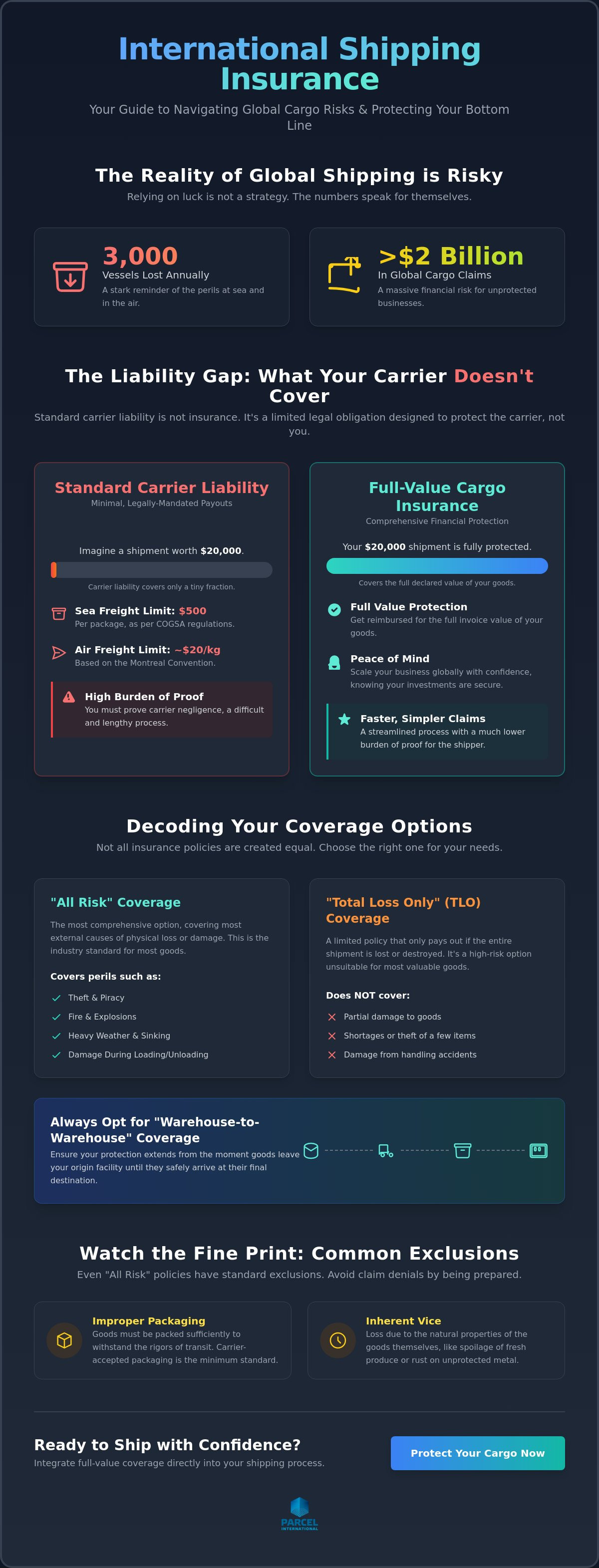
Approximately 3,000 vessels are lost each year to maritime perils, contributing to more than $2 billion in global cargo claims. If you're moving high-value goods in 2026, you've likely felt the stress of deciphering complex policies or worrying about hidden costs in your logistics chain. Understanding international shipping insurance what does it cover is the only way to move from uncertainty to total control over your global cargo.
It's common to feel frustrated by the gap between carrier liability and actual insurance, especially when carrier limits are often as low as $500 per ocean package or $20 per kilogram for air freight. We promise to strip away the jargon and show you exactly how to protect your bottom line. In this article, you'll discover the critical differences between "All Risk" and "Total Loss" coverage, learn how to navigate the latest 2026 regulatory changes, and find a streamlined way to manage protection across all your shipping lanes. We'll give you the clarity you need to make your global logistics predictable, transparent, and secure.
Key Takeaways
Discover exactly international shipping insurance what does it cover by exploring the differences between "All Risk" protection and "Total Loss Only" policies.
Learn why standard carrier liability is often insufficient, usually covering only a fraction of your cargo's value, and how to bridge that financial gap.
Understand the procedural advantages of full insurance, including a significantly faster claims process and a lower burden of proof than carrier liability disputes.
Identify common "fine print" exclusions like inherent vice and improper packaging to ensure your claims aren't denied before your goods leave the port.
Explore how to simplify your global logistics by integrating full-value coverage directly into your booking process for sea, air, and road freight.
Table of Contents
Understanding International Shipping Insurance: Why Liability Isn't Enough
Shipping insurance, also known as marine cargo insurance, is a specialized financial product that protects your goods against physical loss or damage during ocean, air, or land transit. In 2026, global cargo claims exceed $2 billion annually, making it vital for businesses to understand the risks of the open road and sea. When researching international shipping insurance what does it cover, it's vital to distinguish between standard policy inclusions and the minimal protection offered by carriers. Relying on the carrier alone often leaves a massive financial hole in your balance sheet if a shipment goes missing or arrives damaged.
The "Liability Gap" is the difference between the actual value of your cargo and the maximum amount a carrier will pay out. Most carriers limit their exposure to a set amount, often as low as $100 or a specific dollar amount per kilogram. If you're shipping high-value electronics or luxury goods, this payout won't even cover your shipping costs, let alone the inventory value. Additionally, Incoterms play a decisive role here. These international rules define whether the buyer or the seller is responsible for arranging and paying for insurance during specific legs of the journey. Without clear insurance in place, a simple misunderstanding of Incoterms can leave your cargo unprotected during the most dangerous parts of the transit. 2026 supply chain volatility, driven by environmental regulations and geopolitical shifts, makes third-party insurance more critical than ever for SMBs looking to stabilize their costs.
The Limits of Carrier Liability
Carriers operate under international conventions that protect them more than they protect the shipper. For sea freight, the Carriage of Goods by Sea Act (COGSA) generally limits liability to $500 per package. For air freight, the Montreal Convention limits payouts to roughly $20 per kilogram. To even receive these small amounts, you must prove the carrier was negligent, which is notoriously difficult when a container is lost in international waters. Carrier liability is a limited legal obligation rather than a comprehensive protection plan.
Peace of Mind for Global Exporters
Moving from fragmented, uninsured shipping to a unified solution offers immediate emotional relief. You no longer have to worry about vessel sinkings or port accidents destroying your cash flow. This security is especially critical when managing international shipping for ecommerce, where customer satisfaction depends on your ability to replace lost items quickly. By securing third-party insurance, you ensure that a "total loss" scenario doesn't become a business-ending event. You gain the confidence to scale into new markets, knowing your investment is shielded from the unpredictable nature of global logistics.
Defining the Scope: What Does International Shipping Insurance Actually Cover?
When businesses ask international shipping insurance what does it cover, the answer depends on the specific policy tier selected. In 2026, the cargo insurance market is dominated by "All Risks" coverage, which accounts for an estimated 59% of insured shipments. This tier offers the broadest protection, covering almost any physical loss or damage caused by external factors. Whether your goods face theft, fire, or heavy weather in the middle of the ocean, an All Risks policy ensures you aren't left holding the bill. Handling accidents during the loading and unloading process are also standard inclusions, which is vital given that air freight constitutes 31% of all claims.
In contrast, "Total Loss Only" (TLO) is a more limited option. This coverage only triggers if the entire shipment is destroyed or disappears, such as a vessel sinking. While TLO might seem cost-effective for low-value bulk commodities, it provides zero protection for partial damage or "shortages" where only a portion of the cargo is missing. For most commercial shipments, relying on TLO is a significant gamble that can disrupt your cash flow. To ensure complete security, look for "warehouse-to-warehouse" clauses. These clauses extend your protection from the moment the goods leave your facility until they arrive at the final destination, providing true door-to-door security.
All-Risk vs. Named Perils
Understanding the difference between All-Risk and Named Perils is essential for protecting high-value cargo. All-Risk policies assume everything is covered unless it's specifically excluded. Named Perils policies only cover the specific events listed in the contract, such as a collision or a sinking. High-value electronics and fragile goods require All-Risk protection because partial damage from vibration or rough handling is common. Always verify the insurance notations on your Bill of Lading to confirm which standard applies to your shipment. If you want to simplify this process, you can secure comprehensive coverage that protects your goods across every mode of transport.
The 'General Average' Concept
General Average is an ancient maritime principle that catches many modern shippers off guard. If a ship's captain makes a deliberate sacrifice, such as jettisoning cargo to save the vessel during a storm, all cargo owners on that ship are legally required to share the financial loss. You could be hit with an invoice for thousands of dollars to cover someone else's lost cargo even if your own goods are perfectly safe. General Average is a shared maritime sacrifice requirement where all stakeholders contribute to losses incurred for the common safety. Without a robust insurance policy to cover these contributions, your goods will be held at the port until you pay your share of the loss.
Carrier Liability vs. Full-Value Insurance: A Direct Comparison
Choosing between carrier liability and full-value insurance is the difference between a minor setback and a financial catastrophe. When asking international shipping insurance what does it cover, you must recognize that insurance is a commercial contract designed to protect you, while liability is a legal minimum designed to protect the carrier. The most striking difference lies in the burden of proof. With carrier liability, you're required to prove the carrier was negligent. This is a high bar to clear. With a dedicated insurance policy, you simply prove the loss occurred during the covered period. This shift in responsibility is why insurance claims are typically settled in weeks, whereas liability disputes can drag on for months or even years as carriers conduct internal investigations.
Burden of Proof and Settlement Speed
Third-party insurance effectively bypasses the carrier’s internal bureaucracy. Instead of waiting for a shipping giant to admit fault, your insurer handles the reimbursement based on the evidence you provide. Most professional policies use the "110% of CIF value" standard. This covers the cost of the goods, the insurance premium, and the freight charges, plus an additional 10% to account for administrative time and lost profit. It ensures you aren't just breaking even but are actually made whole. To speed up this process, always photograph your cargo before sealing the container or box. These images serve as undeniable proof of the shipment's condition before it entered the logistics chain.
Calculating Your Risk Exposure
Determine your risk exposure by looking at your product margins and total shipping volume. If you're shipping low-margin goods, even a single lost container can wipe out a year's profit. You should always factor these premiums into your international shipping rates to understand your true landed cost. Express shipping for small parcels often requires different logic than bulk sea freight. While express carriers have higher reliability, the sheer volume of handling increases the risk of damage or loss during sorting. Conversely, sea freight faces "Acts of God" like hurricanes or tsunamis. Carriers are legally exempt from paying for these events under international law, but a comprehensive insurance policy covers them fully.
Common Exclusions: What Is NOT Covered by Shipping Insurance?
Insurance isn't a blank check for every logistics mishap. While we've discussed international shipping insurance what does it cover in terms of external accidents, you must also understand the "fine print" exclusions that can lead to a denied claim. The most common pitfall is "Inherent Vice." This refers to damage caused by the nature of the product itself rather than an external transit event. For example, if untreated steel develops rust due to atmospheric humidity or if perishable fruit rots because of its natural lifespan, insurance typically won't pay out. Coverage is designed for unexpected external perils, not the inevitable chemical or biological changes of your cargo.
Prohibited or restricted items present another significant hurdle. Shipping hazardous materials, such as certain lithium batteries or flammable chemicals, without proper declaration and specialized riders will void your entire policy. If an undeclared battery causes a fire, you won't just lose your coverage; you could be held liable for damage to the entire vessel. Additionally, you must be aware of the "Concealed Damage" rule. When a box arrives looking perfect on the outside but the contents are shattered inside, you usually have a very narrow window of 48 to 72 hours to report the issue. Wait any longer, and the insurer will assume the damage happened in your own warehouse after delivery.
The Packaging Trap
Improper packaging is the leading cause of denied insurance claims. Many exporters assume that "original manufacturer packaging" is sufficient for global transit, but retail boxes are rarely built for the pressure of being stacked ten-high in a shipping container. To ensure your claim is protected, use double-walled corrugated boxes and at least two inches of cushioning around all sides of the product. If your cargo is particularly heavy or fragile, a professional freight forwarder can provide crating services that meet the rigorous standards required by international underwriters. If you fail to meet these packing specifications, the insurance company will likely categorize the loss as "preventable" and refuse reimbursement.
Filing a Successful Claim
Speed and documentation are your best allies when a shipment goes wrong. Follow this 3-step evidence checklist to maximize your chances of a payout: take high-resolution photos of the external box before opening, document the damaged item inside, and always note "damaged" on the delivery receipt before signing. Never sign a clean receipt if you see punctures, crushing, or water stains on the exterior. Using a unified platform like Parcel International allows you to manage your global protection and submit claims through a streamlined digital workflow. This replaces the traditional, fragmented process of chasing individual carriers and insurers, moving you from administrative friction to a fast, professional resolution.
Simplifying Your Global Coverage with Parcel International
Parcel International transforms the way you approach risk management by providing a singular, unified solution for global logistics. Instead of navigating multiple portals or deciphering the varying terms of individual carriers, our platform allows you to add full-value protection in seconds during the booking process. When evaluating international shipping insurance what does it cover through our dashboard, you'll find a direct, transparent breakdown that eliminates the anxiety of hidden exclusions. This integrated approach ensures that whether you're utilizing air freight, sea freight, or road freight, your cargo is shielded by comprehensive terms that prioritize your peace of mind.
We provide carrier-agnostic protection that remains consistent across all major providers. You'll receive unified insurance terms whether your goods move via DHL, FedEx, UPS, or a specialized ocean vessel. This consistency is vital for modern exporters who need to understand international shipping insurance what does it cover across their entire multi-carrier network. By removing traditional barriers like subscription fees or volume minimums, we've made professional-grade coverage accessible for both small-scale projects and large commercial shipments. Our pricing is straightforward; you pay a clear, per-shipment rate without the friction of complex contracts or surprise administrative costs.
Efficiency Through Automation
Our platform strips away procedural friction by bundling insurance directly with your customs documentation. This automation ensures that your commercial invoices and insurance values are perfectly synchronized, which is essential for faster customs clearance and preventing documentation errors. You also gain the advantage of a single point of contact for both your logistics and any potential insurance claims. We act as a stable intermediary, managing the communication flow so you don't have to chase multiple parties. This unified dashboard provides the security and punctuality needed to thrive in the 2026 trade environment.
Ready to Ship with Confidence?
Don't let the complexity of global logistics slow your growth. You can take control of your supply chain by choosing a partner that values radical transparency and operational efficiency. We serve as the reliable bridge in the complex global market, transforming chaotic workflows into orderly, predictable successes. Take the final step toward a more secure shipping strategy and protect your investment from the first mile to the last. Compare international shipping rates and secure your cargo today.
Take Control of Your Global Supply Chain
Deciphering the complexities of logistics is the first step toward building a resilient business. You now have a clear roadmap for 2026 trade. You understand that carrier liability is merely a legal minimum, not a protection plan, and you've seen how All Risk coverage shields you from shared maritime losses like General Average. By mastering international shipping insurance what does it cover, you move from reactive damage control to proactive global growth. You can finally stop worrying about the "fine print" and start focusing on your customers.
Since 2007, we've built stable partnerships with major carriers to serve over 220 countries and territories. Our platform eliminates fragmented workflows by providing automated customs and insurance integration in a single, unified dashboard. You don't have to deal with hidden fees, restrictive volume minimums, or complex claims processes. We act as your reliable bridge in a high-stakes market, ensuring your cargo arrives securely and on time. Compare international shipping rates and add full-value insurance now. Secure your cargo today and ship with the confidence of a true industry optimizer.
Frequently Asked Questions
Is international shipping insurance mandatory for all shipments?
Insurance is not legally mandatory for every shipment, but it's often a contractual requirement under specific Incoterms like CIF (Cost, Insurance, and Freight) or CIP (Carriage and Insurance Paid To). While you aren't forced by law to buy it, skipping coverage leaves your business fully exposed to the liability limits of carriers. Treat it as a strategic tool for financial stability rather than a legal hurdle.
How much does international shipping insurance typically cost?
Premium rates typically fall between 0.2% and 1% of the total insured value of your cargo. Your specific rate depends on factors like the commodity type, the shipping route, and whether you choose sea or air freight. Third-party options are usually more cost-effective than carrier-provided protection, especially for high-value commercial shipments where carrier surcharges can be significantly higher.
Can I buy insurance after my package has already been shipped?
You cannot purchase insurance once your package has already been shipped or is in transit. Coverage must be in place before the goods begin their journey to ensure the insurer is assuming a fair risk. Always add protection during the initial booking process to avoid being left without recourse if an accident occurs during the first mile of transit.
What is the difference between 'All-Risk' and 'Marine Cargo' insurance?
Marine Cargo insurance is the broad industry category for all transit protection across sea, air, and land, while All-Risk is a specific tier of coverage. Think of Marine Cargo as the general service and All-Risk as the most comprehensive policy type available. Selecting All-Risk ensures you're protected against most external causes of damage unless they are explicitly excluded in the policy fine print.
How long do I have to file a claim if my international shipment is damaged?
You have a very narrow window to report damage, usually 48 to 72 hours for concealed issues that aren't visible on the outer box. For total loss or visible damage, you must note the problem on the delivery receipt immediately upon arrival. Waiting too long allows the carrier to argue that the damage occurred after the shipment was already in your possession.
Does shipping insurance cover the cost of the shipping labels too?
Comprehensive policies do cover the cost of shipping labels and freight charges when you use the "110% of CIF value" standard. This standard rule reimburses you for the cost of the goods, the shipping fees, and an extra 10% to account for your administrative time and lost profit. It's the only way to ensure your business is truly made whole after a loss.
What happens if my package is seized by customs—does insurance cover that?
Insurance does not cover packages seized, fined, or delayed by customs authorities. These events are considered regulatory or administrative failures rather than physical transit perils like fire or theft. To protect your shipment from these risks, you must ensure your customs documentation is accurate and fully compliant with the destination country's laws before the goods depart.
How do I prove the value of my items for an insurance claim?
You prove the value of your items by providing a commercial invoice that matches the declared value on your insurance policy. This document is the primary evidence insurers use to calculate your final payout. Understanding international shipping insurance what does it cover means knowing that your reimbursement is strictly limited to the documented transaction value of the goods at the time of transit.